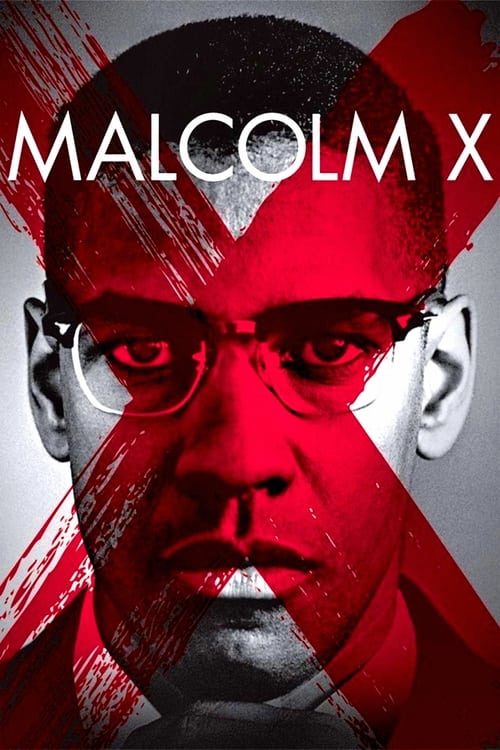
Malcolm X
1992 · Spike Lee
For when you want to commit an evening to something substantial — a true story with real fire in it, equal parts entertainment and reckoning. Choose it when you're ready to be moved and provoked, not soothed.
What it's about
The life of Malcolm X told at full scale: the Harlem hustler who hits bottom in prison, the conversion that remakes him into the Nation of Islam's most electrifying minister, and the final transformation after Mecca into a man whose widening vision made him dangerous to allies and enemies alike. It follows him from zoot suits and numbers running to the podium, the pilgrimage, and the assassination that turned him into a legacy.
The experience
Three and a half hours that move like one — exuberant and funny in its early stretch, fiercely charged in its middle, and solemn, almost devotional, by the end. It's a film that carries you through a whole life and leaves you stirred up rather than settled.
Performances
Denzel Washington's Malcolm is one of the towering screen performances — he doesn't imitate so much as inhabit, capturing the wit, the discipline, the oratorical lightning, and the growing weight of a man who knows what's coming. Every era of the life feels like the same soul at a different temperature.
The craft
Spike Lee directs at epic scale without losing intimacy: Ernest Dickerson's cinematography gives each phase of the life its own palette, from the hot saturated colors of the Harlem years to the graver tones of the final act, and the set pieces — the dance halls, the rallies, the pilgrimage — have real sweep. The screenplay's structure, three lives in one man, keeps the long runtime taut.
Why it matters
A landmark of American biography on film and a defining work of Black cinema — released into the raw aftermath of the 1992 Los Angeles uprising, it became a cultural event and the benchmark against which serious biopics are still measured.
Snapshot
Spike Lee's three-and-a-half-hour epic biography of El-Hajj Malik El-Shabazz — born Malcolm Little, transformed into Malcolm X — stands as the most ambitious American biopic of the 1990s and one of the definitive works of African American cinema. Anchored by Denzel Washington's career-defining performance, the film moves across three distinct lives: the street hustler navigating Roxbury and Harlem, the electrifying Nation of Islam minister, and the post-Mecca universalist whose expanding vision made him a target. Released in November 1992 against the political backdrop of the Los Angeles uprising, Malcolm X arrived not merely as a film but as a cultural event — a reckoning with Black history, identity, and the costs of radical self-determination delivered at a moment when those questions burned with fresh urgency.
Industry & production
The road to the screen was contested from the outset. Warner Bros. initially attached Norman Jewison — a white Canadian director with a record of socially conscious Hollywood filmmaking — to develop the project, building on an earlier screenplay by Arnold Perl that had grown from Perl's 1972 documentary on Malcolm. Spike Lee mounted a public campaign arguing, on both artistic and political grounds, that this story required a Black director at the helm. Lee's intervention succeeded; he took over the project, rewrote Perl's script substantially, and retained Perl's credit alongside his own after Perl's death.
Production was among the most complicated of Lee's career. The shoot ranged across New York and New Jersey, Egypt (to represent Mecca and Cairo, since non-Muslims cannot enter the actual holy city), and South Africa, where Nelson Mandela was filmed specifically for the film's coda — an act of political solidarity that gave the closing sequence remarkable moral weight. The budget overran its initial ceiling significantly, and when the completion bond company moved to assume control of the picture, Lee responded by soliciting personal contributions from prominent Black public figures — among them Bill Cosby, Magic Johnson, Michael Jordan, Janet Jackson, and Oprah Winfrey — to secure the funds needed to finish the film on his own terms. The episode became a landmark story in Hollywood production history, illustrating both the financial precariousness of ambitious Black filmmaking and the community solidarity Lee was able to mobilize.
The finished film runs approximately 202 minutes, making it one of the longest mainstream American releases of its era, a length Lee defended as the irreducible minimum required to honor a life of such complexity.
Technology
Malcolm X was shot on 35mm, and the film's extended timeframe — from the early 1940s through 1965 — demanded a careful, period-specific approach to stocks and color timing. The production employed anamorphic lenses for portions of the film, supporting the epic visual scale appropriate to the subject. The film's famous opening sequence incorporates documentary video footage of the 1991 Rodney King beating, spliced against dramatic material and an image of the American flag burning down to the shape of an X — a decision that positioned the film not as historical artifact but as living political argument. That footage was added after the initial principal photography, its insertion transforming the film's opening register entirely and demonstrating Lee's willingness to hybridize documentary and dramatic materials when the historical moment demanded it.
Technique
Cinematography
Ernest Dickerson, Spike Lee's cinematographer throughout the formative first decade of his career — from She's Gotta Have It through Jungle Fever — brings a sophisticated visual taxonomy to the different chapters of Malcolm's life. The Roxbury and Harlem hustle sequences are shot with warm, saturated color and a kinetic energy that romanticizes the zoot-suit world even as the narrative will later condemn it; these scenes carry something of a jazz-inflected nostalgia, the palette lush and theatrical. The prison sequences shift toward cooler, more institutional tones and tighter framings that compress Malcolm's world before the conversion that expands it. The Nation of Islam chapters are composed with a formal gravity — symmetrical compositions, respectful distances — that reflects the discipline and hierarchical structure of the organization. In Egypt, the hajj sequences open into bright, overexposed light and crowds of white-clad pilgrims, the image itself conveying the spiritual dissolution of racial categories Malcolm undergoes. Dickerson and Lee deploy the lateral "floating" dolly shot Lee has used across his career — the subject appearing to glide through space while the environment drifts behind them — at key moments of Malcolm's ascent and exposure. Malcolm X was among the last films Dickerson shot as a cinematographer before transitioning to directing, and it represents the fullest expression of their collaborative visual language.
Editing
Barry Alexander Brown, another longtime Lee collaborator, faces an editorial challenge commensurate with the film's scope: compressing more than two decades of transformation into a coherent dramatic arc while managing abrupt tonal shifts between the film's three major registers. The early sections have a looser, more associative rhythm that suits the picaresque hustler narrative; the middle sections grow more controlled, reflecting Malcolm's self-discipline; the final third moves toward a mounting urgency as the threat against Malcolm's life tightens around him. The intercut opening — Rodney King footage, flag, burning X, the audience's present colliding with the film's historical past — establishes an editorial mode that never lets the viewer settle into mere period spectacle.
Mise-en-scène / staging
Ruth E. Carter's costume design is among the most exacting period reconstructions in American film up to that point, earning her an Academy Award nomination and establishing her reputation as a major figure in the field (she would later win for Black Panther in 2018). The zoot suits of the early Roxbury sequences are vivid, almost theatrical objects — costumes that function as arguments about Black style as assertion and resistance. The NOI suits and bow ties carry a contradictory visual weight: immaculate, almost puritanical, yet freighted with the political volatility that immaculateness was meant to contain. Wynn Thomas's production design navigates the same span of decades and geographies, and the South African and Egyptian locations give the film a physical breadth unusual in American biographical filmmaking of the period. Lee stages the crowd sequences — the Savior's Day rallies, the Audubon Ballroom — with a documentary density, populating the frame with hundreds of extras to give Malcolm's oratory the scale it demands.
Sound
Terence Blanchard, who became Lee's composer of record after the early films scored by the director's father Bill Lee, provides a score that moves between jazz-inflected period recreation and more explicitly dramatic orchestration. The music is most effective when it underscores the internal temperature of Malcolm's spiritual evolution rather than simply marking period. The sound design of the assassination sequence — the Audubon Ballroom, the chaos, the gunshots — is handled with brutal directness, contrasting sharply with the elevated rhetoric of the speeches that precede it.
Performance
Denzel Washington's performance is the film's organizing axis and its central achievement. He prepared for the role through extensive physical and biographical research, studying Malcolm's speeches, bearing, and rhetorical patterns, and he delivers the oratorical sequences with an authenticity that makes them play as historical events rather than theatrical set pieces. The challenge Washington navigates is continuity across radical transformation: the cocky Harlem dandy, the contained minister, the shaken pilgrim, the man who knows he is being killed and delivers speeches anyway are recognizably the same person. Angela Bassett brings considerable force to Betty Shabazz. Al Freeman Jr. brings a disturbing charisma to Elijah Muhammad — a performance calibrated to make the man's hold on Malcolm intelligible — while Delroy Lindo's West Indian Archie establishes the texture of Harlem's criminal underworld in relatively limited screen time.
Narrative & dramatic mode
Lee and Perl structure the film as a classical bildungsroman with an inverse arc: where the form typically traces a rise, Malcolm X dramatizes a series of deaths and rebirths — each transformation constituting the death of the previous self. The hustler dies in prison; the minister dies after Mecca; the universalist dies at the Audubon Ballroom. This structure gives the narrative an almost liturgical weight, each phase complete in itself, the forward motion less a progress toward success than toward clarity. The film refuses to sentimentalize the NOI years, but it also refuses to condemn them entirely; Malcolm's time within the Nation is dramatized as necessary scaffolding, the form his will to transformation required at that historical moment. The assassination is staged with minimal sensationalism, its horror located in the sense of interrupted possibility rather than in the violence itself.
Genre & cycle
Malcolm X operates within the tradition of the American prestige biopic — a form with roots in Warner Bros. social films of the 1930s and 1940s — but inflects it through the specific concerns of Black American historical cinema. It arrives in a cycle that also includes Do the Right Thing (1989), Boyz n the Hood (1991), and Menace II Society (1993), a period sometimes called the New Black Cinema or the African American New Wave, characterized by a fresh generation of Black directors bringing structural critiques of American society into mainstream theatrical distribution. Lee's film is the cycle's most explicitly historical work, reaching back to the 1940s rather than engaging the contemporary moment directly, but its opening sequence insists on the continuity between historical racism and the present tense of 1992. Within Lee's own filmography it represents the culmination of a first major phase, following She's Gotta Have It (1986), Do the Right Thing (1989), Mo' Better Blues (1990), and Jungle Fever (1991) in rapid succession.
Authorship & method
Spike Lee trained at NYU's Tisch School of the Arts, absorbing the influence of Italian neorealism alongside the Hollywood studio tradition, and his mature style synthesizes those inheritances with a Black American vernacular visual culture. On Malcolm X he functions as producer, co-writer, and director — and his cameo as Shorty, Malcolm's Boston friend, is characteristic of his habit of appearing in his own films. Lee's working method involves careful historical research alongside a willingness to take formal liberties when the argument requires it; the Rodney King opening is the most dramatic example on this film, a choice that would have been unthinkable in the classical biopic tradition.
Ernest Dickerson, as noted, provided the visual imagination through which Lee's period reconstruction was rendered. Terence Blanchard's score marked the consolidation of a musical collaboration that has continued across Lee's career. Ruth E. Carter's contribution to the film's historical argument through clothing cannot be overstated: in a film about a man whose public identity was inseparable from his self-presentation, costume design is interpretation.
Movement / national cinema
Malcolm X belongs squarely to the African American cinema tradition that runs from Oscar Micheaux's race films of the silent era through the blaxploitation cycle of the 1970s — films Lee's work explicitly engages and critiques — through the emergence of a commercially viable Black art cinema in the 1980s. Its most immediate precursor in the biopic tradition is not a Black film but Gandhi (1982), whose sprawling historical architecture Lee has acknowledged as a model for managing a life of comparable complexity and political scope. The film's international dimension — Egypt, South Africa, Malcolm's own pan-African and Third Worldist politics — positions it as a work of African diasporic rather than narrowly American cinema, a distinction Malcolm himself insisted on in his later life.
Era / period
The early 1990s represented a contested conjuncture for Black American filmmaking: the commercial success of Lee's earlier films and the debut of directors like John Singleton, the Hughes brothers, and Julie Dash had created a window of studio interest in Black-directed projects, but that interest was always conditional on commercial viability and rarely extended to the kind of budget and running time Malcolm X required. The film's production crisis was partly a symptom of this structural condition. Politically, the period was marked by the Thomas-Hill hearings, the Los Angeles uprising, and a hardening of both Black nationalist and conservative racial politics in American public life — Malcolm X arrived into a present that made its historical subject feel urgently contemporary.
Themes
The film's central inquiry is transformation itself — what it costs, what it requires, what remains continuous across it. Malcolm X is presented not as a fixed icon but as a process: the film's dramatic interest lies in the recognition that the man who was killed in 1965 held positions incompatible with the man who had been the NOI's most effective minister, and that this incompatibility was the direct cause of his death. Related to this is the film's sustained meditation on self-making as a specifically Black American practice — the way in which the systematic denial of Black subjecthood makes the construction of an alternative self both an urgent political act and a survival strategy. The Nation of Islam is dramatized as one powerful but ultimately insufficient answer to that problem; Mecca provides another; the film ends before Malcolm's new synthesis could be fully articulated, which is itself the tragedy.
Race and American nationalism are examined with a complexity that resists both simple condemnation and celebration. The film takes seriously Malcolm's critique of integration as a framework for Black liberation, while also dramatizing the costs of absolutism. The FBI and government surveillance — the machinery of COINTELPRO that operated against both Malcolm and the NOI — appears throughout as a structural condition rather than a dramatic surprise, normalizing the paranoia that any serious Black political figure of the period had reason to feel.
Reception, canon & influence
Malcolm X received strong critical notices on release, with near-universal recognition of Washington's performance as one of the finest in American cinema. Washington won the Silver Bear for Best Actor at the Berlin International Film Festival, and his subsequent Academy Award nomination — a nomination that made his loss to Al Pacino for Scent of a Woman one of the most contested Oscar outcomes of the decade — became, in retrospect, a reference point for discussions of race and recognition in Hollywood awards culture.
Influences on the film. David Lean's Lawrence of Arabia (1962) is the most legible template for the structural challenge of rendering a historical transformation across an epic timeframe; Lee has spoken of Lean's film as a touchstone for what a biopic could accomplish at scale. Richard Attenborough's Gandhi (1982) provided a more proximate model of the post-colonial prestige biography. The source text — The Autobiography of Malcolm X as told to Alex Haley (1965) — is itself a work of considerable literary ambition, and the film inherits its tripartite structure directly. Gordon Parks's photography of the Nation of Islam in the early 1960s influenced the visual conception of those sequences. More broadly, Lee's training in Italian neorealism is visible in the texture of the Harlem street scenes.
The film's legacy. The cultural phenomenon surrounding Malcolm X extended well beyond the film itself: the "X" cap became an omnipresent cultural symbol in the months around the release, an instance of a film's marketing entering the visual culture in ways that preceded and exceeded its theatrical run. More durably, Washington's performance established a standard for the inhabitation of historical Black figures on screen against which subsequent performances have been measured. Ruth E. Carter's work on the film set a template for period costume design in African American historical filmmaking that can be traced through her subsequent career and through the work of designers who followed her.
In terms of direct influence on American filmmaking, Malcolm X is a clear precursor to Ava DuVernay's Selma (2014) — both in its formal ambition and in its argument that the full complexity of Black political life deserves the resources and running time typically reserved for figures recognized as universally canonical. The subsequent cycle of Black historical biopics — Michael Mann's Ali (2001), Taylor Hackford's Ray (2004), Tate Taylor's Get on Up (2014) — all inhabit a space that Lee's film helped open. The film also intensified the ongoing Hollywood conversation about which directors are permitted to tell which stories, a conversation that has only deepened in the decades since Lee's successful campaign to replace Jewison.
Within Lee's own filmography, Malcolm X occupies a singular position: the film in which his formal ambitions, his political commitments, and the full resources of the American studio system converged most completely, producing a work whose length, scope, and seriousness make it the fullest expression of what Lee's cinema, at its most uncompromising, can do.
A Deleuzian reading
A flag burns down to the shape of an X.
The full Deleuzian reading of Malcolm X →
Reception
Acclaimed on release in 1992 — especially for Denzel Washington's towering performance — but famously shortchanged at the Oscars with just two nominations; it has since been canonized as one of the great American biopics, entering the National Film Registry in 2010 and now regularly cited as Spike Lee's crowning achievement.
How Malcolm X was received, from release to now →
Influences: the films it descends from and the films it influenced
- Malcolm X (1972) — Perl's compilation documentary established the newsreel-and-archive grammar — cutting FBI surveillance footage, rally recordings, and interview material into a single argumentative stream — that Lee inherited directly, splicing the Rodney King tape into the 1992 film's opening with the same juxtaposition-as-political-indictment logic.
- The Battle of Algiers (1966) — Pontecorvo's deliberate manufacturing of a newsreel aesthetic — grain, handheld instability, interview-mode framing — for wholly scripted drama established the documentary-dramatic hybrid mode Lee adopts, using it not as period atmosphere but as political argument about the continuity between historical state violence and the present.
- Lawrence of Arabia (1962) — Lean's anamorphic widescreen prestige biopic — in which a figure's spiritual dissolution into a foreign landscape is mapped through overexposed light and shifting compositional registers — provides the formal template for Lee's hajj sequences, where Malcolm's racial identity dissolves into blinding white pilgrim crowds shot in the same overexposed, spatially expansive grammar.
- Gandhi (1982) — Attenborough's division of a political icon's life into three spiritually discrete phases — provincial agitator, mass-movement leader, martyred prophet — provided Lee with the liturgical-phased biographical structure he replicates almost measure-for-measure across hustler, NOI minister, and post-Mecca universalist.
- Raging Bull (1980) — Scorsese's inverse-bildungsroman — a self-destroying outsider achieves celebrity through controlled aggression, undergoes moral corruption, and arrives at painful self-knowledge — provided Lee with the structural template for Malcolm's arc from charismatic NOI peak to sober universalism, including the tonal register shift from romanticized early sequences to the austere final third.
- Bicycle Thieves (1948) — De Sica's neorealist principle — that filming actual urban poverty in real locations makes socioeconomic specificity legible in ways studio reconstruction cannot — is the direct ancestor of Lee's Roxbury and Harlem street sequences, which treat the actual neighborhoods as political evidence rather than nostalgic backdrop.
- Do the Right Thing (1989) — Lee and Dickerson's lateral floating-dolly shot — the subject gliding through urban space while the environment tracks behind, creating the impression of political buoyancy or exposure — was developed to its definitive form here and transplanted directly into Malcolm X as the visual signature of Malcolm's ascent and vulnerability.
- Hellzapoppin' (1941) — Restages the Savoy Ballroom aerial Lindy Hop as a bravura set piece, reviving the exact vernacular dance craft that Hellzapoppin' preserved on film for the swing-revival dancers who studied it.
- Ali (2001) — Mann deploys a period-color-taxonomy distinguishing early-1960s saturated warmth from mid-1970s desaturated cool, anamorphic widescreen for physical spectacle, and the inverse-bildungsroman of a Black icon's political exile and return — all inherited directly from Lee's formal template, applied to a figure from the identical civil rights milieu.
- Ray (2004) — Hackford's tripartite structure — addiction, celebrity ascent, redemptive reckoning — applies Lee's liturgical phased biography to a Black musical icon; the decade-by-decade visual color taxonomy and period wardrobe marking Charles's shifting social positioning directly inherit Lee's approach to prestige Black biography as costumed historical argument.
- Selma (2014) — DuVernay folds archival FBI surveillance documents, period photographs, and documentary materials into dramatic reconstruction — the documentary-dramatic hybrid mode Lee established — and uses period-accurate costume as political argument about authority and resistance, inheriting Lee's formal premise that a Black political biography must function as living argument rather than historical pageant.
- Straight Outta Compton (2015) — Gray deploys period-color-taxonomy distinguishing late-1980s Compton from mid-1990s commercial success, costume as cultural-political argument (Jheri curls, Starter jackets, then suits marking NWA's ideological fracture), and the inverse-bildungsroman arc of group formation and corruption — inheriting Lee's template for the prestige Black biopic as a form organized around transformation-under-pressure.
- Moonlight (2016) — Jenkins divides his protagonist's identity formation into three named chapters each with a distinct color palette and tonal register — warm amber, cool blue, saturated orange — applying Lee's period-color-taxonomy principle to interior psychological states rather than historical eras, condensing the tripartite inverse-bildungsroman from epic to intimate scale.
- One Night in Miami (2020) — King's chamber film — Malcolm X, Muhammad Ali, Jim Brown, and Sam Cooke negotiating Black political identity in February 1964 — inherits Lee's staging of costume as embodied ideological argument (Malcolm's suit versus Ali's robe versus Cooke's showbiz glamour as competing political positions) and his approach to historical interiority as live debate rather than period recreation.
- Judas and the Black Messiah (2021) — Shaka King's Fred Hampton biopic deploys documentary-dramatic hybrid editing (archival FBI surveillance footage, period newsreel spliced with dramatic reconstruction) and the liturgical phase structure of radicalization, mass organizing, and assassination — inheriting both the form and the political argument from Lee's Malcolm X, right down to the martyrdom sequence's formal gravity and the implication that the state's violence is present-tense, not historical.
- Black Panther (2018) — Lee choreographed Black political oratory as a spatial and physical event — the posture of authority at the podium, the congregation as acoustic chamber, the cut between speaker and crowd as political call-and-response — supplying the compositional grammar Coogler uses to stage the competing sovereignty speeches.
- BlacKkKlansman (2018) — Lee's template for period Black political biography using genre scaffolding, with the full Lee–Blanchard–Brown ensemble working at scale; the strategy of ending with documentary footage — Mandela addressing schoolchildren — to refuse fictional closure is the direct antecedent to BlacKkKlansman's Charlottesville epilogue.
- 25th Hour (2002) — Establishes the floating double-dolly shot (actor and camera gliding on the same rig so the figure drifts uncannily through space) that Lee reprises for Monty, paired again with Terence Blanchard's mournful orchestral-jazz scoring.
- Origin (2023) — Renders the evolution of a Black thinker's ideas as embodied biographical drama — intellectual transformation carried by performance and staging rather than exposition — the challenge Ellis-Taylor's Wilkerson inherits.
- He Got Game (1998) — Perfects the Lee–Washington directing method — long unbroken interior close-ups holding on Denzel's controlled stillness — later applied to the imprisoned father Jake Shuttlesworth.
- Bird (1988) — Eastwood's jazz-inflected biopic treats music not as atmospheric score but as the protagonist's interior state and historical location simultaneously, shifting in register to track moral and spiritual transformation — the principle Terence Blanchard's score for Malcolm X inherits, using jazz articulation as biographical evidence rather than period dressing.
- JFK (1991) — Stone developed documentary-dramatic hybrid editing — archival footage, reenacted newsreel grain, and fictional dramatic reconstruction interlocked as political argument about state violence against its own citizens — in the same production season Lee was making Malcolm X; both films insert actual footage of real violence to collapse the period drama's historical distance into the viewer's present.
- The Hurricane (1999) — Immediate model for Denzel's prison-conversion resurrection arc and his vocal/physical transformation sustained across decades of a single real figure's life.
- What's Love Got to Do with It (1993) — Contemporary early-1990s Black-cinema adaptation of a first-person memoir that compresses a decades-long life and makes renaming (self-chosen identity) the spine of self-reclamation, paralleling Anna Mae becoming Tina.
- Marighella (2021) — The model for the hagiographic Black-revolutionary biopic that structures a life around its assassination, stages oratory as the character's principal action, and lights dark skin as a deliberate expressive value rather than a technical problem — all three carried directly into Seu Jorge's Marighella.
Similar films
- Do the Right Thing (1989) — influence & lineage · same viewing thread
- One Night in Miami... (2020) — influence & lineage
- Judas and the Black Messiah (2021) — influence & lineage
- Selma (2014) — influence & lineage
- Raging Bull (1980) — influence & lineage
- Gandhi (1982) — influence & lineage
- Straight Outta Compton (2015) — influence & lineage · same viewing thread
- American History X (1998) — same viewing thread
All the films related to Malcolm X →
Watch it with: curated runs of related films
- Reckoning with the Color Line — A run through a century of American film on race — from the movie that industrialized screen racism to the ones that talk back to it — best watched in rough chronological conversation.