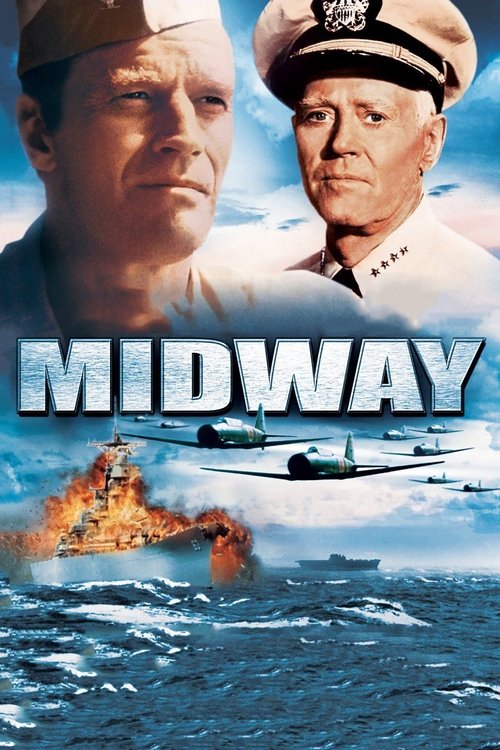
Midway
1976 · Jack Smight
For a Sunday-afternoon war-movie mood — when you want big ships, real history, and the satisfaction of watching a plan come together against the odds. Comfort viewing for military-history buffs, not a gut-punch.
What it's about
June 1942: American codebreakers have cracked enough of Japan's naval cipher to guess where its fleet will strike next, and the outgunned U.S. Navy gambles everything on an ambush near a tiny Pacific atoll. The film moves between both sides' war rooms and carrier decks — admirals weighing intelligence against instinct, pilots waiting for the launch order — while an invented father-son story about a senior officer and his aviator son threads through the history. It's the battle that turned the Pacific war, staged as a big all-star ensemble picture.
The experience
Stately and procedural in the map rooms, then loud and chaotic when the dive-bombers come screaming in — this was built to make theater seats rumble, and it still plays like an event. You watch it less on the edge of your seat than leaning forward over the chart table, tracking who knows what and when.
The craft
Its signature gimmick was Sensurround, a low-frequency sound process designed to physically shake the auditorium during air attacks — so it genuinely rewards a subwoofer. The battle scenes blend newly staged action with documentary and archival combat footage, giving the fighting a rough, newsreel-flavored texture, while the command-level scenes play like a docudrama of the intelligence war behind the shooting war.
Why it matters
A solid box-office performer, it capped the era of roadshow-scaled, all-star World War II ensemble pictures and showed a studio could sell a history lesson as a sensory spectacle. Its version of Midway remained the definitive screen account for decades, until the story was retold in the CGI age.
Snapshot
Midway is a big-budget, all-star Universal reconstruction of the June 1942 naval battle that broke Japanese momentum in the Pacific. Directed by Jack Smight and produced by Walter Mirisch, it belongs to the late cycle of roadshow-scaled World War II ensemble pictures descended from The Longest Day (1962) and Twentieth Century-Fox's Tora! Tora! Tora! (1970). Its defining commercial gambit was Sensurround, the low-frequency sound process Universal had introduced with Earthquake (1974), here used to make the cinema seats shudder under aerial attack. The film interleaves a documentary-styled command-level account of the battle — Nimitz, Spruance, the codebreakers at Station HYPO, Yamamoto's fleet — with an invented melodramatic subplot about a senior officer and his pilot son. It was a notable box-office performer and a critical disappointment, remembered today as much for its reliance on recycled combat footage as for its marquee cast. It is a major film by virtue of scale, stars, and cultural footprint rather than artistic accomplishment.
Industry & production
Midway was a Walter Mirisch production for Universal Pictures, arriving at the tail end of the 1970s vogue for star-laden catastrophe and combat spectacles. The economic logic was the era's standard "package" model: assemble a roster of recognizable names — Charlton Heston, Henry Fonda, Glenn Ford, James Coburn, Robert Mitchum, Hal Holbrook, Cliff Robertson, Robert Wagner, Robert Webber, Edward Albert, plus Toshiro Mifune and James Shigeta on the Japanese side — each carrying a contained block of screen time, and sell the event rather than a continuous narrative. This spread the dramatic load and the salary cost across many short engagements, a structure visible in the finished film's compartmentalized scenes.
The production's most consequential decision was financial as much as aesthetic: rather than stage the carrier battle wholesale, it leaned heavily on existing combat material. Sequences were drawn from authentic wartime newsreel and gun-camera footage, from John Ford's 1942 documentary short The Battle of Midway, and — most visibly — from earlier studio war films including Tora! Tora! Tora! and other Pacific pictures. This kept costs down and let the film deliver large-scale action it could never have afforded to mount, but it produced the mismatches of film stock, color timing, and aircraft type that critics seized upon. The new, original photography concentrated on shipboard interiors, command rooms, cockpits, and the actors.
Universal's marketing centerpiece was Sensurround, deployed as a roadshow attraction in equipped theaters. The film opened in the summer of 1976 and performed strongly at the box office; precise grosses vary by source and I won't assign a specific figure. It later circulated widely on television in an expanded cut that restored subplot material trimmed for theatrical release.
Technology
Sensurround is the film's signature technological identity. Developed at Universal for Earthquake, the system fed amplified low-frequency, near-subsonic sound through additional theater speakers to create a felt, bodily vibration during the bombing and strafing sequences. Midway was the second major Sensurround release, and the process suited aerial-attack spectacle better, arguably, than the earthquake it was invented for. The technology was a theatrical-exhibition gimmick — its effect did not survive home formats — and it represents a strand of mid-1970s "experiential" cinema marketing that ran parallel to the wider-screen and multitrack experiments of the period.
The other governing technology is, in effect, the film archive itself. The picture's combat is assembled from heterogeneous photographic sources spanning roughly three decades — wartime 16mm and 35mm documentary footage, color combat film, and 1960s–70s studio effects work. The seams between these sources, and between them and the newly shot Panavision material, are the technological story of the film: the production treated the surviving photographic record of the Pacific war as a resource to be edited rather than re-created.
Technique
Cinematography
The new photography was supervised by Harry Stradling Jr., working in color and widescreen. His original material is competent, classical studio coverage: clean, well-lit command-center and shipboard interiors, cockpit close-ups, and conversational two-shots that frame the star faces legibly. The visual problem of the film is not Stradling's footage in isolation but the impossibility of matching it to the archival inserts. Grain structure, color saturation, lens character, and the very texture of the emulsion shift abruptly between the staged and the stock material, so that the film never achieves a unified photographic surface. Where Tora! Tora! Tora! had mounted its own large-scale effects to maintain consistency, Midway accepts visible disjunction as the price of spectacle.
Editing
Editing — credited to Robert Swink and Frank J. Urioste — is the film's true authorial center, because the battle exists primarily as an act of assembly. The cutting must bind library footage to new shots of actors reacting, build geographic clarity from materials never intended to fit together, and sustain the cross-cutting between American and Japanese command decisions that the docudrama structure demands. The intercutting of strategic deliberation with action is handled functionally; the action montages themselves are where the mismatches register most, as aircraft and ships of inconsistent type and provenance are stitched into single engagements. The film's rhythm is sober and expository rather than kinetic, closer to the lecture-illustrated mode of the war docudrama than to the propulsive editing that would mark later combat cinema.
Mise-en-scène / staging
Staging divides sharply between two registers. The command scenes — Nimitz's Pearl Harbor headquarters, the cryptanalysis section under Rochefort, the flag bridges of the carriers — are theatrical, dialogue-driven tableaux in which officers debate intelligence, risk, and the famous ruse used to confirm that "AF" meant Midway. These are staged for the actors and the information they convey. The combat, by contrast, is largely not staged at all in the new material but constructed in the cutting room. The invented domestic subplot — Captain Matt Garth (Heston) and his aviator son Tom (Edward Albert), and Tom's relationship with a Japanese-American woman, Haruko Sakura, whose family is caught in wartime internment — is staged in conventional melodramatic interiors and supplies the film's only sustained civilian and emotional space.
Sound
Beyond Sensurround, the sound design serves the docudrama's clarity: radio chatter, engine noise, and ordnance are mixed to support comprehension of the unfolding tactical picture rather than for immersive abstraction. John Williams's score is the most distinguished craft element. Composed in the same mid-1970s window as his work for Jaws (1975) and just before Star Wars (1977), it provides a martial main theme and the structural and emotional through-line that the fragmented, footage-driven action cannot supply on its own. Williams's music does much of the work of unifying the film.
Performance
Performance is parceled out in the ensemble manner. Henry Fonda's Admiral Chester Nimitz is the film's gravitational center — measured, paternal, authoritative — and anchors the command narrative; Fonda would return to a comparable register elsewhere in his late career. Hal Holbrook's Commander Joseph Rochefort gives the codebreaking thread its texture and is among the more engaged performances. Glenn Ford's Spruance, Robert Mitchum's briefly seen Halsey, and James Coburn and Robert Webber as staff officers function as recognizable presences delivering exposition. Charlton Heston, in the fictional Garth role, carries the invented emotional plot with his characteristic stolid conviction. On the Japanese side, Toshiro Mifune plays Admiral Yamamoto and James Shigeta appears among the Japanese command; their scenes give the film a measure of the dual-perspective ambition that Tora! Tora! Tora! had pursued more fully, though with less screen time and development.
Narrative & dramatic mode
The film operates in the docudrama or "illustrated history" mode: a largely chronological reconstruction of a real battle, organized around decisions made by named historical commanders, with intertitles, dates, and a quasi-objective vantage that moves between the two navies. Onto this it grafts a fictional melodrama — the Garth father-son relationship and the internment romance — designed to provide individual stakes and a human entry point into the strategic machinery. The two modes sit uneasily together. The historical material aspires to authority and breadth; the invented material supplies sentiment but can feel like an obligation imposed by genre convention. The result is a bifurcated narrative whose documentary half is its reason for being and whose fictional half is its concession to conventional drama.
Genre & cycle
Midway is a war film of a specific, datable kind: the big-canvas, multi-star, real-battle reconstruction that flourished from The Longest Day through Battle of the Bulge (1965), Tora! Tora! Tora!, Patton (1970), and A Bridge Too Far (1977). These films treated WWII as a subject for prestige spectacle and ensemble casting, often with an internationalist, dual-perspective gesture toward the former enemy. Midway arrives near the cycle's end and shares DNA with the parallel 1970s disaster-movie cycle — also star-packed, also event-marketed, also Universal's Sensurround business — so that it sits at the intersection of the combat epic and the catastrophe spectacle. It can be read as the war film absorbing the disaster movie's exhibition logic.
Authorship & method
Jack Smight was a capable studio professional whose career ranged across genres — Harper (1966), No Way to Treat a Lady (1968), the science-fiction anthology The Illustrated Man (1969) — without a strong signature style. Midway is a producer's and studio's film more than a director's: its shape was determined by the package-casting strategy, the decision to build the battle from archival footage, and the Sensurround release plan, all of which precede and constrain directorial choice. Smight's contribution is the efficient, unfussy handling of the command scenes and the management of a large cast in short bursts.
The key collaborators carry comparable weight. Producer Walter Mirisch, a major industry figure, set the project's terms. Screenwriter Donald S. Sanford built the dual-navy structure and the fictional subplot. Cinematographer Harry Stradling Jr. shot the new material; editors Robert Swink and Frank J. Urioste performed the central act of assembling battle from disparate footage; and composer John Williams supplied the unifying musical architecture. The method, in sum, was assembly and packaging — a film constructed from existing images, existing stars, and an exhibition technology, organized by craftspeople into a coherent commercial event.
Movement / national cinema
This is mainstream Hollywood studio filmmaking, with no avant-garde or movement affiliation. It belongs to the commercial American war picture and to the late-studio prestige tradition. Its one cross-national dimension is the inclusion of the Japanese command perspective and the casting of Toshiro Mifune — a gesture toward the binational symmetry that Tora! Tora! Tora! had institutionalized — though Midway pursues this far more lightly and remains an American-centered account. The internment subplot gestures, however conventionally, toward the Japanese-American experience, situating the film within a slowly emerging Hollywood willingness to acknowledge that history.
Era / period
Midway is a deeply mid-1970s object on two clocks. As history, it reconstructs 1942 and the high-water mark of Japanese expansion in the Pacific. As a product, it is shaped by its own moment: the disaster-cycle exhibition economy, the all-star package, the Sensurround novelty, and a post-Vietnam American appetite for a "good war" narrative of decisive, righteous victory. Released in the year of the U.S. Bicentennial, it offered audiences an unambiguous national triumph at a time of considerable disillusion about American military power. That context — patriotic reassurance refracted through 1976 — is essential to understanding both its commercial success and its tone.
Themes
The film's central theme is the role of intelligence and rational calculation in warfare: its most genuinely engaged material concerns the codebreakers who divined the Japanese objective, the "AF is short of water" ruse, and Nimitz and Spruance's willingness to stake the fleet on that analysis. It dramatizes command as a matter of judgment under uncertainty. Secondary themes include duty and generational continuity, channeled through the Garth father-son plot, and — via the internment subplot — a tentative acknowledgment of injustice toward Japanese-Americans on the home front, raised but not deeply pursued. Underlying all of it is the period theme of decisive American victory as moral vindication, the "turning point" framing the synopsis foregrounds.
Reception, canon & influence
Critically, Midway was received as a disappointment relative to its scale and cast. The recurring complaints concerned the heterogeneous combat footage — visibly mismatched stock and anachronistic aircraft and ships — and the perfunctory, distracting fictional subplot, against which the codebreaking and command material and Fonda's Nimitz were the most often-praised elements. Commercially it was a clear success, propelled by stars and the Sensurround attraction; I won't cite specific figures.
The influences on the film are plain: The Longest Day established the all-star, real-battle docudrama template, and Tora! Tora! Tora! supplied both the dual-navy structure and, literally, some of the footage. John Ford's 1942 documentary and the wartime photographic record are direct material sources. Looking forward, Midway's legacy is modest and double-edged. It stands as a late, somewhat exhausted example of the ensemble war epic, and its reliance on recycled footage became a textbook illustration of that practice's pitfalls. Sensurround, of which this was the most prominent military application, faded within a few years as an exhibition novelty. The battle itself was returned to the screen in Roland Emmerich's effects-driven Midway (2019), which can be read in part as a CGI-era answer to the 1976 film's archival improvisation — staging digitally what Smight's production had to scavenge. The earlier film's durable reputation rests less on craft than on its star cast, its Sensurround moment, and its status as a Bicentennial-year monument to American victory.
A Deleuzian reading
Watch the sky over Midway during one of the big attack runs and something keeps flickering at the edge of belief.
The full Deleuzian reading of Midway →
Reception
Critics shrugged at it in 1976 — a stock-footage patchwork riding the all-star war-epic formula — but audiences made it one of the year's biggest hits, and it's since settled into beloved dad-movie status, a Memorial Day cable perennial.
How Midway was received, from release to now →
Influences: the films it descends from and the films it influenced
- The Battle of Midway (1942) — Ford's handheld 16mm color combat footage shot from Midway atoll is a literal material source recycled into the 1976 film's battle sequences, making it an ancestor in the most direct physical sense.
- The Longest Day (1962) — Established the all-star, real-battle docudrama template — fragmenting a historical engagement into short ensemble vignettes across both sides' command chains — that Midway directly imitates.
- Tora! Tora! Tora! (1970) — Supplied both the dual-navy parallel structure (American and Japanese command intercut) and, literally, aerial and naval effects footage repurposed into Midway's combat assembly.
- In Harm's Way (1965) — Pacific naval-command melodrama built on miniature-and-stock battle staging grafted onto a fictional officer subplot — the exact craft compromise Midway repeats.
- Earthquake (1974) — Debuted Sensurround as an exhibition technology; Midway was its most prominent military application, inheriting the low-frequency rumble release gimmick wholesale.
- Battle of Britain (1969) — Modeled the all-star aerial-combat ensemble epic, assembling air battle from miniatures and archival sorties around a dispersed cast of named officers.
- Why We Fight (1943) — Pioneered compilation editing that cuts disparate captured and newsreel combat footage into a single narrative line — the editorial method Swink and Urioste applied to Midway's battle.
- Sands of Iwo Jima (1949) — Intercut recycled documentary Pacific-combat footage with studio-staged drama, the textbook precedent for Midway's stock-and-melodrama assembly and its visible stock mismatches.
- They Were Expendable (1945) — Set the Pacific naval-melodrama register — small-unit duty, command stoicism, miniature sea battle — that Fonda's Nimitz command scenes descend from tonally.
- Victory at Sea (1952) — Demonstrated unifying naval-combat compilation footage with a single sweeping symphonic architecture (Richard Rodgers), the scoring strategy Williams reprises to bind Midway's mismatched images.
- The Final Countdown (1980) — Restages the Pacific carrier war aboard the USS Nimitz by interweaving documentary naval-aviation footage with new flight-deck material, extending Midway's stock-plus-new compositing.
- Rollercoaster (1977) — One of the few subsequent Sensurround releases, continuing the brief exhibition-technology lineage Midway helped popularize before the format faded.
- Pearl Harbor (2001) — Grafts a fictional romance melodrama onto a real Pacific battle exactly as Midway grafted its subplot, the same producer-driven dramatize-the-engagement formula at blockbuster scale.
- Midway (2019) — A CGI-era answer that digitally stages what Smight's crew scavenged, while retaining the 1976 film's dual-perspective and intelligence/codebreaking emphasis as its spine.
- Letters from Iwo Jima (2006) — Extends the dual-perspective Pacific-war structure to its limit by devoting an entire companion film to the Japanese command POV that Midway only intercut.
- A Bridge Too Far (1977) — A near-simultaneous late-cycle all-star WWII ensemble docudrama using the same package-cast-across-a-real-operation construction, sharing Midway's exhausted-genre moment.
- MacArthur (1977) — Universal's producer-driven Pacific-war biographical docudrama built as a star vehicle around command scenes and archival inserts, the same assembly-and-packaging method.
Similar films
- Pearl Harbor (2001) — influence & lineage
- Tora! Tora! Tora! (1970) — influence & lineage
- The Longest Day (1962) — influence & lineage
- Letters from Iwo Jima (2006) — influence & lineage
- A Bridge Too Far (1977) — influence & lineage
- Silent Victory Submarine Warfare in WWII (2010) — shared sensibility
- Top Gun: Maverick (2022) — shared sensibility
- Pressure (2026) — shared sensibility