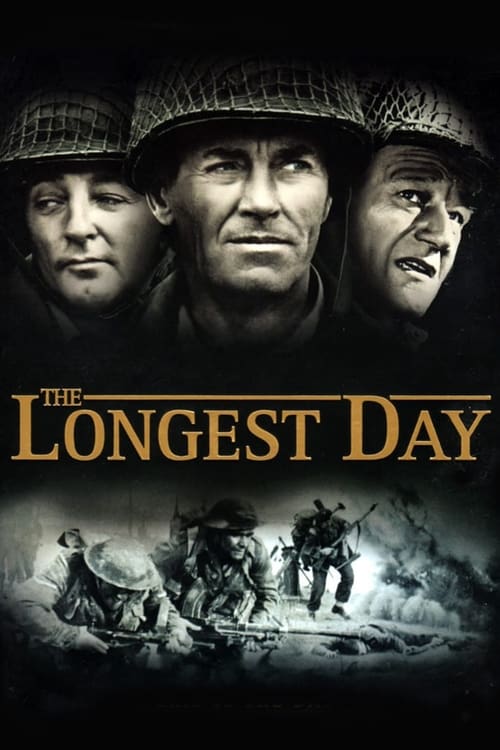
The Longest Day
1962 · Ken Annakin
For when you want a big, old-fashioned war epic on a Sunday afternoon — history rendered at full scale, absorbing rather than harrowing. Comfort viewing for anyone who loves WWII history; a commitment, at three hours, but an easy one.
What it's about
June 6, 1944, told hour by hour from every side at once: German officers arguing over where the Allies will land, American paratroopers dropping into the dark, British glider troops racing to seize a bridge, French commandos and Resistance fighters, and thousands of soldiers wading toward the beaches of Normandy. There's no single hero — the invasion itself is the protagonist, assembled from dozens of small episodes of confusion, luck, and nerve.
The experience
It moves like a countdown, cutting between commanders poring over maps and the men who have to make their decisions real. The scale is genuinely awesome and the tone stays sober rather than rah-rah — more monument than melodrama, with long stretches of tension released in bursts of chaos.
Performances
The cast is a who's-who of the era — John Wayne, Robert Mitchum, Henry Fonda among dozens of stars — most appearing in brief, vivid episodes rather than starring roles; Mitchum's weary beachhead commander is the one people remember.
The craft
Producer Darryl F. Zanuck staged the invasion at near-documentary scale, in stark black-and-white widescreen when color spectacle was the norm, with each nationality speaking its own language — Germans in German, French in French. The massive practical set pieces, including sweeping single takes over battlefields full of extras, still look staggering and absolutely reward the biggest screen you can find.
Why it matters
It set the template for the all-star, multi-perspective war epic and stood as the definitive screen account of D-Day for decades, until later films answered its sweeping panorama with ground-level visceral realism.
Snapshot
The Longest Day is the great Hollywood monument to D-Day, a vast, semi-documentary reconstruction of the Allied invasion of Normandy on June 6, 1944, conceived and driven by the producer Darryl F. Zanuck as the crowning project of his career. Adapted from Cornelius Ryan's best-selling 1959 work of popular history, it abandons the single-protagonist arc of the conventional war picture in favor of a panoramic, multi-national mosaic that cuts among the German command, the American airborne and seaborne assaults, the British beaches and glider landings, the French commandos and Resistance, with each nationality speaking its own language. Shot in stark black-and-white CinemaScope at a time when color spectacle was the studios' default, mobilizing a cast of some four dozen international stars — John Wayne, Robert Mitchum, Henry Fonda, Robert Ryan, Richard Burton, Sean Connery, Curd Jürgens, Gert Fröbe, and many more — and staged with the cooperation of multiple armies on the actual or near-actual geography of the campaign, the film aspired to the authority of historical record rather than the intimacy of drama. It was a critical and commercial triumph that helped steady a financially imperilled 20th Century-Fox, won Academy Awards for its cinematography and special effects, and established the template for the all-star, multi-strand war epic that would dominate the genre for the next fifteen years. Three credited directors and several uncredited hands executed it, but its true author is Zanuck, whose obsessive scale and documentary ambition shape every reel.
Industry & production
The film was the personal undertaking of Darryl F. Zanuck, the founding production chief of 20th Century-Fox, who by the late 1950s had left his executive post to work as an independent producer in Europe. The Longest Day was his comeback and his self-justification — a project he pursued with single-minded determination, reportedly committing his own resources and a great deal of personal will to a venture many considered foolhardy. He acquired the rights to Cornelius Ryan's book, then the most celebrated popular account of the invasion, and set about mounting a reconstruction on a scale no studio would have casually financed.
The production was enormous and logistically punishing. Filming took place largely in France, including locations on and near the Normandy coast, with the participation of military personnel and matériel supplied by several governments; period landing craft, aircraft, and armor were assembled for the staging of the beach assaults and airborne drops. The budget — frequently cited as around ten million dollars — made it one of the most expensive black-and-white films produced up to that time, a distinction it would hold for decades. Zanuck divided the directing labor by national episode: Ken Annakin handled the British and French exterior sequences, Andrew Marton the American exteriors, and the German director Bernhard Wicki the German scenes, with Elmo Williams serving as coordinator of the battle episodes and associate producer. Additional second-unit and uncredited directorial work was folded in, and Zanuck himself is generally understood to have exercised hands-on control over much of the staging. The casting strategy — packing the frame with recognizable faces in roles sometimes lasting only a scene — was both a commercial insurance policy and a structural device, lending each fragment of the mosaic an instant legibility.
The picture's release came at a moment of acute crisis for Fox, whose finances were being drained by the runaway production of Cleopatra. The Longest Day proved a major commercial success and is widely credited with helping to shore up the studio; in its wake Zanuck returned to Fox as its president. The film's profitability vindicated his gamble on a sober, monumental war film at a scale that had looked reckless.
Technology
The most consequential technological decision was an aesthetic one: to shoot in black-and-white at a time when the epic was synonymous with color and widescreen color processes. The film uses the anamorphic CinemaScope frame but renders it in monochrome, a choice that ties the imagery to the visual register of wartime newsreel and combat photography and lends the reconstruction an air of documentary truth. The trade-off was deliberate — surrendering the commercial allure of color for the authority of the archival look. Beyond this, the film's technical achievement lies in the practical, large-scale staging of its set pieces: the parachute and glider landings, the naval bombardment, the amphibious assaults, and the cliff-scaling at the Pointe — accomplished with real aircraft, ships, vehicles, pyrotechnics, and large bodies of extras rather than optical trickery. The special-effects work, honored with an Academy Award, was substantially a matter of physical effects, explosions, and the coordination of military hardware at scale. There is no credible record of novel camera or process technology driving the film; its innovation is one of logistics and of the disciplined marshalling of period equipment to photograph mass action convincingly.
Technique
Cinematography
The cinematography — credited to Jean Bourgoin, Henri Persin, and Walter Wottitz, and awarded the Oscar for Best Cinematography, Black-and-White — is the film's defining formal achievement. The monochrome CinemaScope images favour deep, populated compositions in which masses of men and machines fill the wide frame, recalling the look of contemporaneous combat photojournalism. The film's most celebrated single image is a sustained high, gliding aerial shot that follows the commando assault through the streets of Ouistreham toward the casino strongpoint, the camera floating over the action in one unbroken sweep — a virtuoso piece of staging that surveys the chaos with an almost god's-eye detachment. Throughout, the photography balances the panoramic and the particular, pulling back to register the scale of the operation and pressing in to isolate individual figures within it. The gray tonal palette, the smoke and overcast skies, and the flat coastal light all serve the picture's documentary aspiration.
Editing
The editing organizes a genuinely sprawling body of material — multiple nations, multiple fronts, command posts and front lines — into a coherent, cross-cut chronicle of a single day. The structure is episodic and parallel, intercutting among the German anticipation of the invasion, the Allied preparations and the agonizing weather decision, the airborne drops behind the lines, and the dawn assaults on the beaches. The cutting must continually re-orient the viewer in space and affiliation, and it does so largely through the clarity of the staging and the recognizability of the cast. The rhythm builds from the tense, talky stillness of the pre-invasion sequences — the waiting, the forecasts, the orders — into the accelerating kinetic chaos of the landings, allowing the film's accumulated scale to pay off in its combat passages.
Mise-en-scène / staging
The film's staging is its raison d'être: this is cinema as historical reconstruction, and its authority depends on the conviction of its physical mise-en-scène. Production design assembles the apparatus of 1944 — bunkers and beach obstacles of the Atlantic Wall, landing craft disgorging troops into the surf, gliders crumpling into Norman fields, the tangled hedgerows and stone villages of the interior. The blocking of mass action is handled with a clarity that keeps the geography of each engagement legible even at its most crowded. Individual vignettes are staged for memorable, often near-anecdotal effect: the paratrooper snagged on a church steeple at Sainte-Mère-Église, the bagpiper striding the beach amid fire, the commander urging his men forward. The staging consistently subordinates individual heroics to the depiction of a collective, coordinated, and terrifyingly large operation.
Sound
The soundscape pairs the percussive realism of battle — gunfire, shellfire, aircraft, the churn of the sea — with Maurice Jarre's martial orchestral score and the film's insistent title march. Paul Anka, who also appears in the film as one of the Rangers, wrote the song "The Longest Day," whose drum-and-brass theme functions as the picture's signature, recurring as a motif of grim forward momentum. The most distinctive aural strategy, however, is linguistic: the Germans speak German and the French speak French, with English subtitles, a marked departure from the Hollywood convention of having all characters speak accented English. This polyphony of languages is central to the film's claim of authenticity and to its multi-perspective design.
Performance
Performance in The Longest Day is necessarily a matter of ensemble and of iconography rather than sustained character study. With so many roles compressed into brief appearances, the film trades on the established personae of its stars: John Wayne's stolid command presence, Robert Mitchum's laconic toughness as a beachhead general, Henry Fonda's principled gravity, Richard Burton's wry fatalism as a downed flier, Robert Ryan, Rod Steiger, Red Buttons (memorable as the paratrooper left hanging at the steeple), and Eddie Albert among the Americans and British. A young Sean Connery appears among the British troops. The German roles are played with seriousness and dignity by Curd Jürgens, Gert Fröbe, and others, and the film is notable for granting its German officers genuine professional competence and foreboding rather than caricature. The performances are vignettes — sharp, economical, often built on a single attitude — and their cumulative effect is less psychological depth than a sense of a whole generation rendered in recognizable faces.
Narrative & dramatic mode
The film's dramatic mode is that of the documentary epic or historical chronicle, structured not around a protagonist's arc but around an event reconstructed from many vantage points. Its model is the panoramic popular history of its source — a "you are there" assemblage of vignettes, command decisions, and individual incidents woven into the master narrative of a single decisive day. The drama derives from dramatic irony and from scale: the audience knows the outcome, and the tension lies in watching the immense machinery of the invasion lurch into motion, in the German failure to read the assault correctly, in the weather gamble on which everything hinges. Rather than inviting deep identification with any one figure, the film cultivates a near-encyclopedic comprehensiveness, treating the invasion itself as the protagonist and the human players as facets of a collective effort. This breadth is both its ambition and its limitation: emotional involvement is diffused across dozens of brief encounters, in exchange for a uniquely total view of the operation.
Genre & cycle
The Longest Day belongs to the combat film and, more specifically, inaugurates the modern cycle of the large-scale, all-star, multi-perspective war epic. It stands apart from the intimate platoon picture and the individual-centred war drama by virtue of its panoramic ambition and its commitment to historical reconstruction. The film effectively defined a template that the genre would follow through the 1960s and 1970s: the spectacular recreation of a famous battle or campaign, an international cast of marquee names in cameo-scale roles, multiple directors dividing the labor, and a sober, fact-respecting tone. Its semi-documentary treatment of mass warfare distinguishes it from the more myth-making or melodramatic war films of the studio era, aligning it instead with a strain of monumental, quasi-official commemorative cinema.
Authorship & method
Despite three credited directors, the film's authorship belongs unambiguously to Darryl F. Zanuck, whose conception, financing, and controlling vision unify the enterprise; it is among the clearest cases in classical Hollywood of a producer functioning as the decisive creative author. Ken Annakin (British and French exteriors), Andrew Marton (American exteriors), and Bernhard Wicki (German sequences) executed their assigned national episodes under Zanuck's overall command, with Elmo Williams coordinating the battle staging. The screenplay was adapted by Cornelius Ryan from his own book, with additional writing contributed by several hands — among them figures brought in to sharpen particular national episodes and dialogue. The cinematography of Bourgoin, Persin, and Wottitz supplied the documentary-grade monochrome look; Maurice Jarre, near the start of the international career that would shortly bring him to David Lean's epics, composed the score; and Paul Anka furnished the title theme. The method — dividing a single film among directors by nationality and language, then binding the parts through a producer's controlling sensibility and a unifying visual and musical style — was itself a notable production strategy, one suited to the film's polyphonic, multi-perspective design.
Movement / national cinema
The film is a product of Hollywood — specifically of 20th Century-Fox — but it is a transnational European production in execution, shot in France with French, German, British, and American talent before and behind the camera. It belongs to the era of "runaway" American productions mounted in Europe to exploit lower costs, available locations, and local crews and military cooperation. In its multilingual casting and its respectful treatment of the German perspective, it reflects a postwar, NATO-era sensibility in which former adversaries are absorbed into a shared, commemorative account of the war. It is less an entry in any national-cinema movement than a monument of international commercial filmmaking, drawing on the resources of several countries to memorialize an event that belonged to all of them.
Era / period
Released in 1962, eighteen years after the events it depicts, the film arrives at the height of the Cold War and at a moment of intense Western memorialization of the Second World War. Its reverent, comprehensive treatment of D-Day speaks to a culture engaged in consecrating the wartime achievement of the Allied nations and of the generation that fought. The decision to dignify the German soldiers and commanders as competent professionals rather than villains reflects the geopolitics of the period, in which West Germany had become a key NATO ally. The film's monumental scale and its documentary sobriety also belong to the early-1960s vogue for the historical epic, even as its black-and-white austerity sets it apart from the color spectacles of the day. It is, in a sense, an official-feeling tribute, made while many participants and commanders were still living and while the memory of the invasion remained central to Western self-understanding.
Themes
The film's governing theme is the magnitude and contingency of the invasion itself — the sheer scale of coordinated human effort required to breach Hitler's Atlantic Wall, and the precariousness of the whole undertaking, hinging on weather, timing, and deception. Closely linked is the theme of war as a collective rather than an individual endeavor: the film's diffuse, ensemble structure embodies the idea that victory was the product of countless small actions across many fronts and nations. The multi-national, multilingual design advances a theme of shared sacrifice and, in its even-handed treatment of the German command, a recognition of war as a tragedy experienced on all sides — the film's title phrase, voiced by Rommel, that the day would be "the longest" for Allies and Germans alike, captures this doubled perspective. There is, too, a persistent motif of irony and chance: orders misread, the airborne scattered, the Germans expecting the assault elsewhere, the outcome turning on contingencies invisible to those living through them. Underlying all of it is the commemorative impulse — the conviction that the events of June 6, 1944, deserved to be recorded with documentary fidelity and on the largest possible scale.
Reception, canon & influence
The Longest Day was a substantial critical and commercial success on its release, admired for the scale and conviction of its reconstruction and for the documentary authority of its black-and-white photography, and credited with helping to rescue Fox from the financial peril of the Cleopatra era. It was nominated for the Academy Award for Best Picture and won Oscars for its cinematography (Black-and-White) and its special effects. It has retained a secure place in the canon of war cinema as the definitive Hollywood treatment of D-Day for its generation and as a landmark of the large-scale historical epic.
Influences on the film run backward to the tradition of wartime combat photography and newsreel — the visual idiom the monochrome imagery deliberately evokes — and to the documentary-historical method of Cornelius Ryan's source book, with its mosaic of perspectives assembled from interviews and records. The producer-driven, set-piece spectacle of the classical Hollywood epic supplied its commercial model.
Its influence forward was decisive for the war genre. The film established the formula of the all-star, multi-strand, multi-director battle epic that shaped the next decade and a half — most directly Fox and Zanuck's own Tora! Tora! Tora! (1970), which extended The Longest Day's strategy of multinational casts, divided direction, and dual-perspective authenticity to Pearl Harbor, and A Bridge Too Far (1977), again adapted from a Cornelius Ryan history and again deploying an international all-star ensemble to reconstruct a single operation. Battle epics such as Battle of the Bulge and the broader 1960s cycle of large-scale combat films worked in its shadow. Its insistence on having each nationality speak its own language anticipated the authenticity-seeking impulse of later war cinema, even as subsequent landmark D-Day depictions — most famously the opening of Saving Private Ryan (1998) — would pursue a visceral, subjective horror that The Longest Day's panoramic, commemorative mode had largely held at arm's length. As both the culminating achievement of Darryl Zanuck's career and the prototype of the modern war epic, it remains a foundational work of the genre.
A Deleuzian reading
A man hangs from a church steeple at Sainte-Mère-Église, his parachute snagged on the stonework, the bells hammering his ears deaf, while the battle for the town goes on below him without his help.
The full Deleuzian reading of The Longest Day →
Reception
A box-office colossus in 1962 — Zanuck's all-star, three-director D-Day epic was event cinema and an Oscar winner for its cinematography. Today it's mostly read as the stately, respectful 'before' picture to Saving Private Ryan's visceral 'after'.
How The Longest Day was received, from release to now →
Influences: the films it descends from and the films it influenced
- All Quiet on the Western Front (1930) — Established the war film's convention of granting the enemy's foot soldiers full human interiority — the direct forebear of The Longest Day's sympathetic, professionally drawn German officers.
- The Memphis Belle: A Story of a Flying Fortress (1944) — Its authentic combat-camera footage shot aboard a B-17 fixed the newsreel-monochrome idiom of aerial and frontline photography that Annakin's black-and-white CinemaScope deliberately imitates for documentary authority.
- The Story of G.I. Joe (1945) — Adapted from correspondent Ernie Pyle's reporting, it pioneered the documentary-grade, journalistically sourced combat reconstruction that Cornelius Ryan's interview-mosaic method extends.
- They Were Expendable (1945) — Modeled the deep-focus, densely populated combat tableau and elegiac newsreel monochrome that underwrite Sightlines' deep-populated compositions.
- Battleground (1949) — Its multi-character mosaic of an ordinary unit experiencing a single campaign (Bastogne) prototyped the collective-over-individual, many-strands-one-operation structure.
- Gone with the Wind (1939) — David O. Selznick's controlling-producer authorship over multiple directors is the classical-Hollywood template for Zanuck functioning as the unifying author across three national directorial units.
- Around the World in 80 Days (1956) — Mike Todd's all-star cameo packaging — selling roadshow spectacle through a parade of recognizable faces — is the commercial machinery behind The Longest Day's star-ensemble iconography.
- The Bridge (1959) — Direct authorial line: Wicki himself directed the German-language sequences, carrying his unglamorous, defeat-inflected staging of German soldiers into an international production.
- Is Paris Burning? (1966) — Directly copies the formula — multinational all-star cast, multilingual subtitled dialogue, mosaic reconstruction of a single liberation operation — scripted partly by hands later associated with the Ryan-style chronicle.
- Battle of the Bulge (1965) — Annakin's own follow-through on the large-scale all-star combat epic, extending the panoramic, dual-perspective battle reconstruction to the Ardennes.
- Tora! Tora! Tora! (1970) — Zanuck-Fox's most literal extension: division of direction by nationality, dual-perspective dramatic irony, and each nation speaking its own subtitled language, applied to Pearl Harbor.
- Waterloo (1970) — Pushes the mass-action blocking and aerial-tracking survey of a reconstructed battlefield to its extreme, choreographing tens of thousands of real extras as the camera cranes and sweeps overhead.
- Battle of Britain (1969) — Carries forward the all-star ensemble plus authentic aerial photography of a single decisive engagement, with sympathetic cross-cutting to the German command.
- A Bridge Too Far (1977) — The closest lineal heir — another Cornelius Ryan history adapted into an international all-star reconstruction of one failed operation, sustaining the multi-strand panoramic chronicle.
- Saving Private Ryan (1998) — Inherits the D-Day reconstruction subject but pointedly inverts the commemorative panoramic mode into handheld, desaturated subjective horror that The Longest Day had held at arm's length.
- We Were Soldiers (2002) — The film's sustained parallel intercutting between Allied and German command structures — granting German commanders extended sequences of tactical interiority — established the dual-national editorial architecture that Hoy's cutting between Moore and Nguyen Huu An directly inherits.
- Midway (1976) — Established the all-star, real-battle docudrama template — fragmenting a historical engagement into short ensemble vignettes across both sides' command chains — that Midway directly imitates.
- Avengers: Endgame (2019) — A producer's-cinema (Zanuck as architect, multiple directors as executors) ensemble war film that converges a vast star roster on one assault — the production model Feige's MCU and Endgame's battle inherit.
- Pearl Harbor (2001) — The all-star, multi-perspective reconstruction of a single decisive battle, whose cross-cutting between command rooms and frontline soldiers Pearl Harbor imitates around the attack.
- The Guns of Navarone (1961) — A contemporaneous international all-star ensemble built around a single large military operation, sharing the runaway-European-production economics and big-cast war-epic packaging.
- The Great Escape (1963) — Deploys the same star-ensemble-vignette architecture, allotting each recognizable lead his own self-contained set-piece within one collective operation.
Similar films
- A Bridge Too Far (1977) — influence & lineage
- The Guns of Navarone (1961) — influence & lineage
- Saving Private Ryan (1998) — influence & lineage
- Waterloo (1970) — influence & lineage
- All Quiet on the Western Front (1930) — influence & lineage
- The Great Escape (1963) — influence & lineage
- Pressure (2026) — shared sensibility
- Dunkirk (2017) — shared sensibility