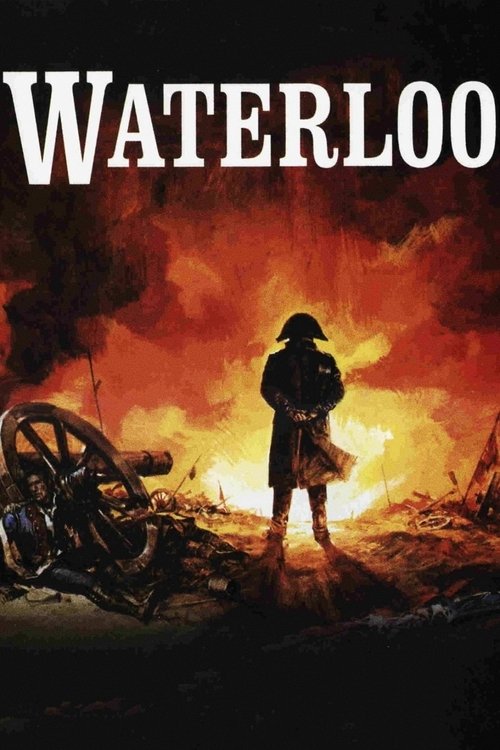
Waterloo
1970 · Sergey Bondarchuk
For when you're in the mood for grand-scale history — a Sunday-afternoon epic to put on the biggest screen you have and marvel at what filmmaking once physically did. Comfort for history buffs, a spectacle for everyone else.
What it's about
Napoleon escapes exile on Elba, the French army defects back to him, and Europe scrambles to stop his return — all funneling toward one catastrophic day in June 1815 on a muddy field outside Brussels, where the Duke of Wellington's allied army makes its stand. The film reconstructs the entire final campaign, from throne rooms to the smoke and chaos of the battle itself.
The experience
Awe is the operative feeling: when the armies collide, you're watching thousands of actual uniformed men, real cavalry, and real cannon smoke maneuvering across a purpose-built landscape. The drama between battles is stately, but the spectacle is jaw-dropping in a way no digital crowd can replicate.
Performances
Rod Steiger plays Napoleon as a brooding, ailing force of will, all interior storm, opposite Christopher Plummer's cool, dry-witted Wellington — two opposed temperaments as much as two opposed armies.
The craft
Soviet director Sergei Bondarchuk, backed by Mosfilm's resources and a literal army of extras, staged one of the last great pre-digital battle epics: aerial shots of infantry squares under cavalry charge that remain staggering. The sheer physical logistics are the star, and it demands the biggest screen you can manage.
Why it matters
A landmark of practical-scale filmmaking whose battle scenes became the reference point for every Napoleonic epic since — proof of what an East–West co-production could mount at the height of the roadshow era.
Snapshot
Waterloo is a large-scale historical spectacle that reconstructs the final campaign of Napoleon Bonaparte, from his return from Elba and the collapse of the restored Bourbon monarchy to the single catastrophic day of 18 June 1815 outside Brussels. Directed by the Soviet filmmaker Sergei Bondarchuk fresh from his monumental four-part War and Peace (1966–67), it was mounted as an Italian–Soviet co-production yoking Dino De Laurentiis's producing muscle to Mosfilm's resources and the Soviet state's ability to field an army of extras. The result is one of the last great pre-digital battle epics: a film whose reputation rests less on its dramaturgy than on the sheer physical fact of thousands of uniformed men maneuvering across a purpose-built landscape. Rod Steiger plays a brooding, ailing Napoleon; Christopher Plummer a cool, ironic Wellington. The film was a commercial disappointment on release, and its failure is routinely cited as the event that persuaded a major studio to abandon Stanley Kubrick's long-planned Napoleon film — a negative legacy that has become inseparable from Waterloo's place in film history.
Industry & production
Waterloo belongs to the twilight of the international roadshow epic, the cycle of long, expensively appointed prestige pictures that had dominated the late 1950s and 1960s and was, by 1970, in steep commercial decline. It was produced by Dino De Laurentiis in partnership with Mosfilm, with Columbia Pictures handling much of the Western distribution. The co-production model was itself the film's defining logistical fact: De Laurentiis brought Western financing, English-language stars, and access to international markets, while the Soviet side supplied the studio infrastructure Bondarchuk had commanded on War and Peace and — decisively — soldiers of the Red Army as extras.
The scale of that manpower is the production's most frequently repeated statistic. Popular accounts consistently report that many thousands of Soviet troops — commonly given in the range of roughly fifteen thousand infantry plus cavalry — were placed at Bondarchuk's disposal, drilled for months in Napoleonic-era formations and choreography. These figures circulate widely but should be treated as journalistic estimates rather than audited records; the precise numbers vary by source. What is not in doubt is that the film mobilized human resources on a scale no purely commercial Western production of the era could have afforded, and that this was possible only because a state army could be seconded to a film set.
The film was among the most expensive productions of its moment, but exact budget and box-office figures reported in secondary sources are inconsistent, and I will not assert a specific number. The commercial outcome, however, is well established in outline: Waterloo underperformed relative to its cost, and its disappointing reception in 1970 hardened studio skepticism toward the giant historical epic at precisely the moment such projects were being weighed. The most consequential casualty was Kubrick's Napoleon, a meticulously researched film that MGM and then United Artists declined to finance in the wake of Waterloo — a linkage Kubrick scholars and Kubrick himself acknowledged.
Technology
Waterloo is a monument to analog, in-camera spectacle. It was shot on 35mm (with large-format capacity for the roadshow presentation) in color, and its scale effects are achieved not through optical trickery but through the physical arrangement of real bodies, horses, artillery, and terrain. Production centered on locations in Soviet Ukraine, near Uzhhorod, where the filmmakers effectively built the battlefield: reports describe the relocation of earth, the laying of roads, the digging of trenches, the planting of fields (including rye), and the construction of the farmhouse strongpoints — Hougoumont and La Haye Sainte — around which the historical battle turned.
The film's technological signature is aerial and elevated coverage. Bondarchuk used helicopters and tall camera towers to capture the geometric spectacle of massed formations from directly overhead, turning columns, squares, and cavalry charges into shifting abstract patterns. This "God's-eye" perspective, which he had already explored in War and Peace, is the film's most imitated visual idea and depends entirely on the reality of the mass beneath the lens. In an era before computer-generated crowd replication, the image's power is indexical: what you see moving is what was actually there.
Technique
Cinematography
The cinematography is credited to Armando Nannuzzi, an accomplished Italian director of photography, and it operates in two contrasting registers. The intimate scenes — councils, Napoleon's chambers, Wellington's headquarters — are lit and composed with a painterly, Old Master sobriety appropriate to a period drama. The battle passages open the frame to vast deep-focus panoramas and the vertiginous overhead shots described above. Nannuzzi and Bondarchuk repeatedly cut between ground-level immersion, where the camera is inside the smoke and chaos, and the detached aerial vantage that reads the battle as pure form. The color palette exploits the contrast of scarlet British coats, blue French uniforms, and green fields churned to mud, so that the battlefield is legible as a moving map even as it dissolves into carnage.
Editing
The editing must reconcile documentary-scale spectacle with a compressed dramatic clock. The film builds toward the single day of battle and then structures that day as a rhythmic alternation between command decisions and their consequences on the field. Bondarchuk favors long, kinetic buildups — the slow advance, the gathering charge — released into bursts of rapid cutting at moments of collision. The credited editing on the international version is generally attributed to Richard C. Meyer, though editorial work on a Soviet co-production of this kind was necessarily collaborative and the precise division of labor between Western and Soviet cutters is not something I can specify with confidence. The most celebrated set piece, the great French cavalry charge against the British infantry squares, is a study in escalating tempo, intercutting the aerial pattern of the assault with the claustrophobic interior of the squares.
Mise-en-scène / staging
Staging is the film's true subject and its greatest achievement. The production design by Mario Garbuglia and the costuming (with Maria De Matteis associated with the film's period wardrobe) furnish a densely accurate material world, but the defining directorial gesture is the choreography of masses. Bondarchuk stages the battle as a sequence of legible tactical events — the assault on Hougoumont, the massed infantry advance, the cavalry charge, the arrival of the Prussians, the last throw of the Imperial Guard — each realized with thousands of coordinated performers. The infantry squares, the rolling artillery, the disciplined volleys are presented with an attention to Napoleonic drill that gives the spectacle an almost instructional clarity. Where many war films render battle as generalized chaos, Waterloo insists on the readability of maneuver, then shows that order collapsing into slaughter.
Sound
Nino Rota, best known for his work with Fellini and for The Godfather, composed the score, and his music supplies both martial grandeur and elegiac undertow, resisting simple triumphalism. The battlefield soundscape combines cannon, musketry, drums, hooves, and the shouted commands that hold formations together, with the noise of massed fire functioning almost as a percussive extension of Rota's orchestration. As an English-language international co-production with a multinational cast, the film relied on post-synchronization and dubbing to unify performers of different native languages — a standard practice of the European epic that occasionally flattens vocal texture.
Performance
Rod Steiger's Napoleon is the film's dramatic center: a Method-inflected, physically deteriorating figure, by turns imperious, sentimental, and visibly unwell, whose interior monologues externalize his fatalism. The performance divides opinion — some find it magnetic, others overwrought — and that division is itself part of the film's critical record. Christopher Plummer's Wellington is the deliberate counterweight: dry, aristocratic, unflappable, delivering his ironies with cool detachment. Around them a distinguished supporting cast includes Orson Welles in a brief turn as the restored Louis XVIII, Jack Hawkins as Picton, and a gallery of British and Continental character actors. The contrast between Steiger's volatility and Plummer's reserve stages, at the level of acting style, the very clash of temperaments the film argues decided the day.
Narrative & dramatic mode
The film's dramatic mode is the historical tableau organized around a duel of great men. Its structure is essentially bipartite: a first movement of political and psychological setup — the return from Elba, the army's defection from the Bourbons, the tense march toward confrontation — and a second, longer movement given almost entirely to the battle itself. This is not a character study in the novelistic sense; the interiority it offers is emblematic rather than developmental, with Napoleon and Wellington functioning as embodiments of contending principles (audacity versus endurance, imperial will versus professional discipline). The screenplay, credited to H.A.L. Craig with Bondarchuk and Vittorio Bonicelli, leans on historical set pieces and attributed aphorisms rather than invented intrigue. The mode is fundamentally elegiac and deterministic: the outcome is known, and the drama lies in watching men enact a fate the audience has already been told.
Genre & cycle
Waterloo is a war film and a historical epic, and specifically a battle-piece — a subgenre in which a single engagement provides the whole architecture. It arrives at the tail end of the 1960s roadshow-epic cycle and can be read as both a culmination and a last gasp of that tradition. Within the war genre it is unusual for its restriction to a single day and place, and for its cool, panoramic detachment rather than the identification with a small unit that characterizes much combat cinema. It also belongs to a distinctly European (and specifically Soviet-inflected) lineage of the mass historical spectacle, in which crowds themselves, rather than individuals, are the primary expressive material.
Authorship & method
Sergei Bondarchuk is the decisive author. His method, developed on War and Peace, treats the historical battle as a total art form requiring quasi-military planning: months of rehearsal, the construction of a real battlefield, the drilling of thousands of extras, and a command structure on set analogous to the armies being depicted. His signature is the dialectic between the individual face and the anonymous mass, and between ground-level immersion and the aerial abstraction of formations. The film is the product of that method applied on a scale even War and Peace had not demanded of a single location.
His key collaborators shape the film in identifiable ways. Cinematographer Armando Nannuzzi supplies the painterly interiors and the deep-focus battlefield panoramas. Composer Nino Rota provides a score that tempers martial pomp with melancholy. Production designer Mario Garbuglia and the costume department deliver the dense period authenticity. The screenplay by H.A.L. Craig, with Bondarchuk and Vittorio Bonicelli, supplies the aphoristic, tableau-driven text. The editing (attributed on the international version to Richard C. Meyer, within a necessarily collaborative Soviet-Western workflow) governs the film's alternation of grand buildup and violent release. The presiding sensibility, though, is unmistakably Bondarchuk's.
Movement / national cinema
The film sits astride two cinematic cultures. On the Western side it is a late entry in the international epic mounted by De Laurentiis for the English-language market. On the Soviet side it is a Mosfilm production directed by the U.S.S.R.'s pre-eminent maker of historical spectacle, drawing on a specifically Soviet tradition — reaching back to Eisenstein — of using the crowd and the mass event as the true protagonist of history. Waterloo is thus a hybrid: a Soviet mass-cinema sensibility financed and packaged for Western audiences. This dual parentage is central to how it should be understood, and it makes the film an unusual artifact of Cold War-era cultural collaboration, produced across the ideological divide at a moment of relative détente.
Era / period
Made in 1970, Waterloo stands at a hinge in film history. The roadshow epic was collapsing commercially; the New Hollywood of smaller, director-driven films was ascendant; and the technological future of the mass spectacle — eventually digital crowd replication — was still decades off. The film is therefore a kind of terminal object: among the last works that could depict a Napoleonic battle by actually assembling something approaching an army. Its very possibility depended on a specific historical conjunction — a Soviet state willing to lend its military to a co-production — that would not recur. That it disappointed at the box office in 1970 is inseparable from the era's shifting audience: the mass-prestige historical film was losing the public that had sustained it a decade earlier.
Themes
The film's governing theme is the futility and cost of martial glory. It is skeptical of triumph even as it lavishes spectacle upon war, repeatedly undercutting grandeur with images of the dead and dying and with Wellington's famous, historically attributed reflection that next to a battle lost, the saddest thing is a battle won. Napoleon is figured as a man of will confronting the exhaustion of his own myth — aging, ill, propelled by ambition into a gamble he half-knows is doomed — so that the film becomes a meditation on hubris and the vanity of imperial ambition. Against him, Wellington embodies discipline, endurance, and professional detachment. Underlying both is a fatalism about history as a machine that grinds individuals, however great, into mud. The overhead shots reinforce this: from above, the men are patterns, and the pattern is indifferent to any single life within it.
Reception, canon & influence
Critical reception in 1970 was mixed and has remained so. Reviewers consistently praised the staging of the battle as an astonishing, perhaps unrepeatable feat of logistics and spectacle, while dividing sharply over the film's dramatic substance and over Steiger's performance, which some found powerful and others excessive. The consensus that has hardened over time treats Waterloo as a spectacle of genuine and enduring value housed in a drama of limited depth — admired for what it shows more than for what it says.
Its influences run backward to a clear lineage: Bondarchuk's own War and Peace, the Soviet tradition of mass historical cinema descending from Eisenstein, and the broader 1960s roadshow epic. Its forward legacy is twofold and slightly paradoxical. As spectacle, it became a touchstone and a technical benchmark; the aerial choreography of massed formations influenced how later filmmakers imagined pre-modern battle, and the film is frequently invoked in discussions of large-scale combat cinema up to and including the digital era, precisely as the analog standard against which CGI crowds are measured. As commerce, its failure had an outsized historical effect: it is widely credited as the immediate cause of the studios' retreat from Stanley Kubrick's Napoleon project, making Waterloo the film that, by falling short, foreclosed one of the great unmade films. That double legacy — celebrated as the last of its kind, and remembered for what its failure prevented — is the form in which Waterloo survives in the canon.
Reception
A notorious flop in 1970 — it lost a fortune for Dino De Laurentiis and Columbia — but decades later it's been reclaimed as the last word in pre-CGI spectacle, the 'they literally used an army' epic that modern battle scenes get measured against.
How Waterloo was received, from release to now →
Influences: the films it descends from and the films it influenced
- Battleship Potemkin (1925) — Founds the Soviet grammar Bondarchuk inherits: the crowd as protagonist and montage cut to an escalating rhythmic tempo, which Waterloo restates in its alternation of slow buildup and violent release.
- Alexander Nevsky (1938) — The Battle on the Ice codifies pre-modern combat as graphically legible massed formations shot from elevation with music-locked cutting — the direct model for Waterloo's aerial abstraction of squares and cavalry into moving geometry.
- Ivan the Terrible (1944) — Perfects the dialectic of the sculptural individual face held against a tableau mass, the exact figure/ground rhetoric Bondarchuk builds his whole battle around.
- Napoléon (1927) — Establishes the mobile, sweeping, quasi-aerial camera coursing over historical multitudes and the treatment of Napoleon himself as a spectacle-subject, both of which Waterloo scales up with helicopter overheads.
- War and Peace (1966) — Bondarchuk's own Borodino sequence invents his working method — a constructed real battlefield, thousands of drilled soldier-extras, and a ground-immersion-to-aerial-abstraction cutting scheme — applied at Waterloo to a single location.
- Lawrence of Arabia (1962) — The 70mm roadshow template of real crowds moving through real terrain at extreme scale, prioritizing in-camera landscape spectacle over process work — the commercial and formal frame Waterloo occupies.
- Spartacus (1960) — Drills actual army units (Spanish infantry) into geometric battle formations arranged for the camera, the analog logistics-as-choreography approach Bondarchuk pushes to its limit with 15,000 Soviet troops.
- El Cid (1961) — Stages historical warfare with genuine armored cavalry charges and thousands of loaned soldiers on real ground, the in-camera crowd spectacle Waterloo is the culmination of.
- The Longest Day (1962) — Pushes the mass-action blocking and aerial-tracking survey of a reconstructed battlefield to its extreme, choreographing tens of thousands of real extras as the camera cranes and sweeps overhead.
- War and Peace, Part II: Natasha Rostova (1966) — Bondarchuk exports his own method wholesale: Red Army divisions drilled as period formations, helicopter-mounted verticals over living geometric battle patterns, and cut-in subjective inserts from inside the squares — the crowd-choreography system of the War and Peace battles, minus the interior monologue that made Part II work.
- Barry Lyndon (1975) — Kubrick's redirected Napoleon research resurfaces here: eighteenth-century linear warfare rendered as painterly, deep-focus period tableau with ironic detachment — the craft of the unmade Napoleon channeled into a different frame after Waterloo foreclosed it.
- Come and See (1985) — Extends Soviet mass war cinema forward but inverts Waterloo's aerial abstraction into total ground-level immersion, keeping Bondarchuk's individual-face-versus-catastrophe dialectic while stripping away the elevated overview.
- Ran (1985) — Organizes massed armies into color-coded banners read as moving graphic blocks from high and near-aerial vantages, the same formations-as-legible-geometry staging Waterloo pioneered with helicopter shots.
- Braveheart (1995) — Revives pre-modern massed-infantry collision with overhead shots of formations closing on open ground, explicitly modeling battlefield legibility on Bondarchuk's aerial choreography of ranks.
- Gladiator (2000) — Opens with a set-piece battle whose massed-army scale is achieved by compositing digital crowds onto a modest core of real extras — the hybrid method that made Waterloo's all-analog thousands the benchmark it was measured against.
- The Lord of the Rings: The Return of the King (2003) — The Pelennor Fields deployment of Massive crowd-simulation software is repeatedly framed against Waterloo as the digital answer to Bondarchuk's real drilled thousands, inheriting the aerial formation-choreography while replacing the bodies.
- Napoleon (2023) — Takes the identical subject and Waterloo climax, restaging the squares-versus-cavalry engagement with digitally multiplied crowds shot from Bondarchuk's overhead formation vantage — the CGI-era remake of the analog standard.
- A Bridge Too Far (1977) — Attempted the large-scale all-star prestige epic of a famous historical military defeat using massed practical troop movements on location — establishing both the commercial template and the production methodology for staging a catastrophic Allied failure that Levine and Attenborough directly inherited and applied to a larger canvas.
- Lion of the Desert (1981) — Shares screenwriter H.A.L. Craig and models the practical mass-battle staging — thousands of real drilled soldiers filmed in-camera — that underwrites Lion's grid-versus-open-space combat and asymmetric battle montage.
- The Charge of the Light Brigade (1968) — A contemporaneous Napoleonic-era battle piece built on the same elegiac-deterministic reading of glory as futility, staging cavalry destruction as ironic tragedy rather than triumph.
- Cromwell (1970) — Released the same year as a twilight roadshow historical battle film, staging a great-man political duel around massed pike-and-cavalry set-pieces in the same fading in-camera-spectacle idiom.
Similar films
- Alexander Nevsky (1938) — influence & lineage · often watched together
- Napoleon (2023) — influence & lineage
- Napoleon (1927) — influence & lineage
- Spartacus (1960) — influence & lineage
- Battleship Potemkin (1925) — influence & lineage
- Barry Lyndon (1975) — influence & lineage
- Gladiator (2000) — influence & lineage
- All Quiet on the Western Front (1930) — shared sensibility