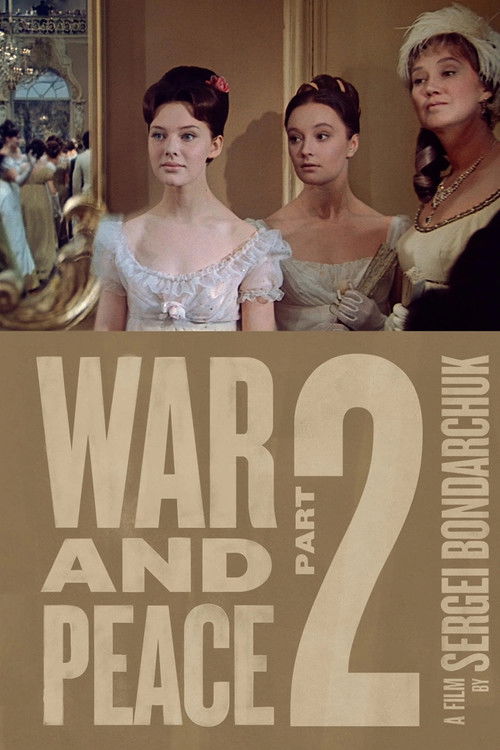
War and Peace, Part II: Natasha Rostova
1966 · Sergey Bondarchuk
For when you want to be swept away — a period romance on the grandest possible scale, best saved for an evening when you can surrender to it completely. It stands on its own as the love story of the saga, even if you haven't seen Part I.
What it's about
The second movement of the monumental Soviet adaptation of Tolstoy's novel turns from the battlefield to the ballroom. It follows Natasha Rostova from her first ball — where the widowed Prince Andrei falls in love with her — through a forced year of waiting while he travels abroad, her restless longing at home, and the arrival of the dashing Anatol Kuragin, who threatens to undo everything. Between the romance come a wolf hunt, a night of folk music in the country, and an evening at the opera: a whole vanished world of Russian aristocratic life, rendered at full scale.
The experience
Sumptuous and surprisingly intimate — an epic production aimed not at armies but at the flutter of a young woman's inner life. It's swooning at the ball, aching in the long middle stretch of waiting, and genuinely tense as temptation closes in; the pace is stately but the feeling is immediate.
Performances
Lyudmila Savelyeva's Natasha is the film's beating heart — she captures the character's leap from giddy girlhood into painful experience with a radiance and vulnerability that carry the entire production.
The craft
Shot in 70mm with six-track stereo sound and the near-unlimited resources of the Soviet state, and the astonishing thing is what all that machinery is spent on: candlelit ballrooms, a thundering wolf hunt, the hush of a country house at night. The ball sequence alone — the camera gliding among hundreds of dancers — is one of the most lavish set pieces ever filmed. This one genuinely demands the biggest screen and best sound you can give it.
Why it matters
Part of the most expensive film production ever mounted in the Soviet Union, the four-part epic won the Academy Award for Best Foreign Language Film and remains the benchmark for putting a great novel on screen at full scale.
Snapshot
The second movement of Sergey Bondarchuk's four-part adaptation of Tolstoy is the chamber piece inside the colossus. Where Part I: Andrei Bolkonsky (1965) ended in the smoke and sky of Austerlitz and Part III: The Year 1812 (1967) would deliver Borodino, Natasha Rostova covers the novel's domestic middle — roughly 1809 to 1811 — and stakes the largest production apparatus in Soviet film history on the interior life of a teenage girl. Its set pieces are a first ball, a wolf hunt, a night of folk music at a country uncle's house, an opera, and a botched elopement. The 70mm frame, six-track stereo, and Mosfilm's near-unlimited state credit are turned not on armies but on the texture of a young consciousness moving through rooms.
That inversion is the film's argument. Bondarchuk had understood something structural about Tolstoy: the war chapters and the peace chapters are not alternating subjects but a single method applied at two scales, and the same mobile, roving, quasi-omniscient camera that surveys a battlefield can survey a ballroom. Natasha Rostova is where the adaptation's technique is most exposed, because there is no spectacle of scale to carry it. It is also, for many viewers, the most immediately pleasurable of the four parts, and the one that most fully justifies Lyudmila Savelyeva's casting — a Kirov-trained ballet dancer with almost no screen experience, asked to hold the center of a state epic.
Industry & production
The project was conceived at the intersection of cultural policy and wounded pride. King Vidor's Italian-American War and Peace (1956), with Audrey Hepburn as Natasha, had circulated internationally as the screen Tolstoy, and the prospect of the Soviet Union ceding its national novel to Hollywood was treated in Moscow as a matter of state. Around 1961–62 — with the 150th anniversary of the 1812 campaign supplying the occasion — the Ministry of Culture committed Mosfilm to a definitive Soviet adaptation. Bondarchuk, then best known as an actor (Othello, 1955) with a single celebrated directing credit (Fate of a Man, 1959), was selected over more senior contenders, among them Ivan Pyryev. It remains one of the more consequential casting decisions in Soviet cinema administration.
The production ran, in various phases, from roughly 1962 to 1967, and was effectively a national mobilization. The Soviet Army supplied personnel and horses; a dedicated cavalry unit was maintained at Mosfilm's disposal for period film work and long outlived the production. Museums across the USSR lent furniture, porcelain, weapons, and textiles; costume and decor were researched to a standard closer to museum practice than to studio convention. The frequently repeated figures — hundreds of thousands of extras, budgets of $100 million and up in period dollars — should be treated with real caution. They originate largely in promotional material and Cold War press comparison, and they cannot be reconciled with the non-convertible ruble accounting of a state studio where army labor, museum loans, and state film stock were not costed the way a Western production would cost them. What can be said without invention is that the film consumed resources on a scale no Soviet production before or since approached, and that this was a deliberate act of cultural policy rather than a commercial calculation.
Natasha Rostova is the least materially demanding of the four parts and, tellingly, the one that most exposes where the money actually went: not into crowds but into rooms — the density of a ballroom, the specificity of a provincial manor, the plausibility of an 1810 opera house.
Domestic release came in 1966, with the parts issued serially between 1965 and 1967. Soviet admissions declined steeply across the series, with Part I far outdrawing the later installments — a pattern consistent with an audience that turned out for the event and did not all return four times over three years. Internationally, the Walter Reade Organization handled the United States release in 1968–69 in an English-dubbed version, substantially shortened and exhibited in two sittings. That version won the Academy Award for Best Foreign Language Film, the Golden Globe, and the New York Film Critics Circle prize — and simultaneously deformed the film's Western reputation for four decades, since the dubbed, cut, faded prints in circulation bore little relation to what Mosfilm had made. Only with Mosfilm's photochemical and digital restoration, distributed internationally in 2019, did the film become properly legible abroad.
Technology
War and Peace was shot in Sovscope 70, the Soviet 70mm process, at roughly 2.20:1, with six-track magnetic stereo sound. The choice was not incidental: 70mm was the international idiom of the reserved-seat epic, and adopting it was part of the film's claim to compete on world terms. But the Soviet infrastructure for it was young. Domestic 70mm stock and lens manufacture were still being developed alongside the production, and the technical problems this created — grain, color inconsistency, emulsion behavior across a five-year shoot — are among the reasons the film long looked worse than it was. The restoration's principal achievement was to recover from the large-format elements an image whose density and color the original release prints, and certainly the export prints, never reliably delivered.
The production also required camera equipment that 70mm did not naturally afford. Large-format cameras of the period were heavy and ill-suited to the fluid, intimate, close-quarters movement Bondarchuk wanted. Accounts of the production describe purpose-built rigs and improvised mobility solutions developed with the camera department for the interior sequences — the ball above all — and the results are visible: the film moves in 70mm the way most films of the era moved only in 35mm. Aerial photography by helicopter, extensively used in the battle parts, appears here in the landscape and hunt material.
Technique
Cinematography
The photography is credited principally to Anatoly Petritsky, with Alexander Shelenkov and Yu-Lan Chen credited in connection with portions of the production; the division of labor across the five-year schedule is not cleanly documented. The visual grammar of Part II rests on three modes held in tension.
The first is the mobile long take, most famously in Natasha's first ball. The camera does not observe the room from a privileged vantage; it enters, threads between dancers, rises, and circles, so that the ballroom is disclosed as a continuous, inhabited space rather than assembled from coverage. The effect is that the viewer arrives at the ball as Natasha does — provincial, uncertain, dazzled by the sheer volume of it — and the sequence's emotional turn, Andrei's invitation, registers as a change in the room's physics.
The second is the extreme subjective insert: wide-angle distortion, canted framing, whip pans, direct-to-lens address, and abrupt shifts to a character's optical point of view. Bondarchuk deploys these sparingly but violently, usually at moments of psychological rupture — the opera, Natasha's collapse after Anatole.
The third is the lyrical landscape register, most purely in Andrei's two journeys past the oak. The bare oak on the road to Otradnoye and the same tree in full leaf on the return are photographed as a straightforward, unhurried natural observation, and the film trusts the audience to carry Tolstoy's meaning without commentary.
Editing
Tatyana Likhachyova's cutting is the least discussed and arguably the most radical element. The film alternates between two rhythms that ordinarily do not coexist: passages of extreme patience, where a scene is allowed to run at conversational length, and passages of near-Eisensteinian accumulation, where fragments pile up faster than they can be parsed. The hunt sequence and the opera are the clearest cases of the latter. Superimposition and dissolve are used not as transitions but as thought — images layered over faces to render memory and anticipation, a device inherited from Soviet silent practice and revived here in color and large format. The interior-monologue voiceover is cut against image with real freedom, so that speech, thought, and vision run on separate tracks.
Mise-en-scène / staging
The staging principle is depth and simultaneity. Rooms are populated to the edges of the frame with characters pursuing their own business; the camera selects rather than arranges. This is the ballroom's method applied throughout — Uncle's house at Mikhailovka, the Rostov drawing rooms, the opera's auditorium. The production design of Mikhail Bogdanov and Gennady Myasnikov, working with museum-sourced material, is doing something specific here: it establishes a world dense enough to survive being wandered through, which is the precondition for Bondarchuk's roving camera to mean anything.
The opera sequence deserves separate note. Tolstoy's chapter is one of literature's foundational exercises in defamiliarization — the opera described flatly, as painted boards and people in tights making noise, because Natasha has been dislodged from the conventions that would let her see it as art. Bondarchuk stages it accordingly: the performance is presented as garish, artificial, faintly absurd, its stylization deliberately at odds with the film's prevailing realism. It is one of the few instances in cinema of a literary device being translated into mise-en-scène rather than paraphrased.
Sound
The six-track stereo mix was among the most ambitious of its era. Bondarchuk uses directionality dramatically — sound entering from offscreen space, crowd murmur distributed around the auditorium, orchestral music placed against dry interior acoustics — and the interior monologues are mixed with a closeness and intimacy that the surrounding scale makes startling. Vyacheslav Ovchinnikov's score is central: period dance forms for the ball, a waltz that functions as Natasha's theme, folk idiom in the Otradnoye sequences, and long stretches where the score withdraws entirely in favor of ambient sound. Ovchinnikov, still in his twenties, had already scored Tarkovsky's Ivan's Childhood (1962) and would score Andrei Rublev (1966) — a reminder of how narrow the pool of Soviet film music talent was, and how directly the state epic and the emerging art cinema drew on the same well.
Performance
Savelyeva is the film's gamble. Cast out of the Leningrad ballet with no significant acting experience, she is asked to age from adolescent exuberance through infatuation, humiliation, and something like ruin. Her ballet training is legible and used — the carriage, the way she occupies space at the ball, the folk dance at Uncle's house — but the performance's success lies in its unguardedness, a quality that a more technically equipped actor would have found harder to counterfeit. Vyacheslav Tikhonov's Andrei is deliberately opaque and slightly cold, which some Soviet critics found insufficiently romantic and which reads now as a defensible account of a man who has decided to feel again and is bad at it. Vasily Lanovoy's Anatole is played as glamorous surface without interior — precisely the point. Bondarchuk himself, as Pierre, is largely peripheral here, gathering weight for the later parts.
Narrative & dramatic mode
The mode is serial and novelistic in the strict sense: the film assumes prior knowledge of Part I and does not resolve, ending in suspension rather than closure. Within that, it operates as a domestic melodrama subjected to epic technique. Its through-line is a single arc of desire, deferral, and transgression — Natasha's engagement, the imposed year's wait, Andrei's absence, Anatole's intrusion, the failed elopement — and the film's structural intelligence is to let the intervening episodes (the hunt, Uncle's, the yuletide sleigh ride) function as pure duration, an accumulation of lived time that makes the year of waiting materially felt rather than merely stated.
Interior monologue carries what Tolstoy's free indirect discourse carries. Bondarchuk's use of it is unusually literary — long, uncut, spoken over faces held in silence — and it establishes that this cinema's ambition is access to consciousness rather than to event.
Genre & cycle
The film belongs to the ekranizatsiya, the Soviet prestige literary adaptation, and to the international roadshow epic of 1955–1970. It is the meeting point of two cycles that elsewhere stayed apart: the state-sponsored classic adaptation (Kozintsev's Hamlet, 1964; Gerasimov's And Quiet Flows the Don, 1957–58; Zarkhi's Anna Karenina, 1967) and the 70mm historical spectacle (Lawrence of Arabia, Doctor Zhivago, The Fall of the Roman Empire). Part II sits closest to the adaptation pole; the war parts sit closest to the spectacle pole. That the same film contains both is the series' distinguishing fact.
Authorship & method
Bondarchuk's method, evident here, was to treat fidelity as a technical problem rather than a reverential one. He and co-writer Vasily Solovyov preserve Tolstoy's episode structure and much of his dialogue, but the significant decisions are formal: how to film a thought, how to film a room, how to film the difference between seeing and looking. The core collaborators — Petritsky's camera, Ovchinnikov's score, Likhachyova's cutting, Bogdanov and Myasnikov's design — worked over five years on a single object, and the film has the coherence of a long-held idea rather than an assembled production.
Bondarchuk's own contribution is a specific brand of first-person cinema at monumental scale: he wanted the audience placed inside the perceptual field of a character, and he was willing to build a national film industry's worth of apparatus to get there. The personal cost was reportedly severe; accounts of the production describe serious cardiac illness during the shoot. He would apply the same crowd-staging and camera methods to Waterloo (1970), a Mosfilm–De Laurentiis co-production that failed commercially and, in the standard account, contributed directly to MGM's cancellation of Kubrick's Napoleon.
Movement / national cinema
The film sits awkwardly and productively across the end of the Thaw. Its production began in the years of The Cranes Are Flying and Ballad of a Soldier — a cinema of intimacy, subjective camera, and skepticism toward the heroic — and it absorbed those techniques wholesale. But it was completed and released under Brezhnev, as an instrument of national prestige, and it deploys Thaw subjectivity in the service of monumentality. Part II is where that contradiction is most visible and least troubling: the intimate mode and the intimate subject match.
Genealogically, it descends from Eisenstein's Ivan the Terrible (compositional density, montage as thought) and from the Soviet tradition of literature-as-national-patrimony. It also participates in a specifically Russian argument the film stages without resolving: the aristocracy speaking French at the ball, versus Natasha's instinctive folk dance at her uncle's house — the sequence from which Orlando Figes later took the title of his cultural history Natasha's Dance.
Era / period
The depicted period, 1809–1811, is the pause before catastrophe, and the film knows it. The peace of Tilsit holds; society dances; the invasion is three years off. Bondarchuk films this as unearned innocence, and Part II's lightness is retroactively converted by Part III into elegy.
The production period, 1962–67, was itself transitional: the anniversary of 1812, the fall of Khrushchev in 1964, the approach of the October Revolution's fiftieth anniversary in 1967. A film about the nation surviving invasion had obvious resonance for an audience two decades removed from 1941–45, and the Great Patriotic War is the unspoken addressee of the whole enterprise.
Themes
The governing theme is the education of feeling. Natasha's arc is not moral instruction but the discovery that desire is not self-authenticating — that the same faculty which makes her radiant at the ball makes her catastrophically legible to Anatole. Bondarchuk refuses to condemn her, and the film's sympathy is its ethical position.
Around this: the tension between social form and natural life, staged as ballroom versus hunt, French versus Russian, opera versus folk song; time as the medium in which people are altered, embodied in the oak; and the Tolstoyan proposition that history is made of the same substance as a young woman's evening — that there is no separate register for great events.
Reception, canon & influence
Backward, the film's debts are clear: Tolstoy's own formal devices, particularly defamiliarization, translated into image; Eisenstein's montage and compositional crowding; the Thaw cinema's subjective camera and handheld intimacy; and, negatively, Vidor's 1956 adaptation, which functioned as the thing to refute.
Reception was bifurcated. In the USSR the series was a state event and a genuine popular success at first, with attendance falling across the installments. Abroad, the truncated dubbed version nonetheless swept the major American foreign-film awards for 1968 and was widely reviewed with respect, if often with a note of exhaustion at its length; Part I had earlier shared the Grand Prix at the 1965 Moscow International Film Festival. Critical assessment then largely stalled for decades, hampered by the unavailability of a decent print — the film was famous rather than seen. The 2019 restoration and international reissue reversed this, and current criticism tends to rate the intimate parts, Part II foremost, above the battle parts that originally made the film's reputation.
Forward, its influence runs along two lines. The first is institutional: it established the total literary adaptation as a Soviet and later Russian prestige form, and set a standard of material accuracy that subsequent Russian screen Tolstoy and Dostoevsky have measured themselves against — usually unfavorably. The second is technical: the mobile long take through a crowded historical interior, executed at large format, is a specific achievement, and later ballroom-as-continuous-space sequences — Sokurov's Russian Ark (2002) being the most conspicuous Russian instance — belong recognizably to the same lineage, though direct causal claims should be made carefully. Bondarchuk's crowd choreography was exported directly through Waterloo, and via that film's failure it altered the history of a Kubrick project that was never made.
The most durable legacy may be simplest. Natasha Rostova demonstrated that the apparatus of the epic — 70mm, stereo, unlimited resources — could be aimed at interiority without absurdity, and that the largest camera available could be used to film a girl deciding what she wants.
A Deleuzian reading
Twice on the road to Otradnoye, Andrei passes the same oak.
The full Deleuzian reading of War and Peace, Part II: Natasha Rostova →
Reception
A state-scale event in the USSR on release, but for decades the West mostly knew Bondarchuk's epic through butchered, dubbed cuts — the 2019 Mosfilm restoration (and Criterion release) turned it into a bucket-list watch, with this Natasha-centred part frequently singled out as the emotional peak.
How War and Peace, Part II: Natasha Rostova was received, from release to now →
How to watch War and Peace, Part II: Natasha Rostova: what to notice on a first viewing
- Watch the camera enter the ballroom and never stop moving. It threads between dancers, rises, and circles instead of cutting between fixed angles, so the room feels like one continuous space rather than assembled shots. You arrive at the ball exactly as Natasha does, dazzled and slightly behind the room.
- Watch for the same bare tree appearing twice. Bondarchuk films Andrei passing the same oak once bare and later in full leaf, with no music or dissolve marking the change between the two shots. The months that changed the tree are handed to you as a gap, not an explanation.
- Watch how Natasha carries herself in a crowded room. Savelyeva, trained as a ballerina rather than an actress, uses her carriage and the way she occupies space to let the room move her rather than acting a scene. The room carries her rather than the other way around.
- Notice people in the background pursuing their own business. Rooms are filled to the edges of the frame with characters doing their own thing, so the camera selects from a full world rather than arranges one. Every space feels inhabited beyond whatever the main scene is asking you to watch.
- Listen for sound arriving from off to the side. Crowd murmur, music, and voices are placed directionally around you, so a room's noise surrounds you rather than sitting flatly in front. The sound design puts you physically inside the crowd instead of facing it from outside.
The whole guide to watching War and Peace, Part II: Natasha Rostova, with the keys for a rewatch →
Influences: the films it descends from and the films it influenced
- Napoléon (1927) — Gance's superimposition of remembered and imagined images over a character's face, plus the camera unchained from the tripod (strapped to bodies, swung on pendulums), is the direct formal template for Bondarchuk's superimposition-as-thought and his first-person inserts inside Andrei's and Natasha's perceptual fields.
- Ivan the Terrible, Part I (1944) — Eisenstein's crowding of historical interiors into deep, simultaneously active planes — foreground faces in extreme close-up against choreographed background processions under low ceilings — is the staging grammar Bondarchuk applies to the Rostov house and the ballroom, where multiple social actions run at once in a single deep frame.
- The Earrings of Madame de... (1953) — The serial waltz sequence, in which a crane traces a couple through a ballroom in unbroken circular motion and uses the dance itself as the ellipsis that carries emotional change, is the specific precedent for filming Natasha's first ball as continuous choreographed space rather than as cutaway coverage.
- War and Peace (1956) — A negative ancestor: its studio-bound ballroom, compressed episode structure and Anglophone star casting supplied the exact defects Bondarchuk's production brief was written against — hence real palace interiors, restored period objects, Tolstoy's episode order kept intact, and serial length instead of a single feature.
- The Cranes Are Flying (1957) — Urusevsky's handheld wide-angle subjective camera — the staircase spiral, the whip-panning delirium, the lens shoved into a face until architecture distorts around it — is the Thaw technique Petritsky rescales to 70mm for Natasha's flushed passages through crowded rooms.
- I Am Cuba (1964) — The impossible continuous take that hands the camera between operators to pass through crowds, doorways and levels without a cut establishes the 'apparently unsupported mobile long take through populated space' that Bondarchuk executes at large format in the ball and hunt sequences.
- Ivan's Childhood (1962) — Tarkovsky's dream inserts — negative-image, slow motion and superimposed water and light breaking into the diegesis without narrative signposting — legitimized the abrupt subjective interpolation that Bondarchuk uses for Andrei's oak-tree and dying-consciousness passages.
- Lawrence of Arabia (1962) — Lean proved that a 65/70mm negative and six-track magnetic stereo, plus overture-and-intermission roadshow architecture, could be spent on a single ambiguous face rather than on spectacle alone — the exact economic and technical argument Bondarchuk makes when he aims SovScope-70 at a girl deciding what she wants.
- Waterloo (1970) — Bondarchuk exports his own method wholesale: Red Army divisions drilled as period formations, helicopter-mounted verticals over living geometric battle patterns, and cut-in subjective inserts from inside the squares — the crowd-choreography system of the War and Peace battles, minus the interior monologue that made Part II work.
- Barry Lyndon (1975) — Kubrick inherits the project's afterlife — Waterloo's failure killed his Napoleon — and its method: authenticated period objects and painted-source lighting, plus the slow reverse zoom that pulls a face back into a composed historical tableau, the optical inverse of Bondarchuk's push from the ballroom crowd into Natasha.
- Come and See (1985) — Klimov takes Bondarchuk's premise — put the audience inside a character's perceptual field with state-scale resources — to its limit: Steadicam locked to Flyora's face, sound design collapsing to concussed ringing, and direct-to-lens address, all subordinating the epic apparatus to one nervous system.
- The Age of Innocence (1993) — Scorsese opens on opera as social theater rendered strange by an outsider's attention, then enters the ballroom on a swirling crane through servants, silver and gossip while an interior-monologue voiceover runs against the image — the Natasha-at-the-opera and Natasha-at-the-ball devices used consecutively.
- Russian Ark (2002) — Sokurov's single unbroken Steadicam pass ending in a fully populated Hermitage mazurka is the terminal case of the ballroom-as-continuous-space long take through a crowded imperial interior that Bondarchuk demonstrated at 70mm.
- Pride & Prejudice (2005) — The Netherfield ball is staged as a single traveling take that hands off between conversations across a crowded room, with dance figures used to separate and rejoin the lovers — the depth-and-simultaneity ball choreography rebuilt for handheld digital-era coverage.
- The Leopard (1963) — Visconti's forty-five-minute ball builds a whole third act out of period-accurate interiors, real chandeliers and continuously reblocked extras, letting a protagonist's interior recognition emerge from the crowd's movement rather than from dialogue — the same wager Bondarchuk makes on Natasha's ball.
- Hamlet (1964) — The other flagship Soviet ekranizatsiya of the decade: canonical text preserved, soliloquy rendered as interior-monologue voiceover laid over a mobile widescreen camera, and a symphonic score (Shostakovich, as Ovchinnikov here) treated as structural counterpoint rather than accompaniment.
- Doctor Zhivago (1965) — A contemporaneous large-format Russian-literature adaptation that solves the same problem by opposite means — front-projected and Spanish-built Russia, a leitmotif score, domestic melodrama scaled to roadshow length — making it the direct international competitor Bondarchuk's material accuracy was measured against.
- Andrei Rublev (1966) — Yusov's wide-angle 'scope long takes drift through crowded, mud-real historical spaces with the camera behaving as an unattached observer among extras — the same Mosfilm-scale conviction that a period world must be built and then wandered through, not assembled in cutting.
Similar films
- The Cranes Are Flying (1957) — influence & lineage
- Russian Ark (2002) — influence & lineage
- Andrei Rublev (1966) — influence & lineage
- Doctor Zhivago (1965) — influence & lineage
- The Leopard (1963) — influence & lineage
- Ivan's Childhood (1962) — influence & lineage
- The Sacrifice (1986) — shared sensibility
- Nostalgia (1983) — shared sensibility
All the films related to War and Peace, Part II: Natasha Rostova →