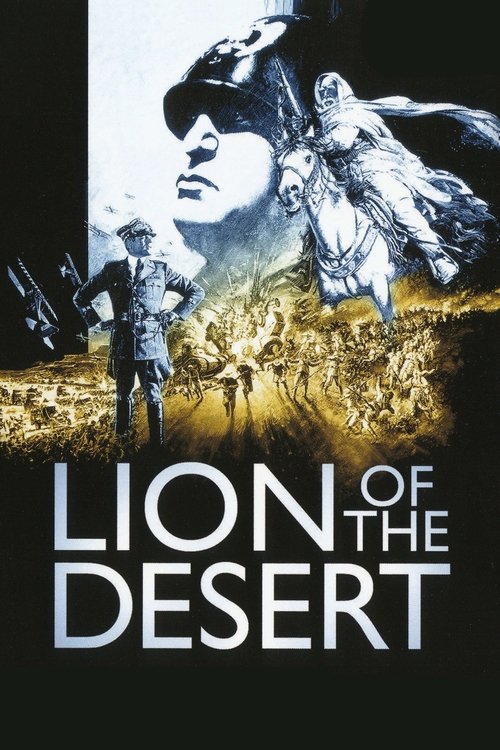
Lion of the Desert
1981 · Moustapha Akkad
For when you want a big, sincere, David-and-Goliath historical epic — a Sunday-afternoon-scale war movie that leaves you moved and a little righteous. Comfort viewing in form, though its subject carries real weight.
What it's about
Libya in the 1920s: an aging Quran teacher named Omar Mukhtar leads Bedouin horsemen in a guerrilla war against Mussolini's occupying army. Against him stands General Graziani, dispatched from Rome with tanks, barbed wire, and orders to crush the resistance by any means. Drawn from the true story of Libya's fight for independence, it's a desert epic about a man defending his home against an empire that vastly outguns him.
The experience
Old-school epic sweep — massed cavalry charges, huge desert vistas, thundering score — anchored by quiet, dignified scenes of a soft-spoken elder who refuses to hate his enemy. It's stirring and often sobering; the machinery of colonial brutality is shown plainly, and the film earns its emotion rather than begging for it.
Performances
Anthony Quinn gives Omar Mukhtar a stillness and moral gravity that holds the whole film together — a warrior played as a teacher first. Oliver Reed makes Graziani coldly compelling, an ambitious officer administering cruelty like policy.
The craft
Mounted on the physical scale of the great 1960s roadshow epics — real armies of extras, real desert locations, practical battle scenes with tanks and horses colliding on screen. Jack Hildyard's widescreen photography and Maurice Jarre's sweeping score reward the biggest screen and best speakers you can find.
Why it matters
A box-office failure on release that became one of the most beloved films in the Arab world — the definitive screen telling of Libya's anti-colonial struggle, and long suppressed in Italy for its depiction of the occupation. It stands with The Message as the heart of Moustapha Akkad's project of bringing Arab and Muslim history to the international epic form.
Snapshot
Lion of the Desert is a large-scale historical war epic dramatizing the final phase of the Libyan resistance to Italian colonial rule, centered on Omar Mukhtar, the Quran teacher turned guerrilla commander who led Senussi fighters against Fascist Italy through the 1920s until his capture and public execution in 1931. Conceived as a companion piece to director Moustapha Akkad's earlier The Message (1976), it reunites much of that film's above- and below-the-line talent — star Anthony Quinn, composer Maurice Jarre, cinematographer Jack Hildyard, and screenwriter H.A.L. Craig — in service of an anti-colonial epic mounted on the physical scale of the 1960s roadshow spectacle. Financed substantially by the Libyan government under Muammar Gaddafi, the film is at once a sincere work of postcolonial memory and an object lesson in how patronage shapes historical cinema. It arrived at the tail end of the era of the film-actual desert epic, drew a hostile or indifferent commercial response in the West, was for years suppressed in Italy, and has since accrued a durable second life as a touchstone of anti-imperial and pan-Arab / pan-Islamic screen culture.
Industry & production
The production is inseparable from its financing. Akkad, a Syrian-American producer-director who had struggled for years to raise money for The Message from conventional Hollywood and Gulf sources, turned to Libyan state backing for Lion of the Desert. Figures in the range of thirty million dollars and above are widely cited for the budget; because the money flowed through governmental and quasi-governmental channels rather than a studio ledger, the precise accounting is not transparent in the public record, and specific totals should be treated as reported estimates rather than audited facts. What is clear is that the film commanded resources — thousands of extras, cavalry, period armor and aircraft, wholesale desert set-building — of a kind that independent producers could rarely assemble by 1980.
The scale was possible partly because much of it was shot on location in Libya itself, in the Cyrenaican desert where the historical campaign took place, supplemented by studio and location work associated with the Italian and English production infrastructure that Akkad's international crew brought with them. The cast was assembled on the internationalist "United Nations of stars" model of the roadshow epic: Quinn as Mukhtar, Oliver Reed as General Rodolfo Graziani, Rod Steiger as Mussolini, Sir John Gielgud as the collaborator Sharif El Gariani, Irene Papas, and Raf Vallone, among others — a polyglot ensemble typical of European-financed spectacle of the period.
The most consequential industrial fact about the film is its reception by the Italian state. Italy effectively banned the picture; the objection, associated with the political establishment of the day, was that the film damaged the honor of the army by depicting Fascist-era atrocities. The suppression lasted for many years, and the film did not circulate freely in Italy until a broadcast decades later (reported around 2009). In the United States and much of the Western market the film's theatrical run was commercially disappointing. The combination — a sponsored epic, banned in the country whose crimes it depicts, and a box-office underperformer in the West — has defined its industrial reputation ever since.
Technology
Lion of the Desert is a late example of the analog, film-actual epic: 35mm color photography, large-format spectacle achieved through real crowds and real landscape rather than optical or (as would come a decade later) digital augmentation. Its battle set-pieces — cavalry charges, columns of infantry, tanks and biplanes deployed against horsemen — are built from practical elements, physical pyrotechnics, and in-camera staging of massed extras. The technological interest of the film lies precisely in its resistance to shortcut: the illusion of an army is an actual assembly of people, animals, and machines organized in the frame. This places it in continuity with Lawrence of Arabia and Akkad's own The Message rather than with the effects-driven cinema that would soon follow. Beyond the standard toolkit of anamorphic-era location shooting, there is no strong evidence of notable technical innovation; the film's ambition is one of scale and logistics rather than of any new apparatus.
Technique
Cinematography
Jack Hildyard, an Oscar-winner for The Bridge on the River Kwai and a veteran of large-canvas location work, shoots the desert as both arena and antagonist. The visual grammar is that of the widescreen epic: deep, sun-flooded exteriors that set the small, mobile bands of Senussi horsemen against vast horizons, and that render the mechanized Italian columns as intrusions of geometry — straight lines of wire, road, and armor — upon an organic landscape. The camera favors the long view for the terrain and the massed movement of forces, then closes to Quinn's weathered face for the moral center. Hildyard's lighting of interiors and of the courtroom and execution material is more restrained and classical, throwing weight onto performance. The overall look is legible, unfussy, and monumental, in keeping with the film's aim of historical gravity rather than stylistic display.
Editing
The cutting organizes a long-form narrative (the film runs to roughly a three-hour epic length) around alternation between the guerrilla campaign and the machinery of colonial command — Graziani's headquarters, Rome, the tribunal. Battle sequences are assembled to make legible the asymmetry of the war: the fluid, dispersed tactics of Mukhtar's cavalry against the massed, linear advance of Italian armor and infantry. The pacing is deliberate rather than kinetic, in the roadshow tradition, using scale and duration to convey both the grind of a decade-long insurgency and the tightening noose of the Italian counterinsurgency (the wire fences, the camps, the closing of the desert).
Mise-en-scène / staging
Production design articulates the film's central opposition materially. On one side: the tents, robes, horses, and improvised weaponry of the Senussi, and the mosque-school world from which Mukhtar comes. On the other: the uniforms, motorcars, and imperial architecture of Fascist Italy, culminating in the film's recurring image of the wire — the barbed-wire barrier drawn across the desert and the concentration camps into which the civilian population is herded. The staging repeatedly frames colonization as the imposition of a grid upon open space. The blocking of the mass scenes emphasizes discipline and mechanization on the Italian side and mobility and improvisation on the Libyan side, so that the choreography of the battles is itself an argument.
Sound
Maurice Jarre's score is the film's dominant sonic signature (discussed below under authorship). The sound design otherwise serves the realism of the war material — hoofbeats, gunfire, engines, the din of massed men and machines — with dialogue delivered in the internationally accented English standard for the co-production epic. As with much cinema of the period and mode, the track is built in post around a large orchestral score rather than toward naturalistic sparseness.
Performance
Anthony Quinn's Omar Mukhtar is the film's spine and its greatest asset. Quinn, then in his mid-sixties, plays the aging teacher-commander with a banked, dignified stillness — a deliberate counter to the flamboyance of his most famous roles. The performance leans on gravitas, restraint, and moral clarity, and it carries the film's claim to Mukhtar as a figure of principled resistance. Around him, Oliver Reed gives Graziani a cold, brooding authority, and Rod Steiger contributes a broad, theatrical Mussolini in a smaller compass. Gielgud lends patrician weight to the collaborator role. The ensemble style is that of the prestige epic: declarative, dignified, pitched to the scale of the images rather than to intimate naturalism.
Narrative & dramatic mode
The film operates in the mode of the historical-tragic epic, structured around a known and foredoomed outcome: the audience understands from early on that Mukhtar will be captured and hanged, and the drama derives its force from the moral endurance of a doomed resistance rather than from suspense about survival. It is built on a clear dualistic architecture — colonizer against colonized, mechanized empire against a people's insurgency, and, at the personal level, Mukhtar against Graziani. The narrative braids the tactical (the campaign's battles and reversals) with the institutional (the Fascist decision-making that escalates toward extermination and internment) and the moral (Mukhtar's conduct as teacher, leader, and finally condemned prisoner). The framing device of Mukhtar's captured effects — including his eyeglasses — and his final trial and execution give the film an elegiac, testamentary shape: this is a story told as martyrology and as historical indictment.
Genre & cycle
Lion of the Desert belongs simultaneously to two overlapping cycles. First, the desert war epic descended from Lawrence of Arabia — the location-shot, star-led, orchestral-scored spectacle of the Middle East and North Africa, of which Akkad's own The Message is the immediate predecessor and near-twin. Second, it belongs to the international wave of anti-colonial and postcolonial cinema, sharing thematic ground with films that dramatize North African resistance to European empire (Pontecorvo's The Battle of Algiers being the towering reference point, though that film's documentary realism is stylistically opposed to Akkad's roadshow grandeur). The film thus sits at an unusual intersection: it deploys the aesthetic machinery of the Western imperial epic to tell an explicitly anti-imperial story from the colonized side.
Authorship & method
Moustapha Akkad (1930–2005) is the organizing authorial intelligence, and his method here is essentially that of the impresario-director: assembling international financing (in this case state financing), international stars, and a seasoned technical crew to realize historical subjects of importance to Arab and Muslim audiences on a scale the Western industry would not otherwise fund. Born in Aleppo and educated in the United States, Akkad is doubly known — for these two epics of Arab and Islamic history and, in a wholly separate career, as the producer of the Halloween horror franchise, whose profits are often noted as underwriting his historical ambitions. He was killed in the 2005 Amman hotel bombings.
His key collaborators are, tellingly, largely the same team as The Message. Screenwriter H.A.L. Craig shapes the material into the moral-epic register. Cinematographer Jack Hildyard brings the large-canvas pedigree of British epic photography. Composer Maurice Jarre — the definitive musical voice of the modern desert epic through Lawrence of Arabia and Doctor Zhivago — supplies a sweeping orchestral score that lends the film its emotional monumentality and ties it stylistically to the genre's canonical works. Production design and the film's editing serve the same goal of legible grandeur. The recurrence of this creative unit across both films makes Lion of the Desert less a one-off than the second panel of an intended Akkad diptych on Arab-Islamic history.
Movement / national cinema
The film resists tidy national placement, and that ambiguity is central to it. In production terms it is an internationally crewed, English-language co-production in the European-financed epic tradition. In sponsorship and subject terms it is a Libyan national project — a state-backed act of historical memory about the founding trauma of modern Libya, the Italian conquest and the Senussi resistance. It is best understood as a work of transnational postcolonial cinema: made with Western technical grammar and stars, funded and thematically owned by a formerly colonized state, and addressed to a pan-Arab and pan-Muslim audience for whom Mukhtar is a shared symbol. Its awkward fit within any single national cinema is itself a symptom of the global, patronage-driven way such large historical films get made.
Era / period
The film depicts the Second Italo-Senussi War of the 1920s, culminating in Mukhtar's capture and execution in 1931 — the period of Graziani's brutal "pacification" of Cyrenaica, the barbed-wire sealing of the desert, and the mass internment of the Bedouin population. It was produced and released in 1980–81, at the close of the classical film-actual epic era and near the high-water mark of Gaddafi-era Libya's cultural self-projection. This double dating matters: a story of 1930s anti-Fascist resistance is retold at a 1981 moment when its Libyan sponsors sought to position the modern state as the heir to Mukhtar's legacy, and when the West's appetite for the long historical epic was waning. The film is thus a period piece twice over — about the 1930s, and of the last gasp of a particular mode of 1960s–70s spectacle.
Themes
Central to the film is anti-colonial resistance and its moral asymmetry: an indigenous, mobile, materially outgunned insurgency against a mechanized empire that answers guerrilla war with atrocity — collective punishment, concentration camps, the poisoning of wells, and the strangling wire drawn across the land. A second theme is principled leadership and martyrdom: Mukhtar embodies restraint, faith, and the ethics of just conduct even in a losing war, and his execution converts military defeat into moral victory and enduring symbol. A third is the corruption and cruelty of Fascism specifically, personified in Mussolini's imperial vanity and Graziani's cold pragmatism. Underlying all of these is a meta-theme of historical memory and whose account of empire is permitted to be told — a theme the film's own suppression in Italy made unusually literal.
Reception, canon & influence
Critically and commercially, the film's Western reception was mixed to poor at release, and its theatrical performance in the United States was disappointing; contemporary Western critics were often ambivalent, praising Quinn and the spectacle while noting the didactic, monumental heaviness typical of the mode and remaining wary of the film's sponsored provenance. Its suppression in Italy — the long official reluctance to let a film depicting Fascist colonial crimes circulate — is the single most-cited fact of its reception history and, paradoxically, part of what has kept it culturally alive.
Its influences run backward to Lawrence of Arabia (the template for the desert epic and, via Jarre, its very sound) and directly to Akkad's own The Message, whose team, scale, and moral-epic register it reproduces; more distantly it converses with the anti-colonial cinema exemplified by The Battle of Algiers, though from an opposite stylistic pole.
Forward, its legacy is less about direct cinematic imitation than about symbolic endurance. Lion of the Desert became, over the following decades, a widely circulated and beloved film across the Arab and Muslim world — a standard reference for the screen memory of Omar Mukhtar and of anti-colonial struggle, frequently invoked in political and cultural discourse (including, at various moments, around Libyan and broader regional politics). Its rehabilitation in Italy years after release reframed it retroactively as a suppressed historical document rather than mere propaganda. Within Akkad's authorship it stands as the second and, owing to his death in 2005, final entry in his projected cycle of Arab-Islamic historical epics, and thus as a capstone of a distinctive one-man effort to fund and stage that history on a world-cinema scale. Where the detailed production record is thin — precise budget figures, exact accounting of the Libyan financing, and granular box-office returns are not reliably documented in the public record — this account flags the gap rather than filling it, but the film's status as a landmark of sponsored anti-colonial epic filmmaking is not in doubt.
Reception
Dismissed in the West on release — critics couldn't see past its Gaddafi-government funding and it bombed at the box office — it's since become one of cinema's great 'how is this not famous?' epics, adored across the Arab world and steadily reappraised everywhere else.
How Lion of the Desert was received, from release to now →
How to watch Lion of the Desert: what to notice on a first viewing
- Watch the camera go wide for terrain, close for Mukhtar. Hildyard shoots vast horizons for the Senussi campaign, then closes to Quinn's weathered face whenever the film needs its moral center. The scale of the land and the scale of one man's conscience share the same visual grammar.
- Notice the wire fences cutting straight lines through open desert. Akkad stages colonization as a grid imposed on organic space: barbed wire, roads, and camp perimeters drawn across land that had none of these lines before. The wire is the whole argument about empire made visible in one image.
- Watch how the two armies move differently on screen. The editing keeps Mukhtar's horsemen scattered and mobile while Italian forces advance in straight, massed columns of armor and infantry. You are watching two different kinds of war before anyone explains the difference.
- Listen for Jarre's score swelling under the desert vistas. A full orchestral score rises whenever the film opens onto landscape, working alongside hoofbeats, gunfire, and engine noise to build scale. The music tells you this is epic history, not just a regional skirmish.
- Watch how little Quinn moves or raises his voice. Quinn plays the aging commander with a banked stillness, a deliberate counter to the flamboyant roles that made him famous. Restraint itself becomes the evidence of his authority.
The whole guide to watching Lion of the Desert, with the keys for a rewatch →
Influences: the films it descends from and the films it influenced
- Lawrence of Arabia (1962) — Supplies the desert-epic grammar the film copies wholesale — Maurice Jarre's sweeping main-theme leitmotif over horizon-line widescreen vistas, and even the same performer (Anthony Quinn as Auda) whose weathered restraint Akkad reuses as Mukhtar.
- The Message (Al-Risalah) (1976) — The direct precursor panel of Akkad's diptych, reassembling the identical creative unit — Craig's script, Hildyard's camera, Jarre's score — to fix the moral-epic register of legible grandeur that Lion reproduces beat for beat.
- The Bridge on the River Kwai (1957) — Jack Hildyard's Oscar-winning deep-focus, large-canvas photography here is the pedigree he carries directly into Lion's widescreen desert compositions decades later.
- Doctor Zhivago (1965) — Establishes Jarre's method of hanging an entire epic's emotional weight on one recurring orchestral theme, the technique that gives Lion its monumental scoring.
- Waterloo (1970) — Shares screenwriter H.A.L. Craig and models the practical mass-battle staging — thousands of real drilled soldiers filmed in-camera — that underwrites Lion's grid-versus-open-space combat and asymmetric battle montage.
- Zulu (1964) — Codifies the staging of a disciplined colonial firing-line as geometric grid set against the open-space human wave, the exact spatial dialectic Akkad uses for Mukhtar's ambushes.
- Spartacus (1960) — The template for roadshow martyrology — a doomed insurgent revolt against imperial power built to end in principled defeat and executed leadership as moral victory.
- 55 Days at Peking (1963) — An earlier Jack Hildyard–shot colonial-siege spectacle whose massed-extra staging and widescreen coverage of a defensive stand feed directly into his approach on Lion.
- Gandhi (1982) — Extends the anti-colonial martyrology into the biopic, staging vast practical crowd scenes as the visual proof of a foredoomed-yet-triumphant principled resistance.
- Kingdom of Heaven (2005) — Carries forward the practical-plus-scaled desert mass battle — real horse charges and crowd formations across arid widescreen vistas — as the inheritor of the film-actual spectacle tradition Lion belongs to.
- Gladiator (2000) — Revives the foredoomed-hero martyrology of the roadshow epic — the principled man destroyed by imperial power whose death is staged as moral vindication — for the modern spectacle era.
- Days of Glory (Indigènes) (2006) — Continues the transnational-postcolonial North African epic, using large-scale period battle recreation to redress a suppressed colonial-era history much as Lion did for the Italian occupation of Libya.
- The Battle of Algiers (1966) — The opposite stylistic pole of the same anti-colonial project: Pontecorvo pursues resistance through newsreel-grain, non-professional immediacy where Akkad pursues it through monumental roadshow scale.
- Khartoum (1966) — Prefigures Lion's structure of foredoomed colonial martyrdom staged as a two-man ideological duel (Gordon/Mahdi ↔ Mukhtar/Graziani) built around a desert siege.
- El Naser Salah el Dine (Saladin) (1963) — The parallel model of the state-patronized Arab historical epic (Nasser's Egypt ↔ Gaddafi's Libya), mobilizing national resources to stage anti-Western resistance history at a scale the Western industry wouldn't fund.
- The Wind and the Lion (1975) — A near-contemporary North-African anti-colonial epic centered on a romanticized Berber resistance leader confronting a Western empire, sharing Lion's charismatic-insurgent-versus-imperial-machine framing.
Similar films
- The Battle of Algiers (1966) — influence & lineage · same viewing thread
- Lawrence of Arabia (1962) — influence & lineage · same viewing thread
- Spartacus (1960) — influence & lineage · same viewing thread
- Gandhi (1982) — influence & lineage
- Paths of Glory (1957) — same viewing thread
- The Thin Red Line (1998) — same viewing thread
- Camp de Thiaroye (1988) — shared sensibility
- Palestine 36 (2025) — shared sensibility
All the films related to Lion of the Desert →
Watch it with: curated runs of related films
- The Futility of War — A run of films about ordinary men fed into war's machinery — from the trenches to the Casbah to the Warsaw sewers — where the futility and human cost rhyme across a century and a dozen conflicts.