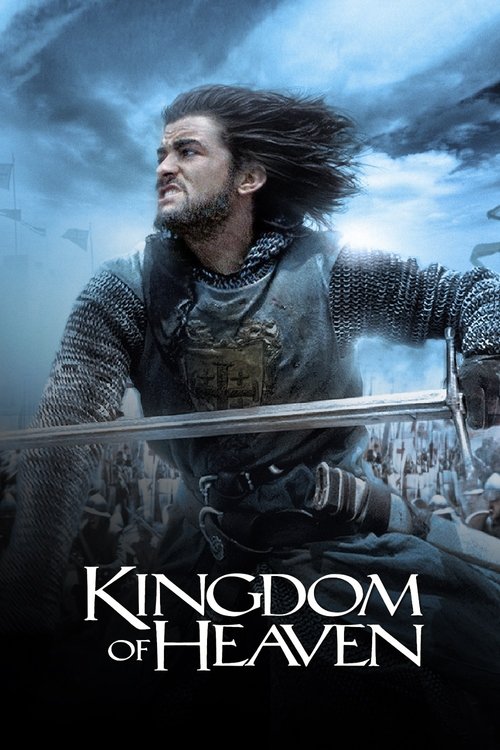
Kingdom of Heaven
2005 · Ridley Scott
For a long epic night when you want scale, swords and something to chew on about faith and fanaticism — seek out the director's cut and give it the full evening it asks for.
What it's about
A grieving French village blacksmith named Balian learns he is the son of a crusader baron and follows him to the Latin Kingdom of Jerusalem, inheriting land, rank and a fragile peace on the edge of collapse. Caught between a dying king trying to hold the truce, warmongering Templar factions, and Saladin's armies beyond the walls, he has to decide what a decent man owes a holy city. It builds toward siege warfare on an enormous scale.
The experience
Somber, spectacular and unhurried — an epic more interested in conscience and politics than triumph, punctuated by battle sequences of massive physical weight. In the director's cut it plays as a rich, brooding saga; the shorter theatrical version feels noticeably thinner.
Performances
The supporting cast is the treasure: Edward Norton, acting entirely through a silver mask and a failing voice as the leper king, is quietly extraordinary, with Eva Green, Jeremy Irons and Liam Neeson giving the kingdom its texture.
The craft
Ridley Scott mounts the medieval Levant with staggering physical craft — real armies of extras, dust-and-golden-light cinematography, and a siege of Jerusalem whose catapults and firelit night assaults still dwarf most digital spectacle. It demands the biggest screen and best sound you can give it.
Why it matters
Dismissed in theaters in 2005, it was transformed by Scott's restored director's cut into what many now rank among his strongest films — cinema's standard example of a movie rescued in the editing room after release.
Snapshot
Ridley Scott's Crusades epic follows Balian, a French village blacksmith who inherits a barony in the Latin Kingdom of Jerusalem and ends up negotiating the city's surrender to Saladin in 1187. Released by Twentieth Century Fox in May 2005, it arrived at the tail end of the historical-epic revival Scott himself had triggered with Gladiator (2000), and it was received in 2005 as the cycle's exhausted last gasp: handsome, overlong in ambition yet strangely truncated, anchored by a lead performance most critics judged too slight for the weight placed on it.
The film's real life began afterward. Scott's 194-minute director's cut, issued on DVD in 2006, restored roughly fifty minutes of political and dynastic material and converted a widely dismissed film into one that many critics and historians now treat as among Scott's strongest works. Kingdom of Heaven is consequently a double object: a case study in how a studio-length theatrical version can gut a film's dramatic logic, and a rare Hollywood epic that stages a religious war without assigning the moral high ground to Christendom. Its central argument — that Jerusalem is worth nothing and everything, and that a kingdom of conscience is the only one worth defending — is delivered in a register closer to secular humanist parable than to devotional history.
Industry & production
The picture was made at the top of the market. Coming off Gladiator's Best Picture win and Black Hawk Down, Scott could command a reported budget in the region of $130 million and the resources to build a Jerusalem in the Moroccan desert. Production was headquartered at Ouarzazate, the Atlas Studios hub that had already served Gladiator and would serve much of the decade's ancient-world cinema, with a standing city set constructed at unusual scale and large numbers of local extras and horse units. European sequences were shot in Spain, including the Romanesque castle of Loarre in Aragón and Andalusian and Castilian locations whose Moorish and medieval fabric supplied period surfaces no set could match.
The script was William Monahan's first produced screenplay — he would win the Adapted Screenplay Oscar the following year for The Departed — and its literary, aphoristic dialogue is unusual for a film of this budget. Casting mixed a young commercial lead (Orlando Bloom, then at peak visibility from The Lord of the Rings and Pirates of the Caribbean) with a deep bench of character actors: Jeremy Irons, Liam Neeson, Brendan Gleeson, David Thewlis, Marton Csokas, Michael Sheen, Alexander Siddig, and Eva Green in an early English-language role. Edward Norton played the leper King Baldwin IV masked and uncredited, a piece of casting the studio initially kept quiet. Crucially, Saladin was played by the Syrian actor Ghassan Massoud in Arabic-inflected performance rather than by a Western star in makeup — a decision that shaped both the film's politics and its reception in the Arab world.
The commercial outcome was poor in North America and considerably better internationally, where the majority of its theatrical gross was earned; the film did not return its costs quickly in theaters. The most consequential industrial fact, however, is the cut. Fox wanted a running time exhibitors could turn over, and the released version ran roughly 144 minutes. Scott has since described the theatrical version as a compression he executed under constraint rather than the film he had assembled, and the director's cut restores whole strands — most importantly the child king Baldwin V, Sibylla's discovery of his leprosy and her decision to end his life, and the political machinery that makes Guy de Lusignan's ascent legible. The documentary record here rests substantially on Scott's own later accounts and the DVD supplements; the internal studio history has not been independently and fully documented.
Technology
Kingdom of Heaven is late-period photochemical spectacle already leaning on digital augmentation. It was shot on 35mm for a 2.39:1 scope frame and finished with the desaturated, dust-and-amber grading that digital intermediate had recently made routine — the tonal separation between the cold blue-gray of France, the bleached ochre of Outremer, and the smoke-black of the siege is a grading achievement as much as a lighting one.
Scott's signature production method is itself a technology: multiple cameras running simultaneously on every setup, sometimes many more than a conventional shoot would attempt, so that battle action is covered from long lens, wide, and inside the melee in a single pass. This is what makes his large-scale sequences economically possible at all — the coverage is harvested rather than built shot by shot — and it pushes decisive authorship downstream into the edit. Scott's own storyboards, drawn by hand, function as the pre-visualization layer.
The siege of Jerusalem combines full-scale practical construction — siege towers, trebuchets, incendiary ordnance, breached wall sections — with digital set extension and crowd replication of the kind that had become standard after the crowd-simulation breakthroughs of the early 2000s. The film's effects work is deliberately unshowy: it multiplies armies and completes the city skyline rather than inventing spectacle, which is why the picture has aged better visually than several of its 2004–2005 peers.
Technique
Cinematography
John Mathieson, Scott's collaborator on Gladiator, Hannibal and Matchstick Men, shoots the film in a mode of atmospheric materialism: everything is filtered through something. Dust, smoke, backlit particulate, heat shimmer, candle haze, and hard shafts of raking light are the constant medium, so that light in this film is visible as a substance rather than merely a means of exposure. Interiors — Baldwin's shuttered chamber, the council rooms of Jerusalem — are lit in deep amber pools against black, closer to Caravaggio than to conventional epic brightness.
The camera is restless in the way Scott's cameras always are, but the compositional grammar is classical: horizon-heavy wide shots for the desert, low angles for architecture, and a recurring use of the frame's depth to place a solitary figure against an indifferent landscape. Battle is covered with a mix of long-lens compression that flattens the charge into a wall of bodies and inserted handheld fragments; Scott and Mathieson stop short of the fully shuddering illegibility that Gladiator's opening had licensed across the industry, and the siege remains spatially readable — you know where the wall is, where the tower is, and how far the sappers have got.
Editing
Dody Dorn, who had cut Memento and Insomnia for Christopher Nolan and Matchstick Men for Scott, faced the classic Scott problem of taming enormous multi-camera coverage. In the battle sequences the cutting is fast but oriented: the rhythm accelerates at impact and decelerates for consequence, and Scott repeatedly holds on aftermath — the field after Hattin, the burnt-out defenders — longer than the action beats that produced it.
The theatrical cut's editorial failure is structural rather than shot-level. Removing the Baldwin V material excises the causal chain by which Sibylla ends up married to Guy and Guy ends up king, so motivations that were dramatized become assertions; Balian's refusal of Sibylla's proposal loses its stakes; Jeremy Irons's Tiberias becomes a commentator rather than a political actor. The director's cut restores the film to a two-movement design — a long political first half in which Jerusalem's fragile equilibrium is built, and a second in which it is dismantled — and in that form the pacing is stately by design, not merely slow.
Mise-en-scène / staging
Arthur Max, Scott's production designer since Se7en, builds Outremer as a hybrid civilization rather than a European outpost: Frankish military architecture grafted onto Levantine urban texture, with the multi-faith market life of Jerusalem staged as background business in almost every exterior. Janty Yates's costumes distinguish factions by weave and wear — the Templars' hard-edged white and red against the softer, sun-bleached, more locally adapted dress of the resident nobility — making the film's political argument visible before anyone states it.
Two staging ideas carry the film. The first is Baldwin's mask: a silver face that renders the most morally lucid character in the film unreadable, so that authority is conveyed entirely through posture, stillness and voice. The second is the desert as moral space — Balian's inherited land is introduced through the problem of water, and the film's turn toward humanism is literalized when a well is dug. Scott stages the siege as labor: men carrying, digging, tipping, burning, exhausted, which is closer to the engineering reality of medieval siegecraft than the duel-centred convention.
Sound
The sound design works by contrast between enclosure and open field. Baldwin's scenes are pitched low and close, breath and cloth foregrounded, the mask making his speech faintly interior. The siege, by contrast, is a mass of low-frequency impact — trebuchet release, stone striking masonry, fire — with human voice largely submerged. The film uses the sonic markers of a shared city, church bells and the call to prayer, as spatial and thematic signposts rather than as exotic color.
Harry Gregson-Williams's score, which began his long working relationship with Scott through Exodus: Gods and Kings and The Martian, sits in the post-Gladiator idiom that had emerged from Hans Zimmer's orbit: percussion-driven action writing braided with solo vocal and non-Western instrumental color for the Levantine material. It is less thematically memorable than Zimmer's Gladiator work but more restrained, often withdrawing entirely in the political scenes.
Performance
The performances split along an axis critics identified immediately. The supporting ensemble is exceptionally strong: Irons's weary realist Tiberias, Gleeson's gleefully brutal Reynald, Csokas's preening Guy, Thewlis's dryly heretical Hospitaller, Sheen's poisonous priest. Massoud's Saladin is played with unhurried gravity and no exoticism — the film's most-quoted exchange, his answer that Jerusalem is worth nothing and everything, works because he underplays it. Norton, denied his face, produces a performance of pure cadence. Eva Green plays Sibylla as intelligence trapped in dynastic machinery, and in the director's cut, where her infanticide-as-mercy is restored, the role becomes tragic rather than decorative.
Against this, Bloom's Balian is deliberately reactive — a man of few words carried by events — and the theatrical cut, having removed the surrounding causality, leaves that reticence looking like vacancy. The longer version is more forgiving: Balian reads as numbed by grief and guilt rather than as underwritten, though the casting remains the film's most contested choice.
Narrative & dramatic mode
The film is a secular pilgrimage narrative. Balian departs for Jerusalem seeking absolution for a wife who died by suicide and for the priest he killed, and discovers that the sacred city offers no metaphysical remedy — only the possibility of acting well. The dramatic mode is the education of a knight: an inherited code (Godfrey's oath — be without fear, speak the truth, safeguard the helpless) tested against institutions that have abandoned it.
Structurally it is a political tragedy with an epic siege as its final movement. The engine is factional: a fragile truce held by a dying king and a pragmatic aristocracy, undermined by zealots who need war for its own sake. Because the outcome is historically fixed — Jerusalem falls — the suspense is displaced onto terms rather than victory, and the climax is a negotiation, not a duel. That is an unusual and genuinely un-Hollywood choice, and it is the film's most distinctive dramaturgical move.
Genre & cycle
Kingdom of Heaven belongs to the post-Gladiator historical epic cycle that produced Troy, King Arthur and Alexander in 2004 and effectively expired in 2005. It also belongs to a much smaller genre: the Crusades film. Hollywood's prior attempt of scale was Cecil B. DeMille's The Crusades (1935), a pageant with no interest in Muslim interiority; the great counter-text is Youssef Chahine's Egyptian epic Saladin the Victorious (1963), a Nasserist reading in which Saladin embodies pan-Arab unity against Western invasion. Anthony Mann's El Cid (1961) supplies the nearest Hollywood model for a hero who refuses confessional absolutism on the Iberian frontier.
Scott's film reverses the genre's default sympathies without inverting them into simple accusation: the fanatics are mostly Christian, but Saladin's camp contains its own hardliners, and the moderates on both sides are shown losing. After 2005 the epic mutated rather than continued — toward the stylized comic-book antiquity of 300 (2007) and, in the following decade, toward long-form television, where the political-siege mode found a more hospitable format.
Authorship & method
The film is a near-complete assembly of Scott's repertory company: Mathieson on camera, Arthur Max on design, Janty Yates on costume, with Dorn cutting and Gregson-Williams scoring. Scott's method — draw it himself, build it practically, cover it with many cameras, shoot fast, find it in the edit — is legible throughout, as is his lifelong preference for texture and world over psychological interiority.
The authorship question here is unusually pointed. Because two substantially different films exist under one title, Kingdom of Heaven became an argument about where authorship resides in a studio production. Scott has consistently treated the 194-minute version as the film, and the four-disc 2006 edition presented it in roadshow form with overture, intermission and entr'acte — a presentation that explicitly claims the prestige of the long-form epic tradition. Monahan's contribution deserves separate emphasis: the film's skeptical theology, its refusal to grant the Church moral authority, and its epigrammatic dialogue are screenwriterly rather than characteristically Scott, and they anticipate the moral bleakness of The Departed.
Movement / national cinema
This is transnational Anglo-American studio production of a familiar late-period kind — an English director, American financing, largely British and European cast, Moroccan and Spanish locations, and a subject that belongs to no single national cinema. Its more interesting affiliation is with the tradition of the British epic of the Middle East: David Lean's Lawrence of Arabia (1962) is the unavoidable precursor, both in its landscape rhetoric and in its ambivalence about a Westerner's authority in Arab affairs. Scott has repeatedly named Lean's film as formative. Where Kingdom of Heaven departs from that lineage is in granting the Muslim antagonist his own political intelligence and dignity, a move that owes as much to Chahine's tradition as to Lean's.
Era / period
Released in May 2005, the film cannot be separated from its moment: the Iraq War, the rhetoric of civilizational conflict, and the loose public use of the word "crusade" in the years after 2001. Scott and Monahan pursued deliberate even-handedness, and the film's insistence that religious identity is less predictive of decency than character is plainly addressed to 2005 rather than 1187.
The response was correspondingly political. Some medievalists attacked the film's historical liberties before release — the Cambridge crusades historian Jonathan Riley-Smith was among the most vocal critics in the British press — while other commentators objected from the opposite direction, arguing the film flattered Muslim audiences at Christendom's expense. Reports of its reception in Arab and Muslim-majority markets were comparatively favourable, particularly regarding Massoud's Saladin, though systematic audience research on this is thin and much of the claim rests on contemporary journalism rather than study.
Historically, the film compresses and invents freely. The real Balian of Ibelin was an established Palestinian-Frankish nobleman, not a French blacksmith or a bastard; he was married to Maria Comnena, the dowager queen, not romantically involved with Sibylla, who was Guy de Lusignan's willing wife. Baldwin IV's leprosy, Reynald de Châtillon's caravan raiding as a proximate cause of war, the catastrophe at Hattin, and Balian's negotiated surrender of Jerusalem — including his threat to destroy the city and its holy places if terms were refused — are grounded in the chronicle tradition. The film's Templars-as-villains schema is a considerable simplification of a more tangled factional politics.
Themes
The governing theme is conscience against institution. Every ecclesiastical authority in the film is corrupt or cowardly — the murderous village priest, the Patriarch who counsels apostasy to save his skin — while the moral center is occupied by a lapsed believer, a masked leper, a heretical Hospitaller and a Muslim commander. "A kingdom of conscience, or nothing" is the film's thesis, and its irony is that Balian achieves it only by giving the physical kingdom away.
Related strands: the transmission of a code across generations, and its inadequacy once inherited; land as the ground of ethics, with the digging of a well as the film's quiet counter-argument to holy war; grief and the impossibility of purchased absolution; and the pointed distinction between what is holy and what is merely fought over. The film's humanism is explicitly deracinated — Balian defends the people of Jerusalem, not its shrines — which is precisely what its religious critics objected to and what its defenders value.
Reception, canon & influence
Contemporary reviews in 2005 were mixed to lukewarm. Praise concentrated on the visual command, the production design and the supporting cast, particularly Norton and Massoud; criticism concentrated on Bloom's centrality, on dramatic thinness in the political scenes, and on a sense that the epic cycle had run out of conviction. The film underperformed badly in North America and recovered ground abroad.
The director's cut inverted this. On release in 2006 it drew notably strong notices from critics who had been cool to the theatrical version, and it has since become the standard reference text for the film. Kingdom of Heaven now occupies a specific and important place in canon: alongside Blade Runner, it is the exemplar cited whenever the argument is made that a studio-shortened film can be a different work from the one its director assembled — and, unlike many "restored" versions, the restoration is structural rather than cosmetic. That reputation fed directly into the fan-culture demand for alternate cuts that has shaped the last two decades of studio filmmaking, though Kingdom of Heaven's cut was a filmmaker's assembly recovered on home video rather than a campaign-driven reshoot.
Its influences run backward to Lean's desert cinema, to El Cid's frontier ambivalence, to Kurosawa's staging of mass battle and siege, and — in Balian's disenchanted knighthood — to the existential crusader of Bergman's The Seventh Seal. Forward, its most concrete legacy is within Scott's own work: the personnel, palette and siege grammar carry into Robin Hood (2010) and Exodus: Gods and Kings (2014), and the willingness to build a historical epic around political negotiation rather than personal vengeance recurs in The Last Duel (2021). More broadly, it stands as the most serious attempt Hollywood has yet made to film the Crusades from something other than a Christian point of view, and it remains the film most often invoked when the question is whether a mainstream American epic can portray Islam without caricature. Claims that it directly shaped the siege staging of later prestige television are plausible but not documented; what is documented is that a film written off in 2005 is now routinely taught and revisited in a version almost nobody saw that year.
A Deleuzian reading
A silver face in a shuttered room, amber light lying in pools on the floor, everything outside the pools black.
The full Deleuzian reading of Kingdom of Heaven →
Reception
Dumped into theaters in a studio-mandated theatrical cut, it got shrugging reviews and soft US box office in 2005 — then the ~45-minutes-longer Director's Cut arrived and flipped the consensus almost overnight. It's now the textbook case of a director's cut rescuing a film's reputation, with many calling it Scott's best work since the '80s.
How Kingdom of Heaven was received, from release to now →
How to watch Kingdom of Heaven: what to notice on a first viewing
- Watch how Baldwin's silver mask holds still while he speaks. Edward Norton plays the king from behind metal. Nothing in the face can move. Authority has to arrive through posture, through stillness, and through a voice coming out of a hole in the mask. Feeling that cannot reach a face stays suspended there. The quietest scenes carry more charge than the cavalry does.
- Notice how the air is always full of something. Mathieson shoots through dust, smoke, candle haze and heat shimmer. Interiors sit in deep amber pools against black. Each world gets one absorbing color: cold blue-gray France, bleached ochre Outremer. You are watching the air as much as the people standing in it. Light here is a substance, not a way of seeing.
- Listen for church bells and the call to prayer. Both run through Jerusalem's exteriors as ordinary city noise. Scott uses them as markers for where you are standing rather than as exotic color. Baldwin's scenes go the other way, close and quiet on breath and cloth. The city is heard as shared long before anyone in the film argues about who owns it.
- Look at the difference between Templar white and local dress. Yates gives the Templars hard-edged white and red. The resident nobility wear softer, sun-bleached, locally adapted cloth. Arthur Max grafts Frankish fortification onto Levantine streets with market life running behind almost every exterior. The political split is visible in weave and wear before anybody argues it out loud.
- Notice how small a rider looks against the desert. Mathieson keeps the horizon high and the figure low, then compresses the approaches with a long lens until the dust between camera and riders becomes the subject of the shot. The framing keeps setting one man against ground that does not care what he wants.
The whole guide to watching Kingdom of Heaven, with the keys for a rewatch →
Influences: the films it descends from and the films it influenced
- Lawrence of Arabia (1962) — Freddie Young's extreme long-lens desert work — holding a figure inside shimmering heat-haze until the compressed distance itself becomes the subject — is the direct model for Mathieson's dust-loaded air and telephoto flattening of the Kerak and Hattin approaches.
- El Cid (1961) — Establishes the frontier epic in which the Christian hero's authority depends on alliance with Muslim rulers and the siege resolves in settlement rather than conversion — the structural precedent for Balian's negotiated surrender of Jerusalem.
- The Seventh Seal (1957) — The disenchanted crusader who bargains and questions rather than smites, and the license for a knight to state his loss of faith aloud in dialogue, underwrites Monahan's skeptical theology and Balian's refusal of Church authority.
- Seven Samurai (1954) — Kurosawa's instruction-then-execution grammar — mapping the defensive perimeter as labored geography before any assault, so the audience reads the battle spatially — is the template for the rampart-by-rampart legibility of the Jerusalem siege.
- Ran (1985) — The castle assault staged on heraldically color-coded massed blocks with diegetic sound dropped out under score during the arrow fall; the first night assault on Jerusalem reuses both the banner-legibility and the sound-drop.
- Mohammad, Messenger of God (The Message) (1976) — The precedent for an English-language epic staged from the Muslim side with Arab actors in authoritative, non-caricatured roles — the lineage Ghassan Massoud's Arabic-speaking Saladin, granted the film's moral high ground, extends.
- The Duellists (1977) — Scott's first sustained use of single-source period lighting and smoke-filled backlight on a costume subject; the Caravaggio chiaroscuro of Balian's forge and the lamplit tent interiors is that method matured with a digital intermediate behind it.
- Gladiator (2000) — The immediate parent kit: Mathieson's particulate air and shuttered battle strobing, Arthur Max's practical builds extended by digital crowd replication, and the Zimmer/Gerrard percussion-and-wordless-vocal score grammar that Gregson-Williams continues.
- Blade Runner (1982) — The precedent within Scott's own filmography that a studio-shortened release and a director's assembly are two different works; Kingdom of Heaven is the second and more structural instance, restoring plot architecture rather than cosmetics.
- Lion of the Desert (1981) — Carries forward the practical-plus-scaled desert mass battle — real horse charges and crowd formations across arid widescreen vistas — as the inheritor of the film-actual spectacle tradition Lion belongs to.
- Robin Hood (2010) — Reassembles the same crew (Mathieson, Arthur Max, Janty Yates) and the same siege grammar — engine crews, long-lens compression of the charge, mud-and-timber texture — onto a Northern European frontier.
- Exodus: Gods and Kings (2014) — Arthur Max's hybrid-culture design logic and the low-frequency mass sound design of falling architecture are scaled up, with digital crowd replication carrying the plague and Red Sea sequences the way it carried Jerusalem's walls.
- Ironclad (2011) — An entire film built from the siege-as-labor vocabulary — sapping, counter-mining, trebuchet crews, attrition staged as work rather than heroics — that Kingdom of Heaven made legible to a mainstream audience.
- The Last Duel (2021) — Extends the negotiated-climax device: a medieval epic whose resolution is adjudication and testimony rather than personal vengeance, with the combat arriving as legal procedure rather than catharsis.
- Napoleon (2023) — Scott's many-camera fast-coverage method at maximum extension, and the now-institutionalised release pattern Kingdom of Heaven created — a substantially longer director's assembly issued afterwards as the companion, and arguably canonical, text.
- Zack Snyder's Justice League (2021) — The end point of the alternate-cut culture Kingdom of Heaven's 194-minute roadshow presentation legitimized — long-form assembly with overture-style chaptering marketed as the authorial version, though produced by campaign and reshoot rather than recovered from the cutting room.
- Body of Lies (2008) — The immediate Scott–Monahan collaboration: Monahan's verbally witty, morally cynical institutional dialogue and the large-scale Middle Eastern location world-building carry directly into Body of Lies.
- Gladiator II (2024) — Prior Scott/Mathieson/Max/Gregson-Williams-adjacent collaboration on digitally extended ancient cities and siege staging, prototyping II's high-contrast golden palette over reconstructed antiquity.
- Alexander (2004) — Contemporaneous long-lens, dust-choked massed set-pieces on a foreign-location shoot, and — like Kingdom of Heaven — a reputation rebuilt entirely by a longer home-video assembly the theatrical audience never saw.
- Troy (2004) — Same post-Gladiator wave's division of labor between practical hero units and digitally multiplied background armies, plus the percussion-and-lament score formula both films inherit from Zimmer's Roman template.
- The Departed (2006) — William Monahan's screenwriting signature travels intact — epigrammatic, aphoristic dialogue and a systematic refusal to grant institutions (Church here, police there) any moral authority over their servants.
Similar films
- Gladiator (2000) — influence & lineage
- Ran (1985) — influence & lineage
- The Last Duel (2021) — influence & lineage
- Lawrence of Arabia (1962) — influence & lineage
- Napoleon (2023) — influence & lineage
- The Seventh Seal (1957) — influence & lineage
- Braveheart (1995) — shared sensibility
- Gladiator II (2024) — shared sensibility