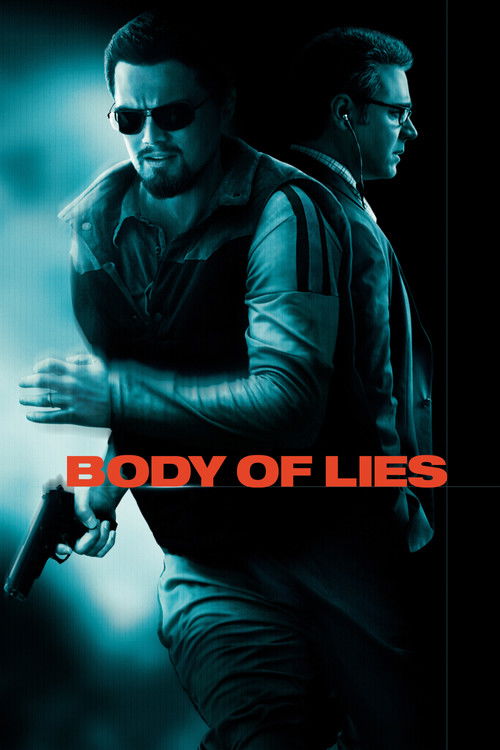
Body of Lies
2008 · Ridley Scott
As famous now for press-tour belligerence ("go f— yourself" to historical accuracy critics of Napoleon) as for the films; Gladiator II's "are you not entertained" marketing and shark-in-the-Colosseum discourse kept him meme-central in his late 80s. The industry's most quotable octogenarian.
For when you want a smart, muscular spy movie with real-world weight — more tradecraft and betrayal than gadgets. Engaging rather than punishing, but it asks you to pay attention.
What it's about
A CIA field operative hunts the mastermind behind a wave of terror attacks, moving through Iraq, Jordan and Dubai on the strength of his own instincts and contacts — while his handler runs him remotely from suburban Virginia, watching through satellite feeds and second-guessing every move between school runs. The real conflict isn't just agent versus terrorist; it's the man on the ground versus the man on the screen, and the local allies caught between them.
The experience
A propulsive, grown-up thriller — tense, globe-hopping and morally murky, with sudden bursts of hard violence between the chess moves. It keeps you working to track the double-dealing, and it doesn't let anyone off clean.
Performances
Leonardo DiCaprio brings sweat and desperation to the field agent, and Russell Crowe is drily chilling as the handler who treats life-and-death calls like conference calls — their phone-line sparring is the film's engine. Mark Strong is a standout as a silkily commanding Jordanian intelligence chief.
The craft
Ridley Scott stages the manhunt with his usual widescreen confidence, cutting between dusty street-level chaos and the cold god's-eye view of drone and satellite footage — that contrast is the film's signature image. William Monahan's script, from a novel by a veteran foreign-affairs journalist, keeps the tradecraft credible. The scale and texture reward a big screen.
Why it matters
One of the key entries in the wave of post-9/11 espionage films that tried to dramatize the war on terror while it was still happening, notable for putting the ethics of remote-control warfare on screen early.
Snapshot
Body of Lies is Ridley Scott's contribution to the cycle of post-9/11 espionage films that tried to dramatize the American "war on terror" while it was still being fought. Adapted by William Monahan from the 2007 novel by David Ignatius — a Washington Post foreign-affairs columnist with long-cultivated intelligence sources — it follows Roger Ferris (Leonardo DiCaprio), a CIA field operative chasing the architect of a terror network across Iraq, Jordan, and beyond, while his handler Ed Hoffman (Russell Crowe) directs and second-guesses him by phone and satellite from suburban Virginia. The film's organizing image is the disembodied overhead gaze: drones and satellites watching Ferris from above, real-time video feeding a man who manages life-and-death decisions between school runs. Around that central man-on-the-ground / man-in-the-sky dyad, the film builds an argument about the limits of technological intelligence and the irreplaceability — and treachery — of human trust, embodied in Ferris's fraught alliance with the elegant Jordanian spymaster Hani Salaam (Mark Strong). Reasonably budgeted and star-driven, it was received as a competent, intelligent genre entry that nonetheless arrived into a crowded field of war-on-terror dramas the public had begun to resist. It is most durable today as a polished record of how mainstream Hollywood imagined the surveillance state circa 2008, and as the source of Mark Strong's career-defining turn.
Industry & production
The film was a Warner Bros. release, produced through Scott Free, the production company Ridley Scott runs with his late brother Tony Scott. It belongs to the most commercially established phase of Scott's career, when he reliably delivered handsome, mid-to-large-budget pictures built around major stars. Its headline assets were the pairing of Leonardo DiCaprio and Russell Crowe — two of the era's biggest male leads — under a marquee director, working from a screenplay by William Monahan, then freshly an Academy Award winner for The Departed (2006). That combination signaled prestige-thriller ambitions rather than pure action spectacle.
Production drew on Scott's well-honed apparatus for staging the Middle East at scale, much of it shot in Morocco, a country he had used extensively before and which doubled for the film's shifting Iraqi, Jordanian, and other regional settings, with additional Washington-area material for the Hoffman scenes. The shoot exemplifies the studio system's globalized, location-driven mode of the 2000s: a large international crew, extensive practical sets and crowd work, and a logistics operation capable of credibly conjuring multiple Arab cities. Commercially the picture is generally regarded as an underperformer relative to its substantial budget and star salaries — it did not become the hit its packaging implied — though precise budget and gross figures from this period should be treated with caution, and I will not assign numbers the record does not firmly support.
Technology
Body of Lies is, at the level of subject, a film about technology — and one acutely of its technological moment. Its narrative engine is the apparatus of networked surveillance: unmanned aerial drones, satellite imagery, signals intercepts, mobile phones, and the secure video links that let Langley watch a man walk down a street in Amman. The film treats this gear as both seductive and dangerously incomplete; the recurring overhead drone shot is its central technological motif and its central thematic anxiety. Made in 2008, it captures a specific transitional instant in real-world intelligence practice, when persistent aerial surveillance and remote, screen-mediated command were becoming routine — the film anticipates, in popular-culture terms, the "drone warfare" discourse that would intensify in the years that followed.
As a piece of filmmaking technology, it was produced at the tail end of the photochemical era for studio films: shot on 35mm and finished through the digital intermediate pipeline that had by then become standard, allowing the burnished, contrast-shaped color palette characteristic of late-2000s Scott. Visual effects were deployed not for spectacle but for plausibility — the surveillance interfaces, aerial plates, and screen graphics that sell the omniscient-eye conceit — and the film's craft ambition is to make the technology of watching feel mundane and real rather than science-fictional.
Technique
Cinematography
The cinematography is by Alexander Witt, a longtime second-unit director and camera specialist for Scott who here served as director of photography. The look is the muscular, slightly desaturated, high-texture realism that defined Scott's contemporary-set thrillers of the period: handheld and shoulder-mounted coverage in the field sequences, dust and heat haze, sodium and fluorescent sources motivating an often warm-to-sour palette, and a restless, kinetic camera in the action and interrogation scenes. Against this, the film deliberately contrasts the cold, clean, screen-lit geometry of Hoffman's American world and the surveillance control rooms. The signal compositional device is verticality — the plunging overhead drone-and-satellite view — which the film returns to as both information and judgment, repeatedly cutting from Ferris's sweating, ground-level subjectivity to the bloodless abstraction of the image from above.
Editing
The film was cut by Pietro Scalia, one of Scott's most important and frequent collaborators (an Oscar winner for Black Hawk Down). The editing is brisk and information-dense, tasked with managing a plot that hops across countries and intercuts continuously between Ferris in the field and Hoffman at a remove. Its defining rhythmic figure is the cross-cut conversation: Ferris and Hoffman talking by phone while the cut shuttles between the danger of the street and the safety of the suburb, the surveillance feed often forming a third term that collapses the distance between them. Action set-pieces are assembled in the fast, fragmentary contemporary idiom, but the film's more distinctive cutting is this spatial irony — the constant montage of proximity and distance, watcher and watched.
Mise-en-scène / staging
Scott's staging works the contrast between two incompatible worlds. The Middle Eastern scenes are dense, crowded, and tactile — markets, safe houses, hospitals, and back rooms thick with extras and incident, staged for immersion and threat. The American scenes are deliberately antiseptic: Hoffman conducts statecraft from minivans, kitchens, and his children's soccer games, the banality of his surroundings used as a moral comment on the lethal abstraction of his decisions. Between them sit the control rooms and screens, spaces of pure mediated vision. The film stages trust and betrayal as matters of physical proximity — Ferris must be in the room, sharing risk, where Hoffman never is — and Hani Salaam's headquarters, all controlled calm and impeccable tailoring, becomes a third spatial register: a vision of intelligence as patience, manners, and human relationship.
Sound
The score is by Marc Streitenfeld, who composed several of Scott's films in this stretch of the director's career. The music leans on regionally inflected textures and percussion to mark place and tension without tipping into pastiche, supporting rather than dominating. More striking is the sound design's treatment of mediated communication: the compressed, filtered timbre of phone and radio voices, the ambient hum of control rooms, and the eerie quiet that attends the overhead surveillance imagery, where violence on the ground is rendered silent and remote on the screens above. The contrast between the chaotic, full-spectrum sound of the field and the muffled, electronic register of the watchers reinforces the film's argument about distance and dehumanization. Specific sound-team credits are not something I will assert without certainty.
Performance
The performances are the film's most consistently praised element. DiCaprio plays Ferris as a competent, idealistic, increasingly disillusioned operative — fluent, physically committed, and morally exhausted by the gap between the mission's stated aims and its methods. Russell Crowe, who notably gained considerable weight for the role, plays Hoffman as a soft, genial, monstrously detached bureaucrat, his folksy warmth curdling into something chilling precisely because he never raises his voice or leaves home. The standout is Mark Strong as Hani Salaam: a performance of immaculate control, courtesy, and implied menace that became a breakout and effectively launched Strong's run as one of Anglophone cinema's most reliable supporting actors. Golshifteh Farahani brings dignity and warmth to Aisha, the Iranian-born nurse who becomes Ferris's romantic anchor — a casting of real-world significance, as Farahani was among the first Iranian actresses to appear in a major Hollywood production while still based in Iran, a step that reportedly carried serious professional consequences for her at home, though the details are best stated cautiously. Oscar Isaac appears in an early supporting role.
Narrative & dramatic mode
The film operates in the realist-procedural register of the modern spy thriller, prizing tradecraft, plausibility, and moral ambiguity over the gadgetry-and-glamour of the Bond tradition. Its dramatic mode is ironic and disillusioned: the audience is positioned to watch competent men do terrible things for defensible reasons, and to register the human cost that the overhead, data-driven view of war systematically erases. The plot is built around a double structure — the manhunt for the terrorist mastermind, and the parallel contest of trust between Ferris, Hoffman, and Hani — and its most characteristic device is the elaborate deception Ferris and Hani construct (a fabricated operative, a manufactured "body of lies"), which literalizes the title and the genre's preoccupation with manufactured truth. The dramatic question is less will the target be caught than whom can Ferris trust, with the answer landing as a rebuke to American technological hubris: the patient, relationship-based human intelligence of the Jordanian outmaneuvers the omniscient American machine.
Genre & cycle
Body of Lies sits squarely within the war-on-terror espionage cycle of the mid-to-late 2000s — the loose run of American films, including Syriana (2005), The Kingdom (2007), Rendition (2007), Lions for Lambs (2007), and Paul Greengrass's Green Zone (2010), that tried to process Iraq, Afghanistan, rendition, surveillance, and CIA practice as popular drama. These films shared a sober, ambivalent, often critical posture toward American conduct, and several — Body of Lies among them — struggled commercially against audience fatigue with the subject. Within the longer history of the spy film, it belongs to the realist, morally compromised lineage descending from le Carré and the 1970s paranoia thriller rather than the escapist secret-agent tradition, and it is a clear forerunner, in popular terms, of the surveillance- and drone-focused thrillers that followed.
Authorship & method
The film is a characteristic late-period Ridley Scott production: technically immaculate, geographically expansive, star-anchored, and thematically engaged without being formally radical. Scott's method here is the one he had refined over decades — meticulous visual world-building, large-scale location work, and a craftsman's control of tone — applied to contemporary geopolitical material. The key collaborators are several of his trusted regulars: editor Pietro Scalia and composer Marc Streitenfeld, both fixtures of Scott's 2000s films, and cinematographer Alexander Witt, who had long worked within Scott's orbit. The screenplay is by William Monahan, adapting David Ignatius's novel; Monahan had previously written Scott's Kingdom of Heaven (2005), and his script supplies the film's verbal wit and its cynical institutional texture. The casting itself is authorial: Scott had a sustained working relationship with Russell Crowe across multiple films (Gladiator, American Gangster, and others), while Body of Lies stands as his sole feature collaboration with Leonardo DiCaprio. The film is best read as Scott orchestrating a deep bench of frequent collaborators around topical material — competent auteur-as-studio-craftsman rather than personal statement.
Movement / national cinema
The film is a product of mainstream American studio cinema, financed and released by a major Hollywood studio for a global market, and it carries no affiliation with an organized aesthetic movement. It is, however, inflected by Scott's British origins and his sensibility as a transnational filmmaker comfortable working across continents, and it participates in Hollywood's long practice of representing — and standing in for — the Middle East through North African locations and an international crew. Its "national cinema" identity is thus the globalized American studio product of the 2000s: American in capital, voice, and ideological frame, transnational in production geography, and shaped by a British director's eye.
Era / period
Body of Lies is a quintessential artifact of the late-2000s, the closing years of the George W. Bush administration, when the wars in Iraq and Afghanistan, the controversies over rendition and interrogation, and the expansion of surveillance had become inescapable public subjects. Its sober tone, its critique of remote and dehumanized warfare, and its skepticism toward American methods all mark it as a film of that specific political climate. Technologically it captures the moment just before drones and mass surveillance moved to the center of public consciousness, giving it a quality of anticipation. It also belongs to a particular industrial era — the late photochemical, pre-streaming period of the star-driven, mid-budget adult thriller, a category that would steadily contract in the years afterward.
Themes
The film's governing theme is the inadequacy and danger of technological omniscience: the overhead eye sees everything and understands nothing, and the men who kill from a distance are insulated from the humanity of those they target. Set against this is the theme of trust as the only real currency of intelligence work — trust that must be earned in person, at shared risk, and that is repeatedly betrayed. The title names the film's deepest preoccupation: deception as both the medium and the message of espionage, where truth is manufactured, identities are fabricated, and even allies operate on layered lies. A pointed contrast runs throughout between American arrogance — impatient, technocratic, expendable in its loyalties — and the Jordanian Hani's patient, relational, almost aristocratic conception of intelligence, a contrast that functions as a critique of American conduct in the region. Secondary themes include the moral corrosion of the operative, the costs of empire borne by those on the ground, and the impossibility of clean hands.
Reception, canon & influence
On release the film drew a broadly mixed-to-positive critical response. Reviewers admired its craftsmanship, intelligence, and performances — Mark Strong's in particular won wide praise — while a recurring criticism held that, for all its polish, it covered familiar ground and lacked a distinctive point of view amid a glut of similar war-on-terror dramas. Commercially it is generally counted a disappointment relative to its cost and star power, a fate it shared with much of the cycle, as audiences proved reluctant to pay to watch the era's wars dramatized. I will avoid citing specific box-office or review-aggregate figures the record does not firmly fix.
Looking backward, the film's influences are clear: David Ignatius's source novel and his insider intelligence reporting; the disillusioned realist spy tradition of John le Carré and the 1970s paranoia thriller; and the immediate company of mid-2000s war-on-terror films that established its themes and tone. Looking forward, its legacy is modest but real. Its most concrete contribution to film culture was launching Mark Strong as a major international supporting actor. More broadly, it stands as one of the more prominent mainstream dramatizations of drone and satellite surveillance before that subject became central — a popular-culture forerunner to later, sharper surveillance-and-drone films and to the streaming-era espionage drama. Within Scott's own filmography it occupies a middling but respectable place: a well-made, topical thriller that demonstrates his command of contemporary material without ranking among his defining works. Its enduring value is largely as a document — an articulate, handsomely mounted record of how Hollywood understood, and worried about, the machinery of remote warfare at the close of the 2000s.
A Deleuzian reading
You remember the view from above before you remember anything Ferris does on the ground.
The full Deleuzian reading of Body of Lies →
Reception
Landed with a thud in October 2008 — mixed reviews and a soft box office, widely read as proof that audiences were exhausted by War on Terror thrillers. It's since drifted into 'underrated late-Scott' territory, regularly invoked in the they-don't-make-mid-budget-adult-thrillers-anymore conversation.
How Body of Lies was received, from release to now →
Influences: the films it descends from and the films it influenced
- The Spy Who Came in from the Cold (1965) — Establishes the le Carré template Body of Lies inherits — the disillusioned field agent betrayed by his own handlers, rendered in chilly realist tradecraft rather than glamour, the cynical-institution texture Monahan's script echoes.
- The Battle of Algiers (1966) — Originates the handheld, documentary-grained staging of urban counterinsurgency in Arab streets — the on-location, immersive realism Scott and DP Alexander Witt adopt for the Amman and Iraq sequences.
- Three Days of the Condor (1975) — The 1970s paranoia-thriller blueprint: an operative discovers the lethal duplicity of his own agency, with surveillance and communication technology dramatized as the apparatus of betrayal that DiCaprio's Ferris confronts.
- Black Hawk Down (2001) — Scott's own prior film — with editor Pietro Scalia — codified the handheld, sun-bleached, multi-camera combat realism and on-the-ground chaos that Body of Lies transposes from Mogadishu to the war-on-terror Middle East.
- Kingdom of Heaven (2005) — The immediate Scott–Monahan collaboration: Monahan's verbally witty, morally cynical institutional dialogue and the large-scale Middle Eastern location world-building carry directly into Body of Lies.
- Syriana (2005) — The mid-2000s geopolitical hyperlink thriller whose cross-cut, multi-strand intelligence-and-oil structure and CIA-handler-versus-field-asset friction Body of Lies streamlines into a two-man dynamic.
- Green Zone (2010) — Extends the handheld Iraq-war realism and the agent-betrayed-by-his-own-intelligence-bureaucracy plot into an even more kinetic, vérité register immediately after Body of Lies.
- Tinker Tailor Soldier Spy (2011) — The next prestige le Carré adaptation, carrying forward the disillusioned-tradecraft lineage Body of Lies invokes — institutional rot and patient analysis over action.
- Zero Dark Thirty (2012) — Sharpens the realist intelligence procedural — analyst-driven manhunt, satellite and signals surveillance, on-location Middle Eastern fieldwork — that Body of Lies anticipated in popular form.
- Good Kill (2014) — Develops the drone-warfare motif Body of Lies introduced — the overhead targeting view and the remote operator's detachment — into its central subject.
- Eye in the Sky (2015) — The mature realization of Body of Lies's overhead-drone-view and cross-cut-conversation grammar: an entire film built on intercut command rooms watching a single feed, the surveillance-and-strike machinery made the form itself.
- Munich (2005) — A contemporaneous prestige espionage procedural that dramatizes the moral cost and grubby mechanics of state-sanctioned covert operations, sharing the realist-tradecraft register and globe-hopping operative structure.
- The Kingdom (2007) — A near-contemporary American-investigators-in-the-Gulf thriller built on handheld immediacy and a Western-procedural-meets-Arab-street collision — the same 'two incompatible worlds' staging.
- Rendition (2007) — Part of the same war-on-terror cycle, cross-cutting a Washington intelligence command with interrogation and surveillance on the ground in the Maghreb, foregrounding mediated remote oversight of field operations.
- American Gangster (2007) — The adjacent Scott–Crowe collaboration with Scalia editing, demonstrating the same realist-procedural cross-cutting between a pursuer and a target across two worlds that structures Body of Lies.
- Traitor (2008) — Released the same year, it works the identical terrain of a deep-cover operative inside a jihadist network watched by satellite and handler, sharing the surveillance-state procedural and deception narrative.
- Safe House (2012) — Shares the post-9/11 corrupt-agency thriller's deglamorized field-procedural texture and conspiracy of institutional betrayal, staged in a non-Western production locale as Safe House does in Cape Town.
Similar films
- Zero Dark Thirty (2012) — influence & lineage · same viewing thread
- Black Hawk Down (2001) — influence & lineage
- American Gangster (2007) — influence & lineage
- Syriana (2005) — influence & lineage
- Green Zone (2010) — influence & lineage
- Three Days of the Condor (1975) — influence & lineage · same viewing thread
- Eye in the Sky (2015) — influence & lineage · same viewing thread
- The Report (2019) — same viewing thread · often watched together
All the films related to Body of Lies →
Watch it with: curated runs of related films
- Inside the Security State — A run of modern espionage and national-security thrillers — globe-trotting spycraft, submarine brinkmanship, and the paper trail behind the black sites — where operatives and investigators race secretive institutions and catastrophic clocks.