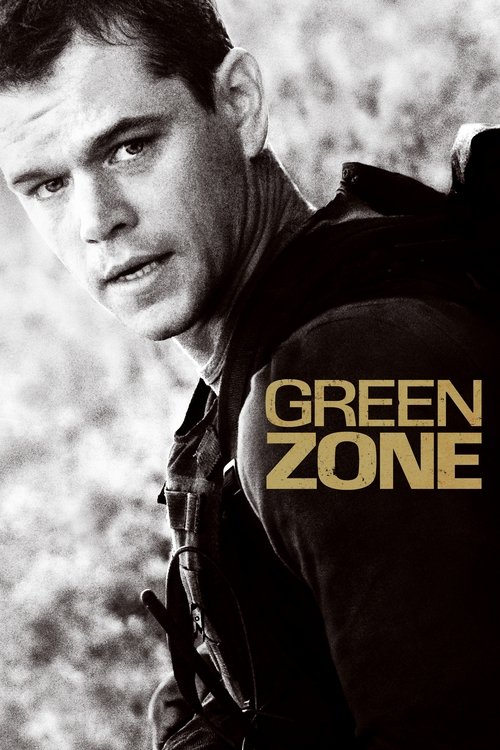
Green Zone
2010 · Paul Greengrass
For when you want an action movie with a brain and a grudge — something fast and gripping that also leaves you arguing about the real events behind it. More charged than comfort viewing.
What it's about
Baghdad, 2003, weeks into the U.S. occupation. Chief Warrant Officer Roy Miller leads an Army team racing from one supposed weapons site to the next, finding nothing but empty warehouses — and starts asking why the intelligence keeps being wrong. His questions pull him into a tangle of officials, journalists, and Iraqis with competing agendas, where the real fight is over the truth itself.
The experience
Relentless and jittery — handheld cameras, foot chases through night streets, and a slow-boiling anger underneath the action. It plays like a conspiracy thriller running on adrenaline and outrage.
Performances
Matt Damon grounds it as a soldier whose competence and moral stubbornness make the politics personal rather than abstract.
The craft
Greengrass shoots it documentary-style — handheld, urgent, cut to the rhythm of confusion — so the chaos of occupied Baghdad feels reported rather than staged. The action is genuinely kinetic, best with the sound up.
Why it matters
One of the boldest attempts to smuggle an argument about the Iraq War's false premises into a mainstream studio thriller, and a key entry in Hollywood's reckoning with that war.
Done. The dossier is written to `dossiers/22972.md` (Green Zone's correct TMDB ID, which I verified against `films.json`).
Below is the full dossier:
Snapshot
Green Zone is Paul Greengrass's attempt to fold the political fury of post-invasion Iraq into the grammar of the contemporary action thriller — to make a film that moves like the Bourne pictures while arguing about the lie that took the United States to war. Adapted loosely from Rajiv Chandrasekaran's nonfiction book Imperial Life in the Emerald City: Inside Iraq's Green Zone (2006), it discards that book's mordant reportage on the Coalition Provisional Authority and instead invents a fictional protagonist, Chief Warrant Officer Roy Miller (Matt Damon), whose hunt for nonexistent weapons of mass destruction becomes the thread by which he unravels the fabrication of the intelligence that justified the 2003 invasion. The film sits at an awkward and fascinating hinge: it is simultaneously a star-driven studio action movie and a partisan piece of journalistic cinema, and it is the third major collaboration between Greengrass and Damon, carrying the kinetic, handheld, present-tense aesthetic of The Bourne Supremacy (2004) and The Bourne Ultimatum (2007) into the territory of recent, contested history. It belongs to the short-lived cycle of Iraq War films that Hollywood produced in the late 2000s, almost all of which struggled at the box office, and it is generally regarded as a commercial disappointment relative to its large budget.
Industry & production
Green Zone was a Universal Pictures production, reuniting the studio with the creative team behind its hugely profitable Bourne sequels. The economic logic was straightforward and, in hindsight, miscalculated: Universal appears to have hoped that the Greengrass–Damon brand and the propulsive style audiences associated with Bourne could carry a politically charged subject to a wide audience. The budget was large — reported in the general range of well over $100 million, a figure inflated by extensive location shooting, a substantial action component, and the logistics of recreating 2003 Baghdad — and the film did not recoup that scale at the box office, a result consistent with the broader commercial failure of the Iraq War cycle (In the Valley of Elah, Rendition, Lions for Lambs, Stop-Loss, and others) that immediately preceded it. I won't cite precise gross figures I can't verify here, but the consensus characterization is that Green Zone underperformed.
Principal photography took place largely in Spain (Algeciras and the surrounding region standing in for Iraq), with Morocco and the United Kingdom also used; recreating Baghdad outside Iraq was both a security necessity and a production challenge. The screenplay is credited to Brian Helgeland, the Oscar-winning writer of L.A. Confidential and Mystic River, who built a fictional thriller architecture onto Chandrasekaran's factual substrate. The development was lengthy, and the project's tonal ambition — a real-world political argument delivered as multiplex action — was present from the outset and remained the central creative tension throughout.
The casting blended star power with character actors: Damon as Miller; Greg Kinnear as a Pentagon official, Clark Poundstone, who functions as the architect of the cover-up; Amy Ryan as a Wall Street Journal reporter whose credulous WMD reporting echoes real-world journalism of the period; Brendan Gleeson as a CIA officer skeptical of the official line; and Khalid Abdalla — previously of United 93 — as the Iraqi informant "Freddy," the film's most morally weighted figure.
Technology
Green Zone was shot on film, predominantly Super 16mm and 35mm, consistent with Greengrass's preference for a grainy, reportorial texture over the clean sheen of early digital cinema. The technological story of the film is less about novel equipment than about a deliberate methodology of capture: multiple cameras running simultaneously, much of it handheld or on lightweight rigs, operated to chase action rather than to compose it in advance. This approach descends from documentary and news practice and from Greengrass's own background in British television journalism; the "technology" that matters here is procedural — the rig-light, multi-camera, long-take pursuit of performers through real, dressed environments.
Night sequences, the chaotic raids, and the climactic chase through Baghdad's streets relied on available-light and source-light strategies that preserve the sense of murk and disorientation. Visual effects were used to extend the Spanish locations into a war-torn Baghdad skyline and to augment scale, but the film's identity is anchored in physical staging — real vehicles, real crowds, practically executed gunfire and explosions — rather than in digital spectacle.
Technique
Cinematography
Barry Ackroyd shot the film, and his presence is central to its look and to its lineage. Ackroyd, the longtime cinematographer for Ken Loach and, immediately prior, the Oscar-nominated director of photography on Kathryn Bigelow's The Hurt Locker (2008–09), brought a documentary realism honed in British social cinema. The handheld camera is restless and reactive: it appears to discover events rather than to have pre-blocked them, whip-panning toward gunfire, losing and re-finding faces in crowds, holding on the wrong thing and then correcting. Focus is sometimes imperfect by design. The palette is the dust-and-sand register that became the visual shorthand for the Iraq War on screen — bleached daylight, sodium-lit night, an absence of the saturated gloss of conventional action cinema. This is a continuous Greengrass strategy: the image as eyewitness, the frame as a body in the space rather than an authorial god's-eye.
Editing
Christopher Rouse, who won the Academy Award for editing The Bourne Ultimatum and is Greengrass's defining editorial collaborator, cut the film. The editing is the most recognizable Greengrass signature: extremely high cutting rates during action, fragments of motion assembled to convey velocity and confusion, sound and image deliberately roughened. The much-debated question about this style — does the rapid cutting clarify the chaos of combat by simulating subjective overload, or does it sacrifice spatial legibility? — applies squarely to Green Zone. Rouse's cutting is also doing argumentative work: it intercuts Miller's on-the-ground discoveries with the bureaucratic and journalistic machinery of the cover-up, building the thriller's logic through juxtaposition. The film's tempo is relentless, and the climactic nighttime pursuit is a set piece of pure montage-driven kinesis.
Mise-en-scène / staging
The production design recreates the surreal bifurcation that is Chandrasekaran's central subject: the fortified, air-conditioned, swimming-pool-and-cafeteria unreality of the Green Zone — the Coalition Provisional Authority's bubble inside Saddam's former palace complex — set against the collapsing, dangerous, under-resourced city beyond the blast walls. Greengrass stages this contrast as moral geography: the further Miller travels from the official version of events, the closer he gets to the chaotic truth. The staging of the raids and searches — the WMD inspection sites that yield nothing, the bird-droppings and abandoned toilets where intelligence promised chemical weapons — is built to convey procedural futility, the bodily labor of chasing a fiction. Crowd staging, checkpoint friction, and the texture of an occupied city are handled with the density Greengrass brings to public-event reconstruction.
Sound
The sound design extends the handheld, in-the-middle-of-it aesthetic into the audio field: overlapping radio chatter, the spatial confusion of unseen gunfire, the percussive weight of explosions, and dialogue that is sometimes caught rather than cleanly recorded. John Powell, Greengrass's regular composer and the architect of the Bourne scores, supplied the music — a driving, percussion-forward, electronically inflected score that propels the action while leaning into Middle Eastern textures. The score's function is momentum; like the cutting, it presses the film forward and rarely allows the audience to settle.
Performance
Damon plays Miller as a fundamentally straightforward man — a competent, dutiful soldier whose disillusionment is the film's emotional engine. The performance is deliberately unshowy; Miller is an everyman conscience, and Damon's stardom is deployed to grant that conscience weight and audience identification. Around him, the cast plays types sharpened to functional clarity: Kinnear's Poundstone as smooth official mendacity, Gleeson's Brown as weary institutional skepticism, Ryan's Lawrie Dayne as the embedded press's complicity. The film's most affecting performance is Khalid Abdalla's Freddy, the Iraqi who risks everything to help and who delivers the film's sharpest rebuke — the reminder that the war's meaning will be decided by Iraqis, not by the Americans arguing over it. His final act of agency is the film's moral pivot and its most discussed dramatic choice.
Narrative & dramatic mode
Green Zone operates in a hybrid dramatic mode: the conspiracy thriller welded to the combat film. Its structure is investigative — Miller as a soldier-detective following a chain of contradictions (the dry WMD sites) back to their source (a fabricated intelligence source, "Magellan") — and its forward motion is generated by the thriller's classic engine of a protagonist who knows too much and is pursued for it. But the film departs from the genre's usual escapism in its insistence on a real, recent, and unresolved political referent. The dramatic stakes are not merely Miller's survival but the audience's understanding of how the war was sold. This produces a tension critics frequently noted: the film wants the satisfactions of the thriller (a clear villain, a chase, a resolution) while arguing about a historical catastrophe that had no clean resolution and no single culpable individual. The decision to personalize systemic deception in the figure of Poundstone is the film's most consequential dramatic compromise — narratively efficient, but reductive of the diffuse institutional reality.
Genre & cycle
The film belongs to two cycles at once. Within action cinema, it is an extension of the post-Bourne style — the handheld, fast-cut, present-tense thriller that Greengrass himself did much to define. Within the war film, it is part of the Iraq War cycle of roughly 2007–2010, a wave of American films that interrogated the war and its conduct and that, almost uniformly, failed to find a large audience — a commercial pattern often attributed to public exhaustion with the subject. Green Zone's distinctive gambit was to try to break that pattern by smuggling the political content inside the most commercially proven action template available. It is therefore best understood as a deliberate genre experiment: the war-critique film disguised as, and engineered to function as, a multiplex thriller. Its kinship is closest to its own immediate predecessor The Hurt Locker (shared cinematographer, shared verité texture) and to Greengrass's docudramas Bloody Sunday (2002) and United 93 (2006), even as its fictional-thriller plotting separates it from those reconstructions.
Authorship & method
Green Zone is unmistakably a Greengrass film, and it crystallizes his method. His career divides loosely between fact-based reconstructions (Bloody Sunday, United 93, later Captain Phillips and 22 July) and the Bourne action films, and Green Zone is the work where those two strands most explicitly meet: the docudramatist's commitment to a real political event executed with the action filmmaker's kinetic toolkit. His authorial signature is a coherent system rather than a set of motifs — the verité handheld camera, the multi-camera "controlled chaos" shoot, the high-frequency cutting, the use of stars as conduits for moral seriousness, and a persistent thematic interest in institutions, truth, and the individual caught inside official machinery.
The method depends on a tight repertory of collaborators, and Green Zone assembles them: cinematographer Barry Ackroyd (bringing the Loach/Bigelow documentary realism), editor Christopher Rouse (the Bourne-honed cutting that is arguably the most identifiable element of the Greengrass style), and composer John Powell (the propulsive Bourne scores). The screenplay by Brian Helgeland supplies the genre architecture, with Chandrasekaran's reportage as the factual ground. Greengrass's own background as a British investigative-television journalist and author (he co-wrote Spycatcher) is the deep source of the film's sensibility: the conviction that cinema can and should function as adversarial journalism, and that the camera's job is to bear witness.
Movement / national cinema
Though a Hollywood studio film financed by Universal and headlined by an American star, Green Zone carries the imprint of British social-realist cinema through Greengrass and Ackroyd. The verité aesthetic both men deploy descends from the British documentary and television-drama tradition and, in Ackroyd's case, directly from years of work with Ken Loach. The film is thus another instance of British realist sensibility migrating into the American blockbuster system — a transatlantic hybrid in which a documentary ethic shapes a tentpole production. It is not the product of a movement so much as of this particular British-to-Hollywood transmission of method, the same lineage that informs the Bourne sequels.
Era / period
Green Zone is doubly a film of its moment. It reconstructs a precise historical period — the spring of 2003, the fall of Baghdad and the immediate chaos of the occupation, the founding of the Coalition Provisional Authority — and it is itself a product of the late-2000s American reckoning with that war. By 2010, the absence of weapons of mass destruction in Iraq was established fact and the intelligence failures (and the question of whether they were failures or fabrications) had been the subject of official inquiries and intense public debate. The film intervenes in that settled-but-raw consensus, dramatizing the cover-up thesis at a time when the war's justification was thoroughly discredited but its political wounds were still open. That timing is essential to reading it: it is not prophecy but retrospective indictment, arriving as the cultural appetite for Iraq films was already waning.
Themes
The film's governing theme is the manufacture of truth — the way official narratives are constructed, propagated through a complicit press, and defended against the evidence of those on the ground. Around it cluster: the gap between the official version and the bodily reality of the war, literalized in the geography of the fortified Green Zone versus the burning city; institutional culpability versus individual conscience, with Miller as the dutiful man whose loyalty curdles into a demand for accountability; the complicity of journalism, embodied in the reporter who printed what she was told; and, most pointedly through Freddy, the displaced agency of Iraqis, whose country and future are treated as a backdrop to an American argument until Freddy insists otherwise. The film's final movement — and Freddy's last action — drives home its bleakest theme: that the truth, once Miller obtains it, may change nothing, because the machinery of the lie has already done its work.
Reception, canon & influence
Critical reception was mixed-to-divided. The film's craft — Ackroyd's camera, Rouse's editing, the sustained intensity of its action — drew respect, and a number of critics admired Greengrass's nerve in attempting a politically explicit studio action film. But many faulted it for the very hybridity that defines it: the sense that the conventions of the chase thriller (a personalized villain, a heroic individual, a propulsive resolution) trivialized or oversimplified the diffuse, systemic reality of the WMD intelligence failure. Some on the political right objected to its cover-up thesis as tendentious; some critics simply found the marriage of multiplex action and earnest polemic uneasy. Commercially it is generally regarded as a flop relative to its budget, consistent with the fate of the wider Iraq cycle.
Looking backward, the film's influences are clear and acknowledged: Chandrasekaran's Imperial Life in the Emerald City as factual source; the conspiracy thrillers of the 1970s (the All the President's Men / Three Days of the Condor tradition of institutional paranoia) as a structural model; the immediately preceding The Hurt Locker as an aesthetic sibling via Ackroyd; and Greengrass's own Bloody Sunday and United 93, and the Bourne sequels, as the twin methodological wells the film draws on. Looking forward, Green Zone's direct influence is more modest than that of Greengrass's reconstructions, in part because of its commercial failure. Its most useful legacy is as a clarifying case study — the limit case of whether the verité-action style can be made to carry contested contemporary politics to a mass audience. Its apparent answer (that the audience would not come) helped mark the practical end of the late-2000s Iraq War cycle, after which Hollywood largely retreated from direct dramatization of the war's politics. Greengrass himself returned to the mode he commands most fully — the fact-based reconstruction (Captain Phillips, 22 July) and the Bourne franchise — and Green Zone stands as the most explicit, and most contested, fusion of his two careers.
A Deleuzian reading
A warehouse outside Baghdad, 2003.
The full Deleuzian reading of Green Zone →
Reception
A notorious flop in 2010 — a reported ~$100M budget against a soft opening, instantly filed under 'proof audiences won't watch Iraq War movies' — it's since been quietly reappraised as one of the smarter studio thrillers about the WMD debacle and a favorite 'underrated Greengrass' pick.
How Green Zone was received, from release to now →
Influences: the films it descends from and the films it influenced
- The Battle of Algiers (1966) — Established the newsreel-grammar reconstruction of a contested political event — grainy long-lens handheld shooting and crowd-level immersion that makes staged history read as captured documentary, the template for Greengrass's verité witness.
- Z (1969) — Fused the procedural conspiracy thriller with kinetic agit-prop editing, proving a real political cover-up could be told at the propulsive pace of a chase picture — Green Zone's exact ambition.
- All the President's Men (1976) — Supplied the structural architecture of institutional paranoia — the lone investigator pulling a thread through an opaque official machine — that Helgeland's screenplay grafts onto the WMD failure.
- Three Days of the Condor (1975) — Modeled the 1970s government-conspiracy thriller's personalization of systemic rot into a hunted protagonist and a deep-state antagonist, the genre move critics flagged in Green Zone.
- Riff-Raff (1991) — Source of Barry Ackroyd's documentary-realist camera method — available-light, reactive handheld framing that follows action rather than pre-composing it — carried directly into Green Zone.
- Bloody Sunday (2002) — Greengrass's own prototype for the multi-camera 'controlled chaos' shoot and overlapping-radio-chatter soundscape reconstructing a real day's catastrophe in near-real-time.
- The Bourne Supremacy (2004) — Where Christopher Rouse's high-frequency, eyeline-driven action cutting and John Powell's percussion-forward score were forged — the kinetic toolkit Green Zone applies to a political subject.
- United 93 (2006) — Perfected the ensemble real-time reconstruction with non-star faces and improvisatory staging, the docudrama discipline Green Zone tries to fuse with multiplex action.
- Black Hawk Down (2001) — Pioneered the disorienting, desaturated urban-combat montage with overlapping comms chatter and soldier's-eye fragmentation that Green Zone's firefights extend.
- Body of Lies (2008) — Extends the handheld Iraq-war realism and the agent-betrayed-by-his-own-intelligence-bureaucracy plot into an even more kinetic, vérité register immediately after Body of Lies.
- Zero Dark Thirty (2012) — Extends the verité-procedural treatment of the War on Terror — Ackroyd-lineage realism and a single dogged conscience inside the intelligence apparatus — but succeeds commercially where Green Zone's polemic-action hybrid did not.
- Captain Phillips (2013) — Greengrass's retreat to the mode Green Zone strained — fact-based reconstruction with the same multi-camera handheld intensity and star-as-moral-conduit, minus the contested partisan thesis.
- Sicario (2015) — Inherits the moral-geography staging of an everyman conscience disillusioned inside an opaque, off-the-books government operation, rendered with desaturated available-light tension.
- Eye in the Sky (2015) — Carries forward the institutional-deception thriller built on parallel-montage cross-cutting between decision-makers and the ground, the bureaucratic-moral architecture Green Zone deployed.
- 22 July (2018) — Greengrass's later reconstruction reaffirming his repertory method — verité handheld, institutional reckoning, restrained naturalist performance — the docudrama strand Green Zone tried to weld to action.
- The Bourne Ultimatum (2007) — The fullest expression of the Greengrass-Rouse-Powell action style — handheld geography of pursuit through real cities — that Green Zone redeploys onto occupied Baghdad.
- The Hurt Locker (2008) — Direct aesthetic twin via cinematographer Barry Ackroyd: desaturated, dust-blasted available-light handheld coverage of Iraq shot multi-camera to harvest unrepeatable spontaneity.
- Children of Men (2006) — Contemporaneous benchmark for embedding the camera inside chaos — long handheld takes that put the viewer at the protagonist's shoulder amid combat — the immersive war-zone grammar Green Zone shares.
- Jason Bourne (2016) — The same unit — Greengrass, Ackroyd, Rouse, Damon — applying the handheld-vérité combat and geopolitically literate paranoia to the Iraq War, a non-franchise sibling built from identical craft DNA.
Similar films
- The Bourne Supremacy (2004) — influence & lineage
- The Bourne Ultimatum (2007) — influence & lineage
- The Hurt Locker (2008) — influence & lineage
- United 93 (2006) — influence & lineage
- Bloody Sunday (2002) — influence & lineage
- Black Hawk Down (2001) — influence & lineage
- Zero Dark Thirty (2012) — influence & lineage
- Captain Phillips (2013) — influence & lineage