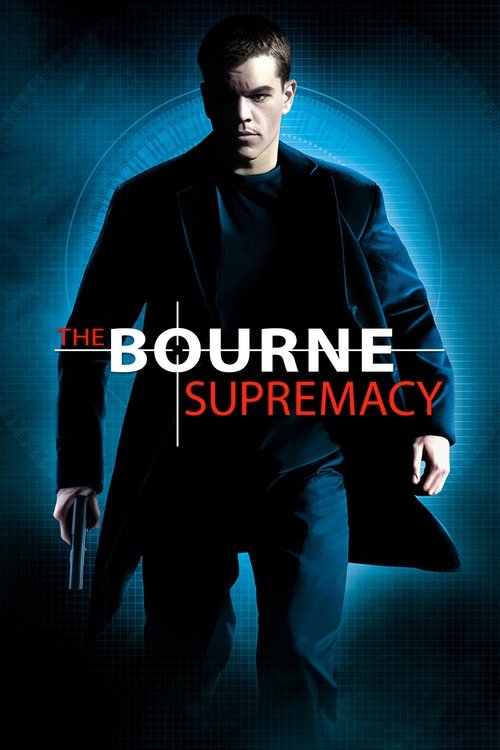
The Bourne Supremacy
2004 · Paul Greengrass
When you want an action film with real velocity and a dark undertow — gripping enough for a Friday night, serious enough to sit with afterward.
What it's about
Jason Bourne has been hiding quietly in India with Marie when a Russian assassin walks into their seaside village and blows the life they've built apart. Framed for the murder of two agents in a botched CIA operation in Berlin, Bourne comes out of hiding to hunt down who set him up — and to face what he actually did in the years he can't remember.
The experience
Jagged, fast, and morally heavy — the handheld camera puts you inside the pursuit, and the film never lets the excitement fully separate from the guilt driving it. It's a revenge thriller that keeps asking whether its hero deserves one.
Performances
Matt Damon deepens Bourne into someone haunted rather than merely hunted, and Joan Allen brings cool, cutting intelligence to the CIA officer chasing him.
The craft
Paul Greengrass brought his documentary instincts to the franchise — handheld cameras, slashing cuts, action that feels caught rather than choreographed — and the climactic Moscow car chase is one of the most punishing ever filmed. The style is divisive but purposeful: chaos you feel in your body.
Why it matters
This is the film that changed how mainstream action was shot for a decade — its vérité, quick-cut grammar was imitated everywhere, and it turned the series from a sleek thriller into an interrogation of institutional complicity.
Snapshot
The Bourne Supremacy is the second installment in Universal's Jason Bourne franchise and the film that decisively redefined the series' identity — and, with it, a generation of mainstream action filmmaking. Where Doug Liman's The Bourne Identity (2002) had been a sleek, character-driven Euro-thriller, Supremacy handed the property to British director Paul Greengrass, whose documentary background and handheld, vérité instincts converted the franchise into something jagged, kinetic, and morally restless. Matt Damon returns as Jason Bourne, the amnesiac former CIA assassin drawn out of hiding when a Russian operation frames him for the murder of two agents. The film is compact and propulsive — a revenge-and-pursuit narrative that doubles as an interrogation of guilt and institutional complicity. Its release marked the arrival of a house style, sometimes admiringly and sometimes pejoratively called "shaky-cam," that would dominate studio action cinema for a decade. It is the connective hinge of the trilogy: it killed off the romance that anchored the first film, deepened the conspiracy, and set the template that The Bourne Ultimatum (2007) would refine to a peak.
Industry & production
The Bourne Supremacy was produced by Universal Pictures, with Frank Marshall, Patrick Crowley, and Paul L. Sandberg among the producing team, continuing the structure established on The Bourne Identity. The first film had a famously troubled production — extensive reshoots, budget overruns, and reported friction between director Doug Liman and the studio — yet it became a sleeper success on home video as much as in theaters, establishing enough commercial momentum to justify a sequel. For that sequel, Universal moved away from Liman (who took an executive producer credit) and hired Paul Greengrass, then known chiefly for the searing docudrama Bloody Sunday (2002).
The choice was unconventional for a studio franchise: Greengrass had no blockbuster track record and came from British television documentary. But the appointment signaled the studio's willingness to let the property mutate stylistically rather than merely repeat the first film. Tony Gilroy, who had worked on Identity, returned to write the screenplay, again adapting Robert Ludlum's source novel loosely — the films retain Ludlum's character and premise while discarding most of his Cold War plotting. Production ranged across multiple countries, with location shooting in Goa, India (standing in for the seaside refuge where Bourne and Marie hide), Berlin, Moscow, Naples, and Amsterdam, lending the film a genuinely transnational texture rather than backlot internationalism. The Moscow sequences in particular gave the film access to locations rarely used in Western action cinema of the period. Commercially, the film outperformed its predecessor theatrically and confirmed Bourne as a tentpole property, directly enabling the third film and shaping the eventual Jason Bourne (2016) reunion of Greengrass and Damon.
Technology
The Bourne Supremacy was shot on 35mm film, not digitally — a point worth stressing because its aesthetic is so often associated with the rawness later linked to digital and handheld video. The grain, instability, and immediacy come from camera operation and editing, not from a low-resolution format. Cinematographer Oliver Wood worked extensively with handheld cameras and long lenses, relying on operator-driven framing rather than locked-off setups or elaborate crane and dolly choreography. The film's technical signature is human and mechanical rather than computational: it largely eschews the digital compositing and CGI-heavy spectacle that dominated other action releases of 2004, favoring practical stunts and in-camera chaos. The climactic Moscow car chase, for instance, is built from real vehicles, practical impacts, and physically demanding camera placement inside and around the cars, with the disorientation generated through editing and framing rather than visual effects. This commitment to the practical and the photographable is part of why the film reads as "real" even when its style is at its most aggressive.
Technique
Cinematography
Oliver Wood, who shot all three films of the original trilogy, is central to the Bourne look, but Supremacy is where the handheld idiom becomes a thesis rather than a flourish. Wood and Greengrass favor restless, operator-led camerawork that treats the frame as something chasing the action rather than composing it. Long lenses compress space and isolate faces in crowds; focus is sometimes deliberately imperfect; the horizon tilts and resettles. The lighting is naturalistic and often available-light in feel, with a muted, desaturated palette of grays, steel blues, and institutional fluorescents that matches the film's bureaucratic-paranoid mood. The effect is to place the viewer inside Bourne's hypervigilant perception — a world scanned for threats, never fully resolved into stability.
Editing
If one craft defines The Bourne Supremacy, it is editing. Christopher Rouse and Richard Pearson cut the film, and Rouse in particular would become Greengrass's essential collaborator, going on to win the Academy Award for editing The Bourne Ultimatum. The cutting is fast, fragmentary, and rhythmically aggressive — action is assembled from brief, often partial glimpses, so that a fight or a chase is conveyed as an accumulation of impacts rather than a legible spatial geography. This is the technique critics have debated most fiercely. Detractors argued it sacrificed coherence; admirers held that it reproduced the subjective overwhelm of violence and motion. Either way, the editing is not incidental to the film's meaning — it embodies Bourne's disorientation and the franchise's refusal of clean, balletic action. The hand-to-hand fight in Munich, built around improvised weapons, and the Moscow chase are the showcase set pieces, and both derive their force from cutting as much as from staging.
Mise-en-scène / staging
The film's worlds are deglamorized. CIA offices are sterile open-plan environments of monitors and lanyards; safe houses and transit spaces are anonymous; cities appear as functional infrastructure — train stations, ferries, ring roads, customs halls — rather than postcards. This is espionage drained of Bond-style luxury. Greengrass stages action in the seams of ordinary life: a fight in a cramped apartment, a pursuit through Berlin's transit system, a confrontation in a hotel. The staging emphasizes Bourne's competence as a function of attention — he reads rooms, exits, sightlines — so that mise-en-scène becomes characterization. The opening Goa sequence is a striking exception in palette, its warmth and openness establishing a fragile domesticity precisely so that it can be violently extinguished.
Sound
John Powell's score, carried over from the first film, is propulsive and percussive, built on driving rhythms and electronic textures that sustain momentum without resorting to conventional heroic orchestration. The franchise's sonic signature — Moby's "Extreme Ways" over the end credits — recurs here, becoming a ritual punctuation across the trilogy. Beyond music, the sound design is dense and immediate: traffic, footsteps, the mechanical violence of the car chase, the crunch of practical impacts. The soundscape reinforces the documentary illusion, privileging the granular and the diegetic.
Performance
Matt Damon's performance is defined by restraint and physical conviction. Bourne is nearly affectless on the surface — watchful, economical, his interiority legible mainly through micro-expressions of grief and resolve — and Damon commits fully to the physicality of the role's fights and chases. Franka Potente returns as Marie, though the film makes the bold structural choice to remove her early, an act that reorients the entire narrative around loss. Joan Allen enters the series as Pamela Landy, a CIA official whose intelligence and integrity make her a worthy institutional counterweight to Bourne; her measured, watchful authority is a key addition. Brian Cox returns as the corrupt Ward Abbott, Julia Stiles reprises Nicky Parsons, and Karl Urban plays the Russian operative Kirill. The ensemble is uniformly underplayed, in keeping with the film's allergy to melodrama.
Narrative & dramatic mode
The Bourne Supremacy operates as a revenge thriller braided with a guilt narrative. Its surface plot is a chase: Bourne, framed for the murder of two CIA agents in Berlin, is hunted while trying to clear himself and find out who is targeting him. But the deeper movement is moral. The film's emotional engine is Bourne's dawning memory of his first sanctioned killing — a crime he must finally confront and, in the film's quietly devastating coda, atone for by seeking out the orphaned daughter of his victims. The dramatic mode is therefore confessional beneath the kinetic surface: an action film whose true climax is not a fight but an apology. This fusion of relentless forward motion with a backward-pulling weight of memory gives the film its distinctive gravity and distinguishes it from the disposable revenge plots it superficially resembles.
Genre & cycle
The film belongs to the post–Cold War spy thriller and, more specifically, to the early-2000s cycle of "realistic," disillusioned espionage cinema that emerged as a counterpoint to the fantasy of the Bond films. It is part of a moment — alongside works like Syriana (2005), Munich (2005), and Gilroy's own later Michael Clayton (2007) — in which American institutions are rendered as opaque, self-protecting, and morally compromised. Within the action genre, Supremacy is a pivotal text in the shift from choreographed, legible spectacle toward fragmented, "immersive" chaos. Its influence pressured even the Bond franchise, whose Casino Royale (2006) reboot is widely read as a response to Bourne's grittier register.
Authorship & method
Paul Greengrass is the decisive author here, importing a method forged in documentary and docudrama. Before Bourne, he had directed Bloody Sunday (2002), a reconstruction of the 1972 Derry massacre shot in urgent, handheld, you-are-there style. That ethic — the camera as participant, history as chaos experienced rather than narrated — is exactly what he brought to the franchise. Greengrass treats the thriller as a vehicle for a kind of moral realism, and his subsequent career (United 93, 2006; Captain Phillips, 2013) confirms a consistent preoccupation with crisis, institutional failure, and ordinary competence under extreme pressure.
His collaborators are integral. Cinematographer Oliver Wood translated the documentary impulse into the franchise's visual grammar. Editor Christopher Rouse became Greengrass's defining creative partner, the architect of the cutting style that is arguably the films' true signature. Composer John Powell supplied the rhythmic propulsion that keeps the fragmentation from collapsing into incoherence. And screenwriter Tony Gilroy, who wrote across the trilogy, shaped Bourne's voice — terse, intelligent, morally awake — and the franchise's skepticism toward power, themes he would carry into his own directorial work. The Bourne style is genuinely collaborative, but it is Greengrass who fused these elements into a coherent and imitable whole.
Movement / national cinema
The film sits at an intersection of British realist sensibility and American studio production. Greengrass emerged from the tradition of British television documentary and social realism — a lineage attentive to institutions, process, and the texture of lived reality — and grafted that sensibility onto a Hollywood action property. It is not a "national cinema" film in any pure sense; rather, it exemplifies the transnational character of contemporary blockbuster production, with British creative authorship, American financing and stars, and pan-European and Indian locations. Its aesthetic kinship is less with American action tradition than with European and documentary modes of immediacy.
Era / period
The Bourne Supremacy is profoundly a product of the post-9/11 era. Released in 2004, amid the Iraq War and intensifying debate over surveillance, rendition, and the conduct of intelligence agencies, the film's portrait of a CIA riven by corruption, secret programs, and unaccountable operatives resonated powerfully with the cultural moment. Bourne — a man weaponized by his own government and then disowned — became a figure for anxieties about state violence and the individual conscience caught inside it. The franchise's increasing focus on illegal black programs and domestic surveillance across its arc tracks the decade's deepening unease about the security state. The film is also of its era technologically and stylistically, capturing the last period before digital capture and CGI fully reshaped action production.
Themes
The film's central themes are memory, guilt, and atonement. Bourne's amnesia is not merely a plot device but a moral condition: he must reconstruct who he was in order to take responsibility for it. Identity is figured as something earned through accountability rather than given. A second theme is institutional corruption and the asymmetry between the individual and the opaque organization — the agency that made Bourne now seeks to erase him. Grief threads throughout, particularly after Marie's death, which strips Bourne of the future he had glimpsed and returns him to a self he had tried to leave behind. Finally, the film meditates on competence and dehumanization: Bourne's extraordinary skills are the residue of his own erasure as a person, and his arc is the slow recovery of a conscience the agency tried to delete.
Reception, canon & influence
Critically, The Bourne Supremacy was well received, generally regarded as equal to or stronger than the first film, with particular praise for Damon, Greengrass's direction, and the propulsive momentum — though its aggressive handheld style and rapid cutting also drew the first sustained wave of criticism that would intensify with the third film. Some viewers and critics found the camerawork disorienting to the point of incoherence, and the film became a touchstone in the broader debate over what critic Matthias Stork would later term "chaos cinema." Commercially, it succeeded strongly enough to cement the franchise and greenlight The Bourne Ultimatum.
Looking backward, the film draws on Robert Ludlum's Cold War spy fiction (heavily reworked), on the disillusioned conspiracy thrillers of 1970s American cinema, and most directly on Greengrass's own documentary and docudrama practice, especially Bloody Sunday. Looking forward, its influence is hard to overstate. The Bourne style — handheld immediacy, fragmented editing, deglamorized realism, morally compromised institutions — became the dominant idiom of studio action filmmaking in the mid-to-late 2000s and 2010s, shaping countless thrillers and pressuring the James Bond series into its grittier Casino Royale reinvention. The collaboration crystallized here, especially between Greengrass and editor Christopher Rouse, would reach its fullest expression in The Bourne Ultimatum, whose editing Oscar effectively canonized the style. The Bourne Supremacy thus stands as a genuine inflection point: the film where a documentarian's ethics of immediacy entered the bloodstream of the Hollywood blockbuster and changed how action looks.
A Deleuzian reading
Watch Bourne in the Goa market before anything has happened.
The full Deleuzian reading of The Bourne Supremacy →
Reception
Well-reviewed on release as that rare sequel that outdoes the original, though its whiplash handheld camerawork split audiences from day one — now it's seen as the film that rewired Hollywood action, for better or worse.
How The Bourne Supremacy was received, from release to now →
Influences: the films it descends from and the films it influenced
- Bloody Sunday (2002) — Greengrass's own docudrama blueprint: the participant-camera reconstruction of the 1972 Derry massacre established the handheld, you-are-there immediacy he imported wholesale into Bourne.
- The French Connection (1971) — Pioneered the grimy, documentary-grained urban thriller and a verité chase aesthetic — long-lens telephoto coverage and deglamorized location shooting that Oliver Wood's Bourne photography directly descends from.
- Three Days of the Condor (1975) — Defined the 1970s paranoid conspiracy thriller of a lone operative betrayed by his own agency — the morally compromised-institution template Tony Gilroy reworked for Bourne's skepticism toward power.
- The Parallax View (1974) — Codified surveillance-state dread and the disposable individual crushed by shadow institutions, the disillusioned-conspiracy grammar Bourne updates for the post-9/11 era.
- The Battle of Algiers (1966) — Originated the newsreel-realist staging of clandestine operations as lived chaos rather than narrated event — the ethics-of-immediacy Greengrass treats as inheritance.
- Z (1969) — Fused political thriller with fragmentary, propulsive cutting and handheld urgency, modeling how montage rhythm can carry a procedural conspiracy plot at speed.
- The Bourne Identity (2002) — Established the franchise's amnesiac-assassin premise, Damon's restrained physical performance, and Oliver Wood's desaturated European palette that Greengrass intensified.
- Enemy of the State (1998) — Greengrass's dual-perspective surveillance architecture—institutional overhead shots of operations centers tracking the protagonist via satellite and CCTV feeds, intercut with the protagonist's ground-level embodied perspective—directly inherits Enemy of the State's structural grammar of the watcher and the watched as competing editorial registers.
- Spy Game (2001) — Inherits Scott's assaultive cutting and surveillance tradecraft but swaps glossy telephoto for handheld vérité — the grittier register that displaced and dated Scott's maximalism.
- Ronin (1998) — Its grounded, practical car chases through real European streets — real cars, real impacts, geographically tracked cutting against the CGI tide — are routinely traced directly to Ronin's analog rigor.
- The Fugitive (1993) — Extends the resourceful-fugitive-improvising-against-his-former-handlers template into a kinetically-edited manhunt procedural.
- The Bourne Ultimatum (2007) — The fullest expression of the Greengrass–Christopher Rouse cutting style begun here; its Oscar-winning editing effectively canonized Bourne's fragmentary action grammar.
- Casino Royale (2006) — Directly pressured by Bourne into a grittier, deglamorized reinvention of Bond — bruising practical stunts, an emotionally scarred agent, and handheld realism replacing gadgetry.
- Quantum of Solace (2008) — Imported Bourne's rapid-cut, shaky-cam action wholesale (editor Rouse-influenced kinetics, second-unit Bourne crew) — the most literal studio imitation of the style.
- Taken (2008) — Adopted Bourne's close-quarters, fragmented hand-to-hand combat editing and lone-operative-with-a-skillset template for a leaner European-set thriller.
- The Dark Knight (2008) — Channeled Bourne's deglamorized realism and handheld, practically-staged action into the superhero film, treating spectacle as grounded crisis under institutional failure.
- Captain Phillips (2013) — Greengrass's reapplication of the Bourne method's ordinary-competence-under-pressure and verité tension to true-story crisis, confirming the style as authored signature.
- United 93 (2006) — The purest distillation of Greengrass's documentary ethics — real-time, handheld, ensemble crisis — showing the Bourne grammar stripped back to its docudrama source.
- Mission: Impossible III (2006) — Establishes the handheld, long-lens, fragmentary-cut treatment of physical combat that III adopts to ground its action in bodily impact rather than choreographed spectacle.
- Green Zone (2010) — Where Christopher Rouse's high-frequency, eyeline-driven action cutting and John Powell's percussion-forward score were forged — the kinetic toolkit Green Zone applies to a political subject.
- Safe House (2012) — Established the handheld shaky-cam-plus-fragmentary-fast-cutting action grammar — shot by Oliver Wood — that Safe House adopts wholesale, down to the same DP rendering chases as disorienting bursts rather than legible geography.
- The Berlin File (2013) — The direct template for the film's fragmented action cutting and handheld documentary-realist coverage — close, jittery, sub-second-cut hand-to-hand combat shot like reportage rather than spectacle.
- Saving Private Ryan (1998) — Its shuttered-shutter, handheld, desaturated combat verité legitimized chaos-as-realism in studio filmmaking, a parallel impulse Bourne extended from war to espionage.
- Mission: Impossible — Ghost Protocol (2011) — Shares the post-Bourne turn toward practical, real-location stunt work and deglamorized institutional intrigue, while pushing back with clearer geographic editing.
- Michael Clayton (2007) — Gilroy carries Bourne's terse, morally-awake voice and corporate/institutional skepticism into his own directorial work — the writerly half of the Bourne DNA.
- Syriana (2005) — Extends the same post-9/11 geopolitical paranoia in a deglamorized, handheld, multi-strand register, treating espionage as bureaucratic and morally compromised.
- Batman Begins (2005) — Fragmented, near-subjective close-quarters fight cutting — the same chaotic, disorienting combat coverage Begins adopts to render Batman as a perceptual terror.
- The Bourne Legacy (2012) — Greengrass's fragmented vérité editing and the agency-control-room intercut-with-field-operative structure are the template Gilroy must shoot around, since Legacy keeps the surveillance-bureaucracy apparatus even after swapping protagonists.
- Man on Fire (2004) — A contemporaneous sibling in handheld long-lens, fragmentary action cutting that subordinates spatial clarity to felt intensity, the other dominant strain of mid-2000s kinetic action editing.
- Captain America: Brave New World (2025) — Shares the post-9/11 idiom of the programd asset unlearning his conditioning amid kinetic, verité-flavored pursuit through official spaces — the action grammar grafted onto the political-thriller skeleton.
- The Blade (1995) — Reaches the same sensation-first grammar independently — sub-second shot lengths, handheld inside the strike zone, spatial coherence traded for felt impact — with no causal line to Tsui; the kinship is formal, not genealogical.
Similar films
- The Bourne Ultimatum (2007) — influence & lineage · same viewing thread
- The Bourne Identity (2002) — influence & lineage · same viewing thread
- Quantum of Solace (2008) — influence & lineage
- United 93 (2006) — influence & lineage
- Ronin (1998) — same viewing thread
- Nikita (1990) — same viewing thread
- Jason Bourne (2016) — shared sensibility
- The Bourne Legacy (2012) — shared sensibility
All the films related to The Bourne Supremacy →
Watch it with: curated runs of related films
- The Silent Professional — A run of lethal loners who move through the world with monkish economy — watch them back to back for pure, terse competence under pressure and men who just want to disappear.