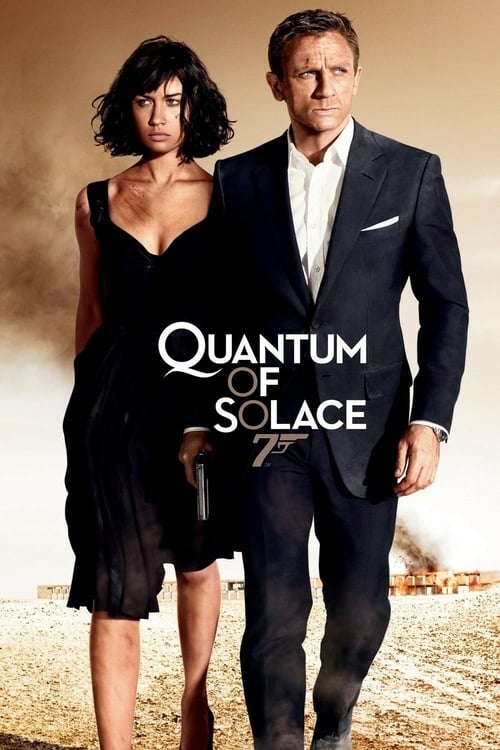
Quantum of Solace
2008 · Marc Forster
For a no-commitment action night when you want intensity over charm — best watched right after its predecessor, as the second half of a double bill. Comfort food for thriller fans, though Bond purists should brace themselves.
What it's about
Picking up barely an hour after the last film ended, James Bond is grieving the woman who betrayed him and channeling it into the hunt for the shadowy organization that owned her. With M half-trusting him and half-fearing he's gone rogue, the trail runs through Europe and South America toward a network hiding in plain sight. It's less a mission than a vendetta wearing a tuxedo.
The experience
Lean, fast, and unusually cold for a Bond film — the action comes in hard, rapid-fire bursts and the quips are mostly gone, replaced by a simmering anger. At well under two hours it moves like it's late for something.
Performances
Daniel Craig plays Bond as an open wound, all clenched grief and controlled violence, and Judi Dench gets more to do as M than most of the series ever gave her.
The craft
Director Marc Forster stages the set pieces around the elements — a car chase, a rooftop pursuit, a fight in mid-air, a finale in flames — cut in the fast, fragmented style that dominated late-2000s action. The globe-hopping photography is genuinely handsome, and the sound mix hits hard on a good system.
Why it matters
The most divisive of the Craig-era films, it marked the franchise's furthest swing toward gritty, stripped-down realism — a limit the series pulled back from afterward. As the first true direct sequel in Bond history, it's a curious structural experiment in a sixty-year franchise.
Snapshot
Quantum of Solace is the twenty-second film in the EON Productions James Bond series and the second to star Daniel Craig, and it occupies an unusual structural position: it is the first direct narrative sequel in the franchise's history, beginning roughly an hour after the events of Casino Royale (2006). Where the earlier film rebooted Bond as an origin story, Quantum is its coda — a study of grief and revenge in which 007 hunts the shadowy organization (Quantum) that blackmailed and effectively killed Vesper Lynd. Directed by Marc Forster, a filmmaker known for intimate dramas rather than spectacle, the film married the franchise's reinvented realism to the kinetic, fast-cut action grammar then dominant after the Bourne trilogy. The result is the shortest official Bond film and one of its most divisive: widely seen as a step down from its acclaimed predecessor, hampered by a production caught mid-stride in the 2007–08 Writers Guild strike, yet retaining real interest as a transitional, mood-driven entry that pushed the series toward serialized continuity.
Industry & production
The film was produced by EON Productions (Michael G. Wilson and Barbara Broccoli) and distributed by MGM and Columbia/Sony. Its production is inseparable from the 2007–2008 Writers Guild of America strike. The screenplay — credited to Paul Haggis with series stalwarts Neal Purvis and Robert Wade — was, by the producers' and Daniel Craig's own later accounts, not fully finished when shooting commenced. Haggis reportedly delivered a draft just before the strike deadline, after which no professional rewrites were permitted; Craig has said in interviews that he and Forster found themselves reworking scenes on set, with the actor describing the experience as writing dialogue themselves under duress. This is the most consequential single fact of the production: much of the film's narrative compression and its reputation for thin connective tissue traces directly to that circumstance.
The title was lifted from Ian Fleming — a 1959 short story collected in For Your Eyes Only (1960) — but the film bears no relationship to its source, which is a melancholy frame narrative about a collapsed marriage and contains no espionage action whatsoever. The phrase ("the quantum of solace" being the minimum measure of human comfort a relationship needs to survive) was retained for its thematic resonance with Bond's emotional state; the title nonetheless became a frequent object of confusion and mockery in the popular press.
Shooting ranged across Panama (doubling for Bolivia and Haiti), Italy (Siena and Lake Garda), Austria (the floating stage at Bregenz), Chile's Atacama Desert, and Pinewood Studios. The production drew on Bond's long-standing global-location tradition while leaning into harsher, more arid landscapes than the franchise's glamour norm.
Technology
Quantum of Solace was shot photochemically on 35mm film and finished through a digital intermediate, the standard high-end workflow of its moment. It predates the franchise's later embrace of large-format and digital capture (Roger Deakins would shoot Skyfall and Spectre partly on Arri Alexa digital cameras). The film is notable instead for the intensity of its post-production manipulation: the rapid editing, ramping, and tight framing were assembled to a degree that effectively makes the cutting room a primary site of the film's "technology." The title sequence broke with recent series practice — rather than Daniel Kleinman, the Kansas City design studio MK12 created the motion-graphics main titles, a more austere desert-and-silhouette treatment scored to the film's theme song.
Technique
Cinematography
Roberto Schaefer, Forster's regular collaborator (Monster's Ball, Finding Neverland, Stranger than Fiction), shot the film. His photography favors high-contrast, sun-bleached palettes — the ochres of the Atacama and Siena, the cool blues of the Austrian opera house — and handheld, in-close camerawork during action. The look is deliberately grittier and less burnished than classic Bond. The standout sequence visually is the Bregenz opera set-piece, staged during a performance of Puccini's Tosca on the festival's vast floating lake stage, where Schaefer and Forster exploit the surreal scenography — a giant eye, stark blue light — for one of the most genuinely cinematic passages in the Craig era.
Editing
Editing is the film's most contested element. Cut by Matt Chesse (another Forster regular) and Richard Pearson, the action is assembled in very short shots with rapid, sometimes disorienting cross-cutting. The influence of Paul Greengrass's Bourne films is direct and not coincidental: second-unit director Dan Bradley had worked on the Bourne pictures, and the franchise was consciously chasing that contemporary action idiom. The pre-titles car chase on Lake Garda and the Siena foot chase are frequently cited by critics as over-cut to the point of incoherence. The most ambitious editing conceit is the Siena sequence's intercutting of Bond's rooftop pursuit with the Palio horse race below, and — more successfully — the Tosca sequence, which crosscuts the staged opera, the assassinations, and Bond's eavesdropping into a montage that the film's defenders single out as its formal high point.
Mise-en-scène / staging
Production designer Dennis Gassner (beginning a long association with the series) built environments that reject Bond's traditional opulence in favor of institutional modernism and harsh natural settings: the brutalist eco-hotel in the desert that becomes the fiery finale, the antiseptic Greene Planet fundraiser, MI6's cold operational rooms. Forster has described organizing the four major action sequences around the classical elements — earth (the Siena foot chase), water (the Haiti boat chase), air (an aerial dogfight over the desert), and fire (the hydrogen-fuel-cell hotel climax) — a schematic conceit that gives the staging an underlying design logic even when the cutting obscures geography.
Sound
David Arnold composed the score — his fifth and final Bond film. His work integrates motifs from Casino Royale, including the "Vesper" theme, reinforcing the films' continuity, and works toward the full deployment of the Monty Norman James Bond theme that the reboot had deliberately withheld. The title song, "Another Way to Die," written and performed by Jack White with Alicia Keys, was the first duet in the series' title-song history; its abrasive, bluesy rock texture divided listeners and sits somewhat apart from Arnold's orchestral score.
Performance
Daniel Craig's performance is the film's spine: a coiled, near-mute portrait of suppressed grief, Bond reduced largely to forward motion and barely-governed rage. Judi Dench's M is given expanded weight as both handler and moral conscience, and the M–Bond relationship — maternal, suspicious, exasperated — becomes a genuine dramatic axis. Olga Kurylenko plays Camille, a Bolivian agent pursuing her own revenge; notably, the film declines the franchise's reflex to romance her, pairing the two as parallel avengers rather than lovers. Mathieu Amalric plays the villain Dominic Greene as a slippery, unglamorous corporate operator. Gemma Arterton's Strawberry Fields, Jeffrey Wright's returning Felix Leiter, Giancarlo Giannini's doomed Mathis, and Jesper Christensen's Mr. White round out the ensemble.
Narrative & dramatic mode
The film's dramatic mode is revenge tragedy compressed into a propulsive thriller. Its through-line is emotional rather than mission-driven: Bond is processing Vesper's death, and the plot's espionage machinery (Greene's scheme to seize control of Bolivia's water supply under cover of an environmental charity, backed by the Quantum organization) is secondary to the question of whether Bond can recover "a quantum of solace." The screenplay deploys doubling throughout — Camille's parental-revenge mission mirrors Bond's; Strawberry Fields's oil-drowned corpse explicitly echoes Jill Masterson's gilded death in Goldfinger (1964). The closing scene, in which Bond confronts Vesper's former lover and chooses restraint over killing, resolves the emotional arc and clears him to function. The narrative's frequent opacity — characters and allegiances introduced and dispatched quickly — is the most-cited weakness, again traceable to the unfinished-script production.
Genre & cycle
Quantum belongs to the post-9/11, post-Bourne cycle of "realist" spy cinema, in which the genre's gadgetry and camp were stripped back in favor of grounded violence, moral ambiguity, and geopolitical anxiety. Within the Bond series it is the second movement of the Craig "reboot" cycle that began with Casino Royale and would continue, with the eventual revival of SPECTRE, through Skyfall, Spectre, and No Time to Die. The Quantum organization functions as a placeholder for the classic criminal syndicate SPECTRE, which EON could not yet use for rights reasons (those rights were resolved before Spectre in 2015) — making this film a key transitional text in the franchise's long-running effort to rebuild a serialized super-villain mythology.
Authorship & method
The defining authorial tension is the casting of Marc Forster, a director with no action background, to make an action film. Forster (a German-born filmmaker raised in Switzerland, known for Monster's Ball, Finding Neverland, and The Kite Runner) brought an interest in interiority and grief that suits the film's emotional register but proved a strained fit with large-scale action, which was substantially delegated to second-unit director Dan Bradley and shaped in the edit. His core collaborators were largely brought over from his own filmography — cinematographer Roberto Schaefer and editor Matt Chesse — grafting an art-cinema team onto the blockbuster apparatus. The franchise's institutional authorship — producers Wilson and Broccoli, the Purvis-and-Wade screenwriting continuity, and composer David Arnold — provided the connective spine. The result reads less as a singular directorial statement than as a collision between an auteur of intimate drama and a producer-driven action machine operating under crisis conditions.
Movement / national cinema
As a British-American studio production rooted in a quintessentially British property, the film belongs to no art-cinema movement, but its aesthetic is firmly that of mid-2000s transnational action filmmaking — shot across four continents, financed through MGM/Sony, and stylistically indebted to the American-produced, British-directed Bourne films. Its hiring of a European art-house director reflects a recurrent late-period Bond strategy of recruiting prestige filmmakers from outside the action genre (continued with Sam Mendes and Cary Joji Fukunaga).
Era / period
Released in 2008, the film is a product of the late-2000s moment: post-9/11 security anxieties, distrust of corporate and Western power, and — in its choice of villainy — an emerging awareness of resource politics, with Greene's plot organized around the privatization of water rather than nuclear weapons or space lasers. This grounding of the threat in environmental and economic exploitation, with a "green" charity as criminal front, marks the film as distinctly of its decade. Its production also bears the literal imprint of a specific industry event, the Writers Guild strike, making it an unusually direct artifact of Hollywood labor history.
Themes
The governing theme is grief and the limits of revenge — the "quantum of solace" itself, the minimal human comfort needed to go on living. Allied themes include betrayal and trust (Vesper's shadow over every relationship), the corruption beneath benevolent fronts (Greene's environmentalism masking exploitation), and institutional loyalty versus personal vendetta (the recurring M–Bond conflict over whether Bond can be trusted not to make the mission personal). Water and thirst operate as literal and figurative motifs — Greene's scheme, the parched Bolivian landscape, the drought of feeling in Bond himself. The film also interrogates Western complicity in the Global South, with American intelligence willing to back a coup for oil and Bond positioned, ambivalently, against that realpolitik.
Reception, canon & influence
Critical reception was mixed and notably cooler than the acclaim for Casino Royale. Reviewers consistently praised Craig's performance, the film's pace and brevity, and individual set-pieces (the Tosca sequence above all), while criticizing a muddled, under-explained plot, a thinly drawn villain, and frenetic editing that obscured the action's geography. The "shortest Bond film" and "most Bourne-like Bond" framings recurred across critical and popular discussion, and the title was a frequent target of bemusement. Commercially the film performed strongly, continuing the franchise's revitalization, though precise figures are best confirmed against box-office records rather than cited from memory.
The influences on the film are clear: Fleming for the title alone; the Bourne trilogy (especially The Bourne Ultimatum, 2007) for its handheld, fast-cut action aesthetic and its hiring of Bourne's second-unit director; and Goldfinger for the deliberate visual quotation of the oil-drowned Strawberry Fields. Its own legacy is chiefly internal to the franchise. As the first true Bond sequel, it established the serialized continuity — recurring villains, carried-over emotional arcs, the slow assembly of an overarching syndicate — that would define the remainder of the Craig era and culminate in Spectre and No Time to Die. Within fan and critical canon it is generally ranked among the weaker Craig entries, but it is increasingly reassessed as a flawed, atmospheric transitional film whose problems were largely circumstantial — the casualty of a strike-shortened script — rather than conceptual. Its experiment with handing Bond to an intimate-drama director also helped shape the franchise's subsequent, more successful courtship of prestige filmmakers.
A Deleuzian reading
A giant blue eye hangs over a lake.
The full Deleuzian reading of Quantum of Solace →
Reception
Landing two years after Casino Royale reinvented Bond, it was greeted as a choppy, Bourne-ified letdown — but the Craig-era retrospectives have been kinder, with a vocal camp now defending it as the era's lean, melancholy black sheep.
How Quantum of Solace was received, from release to now →
Influences: the films it descends from and the films it influenced
- Casino Royale (2006) — Establishes the carried-over emotional arc QoS picks up mid-stride — Vesper Lynd's death is the unresolved grief that motivates Bond, inaugurating the franchise's serialized continuity.
- The Bourne Ultimatum (2007) — Supplies the handheld, fast-cut vérité action grammar QoS imports literally by hiring Bourne's own second-unit director Dan Bradley to stage its chases.
- The Bourne Supremacy (2004) — Pioneers the disorienting foot-chase built from short lenses and cuts-on-motion through Mediterranean rooftops that QoS replays in its Siena pursuit.
- Goldfinger (1964) — Directly quoted: Strawberry Fields' oil-drowned corpse is a deliberate visual rhyme on Jill Masterson painted gold and suffocated.
- The Man Who Knew Too Much (1956) — Provides the template of an assassination choreographed against a live musical performance (the Albert Hall cymbal-crash) that QoS extends in its Tosca set-piece.
- The Godfather (1972) — Model for crosscutting montage that intercuts a sacred cultural performance with synchronized killing — the baptism massacre whose structure QoS's Bregenz Tosca sequence reproduces.
- Monster's Ball (2001) — Source of Forster's interiority-and-grief register and his core team — DP Roberto Schaefer and editor Matt Chesse — grafted whole onto the blockbuster apparatus.
- The Kite Runner (2007) — The immediately prior Forster/Schaefer/Chesse collaboration, carrying the same restrained art-cinema framing and cutting into the Bond machine.
- The Conformist (1970) — Originates the use of cold institutional-modernist architecture as an expression of power, the staging schema Schaefer applies to QoS's Quantum interiors and the Bregenz opera house.
- Jason Bourne (2016) — Continues the shared Greengrass/Dan Bradley handheld action idiom that QoS borrowed, closing the loop between the two franchises' second-unit DNA.
- Skyfall (2012) — Realizes the franchise's courtship of prestige intimate-drama directors that QoS's Forster experiment opened, with even fuller psychological interiority.
- Spectre (2015) — Pays off the slowly assembled overarching syndicate QoS began seeding — Quantum is retconned as a tendril of Spectre — completing the serialized-continuity bet.
- No Time to Die (2021) — Culminates the carried-over grief-and-revenge arc and serialized continuity QoS extended directly out of Casino Royale.
- World War Z (2013) — Recurs the same authorial tension QoS staged — an intimate-drama auteur handed a large-scale action machine, with action again substantially reshaped in post.
- Taken (2008) — Shares the same-year European-shot realist revenge-thriller aesthetic of compressed runtime and fast-cut, geographically aggressive close-quarters action.
- Haywire (2011) — A corrective counter-statement to QoS's frenetic, geography-obscuring cutting, staging spy action in legible wide long takes with diegetic-only sound.
- Safe House (2012) — Demonstrates the same Bourne-contagion — frenetic fast-cutting and handheld chaos imported into a previously classical franchise — that made the shaky-cam idiom the default studio-spy grammar Safe House works in.
Similar films
- Skyfall (2012) — influence & lineage
- Casino Royale (2006) — influence & lineage
- Spectre (2015) — influence & lineage
- No Time to Die (2021) — influence & lineage
- The Bourne Supremacy (2004) — influence & lineage
- The Bourne Ultimatum (2007) — influence & lineage
- Jason Bourne (2016) — influence & lineage
- Goldfinger (1964) — influence & lineage
All the films related to Quantum of Solace →
Watch it with: curated runs of related films
- Inside the Security State — A run of modern espionage and national-security thrillers — globe-trotting spycraft, submarine brinkmanship, and the paper trail behind the black sites — where operatives and investigators race secretive institutions and catastrophic clocks.