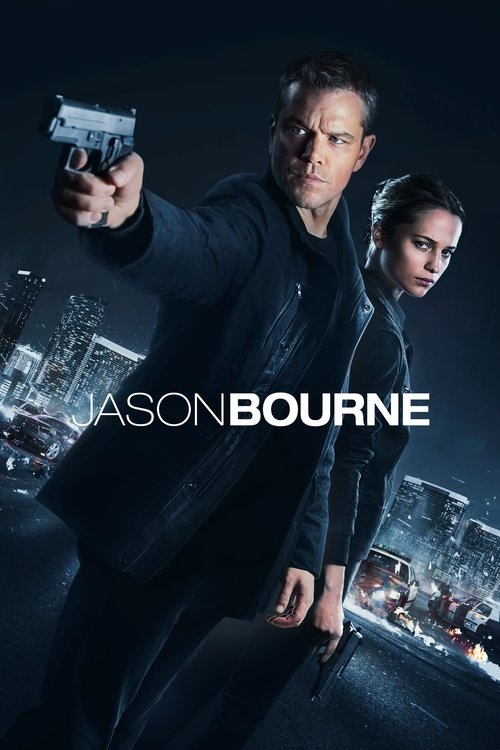
Jason Bourne
2016 · Paul Greengrass
For when you want pure kinetic thriller energy — chases, tradecraft and a hero who barely speaks. An easy, adrenaline-forward pick for action night; no need to remember much from the earlier films.
What it's about
Years off the grid, the CIA's most dangerous former operative is pulled back into the open when a hack of the agency's servers surfaces buried truths about his recruitment and his father. From an austerity riot in Athens to the neon of Las Vegas, Bourne is hunted by a new generation of the agency — a director with secrets to protect, an ambitious cyber chief, and a lethal asset with a personal grudge — while a tech mogul's deal with the CIA raises the stakes on mass surveillance.
The experience
Relentless and propulsive — handheld cameras, whip-fast cutting, chases that barely let you breathe. It's grim and terse rather than fun, a thriller that runs on momentum and paranoia.
Performances
Matt Damon plays Bourne almost wordlessly, all coiled physicality and haunted stillness, while Tommy Lee Jones brings weathered menace to the CIA director and Alicia Vikander is coolly unreadable as the agency's rising star.
The craft
Greengrass's documentary-style action grammar is at full power: the Athens riot sequence, staged amid tear gas and firelight, is a marvel of controlled chaos, and the Vegas finale sends an armored truck through a casino strip with bone-rattling weight. Loud speakers and a big screen do it justice.
Why it matters
It brought the franchise that redefined modern action filmmaking into the post-Snowden era, retooling its paranoia around mass surveillance and big tech — proof of how far the series' handheld style had reshaped the genre.
Snapshot
Jason Bourne is the fifth entry in Universal's Bourne franchise and the fourth to center on Matt Damon's amnesiac assassin, arriving nine years after The Bourne Ultimatum (2007) closed what had felt like a complete trilogy. Director Paul Greengrass and star Matt Damon, who had both publicly resisted returning without a story they believed in, came back together after sitting out the franchise's stopgap spin-off, The Bourne Legacy (2012). The result is at once a reunion and a recalibration: a film that re-applies Greengrass's documentary-derived action grammar to the post-Snowden landscape of mass surveillance, data harvesting, and social-media complicity. It is a study in diminishing dramatic returns wedded to undiminished technical command — a movie whose set pieces (an austerity riot in Athens, a brawl in London, an armored-truck demolition derby down the Las Vegas Strip) are executed with ferocious precision even as critics questioned whether Bourne had anywhere new to go.
Industry & production
The film exists because two men changed their minds. After Ultimatum, both Greengrass and Damon stated they considered Bourne's arc resolved, and Universal proceeded without them on The Bourne Legacy, written and directed by Tony Gilroy (who had scripted the earlier Bourne films) and headlined by Jeremy Renner as a different program operative, Aaron Cross. Legacy performed adequately but did not generate the cultural traction of the Damon films, and Universal's clearest path back to franchise health ran through its original star. Reporting at the time framed the reunion as contingent on Greengrass: Damon had repeatedly said he would only return if Greengrass did.
Greengrass developed the project with Christopher Rouse, the editor who had cut Supremacy and Ultimatum and won an Academy Award for the latter, and who here received a co-screenwriting and story credit alongside Greengrass — an unusually intimate writer-editor-director collaboration that reflects how thoroughly the Bourne films are constructed in the edit. Frank Marshall remained a producing anchor of the series. The production was a major-studio tentpole built for global release in summer 2016, and it performed as one commercially, earning a large worldwide gross that comfortably exceeded its budget and reaffirmed the franchise's international durability; I'd flag that I'm working from general recollection of the figures rather than citing a precise number. Universal positioned it as the return of the "real" Bourne, and the marketing leaned hard on the simple proposition of Damon back in the role.
Technology
Jason Bourne is, at the level of subject matter, a film about technology — specifically the surveillance apparatus that metastasized in the decade between Ultimatum and 2016. Where the original trilogy traded in cell-phone triangulation, CCTV, and the analog-era machinery of "asset" tracking, the 2016 film folds in the vocabulary of the Edward Snowden disclosures of 2013: bulk data collection, backdoors into consumer platforms, and the fusion of state intelligence with Silicon Valley. The plot's engine is a social-media company, "Deep Dream," whose idealistic founder Aaron Kalloor (Riz Ahmed) has secretly been funded by the CIA, which intends to use the platform for mass real-time surveillance under a program called "Iron Hand." This is the film's most contemporary gesture, and it dates it precisely to its moment of cultural anxiety about Facebook-scale platforms and the privacy-versus-security debate.
On the production-technology side, the film was captured digitally, which suited Greengrass and cinematographer Barry Ackroyd's reliance on long, mobile, available-light handheld takes; digital acquisition permits the extended rolling and the low-light latitude their vérité approach demands. (I'd note as a matter of record that I'm not certain of the exact camera package, so I won't assert a specific model.) The Las Vegas climax, with a SWAT-style armored vehicle plowing through traffic, combined large-scale practical stunt work with digital augmentation, in keeping with the franchise's preference for tangible, weighty vehicular destruction over weightless CGI spectacle.
Technique
Cinematography
The defining technical fact of the film is the handover of the camera. The first three Bourne pictures were shot by Oliver Wood, who codified the franchise's restless, grab-it-on-the-fly look. For Jason Bourne, Greengrass turned to Barry Ackroyd, his collaborator on United 93 (2006) and Green Zone (2010), and the cinematographer of Kathryn Bigelow's The Hurt Locker (2008). Ackroyd is one of the foremost practitioners of handheld, observational shooting, and the continuity of style across the cinematographer change is striking: the camera operates as a nervous, embedded participant, reframing constantly, snapping focus, catching action at the edges of the frame as if struggling to keep up with events it did not stage. The visual register is desaturated and functional, privileging the impression of reportage over composed beauty — a deliberate suppression of the "beautiful" image in favor of urgency and plausibility.
Editing
If the Bourne films have an auteur of technique, it may be the editor as much as the director. Christopher Rouse's cutting is the franchise's signature: extremely short average shot lengths, aggressive cross-cutting between geographically dispersed strands (the field, the control room, the surveillance feed), and an action grammar built from fragments that the viewer's mind reassembles into kinetic continuity. In Jason Bourne, Rouse — also co-writer — orchestrates the Athens riot sequence as a masterclass in parallel action, layering Bourne and Nicky's flight through the crowd against CIA operators watching on monitors, so that the chase is simultaneously physical and informational. The approach has its detractors, who argue the cut-rate disorientation substitutes velocity for legible space; its defenders read it as a coherent system in which the editing itself dramatizes the surveillance-state premise, the audience forever assembling meaning from partial feeds.
Mise-en-scène / staging
Greengrass stages action in real, crowded, contested public spaces — a riot, a packed conference, a casino, a city street — rather than the cleared, controlled arenas of conventional action cinema. The mise-en-scène is documentary in ambition: extras, traffic, and architecture are deployed to make violence feel like an intrusion into ordinary life. The control-room spaces, by contrast, are sleek, dark, glowing with screens, and the film cuts insistently between the analog chaos of the street and the antiseptic command of the watchers, a spatial argument about power and visibility that runs through the whole series.
Sound
The franchise's sonic identity rests on John Powell's propulsive, percussion-and-electronics score, carried over and extended here (with David Buckley sharing composing duties), and on Moby's "Extreme Ways," which has closed every Bourne film and functions as the series' aural signature — its arrival over the end credits a ritual payoff. Sound design favors impact and immediacy: the crunch of metal in the Vegas chase, the dense ambient roar of the riot, the clipped chatter of comms. The mix supports the editing's logic, using overlapping radio traffic and surveillance audio to bind the parallel strands.
Performance
Matt Damon plays Bourne with even greater taciturnity than before — the role has contracted to a near-silent engine of physical competence and wounded memory, and Damon reportedly has very few lines of dialogue. The performance is built on stillness, watchfulness, and explosive movement. Around him, the film stocks strong character actors: Tommy Lee Jones as the granite CIA director Robert Dewey, weaponizing his weariness; Alicia Vikander as Heather Lee, the ambitious young cyber-operations chief whose loyalties remain pointedly unresolved; Vincent Cassel as "the Asset," a Treadstone killer with a personal grudge; Julia Stiles returning as Nicky Parsons; and Riz Ahmed as the conflicted tech founder. Vikander's calibrated ambiguity is the film's most discussed performance, seeding a successor/antagonist whose arc the film leaves deliberately open.
Narrative & dramatic mode
The screenplay returns to the well of Bourne's origins, supplying a new piece of buried backstory: Bourne's father, Richard Webb (Gregg Henry), was an architect of the Treadstone program, and the revelation reframes Bourne's recruitment as something closer to a chosen, even patricidally entangled, act rather than a pure violation. This is the film's central dramatic gambit and also its most criticized: where the trilogy was driven by the forward question of who am I and who did this to me, Jason Bourne circles back to re-litigate identity that audiences may have felt was settled. The mode is paranoid thriller in the franchise's established key — pursuit, exposure, the peeling-back of institutional secrets — propelled less by character interiority than by momentum and reversal. The narrative braids three lines: Bourne's quest for the truth about his father, the CIA's internal power struggle (Dewey versus Lee), and the Deep Dream surveillance conspiracy, converging in Las Vegas.
Genre & cycle
The film belongs to the post-9/11 espionage-action cycle that the Bourne series itself helped define and that reshaped the genre around it — most visibly forcing the reinvention of James Bond, whose Casino Royale (2006) absorbed the Bourne template of grounded brutality and psychological damage. By 2016, that cycle had matured and proliferated, and Jason Bourne arrives as both progenitor and late entrant, competing against the very aesthetic it spawned. Within the action genre it sits on the "realist" pole — handheld, consequence-laden, allergic to quips and superheroics — even as the broader action marketplace had tilted toward the comic-book spectacle of the Marvel ascendancy. Its insistence on legible geopolitics and tactile violence reads, by 2016, as almost a throwback to its own earlier innovations.
Authorship & method
The Bourne films of the Greengrass era are the product of a tight, recurring creative unit, and Jason Bourne foregrounds that authorship. Greengrass brings the method he developed in dramatized-reality films — Bloody Sunday (2002), United 93 — in which handheld camera, improvisatory blocking, and rapid montage are marshaled to produce the texture of unfolding fact. His key collaborators here are unusually fused with the directing: Christopher Rouse, editor and co-writer, whose cutting is the action style and whose script credit makes him a genuine co-author; cinematographer Barry Ackroyd, whose embedded-documentary eye matches Greengrass's project precisely; and composer John Powell (with David Buckley), sustaining the franchise's musical DNA. The working method privileges construction in post-production — capturing abundant coverage of action staged in live environments, then building rhythm and meaning at the editing bench — making the film a director-editor artifact as much as a director's.
Movement / national cinema
The film is a transnational studio production with a distinctly British directorial sensibility — Greengrass and Ackroyd both emerged from British factual and television filmmaking, and the vérité aesthetic descends from that documentary tradition rather than from Hollywood's classical action style. Production roamed across European and American locations (Greece, the UK, the United States), and the franchise's worldview is pointedly globalist: borders are porous, surveillance is planetary, and the action treats the whole world as a single contested surface. It is American studio cinema inflected by a British realist lineage that runs back through Ken Loach (with whom Ackroyd worked extensively) to the documentary movement.
Era / period
Jason Bourne is firmly a film of the mid-2010s, legible only against the Snowden disclosures and the era's intensifying debate over digital privacy, platform power, and state surveillance. Its anxieties — that the tools of connection are also the tools of control, that Silicon Valley idealism masks complicity with intelligence agencies — are precisely those of 2013–2016. It also reflects the franchise economics of its moment: the studio impulse to revive dormant, pre-sold properties with their original stars, a legacy-sequel logic that defined much of mid-decade Hollywood. The film's reach backward into its own mythology, rather than outward into new terrain, is itself characteristic of the period's nostalgia-driven tentpole strategy.
Themes
The film's governing theme is surveillance and the erosion of privacy — the question of who watches, who is watched, and whether security and freedom can coexist. Deep Dream literalizes the bargain: a beloved consumer platform secretly weaponized for total observation. Threaded through this is the franchise's enduring concern with identity, complicity, and culpability: Bourne's discovery that his recruitment was bound up with his own father complicates the trilogy's clean narrative of a man victimized by the state, suggesting instead a deeper entanglement and a harder reckoning with his own choices. Institutional accountability — the rogue director, the internal struggle over methods, the younger operative weighing reform against ambition — supplies the political spine. Beneath it all runs the series' melancholy motif of a man who cannot stop, defined entirely by what was done to him and what he in turn has done.
Reception, canon & influence
Critical reception was mixed-to-positive, and notably cooler than for The Bourne Ultimatum, which is generally regarded as the series' high-water mark. Reviewers widely praised the technical execution — the Athens and Las Vegas sequences in particular — and Damon's and Vikander's performances, while expressing fatigue at a plot that seemed to retrace familiar ground, re-opening the question of Bourne's origins rather than advancing him. A recurring critical line held that the film was expertly made but creatively redundant, with some commentators also renewing the long-running debate about whether Greengrass and Rouse's hyperkinetic shaky-cam aids or obscures the action. Commercially it was a clear success, performing strongly worldwide and validating Universal's reunion strategy.
Looking backward, the film draws on the documentary-realist tradition Greengrass and Ackroyd inherited from British factual filmmaking, on the espionage-thriller lineage of writers like Robert Ludlum (author of the source novels, though the films long ago departed from his plots), and on the post-9/11 mood of institutional distrust. Looking forward, the influence that matters most belongs to the franchise as a whole rather than to this entry specifically: the Bourne template — grounded violence, handheld immediacy, a damaged and competent protagonist, geopolitically literate paranoia — reshaped the action and spy genres across the 2000s and 2010s, most famously catalyzing the Daniel Craig–era reinvention of James Bond and influencing countless imitators. Jason Bourne itself, as a legacy sequel, contributed less in the way of new innovation; its open ending with Vikander's Heather Lee gestured toward a continuation that, as of this writing, did not materialize on screen, leaving the 2016 film as the most recent — and, in the critical consensus, a competent but lesser — chapter in one of modern Hollywood's most influential action franchises.
A Deleuzian reading
Athens.
The full Deleuzian reading of Jason Bourne →
Reception
Landed in 2016 to a shrug — big opening weekend, but critics and fans called it a greatest-hits rehash of the trilogy, and a decade on it's settled firmly as the Damon-era entry nobody revisits, cited as Exhibit A that some franchises should stay ended.
How Jason Bourne was received, from release to now →
Influences: the films it descends from and the films it influenced
- The Battle of Algiers (1966) — Pioneered the newsreel-grain, grainy-monochrome staging of insurgency and pursuit through real, crowded public squares — the documentary-as-fiction texture and contested-public-space blocking the Bourne unit later weaponizes in Athens and Tangier.
- The French Connection (1971) — Established American vérité action: stolen-on-location handheld shooting and a chase cut for raw immediacy rather than geographic clarity, the grounded urban-pursuit grammar Greengrass and Rouse inherit directly.
- Z (1969) — Fused reportage realism with rapid, percussive montage to dramatize political conspiracy — the model for cutting a paranoid institutional thriller at the tempo of breaking news.
- The Parallax View (1974) — Built the lone-operative-versus-opaque-institution architecture, the deadpan dread of a protagonist who can't see the system hunting him — the paranoid-thriller skeleton under Bourne's plotting.
- Three Days of the Condor (1975) — Originated the analyst-versus-his-own-agency surveillance thriller with intercut command-room handlers tracking the fugitive, the control-room-counterpoint structure Bourne runs almost beat for beat.
- The Conversation (1974) — Made surveillance tradecraft itself the formal subject — wiretaps, intercepts, the watched-watcher — the mass-surveillance anxiety Bourne updates to NSA-era data feeds.
- Bloody Sunday (2002) — Greengrass's own dramatized-reality method in embryo: improvisatory blocking, available-light handheld camera, and editing that simulates the texture of unfolding fact — the toolkit he ports wholesale into the franchise.
- United 93 (2006) — Perfected real-time cross-cutting between cockpit chaos and air-traffic/military control rooms — the precise control-room-counterpoint editing rhythm that organizes every Bourne set piece.
- The Bourne Ultimatum (2007) — The direct progenitor: Christopher Rouse's Eddie-cut action style, the Waterloo Station surveillance ballet, and the near-silent competent protagonist that the 2016 film reassembles from the same parts.
- Casino Royale (2006) — The Bourne template's clearest catalysis: it strips Bond of glamour and gadgets for a damaged, physically grounded, competent operative and bone-real violence — the reinvention explicitly chasing Bourne's realism.
- Quantum of Solace (2008) — Transplants Bourne's rapid-montage, fragmented handheld action grammar onto Bond outright — overlapping second-unit/stunt personnel and all — the most literal stylistic imitation of the franchise.
- Zero Dark Thirty (2012) — Extends the desaturated, available-light surveillance-procedural mode and intercuts intelligence command rooms with field operations, climaxing in a raid cut for embedded-camera realism rather than spectacle.
- The Hurt Locker (2008) — Shot by Barry Ackroyd using the same embedded multi-camera handheld coverage — capturing abundant live-environment footage to be rhythmically constructed at the bench — making it a DP-method twin of the Bourne films.
- Green Zone (2010) — The same unit — Greengrass, Ackroyd, Rouse, Damon — applying the handheld-vérité combat and geopolitically literate paranoia to the Iraq War, a non-franchise sibling built from identical craft DNA.
- Captain Phillips (2013) — Ackroyd's available-light handheld immediacy cross-cut against Navy command-and-control rooms — the control-room-counterpoint and near-documentary tension method, refined for a true-event thriller.
- Sicario (2015) — Stages tactical operations in contested public/border spaces against a percussion-and-electronics dread score (Jóhann Jóhannsson), with command-room handlers counterpointed against the field — the same staging-plus-sound architecture in a 2010s register.
- The Bourne Legacy (2012) — The direct descendant that reabsorbed the franchise's original face, retaining Legacy's agency-oversight-and-asset-disposal apparatus while reverting to Greengrass's kinetic cutting — the road taken instead of Cross.
Similar films
- The Bourne Ultimatum (2007) — influence & lineage
- Green Zone (2010) — influence & lineage
- Casino Royale (2006) — influence & lineage
- Quantum of Solace (2008) — influence & lineage
- The Bourne Supremacy (2004) — shared sensibility
- The Bourne Identity (2002) — shared sensibility
- The Bourne Legacy (2012) — shared sensibility
- Safe House (2012) — shared sensibility