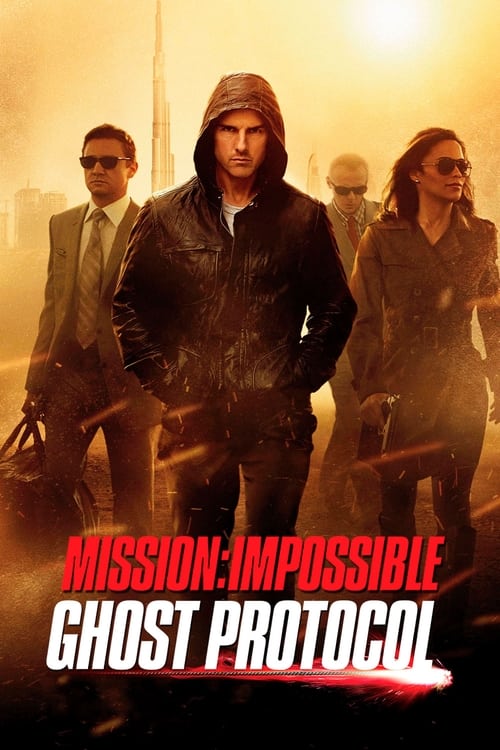
Mission: Impossible - Ghost Protocol
2011 · Brad Bird
For when you want a flawless popcorn night — the reach-for-it movie when you need two hours of grins and vertigo. Zero homework, maximum ride.
What it's about
After a bombing at the Kremlin is pinned on the Impossible Mission Force, the agency is disavowed and Ethan Hunt's small team is cut loose — no backup, no resources, gadgets that keep failing — to stop an extremist racing toward nuclear launch codes. The chase sprints from Moscow to Dubai to Mumbai, with the team improvising every step.
The experience
Pure kinetic pleasure: fast, funny, and engineered to make your palms sweat, especially during the skyscraper sequence that people still talk about. It never stops moving, but it's playful rather than punishing.
Performances
Tom Cruise's commitment is the special effect — he actually scaled the Burj Khalifa, the world's tallest building, and the film's most famous sequence gets its charge from that reality. Simon Pegg's nervy comic energy keeps the whole thing buoyant.
The craft
Brad Bird's first live-action film, and he directs the set-pieces like precision clockwork — the Dubai tower climb, shot on large-format IMAX cameras, is one of the great vertigo sequences in modern movies. Practical stunts over digital trickery throughout; if any film demands the biggest screen and best sound you can find, it's this one.
Why it matters
The entry that turned a wobbly franchise into a durable institution, establishing the escalating real-stunt spectacle that defined the series — and blockbuster action ambitions — for the next decade.
Snapshot
Mission: Impossible – Ghost Protocol is the fourth entry in Paramount's Tom Cruise–anchored espionage franchise and, in the longer view, the film that converted a wobbly series into a durable, decade-spanning institution built around practical, escalating stunt set-pieces. Its headline conceit is structural: an attack on the Kremlin is pinned on the Impossible Mission Force, the agency is disavowed under the "Ghost Protocol" directive, and Ethan Hunt's team is cut loose to chase a nuclear-extremist named Hendricks with no backup, no resources, and malfunctioning gadgets. The film is best remembered for a single sequence — Cruise scaling the exterior of Dubai's Burj Khalifa, the world's tallest building, captured on large-format IMAX film — and for being the live-action directorial debut of Brad Bird, who arrived from Pixar. It is a transitional object in modern blockbuster history: the moment the franchise's identity crystallized around verifiable, body-on-the-line spectacle and globe-trotting clarity rather than the auteur-of-the-moment reinventions that had defined the first three installments.
Industry & production
The picture sits at a specific inflection point for both Paramount and the franchise. The series had been built as a director's showcase — Brian De Palma (1996), John Woo (2000), and J.J. Abrams (2006) each stamped an entry — and Mission: Impossible III had underperformed relative to expectations while Cruise's public standing was unusually fraught in that period. Ghost Protocol was developed by Abrams's Bad Robot, with Abrams producing alongside Cruise and Bryan Burk, and was written by Josh Appelbaum and André Nemec, both veterans of Abrams's television series Alias — a lineage visible in the film's brisk, team-based mission mechanics. The decisive production gamble was hiring Bird, who had never shot live action, to direct a major effects-and-stunt tentpole. The choice paid off; the film became the highest-grossing entry in the series to that point and re-established Mission: Impossible as a reliable theatrical event, a status the subsequent entries (with Christopher McQuarrie) consolidated.
Production was genuinely global, with principal photography spanning Prague, Dubai, Bangalore and Mumbai (standing in for the film's Indian sequences), Vancouver, and elsewhere. The Dubai shoot is the production's signature: Paramount secured access to the then-newly-opened Burj Khalifa, and Cruise performed the tower climb himself, harnessed on wires that were later removed in post, working at heights on the building's exterior. The willingness to organize an entire marquee sequence around a real performer at a real altitude — rather than a green-screen substitute — became the franchise's defining production philosophy from this film forward.
Technology
Ghost Protocol is a landmark in the mainstreaming of IMAX as a production (not merely exhibition) format for narrative cinema. Roughly a quarter of the film — anchored by the Dubai material — was shot with large-format IMAX 15-perf 65mm cameras, with the remainder on conventional 35mm. This predates the wider 2010s adoption of IMAX origination by Christopher Nolan and others, and the film's release was itself a technological event: Paramount used its IMAX engagements to premiere the first prologue footage of The Dark Knight Rises, binding the two films together as proof-of-concept for large-format blockbuster spectacle. The aspect-ratio expansion in IMAX scenes — the image opening up to fill the taller frame during the tower climb — was deployed as a deliberate dramatic device, making scale itself legible to the audience.
Within the story, technology is treated with knowing comedy. The film's gadgets — adhesive climbing gloves, a holographic projection screen that disguises a corridor, magnetic-levitation rigs, contact-lens cameras — are consistently shown failing at the worst possible moment ("Blue is glue… the gloves are not working"), a running joke that converts the spy-gear fantasy into a source of suspense rather than reassurance. This anxiety about unreliable tools is the film's most distinctive contribution to the franchise's texture.
Technique
Cinematography
The most telling craft decision is the hiring of Robert Elswit, Paul Thomas Anderson's regular cinematographer and an Academy Award winner for There Will Be Blood, to shoot a stunt-driven action film. Elswit brings compositional rigor and a preference for clean, comprehensible space; the photography favors wide framings that hold the performer and the hazard in the same shot, so the audience reads geography and risk directly. The Dubai sequence's IMAX photography emphasizes verticality and the dizzying drop, using the format's resolution and frame height to register genuine altitude. The Russian and Indian sequences are handled with a controlled, glossy clarity rather than the desaturated, handheld idiom common to the era's action cinema.
Editing
Paul Hirsch — an editor whose credits reach back to the original Star Wars, for which he shared an Oscar — cut the film. The editing is notable within its genre for legibility: action is assembled to preserve continuity of space and cause-and-effect, with the Dubai climb and the climactic Mumbai automated-parking-garage fight built around sustained, readable beats rather than the fragmented, sub-second cutting that dominated post-Bourne action filmmaking. This clarity is widely credited as a Bird-driven sensibility, and the cutting serves it.
Mise-en-scène / staging
Staging is where Bird's animation background is most visible. The action is choreographed for spatial clarity — entrances, exits, sightlines, and the physical relationship between characters and threats are established before chaos erupts, so that complications land as comprehensible reversals. The Dubai sandstorm car chase, the Kremlin infiltration with its holographic-screen ruse, and the vertiginous parking-structure finale all depend on the audience always knowing where everyone is. This "draw the map first" discipline — knowing the geography of a set-piece and then breaking it — is a hallmark of Bird's Pixar action sequences (notably The Incredibles) carried directly into live action.
Sound
Michael Giacchino's score reworks Lalo Schifrin's iconic 5/4 Mission: Impossible theme into propulsive orchestral action writing while supplying the film's own motifs. The sound design leans on the franchise's signature tension-and-release rhythm: long stretches of near-silence and isolated diegetic detail during the climb (wind, the creak of suction gloves, breathing) punctuated by orchestral surges. The sandstorm sequence in particular uses dense, enveloping sound to disorient.
Performance
Cruise's performance is as much physical as dramatic; the film's meaning is partly indexed to the audience's knowledge that the actor is genuinely performing the stunts. Around him the film assembles an unusually strong ensemble: Jeremy Renner as analyst Brandt (introduced partly as a possible franchise successor), Simon Pegg expanded from a cameo in the prior film into the comic-technical heart of the team, and Paula Patton as Jane Carter, whose arc carries the film's vein of grief and revenge. Swedish actor Michael Nyqvist plays the antagonist Hendricks with cold restraint, and Anil Kapoor, Léa Seydoux, Tom Wilkinson, and a cameo by Ving Rhames round out the cast.
Narrative & dramatic mode
The screenplay runs on the franchise's established engine — the assembled team, the elaborate infiltration, the betrayal-and-reversal — but tightens it around a survival premise: with the IMF disavowed, the heroes operate without institutional cover, which raises the stakes and licenses the gadgets-fail comedy. The dramatic mode is mission-procedural laced with set-piece spectacle and an undercurrent of personal loss (Hunt's imprisonment and the fate of his wife, threaded from the previous film; Carter's bereavement). The structure is essentially a chain of discrete, escalating operations — Moscow, Dubai, Mumbai — each a self-contained suspense module, a design inherited from the series' television origins and from the Alias sensibility of its writers. Renner's Brandt carries a concealed-backstory subplot that adds a note of guilt and moral complication to the otherwise clean heroics.
Genre & cycle
The film is a globe-trotting espionage-action thriller operating squarely in the post-millennial spy cycle then dominated by the Bourne series and the rebooted James Bond. Where Bourne offered gritty realism and fragmented handheld action, Ghost Protocol positioned Mission: Impossible as the spectacle-forward alternative — bigger, cleaner, more openly pleasurable, organized around a single impossible physical feat per film. It belongs to the early-2010s wave of franchise reactivation, but its lasting genre contribution is the "practical stunt as headline" model: the marketing, the IMAX strategy, and the storytelling all converge on a real, dangerous act performed by the star.
Authorship & method
The film is a study in importing authorship across media. Brad Bird, an animation director (The Iron Giant, The Incredibles, Ratatouille), brought a feeling for clear spatial choreography, comic timing, and escalating mechanical complication into live action, and is widely credited with the franchise's renewed emphasis on legibility and practical stakes. He worked with collaborators of unusual pedigree for an action tentpole: cinematographer Robert Elswit (Paul Thomas Anderson's DP), editor Paul Hirsch (Star Wars), and composer Michael Giacchino, Bird's long-standing musical partner from his Pixar features. The screenplay is by Josh Appelbaum and André Nemec, carried over from Abrams's Alias writers' room. Over all of it sits the producing partnership of Tom Cruise and J.J. Abrams's Bad Robot, the structure that would define the franchise going forward — Cruise as star-producer-stuntman and a rotating director given room to stamp the film while the practical-stunt ethos remains constant.
Movement / national cinema
This is a Hollywood studio blockbuster and not part of any art-cinema movement, but its production identity is aggressively transnational. The film's locations and partial financing reflect the early-2010s globalization of the tentpole — Dubai functions both as a real location and as a symbol of the global capital underwriting the new blockbuster economy, and the Indian sequences (Mumbai, Bangalore) court an increasingly important international market. The hiring of a Swedish lead villain and a French and Indian supporting cast is of a piece with the era's drive to build films legible and appealing across many territories.
Era / period
Ghost Protocol is a quintessential early-2010s release, arriving in December 2011 at the moment IMAX origination, practical-stunt marketing, and franchise reactivation were converging into the dominant blockbuster grammar of the decade. It belongs to the same cultural instant as the run-up to The Dark Knight Rises (with which it shared its IMAX premiere) and the consolidation of the "cinematic event" built on theatrical scale that streaming had not yet challenged. It also marks the rehabilitation of Cruise as a bankable global star after a turbulent stretch, repositioning him specifically as cinema's foremost practitioner of real, physical risk.
Themes
Beneath the spectacle, the film is preoccupied with institutional abandonment and self-reliance — the IMF disavowed, the team forced to improvise without state backing, a post-2008 anxiety about systems that fail their own people. A second, almost reflexive theme is the unreliability of technology: nearly every gadget malfunctions, so triumph repeatedly depends on improvisation, nerve, and the body rather than the device — a thesis the production literalizes through Cruise's real stunt work. Threaded through the ensemble are motifs of grief, guilt, and redemption (Carter's loss, Brandt's concealed failure, Hunt's separation), giving the kinetic surface a modest emotional ballast. The villain's nuclear-apocalypse scheme is treated less as ideology than as a pure abstraction of annihilation, keeping the moral universe simple so the suspense can stay physical.
Reception, canon & influence
Critically and commercially, Ghost Protocol was received as a revitalization — broadly praised for the clarity and impact of its set-pieces, the freshness of Bird's staging, and the audacity of the Burj Khalifa sequence, and it became the highest-grossing entry in the franchise to that date. Looking backward, the film draws on the series' television roots and the Alias team-mission template, on the Bourne/Bond spy cycle it defines itself against, and on Bird's own animated action choreography; the IMAX strategy builds on the large-format experiments that Nolan and IMAX had been advancing. Looking forward, its influence on the franchise is foundational: it established the formula — one real, escalating, star-performed practical stunt as the spine of each film — that Christopher McQuarrie carried through Rogue Nation, Fallout, and the Dead Reckoning films, and it cemented Cruise's late-career identity as an evangelist for theatrical, practically-executed spectacle. More broadly, Ghost Protocol helped normalize IMAX-origination and the "the star really did that" marketing logic that shaped a decade of event filmmaking, and it stands as the proof that an animation director's command of staged action could translate, intact, into live-action blockbuster form.
A Deleuzian reading
Start with the glove.
The full Deleuzian reading of Mission: Impossible - Ghost Protocol →
Reception
Landed in 2011 as a genuine surprise — the fourth entry in a franchise many assumed was winding down turned out to be its best-reviewed yet. It's now widely credited as the film that rebooted Mission: Impossible into the last great blockbuster series, kicking off the run that led to Rogue Nation and Fallout.
How Mission: Impossible - Ghost Protocol was received, from release to now →
Influences: the films it descends from and the films it influenced
- The Incredibles (2004) — Bird's animated action grammar — geographically legible space, escalating mechanical complication, and comic-timed beats inside a set-piece — is imported intact, the proof-of-concept that an animation director's command of staged action translates to live action.
- The Iron Giant (1999) — Establishes Bird's insistence on clear scale-of-bodies-in-space staging so the viewer always reads relative size, distance, and threat — the legibility principle GP applies to the Burj Khalifa exterior.
- Ratatouille (2007) — Cemented Bird's working partnership with composer Michael Giacchino and a fluid camera that threads through complex three-dimensional architecture, both carried directly into Ghost Protocol.
- Mission: Impossible (1996) — The Langley vault break-in's silence-and-surge dynamics and suspended-body precision, plus the first major rework of Schifrin's theme, set the template GP extends in its server-room and tower sequences.
- Mission: Impossible III (2006) — Installed the Bad Robot / Cruise star-producer structure and the Alias-derived episodic mission-module screenplay logic (Appelbaum & Nemec) that GP inherits wholesale.
- Safety Last! (1923) — Harold Lloyd dangling on a building face, hazard and performer sharing one wide unbroken frame, is the direct silent-comedy ancestor of the Burj Khalifa climb's framing logic.
- The General (1926) — Keaton performing genuine physical stunts in sustained wide shots — no cutting away to hide the body — is the origin of the 'the star really did that' verifiability GP builds its spectacle on.
- On Her Majesty's Secret Service (1969) — Alpine practical-stunt spectacle and gadget-mission architecture define the Bond spy-cycle grammar GP positions itself against while borrowing its set-piece scale.
- The Dark Knight (2008) — Pioneered originating blockbuster set-pieces on IMAX 65mm with an expanding aspect ratio for select sequences — the exact large-format strategy GP adopts for its marquee scenes.
- Mission: Impossible – Rogue Nation (2015) — Carries forward GP's formula of a single real, escalating, star-performed practical stunt as the film's spine, here Cruise clinging to the A400M at takeoff.
- Mission: Impossible – Fallout (2018) — Extends the practical-stunt-headline model with Cruise's actual HALO jump and helicopter chase, shot for the same spatial legibility on large-format cameras.
- Mission: Impossible – Dead Reckoning Part One (2023) — The motorcycle base-jump off a cliff is the latest iteration of the GP-established one-real-escalating-stunt centerpiece marketed on its authenticity.
- Top Gun: Maverick (2022) — Generalizes Cruise's GP-forged evangelism for theatrical practical spectacle, with IMAX-certified in-cockpit photography capturing real G-loaded flight rather than simulation.
- Mission: Impossible - The Final Reckoning (2025) — Codifies the modern Cruise methodology of putting the real star on a real structure at real height — the Burj Khalifa climb shot IMAX on the actual tower — which becomes the in-camera, no-double doctrine the Final Reckoning is built to consummate.
- The Bourne Ultimatum (2007) — The fragmented handheld shaky-cam action grammar GP deliberately repudiates, choosing spatial-continuity legibility precisely as the counter-statement to Bourne's chaos cinema.
- Mad Max: Fury Road (2015) — Shares GP's commitment to practical vehicular stunts staged with axial, centered-frame clarity so every collision reads cleanly — legibility as the antidote to incoherent modern action.
- Skyfall (2012) — The contemporaneous Bond reset toward legibly-staged practical set-pieces (via Roger Deakins) in the same early-2010s large-format event-film mode GP helped define.
- The Bourne Supremacy (2004) — Shares the post-Bourne turn toward practical, real-location stunt work and deglamorized institutional intrigue, while pushing back with clearer geographic editing.
- The Bourne Legacy (2012) — A contemporaneous sibling that inherited Bourne's globe-trotting, agency-disavowed-its-own-agents structure and grounded stunt-realism, contesting the same franchise-spycraft space Legacy entered.
- Train to Busan (2016) — Demonstrates the animator-turned-live-action director's gift for legible spatial geometry in action, framing each set piece so audiences always read the threat's position — the storyboard-clear staging discipline Yeon carries from animation into the tactical carriage sequences.
Similar films
- Mission: Impossible - Fallout (2018) — influence & lineage · often watched together
- Mission: Impossible (1996) — influence & lineage · often watched together
- Mission: Impossible III (2006) — influence & lineage · often watched together
- Top Gun: Maverick (2022) — influence & lineage · often watched together
- Mission: Impossible - Dead Reckoning Part One (2023) — influence & lineage
- Skyfall (2012) — influence & lineage
- The Bourne Ultimatum (2007) — influence & lineage
- Source Code (2011) — same viewing thread
All the films related to Mission: Impossible - Ghost Protocol →
Watch it with: curated runs of related films
- Inside the Security State — A run of modern espionage and national-security thrillers — globe-trotting spycraft, submarine brinkmanship, and the paper trail behind the black sites — where operatives and investigators race secretive institutions and catastrophic clocks.