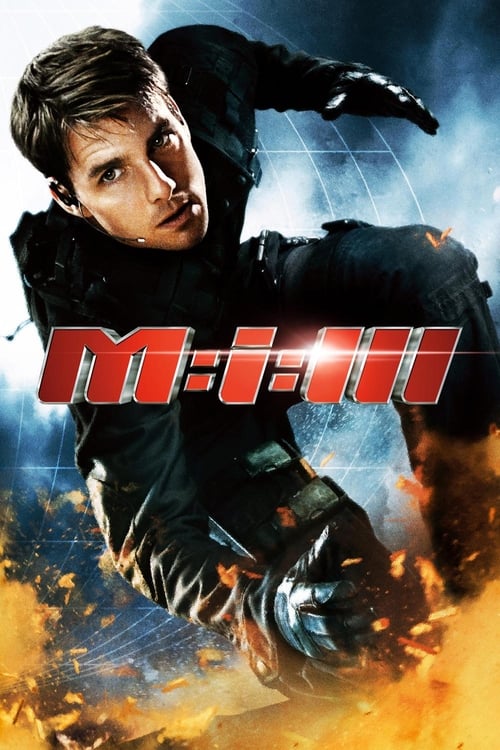
Mission: Impossible III
2006 · J.J. Abrams
For a full-throttle action night when you want spectacle that still makes you care — popcorn viewing with an unexpected pulse. Pure comfort for thriller fans.
What it's about
Ethan Hunt has retired from fieldwork to train recruits and build a normal life with the woman he loves — until a ruthless arms and information broker named Owen Davian forces him back in. The mission spans Berlin, the Vatican, and Shanghai, but the real stakes are personal: Davian knows exactly what Hunt has to lose, and intends to use it.
The experience
Relentless and surprisingly emotional for a blockbuster — it opens at maximum intensity and never lets the tension fully drain, because for once the danger feels aimed at someone the hero actually loves. Fast, brutal, and genuinely gripping.
Performances
Philip Seymour Hoffman is the reason to watch: his Davian is quiet, bored, and utterly terrifying — menace without a single raised eyebrow, and one of the great modern action villains. Cruise matches him by playing desperation instead of cool.
The craft
J.J. Abrams's feature debut brings television's intimacy to blockbuster scale — handheld urgency, tight faces mid-chaos, and set pieces (a bridge ambush, a Vatican infiltration) built on tension rather than gloss. It's loud, kinetic, and made for good speakers.
Why it matters
The film that reset the franchise's formula — personal stakes driving global spectacle — and launched Abrams as a feature director; everything the series became starts here.
Snapshot
Mission: Impossible III is the film on which the franchise found the formula it would ride for the next two decades: a globe-spanning espionage spectacle anchored to an emotional stake rather than a geopolitical one. It is also a debut — the first feature directed by J.J. Abrams, recruited by star-producer Tom Cruise off the strength of his television work, and it bears the unmistakable signatures of that television apprenticeship: kinetic intimacy, ensemble texture, a fondness for the cold open as a structural detonator, and a willingness to put the hero's domestic life at the center of an action picture. Where Brian De Palma's 1996 original had been a paranoid puzzle-box and John Woo's M:I-2 (2000) a balletic excess of slow-motion and doves, Abrams's film recalibrated the series toward grounded brutality and personal jeopardy. Its most durable contribution to film culture is arguably not a set piece but a performance: Philip Seymour Hoffman's Owen Davian, a soft-spoken, affectless arms broker whose menace operates at conversational volume. The picture sits at a hinge point in Cruise's career and in Paramount's relationship with its biggest star, and it set the template — team-based, MacGuffin-driven, sincerity over irony — that Ghost Protocol and after would refine.
Industry & production
The film's production history is among the most protracted of any modern studio tentpole, and the record here is well documented. After M:I-2, Paramount sought a third installment for years. David Fincher was attached at one stage and departed; Joe Carnahan then developed the project for roughly a year and a half, reportedly with a darker conception and casting that did not survive, before exiting over creative differences shortly before a planned shoot. Cruise, who produces the series through his and Paula Wagner's banner, then turned to Abrams, whose series Alias (a spy show with a strong family-melodrama undercurrent) and Lost had impressed him. Abrams agreed on the condition that the start date accommodate his completion of Lost's first season, and the project was reconceived around his sensibility.
The release context is inseparable from the film's commercial story. M:I III arrived in 2006 amid an unusually intense period of public scrutiny of Cruise — his vocal Scientology advocacy, his televised behavior including the widely circulated Oprah appearance, and a generally hostile celebrity-press climate. Industry coverage at the time widely attributed a softer-than-expected domestic opening to that backlash, and the film became the lowest-grossing entry of the first three in the United States even as it performed more strongly overseas (precise figures should be checked against a reliable source rather than asserted from memory). The aftermath was consequential: later that year, Sumner Redstone's Viacom/Paramount publicly ended its long-standing production arrangement with Cruise's company, a rupture explicitly framed in the trade press around Cruise's conduct and the film's perceived underperformance. Cruise and Wagner subsequently took over United Artists. In that sense M:I III is a film whose business narrative — the fraying of one of Hollywood's most lucrative star-studio partnerships — looms nearly as large as its text.
Technology
M:I III is a film of the late-photochemical, pre-digital-capture era for big-budget action: it was shot on 35mm film, and its spectacle is built primarily from practical stunt work, location shooting, and physical effects, supplemented rather than supplanted by digital compositing. The franchise's defining promise — that Cruise performs his own stunts — is present here in earlier, less extreme form than the later, IMAX-driven installments, but the commitment is visible in the bridge sequence and the building-to-building work. Digital tools are deployed mostly for invisible augmentation: wire and rig removal, environment extension, and the seamless joining of disparate shooting locations into single fictional spaces. The film also foregrounds gadget-technology as narrative furniture in the series tradition — most memorably the latex face-and-voice masking that lets the team impersonate Davian, and a small intracranial explosive charge that supplies a literal ticking clock. These devices are diegetic rather than production-technological, but they are characteristic of the franchise's fascination with the prosthetic and the counterfeit.
Technique
Cinematography
Dan Mindel, who would become a frequent Abrams collaborator (continuing into Star Trek and Star Wars: The Force Awakens), shot the film, and his work establishes the visual grammar of Abrams's cinema in embryo: handheld and operator-driven camerawork that stays close to faces, a preference for long lenses that compress and isolate, and a high-contrast, sometimes flared treatment of light sources. The look is grittier and more desaturated than Woo's glossy M:I-2, leaning toward a documentary-inflected immediacy in the action and a warmer, shallower intimacy in the domestic scenes. The locations — Rome and the Vatican, the Chesapeake Bay Bridge, Shanghai and the canal town of Xitang, Berlin and Virginia — are photographed for textural specificity, and the camera's restlessness keeps even expository sequences charged.
Editing
The cutting, by Maryann Brandon and Mary Jo Markey — Abrams's regular editors from his television work — is central to the film's identity. The picture opens in medias res on its most harrowing scene (Davian threatening Hunt's wife) and then flashes back, a structural gambit imported directly from serialized television and used to load the entire film with dread. Throughout, the editors favor rapid, propulsive assembly in the action while retaining spatial legibility, and they orchestrate the film's signature device — intercutting parallel lines of jeopardy against a countdown — to maximize tension. The bridge attack and the Shanghai climax are exercises in sustained cross-cutting that keep multiple threats and the emotional stake alive simultaneously.
Mise-en-scène / staging
Abrams stages the film around a recurring contrast between institutional spaces — IMF briefing rooms, the cold geometry of corridors and vaults — and the warmth of domestic interiors, with the wedding/engagement-party milieu functioning as the emotional baseline the plot then violates. The action set pieces are conceived as discrete, escalating operations: the German warehouse rescue, the Vatican infiltration (with its disguises and a fabricated identity), the freeway-and-bridge ambush during a prisoner transfer, and the Shanghai high-rise heist and pursuit. Each is staged with the heist genre's pleasure in process — planning, execution, complication — and the staging consistently subordinates spectacle to consequence, returning the film to its human stake.
Sound
Michael Giacchino's score is one of the film's most important authorial decisions. Coming from Abrams's television collaborations (Alias, Lost), Giacchino took over a franchise whose musical identity had been Lalo Schifrin's iconic theme as filtered through Danny Elfman (1996) and Hans Zimmer (2000). Giacchino's approach — propulsive, percussive, and reverent toward Schifrin's original while integrating it more thoroughly into the dramatic fabric — established him as the series' musical voice for the films that followed. The sound design otherwise serves the film's grounded intent: weighty, concussive effects for the action and a restrained mix that lets the quiet menace of the Davian scenes register through performance rather than scoring.
Performance
Cruise's Ethan Hunt is here at his most domestically vulnerable, playing fear and grief as openly as competence — a deliberate softening of the franchise's hero. But the performance the film is remembered for is Hoffman's. Cast against the action-villain type, Hoffman plays Davian with a flat, bored cruelty, his most chilling moments delivered at low volume; the cold-open threat, in which he calmly promises to kill the woman Hunt loves while counting, is built entirely on his restraint. The ensemble is deep and reflects Abrams's instinct for company players: Ving Rhames returns as Luther Stickell; Michelle Monaghan plays Julia, the wife whose existence reorients the series; Keri Russell (Abrams's Felicity lead) appears as the doomed agent Lindsey; and the supporting roster includes Billy Crudup, Laurence Fishburne, Jonathan Rhys Meyers, Maggie Q, and — in a franchise-defining debut — Simon Pegg as the technician Benji Dunn, a small comic part that later films would expand into a central role.
Narrative & dramatic mode
The film's dramatic mode is melodrama wearing the clothes of the espionage thriller. Its governing question is not "will the plot be foiled?" but "can Ethan Hunt protect, and keep, the life he has tried to build outside the work?" The MacGuffin — the never-explained "Rabbit's Foot" — is openly acknowledged as a pretext; the film's sincerity is reserved for the marriage. This is the Alias logic transposed to the big screen: the spy whose secret life poisons the domestic one, the agency as a family that competes with the literal family, and betrayal-from-within (the mole plot) as the engine of suspense. The cold-open-then-flashback structure converts the entire running time into a countdown to a scene the audience has already glimpsed, and the recurring motif of disguise and counterfeit identity literalizes the film's theme of a man who can be anyone except, safely, himself.
Genre & cycle
As an entry in the post-Bourne moment of the spy film, M:I III participates in the mid-2000s turn toward grounded, physical, morally shadowed espionage — the same current that produced The Bourne Supremacy (2004) and, the same year, Casino Royale (2006). Within its own franchise it functions as a course correction and a reset: it disciplines the operatic excess of Woo's installment and reorients the series around team dynamics and personal stakes, the formula that Ghost Protocol (2011) would perfect. It is simultaneously a heist film, a hostage thriller, and a domestic melodrama, and its comfort moving between these registers is a large part of what made the Mission: Impossible brand newly elastic.
Authorship & method
The dossier's clearest authorial throughline is the migration of a television showrunner's methods into blockbuster filmmaking. Abrams co-wrote the screenplay with Alex Kurtzman and Roberto Orci, his Alias writers, and surrounded himself with his television collaborators: editors Brandon and Markey, composer Giacchino, and later cinematographer Mindel on subsequent projects. The result is a film whose "authorship" is genuinely collaborative and brand-shaped — Cruise's producorial control over the franchise is decisive, and each Mission film is to a significant degree an auteur showcase for its director under Cruise's umbrella — yet M:I III is legibly Abrams's: the cold open, the family-versus-mission melodrama, the mystery-box withholding (the Rabbit's Foot as pure unexplained object), and the casting of trusted ensemble players. It is the film in which Abrams's signature sensibility — emotional sincerity dressed in genre machinery — first reached a mass cinema audience, immediately before Star Trek (2009) made it his defining brand.
Movement / national cinema
The film is a product of the American studio blockbuster system at its most globalized: financed and distributed by Paramount, conceived for a worldwide market, and shot across Europe, the United States, and China. Its use of Shanghai and the canal town of Xitang reflects the period's growing orientation of Hollywood tentpoles toward international, and specifically Asian, locations and audiences — a commercial logic that would intensify across the franchise. It belongs to no national "movement" in the art-cinema sense; its lineage is the transnational action spectacle, and its most relevant context is the industrial one of the global event picture.
Era / period
M:I III is a quintessential mid-2000s blockbuster: late-photochemical capture, practical-stunt spectacle augmented by maturing digital compositing, and a marketplace still organized around the movie star as the primary attraction — precisely the model whose fragility the film's own commercial fortunes exposed. It arrives at the moment the spy genre was being collectively grounded and de-glamorized, and at the moment when celebrity culture and tabloid scrutiny had become powerful enough to shape a major film's reception. It is, in retrospect, a transitional object: the last Mission film made before the franchise's stunt-spectacle escalated to the IMAX-scale, set-piece-driven identity of the 2010s.
Themes
The film's central theme is the irreconcilability of the secret life and the shared one — the cost, to intimacy, of a vocation built on deception. Disguise, masking, and impersonation recur as both plot mechanism and metaphor: the team's literal face-swapping mirrors Hunt's inability to be honestly present in his marriage. Trust and betrayal structure the mole plot, indicting the institution that is supposed to be a surrogate family. And the film is preoccupied with the body as a site of vulnerability — the explosive charge in the skull, the threat to the spouse — insisting, against the genre's usual invincibility, that its hero and those he loves can be hurt. Underlying all of it is a melodramatic faith in the domestic as the thing worth saving, which the franchise's grandiose plotting exists mainly to threaten.
Reception, canon & influence
Critically, the film was generally well received, with particular and durable praise for Hoffman's villain, for Abrams's revitalization of a series many had written off after M:I-2, and for the tightened, character-grounded approach; reviewers commonly judged it the strongest entry since the De Palma original (specific aggregate scores and quotations should be confirmed against sources rather than asserted here). Commercially its story is more complicated and, as discussed, became part of the larger narrative of the Cruise–Paramount rupture.
The influences on the film run backward in two directions: to the franchise's own predecessors (Schifrin's theme and the De Palma template of the team operation and the agency mole) and to Abrams's serialized television, which supplied the cold open, the flashback architecture, the ensemble texture, and the spy-as-family melodrama imported wholesale from Alias. The broader genre context — the grounded, physical espionage of the Bourne films and the contemporaneous reinvention of James Bond in Casino Royale — shaped its grittier register.
Its influence forward is substantial and franchise-defining. M:I III established the working repertory company and tonal blueprint that subsequent films inherited: it introduced Simon Pegg's Benji, who became a fixture; it installed Michael Giacchino as the series' composer; and it proved that the Mission brand could be handed from one auteur to another as a director's showcase under Cruise's stewardship, a model that produced Brad Bird's, Christopher McQuarrie's, and others' entries. The grounded, team-driven, emotionally sincere approach it pioneered is the through-line of Ghost Protocol and everything after. For Abrams personally it was the launchpad: the calling card that led directly to Star Trek and his subsequent position as one of the era's defining blockbuster filmmakers. If the first two Mission films were a paranoid thriller and a stylist's reverie, M:I III is the one that made the series a franchise in the modern sense — repeatable, elastic, and built to last.
A Deleuzian reading
He says he's going to count to ten.
The full Deleuzian reading of Mission: Impossible III →
Reception
In 2006 it was the flop that wasn't really a flop — reviews were solid but the box office sagged under the weight of Tom Cruise's couch-jumping, Oprah-era PR meltdown. Two decades on, it's the franchise's designated 'actually underrated' entry, largely on the strength of Philip Seymour Hoffman.
How Mission: Impossible III was received, from release to now →
Influences: the films it descends from and the films it influenced
- Mission: Impossible (1996) — Supplies the franchise's core grammar that III rebuilds — the silent process-suspense of the Langley vault break-in, the agency-mole reveal structure, and Schifrin's 5/4 theme as recurring sonic signature.
- Mission: Impossible 2 (2000) — The immediate franchise predecessor whose disguise/latex-mask reveal as a beat of action punctuation III inherits and tightens into its 'disguise-and-counterfeit' identity play.
- Alias (2001) — Abrams imports wholesale the showrunner toolkit — the cold-open in-medias-res hook, flashback-braided architecture, ensemble 'spy-as-family' melodrama, and trusted repertory casting — directly onto a feature canvas.
- The Bourne Supremacy (2004) — Establishes the handheld, long-lens, fragmentary-cut treatment of physical combat that III adopts to ground its action in bodily impact rather than choreographed spectacle.
- The Bourne Identity (2002) — Models the post-Bourne grounded operative whose emotional stakes hinge on a domestic anchor (the lover/civilian), the template for III's marriage-versus-mission spine.
- True Lies (1994) — The prior blockbuster of secret-life-vs-domestic spycraft — the agent concealing his profession from a spouse — which III reworks into sincere melodrama instead of comedy.
- North by Northwest (1959) — The purest MacGuffin lineage: the Rabbit's Foot is Abrams's deliberately unexplained object, the device Hitchcock named and theorized as a pretext whose contents never matter.
- Star Trek (2009) — Carries forward Abrams's signature stack first deployed here — anamorphic lens-flare high-contrast imagery, Giacchino's score, mystery-box withholding, and the cold-open hook — into his defining brand.
- Star Trek Into Darkness (2013) — Reprises the soft-spoken, restrained villainy Hoffman pioneered as Davian — Cumberbatch's quiet, contained menace as antagonist blueprint over bombast.
- Super 8 (2011) — Builds its entire suspense engine on the same mystery-box logic — the withheld, barely-glimpsed creature functioning structurally exactly as the unexplained Rabbit's Foot.
- Mission: Impossible - Ghost Protocol (2011) — Inherits III's tonal blueprint directly — the team-driven emotional sincerity, the Benji/Giacchino repertory company, and the auteur-showcase handoff model under Cruise's stewardship.
- Mission: Impossible - Rogue Nation (2015) — Extends the grounded-team, restrained-antagonist, practical-stunt template III codified, keeping the ensemble fixtures and the director-as-showcase franchise architecture.
- Mission: Impossible - Fallout (2018) — Escalates III's practical-stunts-on-35mm ethos and body-as-vulnerability to extremes (HALO jump, real helicopter chase), the through-line of physical sincerity III began.
- Star Wars: The Force Awakens (2015) — Drives its plot on mystery-box withholding (Rey's parentage, the map fragment) as structural engine — the same 'pure unexplained object' storytelling first mass-deployed in III.
- Casino Royale (2006) — Contemporaneous reinvention of a legacy spy brand toward grit and the body-as-vulnerability — its torture sequence and bruised hero share III's stripped-down, physically-imperiled register.
- The Bourne Ultimatum (2007) — Extends the same kinetic handheld surveillance-and-pursuit craft in parallel, sharing III's grounded mid-2000s espionage idiom and parallel cross-cutting of converging agents.
Similar films
- Mission: Impossible - Ghost Protocol (2011) — influence & lineage · often watched together
- Mission: Impossible (1996) — influence & lineage · often watched together
- Mission: Impossible - Fallout (2018) — influence & lineage · often watched together
- The Bourne Supremacy (2004) — influence & lineage
- The Bourne Ultimatum (2007) — influence & lineage
- The Bourne Identity (2002) — influence & lineage
- Casino Royale (2006) — influence & lineage
- Mission: Impossible - The Final Reckoning (2025) — often watched together