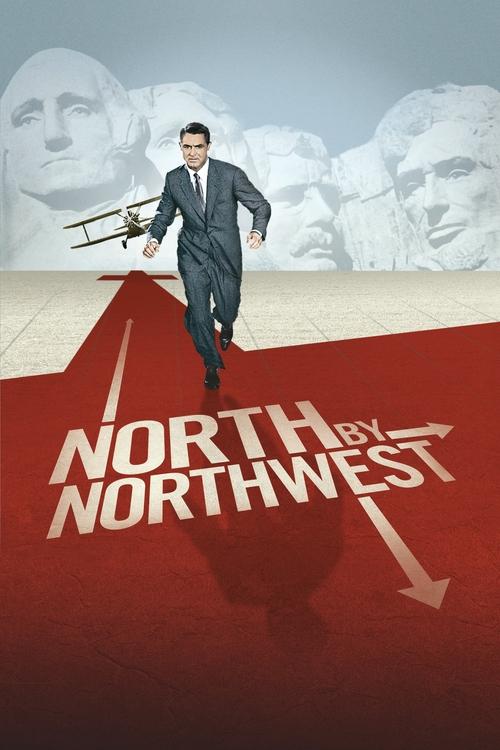
North by Northwest
1959 · Alfred Hitchcock
For when you want classic Hollywood at full sparkle — an escapist adventure with romance, danger, and zero homework. Comfort viewing of the highest grade, even on a first watch.
What it's about
A slick Madison Avenue advertising man is mistaken for a government agent who doesn't exist, and within hours strangers are trying to kill him for secrets he's never heard of. Unable to convince anyone of the truth, he goes on the run across America — through the United Nations, aboard trains, across empty prairie — chasing his own false identity while spies chase him. Along the way he meets a cool, mysterious blonde whose help may not be what it seems.
The experience
Pure pleasure — fast, witty, and glamorous, with suspense sequences so cleanly built you can feel them click into place. It's tense without ever being heavy; the movie grins at you the whole time.
Performances
Cary Grant carries the whole film with effortless charm, playing panic as comedy without losing the stakes; Eva Marie Saint gives the love interest a genuine ambiguity, and James Mason makes the villain elegant enough to invite to dinner.
The craft
Hitchcock at his most confident: every setpiece — a drunken drive, a crop-dusting plane over empty farmland, a chase across the faces of Mount Rushmore — is engineered for maximum suspense with minimum fat. Bernard Herrmann's propulsive score and the wide, sunlit VistaVision images make it one of the best-looking thrillers of its era.
Why it matters
It essentially wrote the blueprint for the modern spy adventure — the charming hero, the exotic locations, the setpiece-driven structure that Bond and decades of action cinema inherited.
Snapshot
A Madison Avenue advertising executive, Roger O. Thornhill, is mistaken for a fictitious CIA operative and plunged into a cross-country pursuit that takes him from the cocktail lounges of New York through the United Nations, across a sun-drenched prairie, and finally onto the faces of Mount Rushmore. Cary Grant plays Thornhill with an irreducible lightness that keeps the film buoyant even as its geometry of betrayal tightens; Eva Marie Saint supplies an ambiguity rare in the genre; James Mason's Vandamm is villainy as connoisseurship. The film is Hitchcock's grandest entertainment and, arguably, his most economically perfect: every sequence earns its place, and the architecture of suspense never wobbles. Made at the height of the director's commercial and critical standing, it codified the modern spy-adventure thriller decades before that genre had a name.
Industry & production
North by Northwest was the product of an unusual studio arrangement. Hitchcock, contractually associated with Paramount through much of the 1950s, made the film for MGM — his sole feature for the studio in this period. MGM provided resources commensurate with its ambitions: extensive location shooting across New York, the United Nations plaza, the plains of the midwest, and South Dakota, combined with large-scale studio construction. The production budget was substantial for the period, though precise figures vary in the historical record and should not be cited without a primary source.
Ernest Lehman, who had written Sweet Smell of Success (1957) and would later adapt West Side Story and Who's Afraid of Virginia Woolf?, came to the project with an explicit ambition: to write what he described as "the Hitchcock picture to end all Hitchcock pictures." He spent over a year in development with Hitchcock, and the screenplay went through substantial revision; the spycraft plot, the MacGuffin of government microfilm secreted inside a pre-Columbian statuette, and the composite structure of set pieces were all worked out in a protracted back-and-forth between director and writer that Lehman later documented in interviews and that is well attested in surviving production correspondence.
The casting of Cary Grant, already Hitchcock's collaborator on Suspicion (1941), Notorious (1946), and To Catch a Thief (1955), was central rather than incidental to the conception. Thornhill was written for Grant specifically: the role depends on an actor capable of being simultaneously humiliated and undefeated, comic and menaced. Eva Marie Saint, fresh from On the Waterfront (1954), was selected in part against type — her clean-featured reserve was meant to keep the audience uncertain about her allegiances in parallel with Thornhill's own uncertainty.
The shoot at the United Nations presented a logistical obstacle. The UN declined to permit a film crew inside the building, and the interior lobby sequence was achieved using telephoto lenses for exterior shots and a studio-built reproduction of the lobby — a reconstruction detailed enough that the deception went largely unnoticed by general audiences. The crop duster sequence was filmed on location in the San Joaquin Valley of California, on flat agricultural land near the town of Wasco and Bakersfield. The Mount Rushmore climax posed a different kind of constraint: the National Park Service refused permission to stage any scenes depicting violence or jeopardy on the monument's sculpted faces. The exterior approach shots were filmed at the actual site; all sequences involving figures on the stone faces were executed on studio-built sets at MGM, with matte paintings and composite photography bridging the two.
Technology
The film was shot in VistaVision, Paramount's eight-perf horizontal widescreen process that Hitchcock and cinematographer Robert Burks had employed on several preceding collaborations, including To Catch a Thief and Vertigo. VistaVision produced a large negative with exceptional sharpness, well-suited to the expansive landscape compositions the film demanded. The projected image was optically printed down to standard 35mm release prints at an aspect ratio of approximately 1.66:1 or 1.85:1, depending on the venue.
The crop duster sequence deployed what were then state-of-the-art practical effects: the biplane and the gasoline truck were real, the stunt choreography live, and the wide compositions were made possible by the format's resolution and Burks's telephoto staging. The sequence is notable for what it withholds technologically — there is no rear projection, no process photography of the kind that defined comparable scenes in the era. Thornhill stands in genuine prairie light, which is what gives the scene its visual and psychological nakedness.
Saul Bass designed the opening title sequence: a glass-and-steel Manhattan skyscraper facade whose rectilinear grid dissolves into diagonal lines of motion and typography. The sequence is among Bass's most formally concentrated and establishes the film's visual grammar — geometry as trap, straight lines redirected at oblique angles — in under two minutes.
Technique
Cinematography
Robert Burks, Hitchcock's director of photography from Strangers on a Train (1951) through Marnie (1964) with one exception, brought to North by Northwest a calculated variation in visual register: intimate Manhattan interiors with constricted depth, the artificially formal compositions of the United Nations space, and then the radical openness of the prairie. The crop duster set piece violates almost every convention of filmed suspense as it existed in 1959. Received wisdom held that menace required shadow, enclosure, restricted sight lines. Burks and Hitchcock place their protagonist in pitiless noon light, on flat land that offers no cover in any direction, and hold the widescreen frame wide. The threat, when it appears, is a distant speck. The sequence works not through claustrophobia but through the annihilation of hiding places; the landscape itself becomes the instrument of vulnerability.
The film's color palette moves from the cool grays and blues of New York interiors to the ochres and bleached skies of the west, and finally to the vertiginous grays of the monument faces at dusk — a progression that quietly charts Thornhill's increasing exposure and disorientation.
Editing
George Tomasini, Hitchcock's regular editor throughout this period, cut the film with a rhythm that is at once propulsive and remarkably unforced. The auction house sequence — in which Thornhill engineers his own arrest as the only means of escaping Vandamm's men — is a clinic in how to use duration and reaction shots to convey the calculated madness of a desperate man. Tomasini's cuts are clean and functional; there is little visible manipulation, which is the highest compliment one can pay editing in a thriller of this kind. The final cut, from Grant hauling Saint up the cliff face to the couple in their train berth, is one of cinema's most celebrated ellipses — a single transition compressing rescue, marriage, and consummation into a match-cut whose wryness is inseparable from its efficiency.
Mise-en-scène / staging
Hitchcock's staging throughout privileges geometric clarity. The United Nations lobby sequence uses the open floor plan as a spatial problem: Thornhill is visible to everyone, the murderer has just placed a knife in his hand, and retreat is simultaneously necessary and incriminating. The Mount Rushmore sequences exploit the literal faces of the monument as a surface that denies both concealment and safe passage — sculpture transformed into treacherous terrain.
The hotel room confrontation between Thornhill and Eve Kendall, and the auction house sequence, demonstrate Hitchcock's characteristic use of architectural enclosure to produce social and moral pressure. Bodies are placed in relation to doorways, windows, and sight lines with a precision that is theatrical in origin but specifically cinematic in execution — the camera's position determines what information the audience holds over the characters, or vice versa.
Sound
Bernard Herrmann's score is perhaps his most openly enjoyable — kinetic, propulsive, rooted in a fandango-derived theme that drives the chase sequences with almost physical energy. Where his scores for Vertigo and Psycho operate primarily through sustained psychological dread, the North by Northwest music is extrovert: brass, propulsive strings, rhythmic momentum. The main title theme, played over Bass's animated grid, announces a film that will be dangerous but never somber.
Herrmann was also precise in his silences. The crop duster sequence is largely unscored for much of its duration; the absence of music during the attack makes the diesel engine and the wheeling crows the only sonic event in a scene of otherwise terrible quiet.
Performance
Grant's Thornhill is calibrated on the edge between light comedy and genuine fear, and Grant's great contribution is to hold both tones simultaneously rather than alternating between them. Thornhill's incompetence in the spy world — he is an advertising man, constitutionally committed to managing appearances, dropped into a situation where appearances are lethal — is a source of both comedy and horror, and Grant makes each scene legible on both registers. The performance draws on Grant's long experience with screwball comedy (Bringing Up Baby, His Girl Friday) while feeding that training into a darker mechanism.
Eva Marie Saint calibrates Eve Kendall as a woman operating under multiple kinds of constraint — professional, emotional, mortal — in a way that gives the film its most complex interiority. That Kendall is a double agent working for the CIA while appearing to be Vandamm's mistress creates an ethical weight the film could have elided; Saint refuses the elision. James Mason's Vandamm is contained, aestheticized, and entirely credible as a man for whom murder is an administrative function.
Narrative & dramatic mode
The film operates through what Hitchcock described, in his interviews with François Truffaut, as the purest form of the MacGuffin: government microfilm whose contents are irrelevant to the audience's emotional experience and whose value exists only as the object around which the antagonists organize. What drives the film is not the microfilm but the error — the mistaken identity of Thornhill for the CIA's wholly fictitious agent George Kaplan — and the comedy-thriller hybrid that error generates.
North by Northwest is structurally a road narrative grafted onto a wrong-man thriller. Thornhill moves east to west, from the city of manufactured identities (Madison Avenue; advertising) to the monumental landscape of national mythology (Mount Rushmore), and this geography is thematically coherent: the film is, among other things, about the fragility of constructed selfhood. Thornhill's middle initial stands for nothing — "O for nothing," he tells Kendall — a joke that resonates through the film's meditation on the performed self.
The MacGuffin, the set-piece structure, and the romantic subplot are interlocked with considerable sophistication: Thornhill falls for Kendall before learning she is the enemy's companion, falls again after learning she is the CIA's operative, and the movement of trust and betrayal that this produces is what lifts the film above pure mechanics.
Genre & cycle
North by Northwest sits at the origin point of several genre trajectories that would define popular cinema in the following decades. It did not invent the spy thriller — Lang's Spies (1928) and Hitchcock's own The 39 Steps (1935) precede it — but it synthesized the wrong-man thriller with Cold War espionage, widescreen spectacle, and romantic adventure in a form that the James Bond franchise would absorb wholesale beginning with Dr. No (1962). The Bond films' combination of globe-trotting locations, suave male protagonist, double-dealing woman, and set-piece action owes an acknowledged debt to Lehman and Hitchcock's template.
Within Hitchcock's own filmography, the film belongs to a cycle of wrong-man narratives that includes The 39 Steps, Saboteur (1942), and The Wrong Man (1956), but it is the most openly pleasurable of them — the genre machinery is operated with a confidence that produces entertainment without neutralizing anxiety.
Authorship & method
The director-collaborator network on North by Northwest was unusually stable, representing the full consolidation of Hitchcock's "repertory company." Burks had photographed nine preceding Hitchcock features; Herrmann had scored since The Trouble with Harry (1955); Tomasini had edited since Rear Window (1954); and production designer Robert Boyle, who would go on to design The Birds and Marnie, shaped the visual environment. This density of accumulated collaboration meant that decisions could be made at a level of shorthand unavailable to less integrated productions.
Lehman's contribution is structural and linguistic rather than thematic. He gave the film its architecture of set pieces — the United Nations assassination, the crop duster, the auction, Mount Rushmore — and the tonal calibration that keeps the comedy and the menace in productive tension. Hitchcock's directorial input reshaped the screenplay through his habitual process of storyboarding, which locked major sequences into visual plans before production began.
Movement / national cinema
North by Northwest is canonical American studio cinema at its apex, made within the MGM production system during the last decade in which that system fully functioned. The film is also, obliquely, a portrait of a particular Cold War American self: mobile, optimistic, commercially fluent, and exposed to forces it cannot see or name. The American landscape — the plains, the interstate, the national monument — is at once backdrop and symbolic terrain. The film's use of Mount Rushmore as its climactic location is too pointed to be accidental: the faces of the founding presidents become the literal surface on which a private American escapes the machinery of his own government.
Era / period
The film appeared in 1959, the last full year of the Eisenhower presidency, in a cultural moment characterized by both postwar prosperity and anxious awareness of Cold War vulnerability. The spy who is not a spy, the government that cannot acknowledge its own operations, the MacGuffin of microfilm carrying secrets whose nature is never disclosed — these are recognizable products of a political climate shaped by the CIA's expansion, the House Un-American Activities Committee's investigations, and the culture of institutional opacity. The film does not engage these contexts polemically; it takes them as given, as the air through which its characters move.
Themes
The film's central preoccupation is identity under duress. Thornhill, a man whose professional life consists of the manufacture of images for consumption, is forced to occupy an identity he did not choose and cannot discard. The comedy of the wrong-man scenario — being mistaken for George Kaplan — exposes the deeper joke: Kaplan doesn't exist, and Thornhill's own identity may not be substantially more substantial. The "O for nothing" motif recurs as a structural joke about the void at the center of a performed self.
The mother (Jessie Royce Landis, only a year older than Grant, playing his mother with arch comic detachment) represents an ironic commentary on the protagonist's arrested development; Thornhill is twice divorced, still reliant on his mother's presence as witness, and his passage through the film is also a passage toward a more unguarded self — the figure who reaches for Eve Kendall's hand at the film's end without calculation.
The American landscape as both promise and trap — open to the horizon, nowhere to hide — is as central a theme as any involving character. The crop duster sequence is the most economical expression of this: the promised freedom of the American plain is the field of maximum exposure.
Reception, canon & influence
North by Northwest opened in the United States in July 1959 to strong commercial performance and largely warm critical reception, though it was treated at the time principally as superior entertainment rather than as art. The auteurist critical revaluation of Hitchcock — consolidated by Truffaut's 1962 Cahiers du Cinéma interview series and published as Hitchcock/Truffaut in 1967 — retroactively elevated the film's standing within what was being reconceived as a coherent directorial body of work. By the 1970s and 1980s, it had entered the canon of essential Hollywood cinema; it consistently appears on major critical polls and retrospective lists, though precise rankings vary by survey and should not be cited from memory.
The film's backward influences are traceable: Hitchcock's own The 39 Steps provided the structural template of the wrong-man cross-country chase, and Notorious (1946) established the model of an ambiguous woman operative whose allegiances are genuinely uncertain. The screwball comedies of the 1930s and early 1940s — particularly the Grant vehicles directed by Hawks and McCarey — contributed the tonal register within which menace and comedy coexist.
Its forward influence is broader and more various. The Bond franchise's synthesis of espionage, spectacle, location, romantic gamesmanship, and a physically capable but emotionally exposed male protagonist is substantially derived from the North by Northwest template; producers Albert Broccoli and Harry Saltzman were explicit about their admiration for the film. Steven Spielberg's Raiders of the Lost Ark (1981) and its successors owe a structural debt to the set-piece architecture that Lehman and Hitchcock developed. Brian De Palma's Mission: Impossible (1996) makes its debts legible. More diffusely, the wrong-man thriller as a genre formation — the ordinary American pulled into a machinery of state power he cannot see or control — descends substantially from this film's template, and its traces are visible in films as various as The Parallax View, Three Days of the Condor, and the Bourne franchise. The crop duster sequence has been cited, analyzed, and imitated often enough that it functions now as a kind of ur-text for the problem of staging menace in wide open space.
A Deleuzian reading
The bus pulls away and leaves Roger Thornhill standing at a crossroads in the Indiana flatland, in a gray suit, in noon light, the whole horizon visible and nothing on it.
The full Deleuzian reading of North by Northwest →
Reception
A box-office hit and crowd-pleaser from day one, it was initially filed under 'Hitchcock having fun' next to weightier work like Vertigo — now it's canonized as the blueprint for the modern action-spy blockbuster and a fixture near the top of his filmography.
How North by Northwest was received, from release to now →
Influences: the films it descends from and the films it influenced
- The 39 Steps (1935) — Hitchcock's own template for the wrong-man road structure: an innocent man handcuffed to a woman of uncertain allegiance, pursued across open landscape, which NxNW expands to continental scale with the same rhythm of escalating entrapment and reluctant romantic alliance.
- Notorious (1946) — Establishes the MacGuffin concealed inside a mundane art-world object (uranium ore in wine bottles → microfilm in a pre-Columbian statuette) and Grant's performance register of charm masking culpability, both carried forward verbatim into NxNW.
- Saboteur (1942) — Cross-country wrong-man pursuit culminating at a famous American monument — jeopardy staged on the Statue of Liberty's torch creates the structural and spatial template NxNW recapitulates at Mount Rushmore, including the staging of mortal peril on vertical civic surfaces.
- His Girl Friday (1940) — Grant's screwball-comedy timing under genuine pressure — rapid-fire dialogue remaining sardonic while the stakes escalate — is the performance register NxNW's cocktail-party drunk scene and Plaza Hotel sequences depend on; NxNW inherits the Hawks mode of comedy as the texture of fear rather than its relief.
- Rear Window (1954) — Robert Burks's technique of isolating a protagonist inside an architectural frame and measuring suspense through the held duration of reaction shots rather than cutting to the threat establishes the editing rhythm NxNW extends from the enclosed courtyard to open prairie.
- To Catch a Thief (1955) — Burks's first VistaVision collaboration with Hitchcock on a Grant vehicle — using the eight-perf horizontal negative to combine sun-saturated landscape with modernist architectural enclosure — develops the formal visual register NxNW inherits directly, from the Riviera terraces to the Côte d'Azur cliff roads.
- Shadow of a Doubt (1943) — Strategic deployment of silence as menace device: the dinner-table scene where Uncle Charlie's threat coexists with domestic normalcy and no underscoring anticipates NxNW's formal method of letting menace accumulate within socially ordinary spaces — the cocktail party, the auction house — without cuing the audience with music.
- Vertigo (1958) — Burks and Hitchcock used the identical VistaVision workflow on back-to-back productions; Bernard Herrmann's scoring method — a fandango-inflected ostinato generating anxiety through rhythmic density rather than dissonance — carries from Vertigo's habanera figure into NxNW's chase theme without revision.
- Foreign Correspondent (1940) — Hitchcock's definitive elaboration of the reluctant-amateur-into-espionage formula, with storyboard-predetermined set pieces — crop duster, Mount Rushmore — that systematize and scale what Foreign Correspondent's windmill and ocean crash established as repeatable method.
- The Lady Vanishes (1938) — Fuses the two mechanisms in color: the sleeper-car seduction and berth-hiding replay the compartment's threshold staging, while the police and the Townsend household calmly deny what Thornhill saw, restaging the disbelief structure with rear projection doing the same scenic labor Cox's process work did in 1938.
- Charade (1963) — Donen transplants NxNW's precise formula — wrong-person comic-thriller, screwball-register protagonist, MacGuffin of hidden valuables, European modernist locations used as architectural traps — and casts an actor (Grant again) performing the same dual register of comedy and genuine fear Lehman scripted for Thornhill.
- Dr. No (1962) — The Bond franchise's formal DNA is drawn directly from NxNW: suave male protagonist versus a connoisseur-villain in a remote architectural compound, government microfilm as the MacGuffin prototype, and exotic locations staged as geometric arenas for pursuit rather than documentary spectacle.
- The Parallax View (1974) — Gordon Willis's telephoto staging in open civic spaces — the Seahawks stadium assassination conducted at distance in full afternoon light — extends NxNW's formal innovation of high-key menace: threat made more terrifying by visibility than by shadow, inverting the shadow-and-enclosure conventions of thriller cinematography.
- The Conversation (1974) — Walter Murch extends NxNW's strategic-silence formal vocabulary: the crop duster sequence's naked ambient soundscape — no score, no dialogue, only wind and propeller — becomes, in Murch's hands, the governing architecture of a film built entirely on sonic gaps and misheard audio as primary suspense mechanism.
- Three Days of the Condor (1975) — A CIA analyst operating under a code-name identity he must shed (Condor/Kaplan) in modernist New York, with Owen Roizman's telephoto surveillance compositions explicitly citing Burks's UN exterior isolation shots; the film's wrong-man road structure across American institutional space is NxNW's blueprint applied to post-Watergate paranoia.
- Tinker Tailor Soldier Spy (2011) — Hoyte van Hoytema's geometric staging within Cold War institutional architecture — the Circus's rectilinear glass offices used as spatial traps — inherits NxNW's architectural-enclosure grammar; Alfredson's sustained reaction-shot duration as the primary carrier of suspense derives from Hitchcock's editing vocabulary via the Burks collaborations.
- Headhunters (2011) — First-act plant/payoff construction where innocuous early details (an auction bid, a monogrammed handkerchief) return as lethal mechanisms; Headhunters' GPS tracker and Rubens painting follow the same precise choreographic logic of planted information becoming structural weapon.
- Mission: Impossible (1996) — The wrong-man-on-the-run dramaturgy and the franchise-able set-piece-as-attraction (crop duster, Rushmore) is the structural template De Palma scales to blockbuster size.
- Mission: Impossible III (2006) — The purest MacGuffin lineage: the Rabbit's Foot is Abrams's deliberately unexplained object, the device Hitchcock named and theorized as a pretext whose contents never matter.
- The Adjustment Bureau (2011) — The everyman swept into pursuit by an unseen organization, chased through legible urban geography by anonymous suited men — the chase grammar and mistaken-cog premise.
- Mission: Impossible - Dead Reckoning Part One (2023) — Codified the globe-trotting MacGuffin chase built as a string of geographically legible suspense set-pieces, the structural template McQuarrie reverse-engineers narrative around.
- Duel (1971) — The crop-duster sequence supplies Duel's core grammar: an everyman menaced by a roaring machine in flat, sunlit, deliberately banal open space with no place to hide.
- The Manchurian Candidate (1962) — Saul Bass designed both title sequences using the same graphic-geometry-to-live-action transition grammar; Frankenheimer's telephoto staging in crowd sequences — figures isolated against undifferentiated backgrounds — applies Burks's NxNW isolation technique to Cold War political paranoia.
- The Man Who Knew Too Much (1956) — Inherits and scales the MacGuffin espionage thriller as a pure formal exercise; the crop-duster and Mount Rushmore finales are both cross-cutting suspense set pieces built on the Albert Hall grammar — an innocent figure in a dangerous landscape, cut against the approaching threat at a rhythm calibrated by Herrmann's score — with the MacGuffin (microfilm in a pre-Columbian statue) functioning as the same category of arbitrary classified object.
- Mission: Impossible - Fallout (2018) — Template for the innocent-man-pursued chase culminating in a vertiginous set-piece on iconic high terrain — Fallout's cliffside helicopter climax descends directly from the Mount Rushmore finale.
- High Anxiety (1977) — Provides the wrong-man-pursued structure and the open-air ambush set-piece (the crop-duster) that Brooks rebuilds as the pigeon attack, lifting the lone-man-in-exposed-space staging grammar.
- The Man from U.N.C.L.E. (2015) — The tailored, unflappable leading man moving through glossy international espionage — the mid-century archetype Cavill's Solo is consciously channeling.
Similar films
- Rear Window (1954) — influence & lineage
- The 39 Steps (1935) — influence & lineage
- Vertigo (1958) — influence & lineage
- Charade (1963) — influence & lineage
- Notorious (1946) — influence & lineage
- The Conversation (1974) — influence & lineage
- To Catch a Thief (1955) — influence & lineage
- Psycho (1960) — shared sensibility
All the films related to North by Northwest →
Film essays and courses that include it
- Alfred Hitchcock
- The Watcher Watched: A History of Screen Espionage
- On the Edge: Cinema's Grammar of Suspense
- Watched: Ten Landmarks of the Paranoia Thriller
- Eyes That Watch: A History of Espionage Cinema
- Full Steam: A Century of Trains, Ships, and Planes
- The Paranoid Eye: How the Spy Film Taught Us to Watch
- The Sound of the Inside