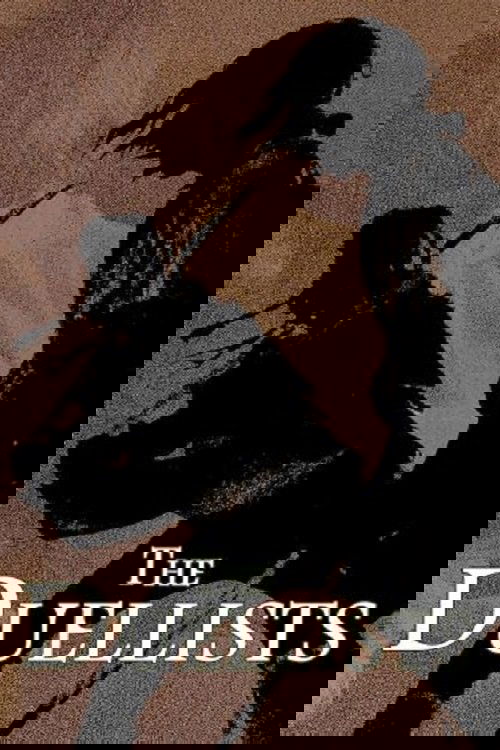
The Duellists
1977 · Ridley Scott
For a night when you want something ravishing to look at and quietly obsessive to think about — a slow-burn period piece that rewards patience with images you'll remember.
What it's about
In Napoleon's army, two French officers fall into a feud over a perceived insult — and can't let it go. Across fifteen years of European upheaval, from 1800 through the retreat from Russia to the fall of the Empire, they keep finding each other and crossing swords, their private war of honor absurdly outlasting the real ones around them.
The experience
Elegant and hypnotic, punctuated by duels of startling physical realism — you feel the weight of the blades and the fear behind the etiquette. It's as much a mood piece as a story, wry about the madness of honor even as it takes it seriously.
Performances
Keith Carradine and Harvey Keitel make a fascinating mismatched pair — one reluctant and civilized, the other implacable, honor burning in him like a religion.
The craft
Ridley Scott's feature debut, adapted from a Joseph Conrad novella and made on a modest budget, looks like a gallery of period paintings brought to life — candlelight, mist, and low sun in nearly every frame. The visual signature he'd carry into his science-fiction landmarks arrives here fully formed, and it's gorgeous on a big screen.
Why it matters
It announced Ridley Scott as a major visual stylist overnight, launching one of the most influential directing careers of the modern era, and remains a touchstone for sword-fight realism.
Snapshot
The Duellists is Ridley Scott's feature directorial debut, an adaptation of Joseph Conrad's 1908 novella The Duel (published in the United States as The Point of Honor). It follows two officers in Napoleon's army — Armand d'Hubert (Keith Carradine) and Gabriel Feraud (Harvey Keitel) — locked into a private feud of honor that recurs, duel after duel, across roughly fifteen years of European upheaval, from 1800 through the fall of the Empire and the Bourbon restoration. Made for a modest budget by a director who had spent the previous decade shooting television commercials, the film is remembered less for its narrative propulsion than for its extraordinary pictorial surface: a painterly, light-drenched period reconstruction that announced, fully formed, the visual signature Scott would carry into Alien two years later. It shared the prize for best first work at the 1977 Cannes Film Festival and has since acquired a reputation as one of the most beautiful debut films of its era.
Industry & production
The film was produced by David Puttnam, then building a run of prestige British pictures, in association with the American distributor Paramount, which held US rights. Its origins lie partly in Scott's own frustrated ambitions: after years of celebrated advertising work through his company Ridley Scott Associates, he had struggled to launch a feature (an adaptation of Tristan and Isolde among the projects that stalled), and Conrad's compact, filmable story offered a producible property scaled to a first-time director's means.
The production was frugal by the standards of a costume epic. Rather than stage the Napoleonic Wars, the screenplay keeps the vast historical canvas mostly offscreen and concentrates resources on a handful of intimate confrontations, allowing Scott to lavish attention on texture and light where a conventional war film would spend on armies. Location shooting in the French countryside — the Dordogne and the region around Sarlat are commonly cited — supplied authentic architecture and landscape in place of expensive builds. The precise budget and box-office returns are not something the public record fixes with confidence; the film is generally described as inexpensive and as a modest commercial performer whose real capital was critical prestige, and I won't attach numbers to it that I can't stand behind. What matters industrially is the trajectory it launched: Cannes recognition converted a commercials director into a bankable feature filmmaker, and Scott moved almost directly from this picture to Alien (1979).
Technology
The Duellists was shot photochemically on 35mm at the tail end of the era before electronic aids reshaped cinematography, and its technical interest lies in what it achieved with conventional tools deployed unconventionally. Working with cinematographer Frank Tidy, Scott pursued a low-key, available-light aesthetic — heavy reliance on natural daylight, window light, firelight and the long amber rakes of "magic hour" at dawn and dusk. This placed the film in direct dialogue with the recent technical conversation around Stanley Kubrick's Barry Lyndon (1975), which had famously pushed the boundaries of shooting interiors by candlelight. Scott did not replicate Kubrick's specialized fast lenses, but he absorbed the same ambition: to make period light itself the subject, and to let filtration, smoke, haze and practical sources do the work that studio lighting rigs conventionally performed. The resulting look — soft, diffused, atmospheric, with a palpable sense of weather and season — was as much a matter of controlled exposure and on-set atmospherics as of any single piece of hardware.
Technique
Cinematography
Frank Tidy's photography is the film's most discussed element and the clearest early statement of Scott's visual philosophy. The compositions are consistently organized like paintings: figures set against luminous skies, interiors modeled by a single window or hearth, foreground haze and backlight separating planes of depth. Landscapes are rendered in the manner of English and French Romantic painting, and the film openly courts comparison with Turner and Constable in its skies and with Dutch and Northern European interior painting — Vermeer, Georges de La Tour — in its lamplit rooms. The duels are staged to exploit environment: a misty garden at dawn, a snowbound field, a cellar. The camera favors the elegance of the tableau over kinetic coverage, so that even violence is framed with a composed, almost frieze-like stillness. This is the origin point of the "Ridley Scott image" — atmospheric, layered, saturated with mood — that would define his subsequent career.
Editing
The film was cut by Pamela Power. The editing serves the picture's episodic architecture: the story is built as a series of discrete encounters separated by ellipses that can leap years, and the cutting manages these jumps economically, using title cards and shifts in season, rank and circumstance to convey the passage of time. Within the duel sequences the editing tightens to register the physical mechanics of swordплей and the sudden brutality of injury, but the film's governing rhythm is measured and contemplative rather than propulsive, matching the pictorial deliberateness of the photography.
Mise-en-scène / staging
Scott's background in design and advertising is legible in every frame's control of the profilmic space. Costume, weathered architecture, cavalry tack, candle smoke and the grain of period materials are marshaled into densely furnished images. The duels themselves are choreographed with attention to the evolving conventions of the honor code — different weapons (saber, small-sword, pistols, mounted combat) and different rules across the years — so that staging carries narrative and thematic information. The framing repeatedly isolates the two antagonists within larger indifferent landscapes and social gatherings, visually stating the film's irony: a private obsession playing out against the vast, uncaring machinery of history.
Sound
Howard Blake composed the score, which leans toward period-inflected, restrained orchestration rather than bombast, in keeping with the film's chamber scale. The sound design gives weight to the physical reality of the duels — the ring and scrape of blades, the report of pistols, the labored breath and boot-fall of exhausted men — set against the ambient textures of wind, weather and the murmur of period interiors.
Performance
The casting is deliberately asymmetrical. Keith Carradine plays d'Hubert as reasonable, weary, increasingly reluctant — a man trapped by a feud he never wanted and cannot honorably end. Harvey Keitel plays Feraud as a coiled, class-resentful fanatic, importing a distinctly modern, Method-inflected intensity into the powdered-wig setting. The decision to cast two Americans in the leads amid a largely British supporting ensemble, with the actors retaining their own accents rather than attempting French, is one of the film's most-noted and most-debated choices; some read it as a distracting mismatch, others as a productive estrangement that keeps the drama from congealing into genteel costume convention. The supporting cast is deep in British character talent — including Edward Fox, Tom Conti, Robert Stephens, John McEnery, Diana Quick and Cristina Raines — and Albert Finney appears in a small, reportedly uncredited role as the police minister Fouché.
Narrative & dramatic mode
The film is structured as a chronicle: an episodic, decades-spanning sequence of encounters rather than a single rising dramatic arc. Its engine is repetition with variation — the same two men, the same unresolved grievance, meeting again and again as their ranks rise, their circumstances change and the Empire crumbles around them. The originating insult is almost comically slight, and the film preserves Conrad's central irony: neither man can fully articulate why the feud must continue, yet the code of honor makes ending it impossible. The dramatic mode is thus closer to fable or moral tale than to conventional biography or war drama; character is revealed through accretion across episodes, and the resolution turns on a gesture of magnanimity rather than a decisive victory. It is a story about the tyranny of an idea over the men who serve it.
Genre & cycle
The Duellists sits at the intersection of the period costume drama, the war film and the swashbuckler, while subverting the expectations of each. It has the settings and swordplay of adventure cinema but none of its exuberance; it has the Napoleonic backdrop of the war epic but keeps the great battles offscreen; it has the surfaces of prestige literary adaptation but a cool, ironic detachment. In the mid-1970s British production landscape it belongs to a cycle of ambitious, painterly literary adaptations — the shadow of Barry Lyndon looms largest — that treated period filmmaking as an occasion for high pictorial art cinema rather than mere heritage spectacle.
Authorship & method
This is a foundational text for understanding Ridley Scott as an author. His formation in graphic design (Royal College of Art), his early work directing and designing for the BBC, and above all his decade of high-gloss commercial filmmaking left him with a director's toolkit oriented around the constructed image — atmosphere, light, production design and mood as primary carriers of meaning. The Duellists demonstrates that these were not the compromises of an advertising man but a coherent visual authorship, one that privileges environment and texture over psychology and dialogue. The key collaborators define the achievement: cinematographer Frank Tidy, whose available-light photography realizes the painterly program; composer Howard Blake; editor Pamela Power; screenwriter Gerald Vaughan-Hughes, who compressed Conrad's novella into filmable episodes; and producer David Puttnam, whose backing enabled the project. Scott's method here — meticulous pre-visualization, control of every element within the frame, atmosphere as narrative — is the template he would carry directly into Alien and Blade Runner.
Movement / national cinema
The film belongs to British cinema of the 1970s and specifically to the wave of internationally minded, prestige-oriented productions that Puttnam and his contemporaries were fostering as a corrective to a struggling domestic industry. It is a British film with American stars, French locations and a Polish-English literary source — a deliberately transnational object aimed at the international art-house and festival circuit as much as the home market. It also stands at the threshold of the run of British directors (Scott, Alan Parker, Tony Scott, Adrian Lyne, Hugh Hudson) who emerged from advertising to remake mainstream cinema's visual language in the following decade.
Era / period
Set across the Napoleonic era — from the Consulate around 1800, through the catastrophe of the 1812 Russian campaign, to Napoleon's fall and the Restoration — the film uses this arc of imperial rise and collapse as an ironic frame. The grand historical narrative that reshaped Europe becomes mere weather passing over a feud that neither begins nor ends for any reason history would recognize. Made in 1977, the film also reflects its own moment: a period cinema newly emboldened, post-Barry Lyndon, to treat the historical film as a vehicle for austere visual art rather than romantic adventure.
Themes
The film's governing subject is honor as compulsion — a code that has detached from any rational purpose and become a self-perpetuating machine consuming the men who obey it. Around this it develops several linked ideas: the absurdity and persistence of male rivalry; class resentment (Feraud's plebeian ferocity against d'Hubert's relative gentility) as a hidden engine of the feud; the individual's smallness before the sweep of history; and the corrosive cost of obsession measured across a lifetime. Its final movement, turning on d'Hubert's refusal to press a lethal advantage, reframes the whole as a meditation on how one escapes a code — not by winning, but by declining to play. Conrad's irony, that the origin of so much bloodshed is essentially trivial and unexplained, is preserved intact.
Reception, canon & influence
Critically, The Duellists was received as a striking, unusually beautiful debut, and its recognition at the 1977 Cannes Film Festival — where it took the award for best first work — established Scott's reputation and helped secure his next projects. Reviews then and since have tended to divide along a consistent line: near-universal admiration for the cinematography and design, alongside reservations about a certain coolness or emotional distance and about the American leads amid the period setting. Its commercial life was modest; its cultural life has been durable, sustained by cinephile esteem and by its status as the origin point of a major directorial career.
Looking backward, the film's influences are clear: Conrad's novella as source; the recent example of Kubrick's Barry Lyndon as its most direct stylistic interlocutor; and the traditions of Romantic landscape and Dutch interior painting — Turner, Constable, Vermeer, de La Tour, with Goya sometimes invoked for its martial imagery — as its pictorial models. Looking forward, its most important legacy is internal to Scott's own filmography: the atmospheric, painterly, design-driven image it perfected became the through-line to Alien, Blade Runner and beyond, and it stands as proof-of-concept for the advertising-to-auteur pipeline that reshaped Anglo-American cinema in the 1980s. It is also frequently cited within the small canon of great cinematic duel and swordplay films for the authenticity and variety of its fencing. As a debut it remains a touchstone — a film whose reputation rests less on what it says than on the completeness with which a first-time director arrived with a fully realized way of seeing.
A Deleuzian reading
A garden at first light, mist standing knee-high, two young officers removing their coats with the elaborate calm of men who have decided not to be frightened.
The full Deleuzian reading of The Duellists →
Reception
Won the best debut prize at Cannes in 1977, then barely got released and quietly vanished — decades later it's the film cinephiles pull out to prove Ridley Scott was a master before Alien, a fixture on 'greatest directorial debuts' lists.
How The Duellists was received, from release to now →
Influences: the films it descends from and the films it influenced
- Barry Lyndon (1975) — The direct stylistic model: natural/available-light exposures and static tableaux composed after 18th-century painting, structuring a decades-spanning episodic chronicle punctuated by formal, rule-bound duels.
- The Three Musketeers (1973) — Fight master William Hobbs — who also arranged The Duellists' saber and rapier work — brought his signature grubby, exhausting, physically plausible swordplay that rejects balletic Hollywood fencing.
- Scaramouche (1952) — The touchstone of the duel-as-extended-set-piece tradition, establishing sword choreography as sustained architectural spectacle that The Duellists both inherits and de-glamorizes.
- The Rise of Louis XIV (1966) — Austere available-light period reconstruction that lets costume, texture and environment carry meaning over psychology or dialogue — the anti-theatrical historicism Scott adopts.
- Alien (1979) — Carries forward the method proven here — meticulous pre-visualization and total control of the frame, with designed environment and atmosphere delivering narrative in place of exposition.
- Blade Runner (1982) — Extends the painterly-light-and-production-design-as-meaning principle, chiaroscuro and haze doing the psychological work the script withholds.
- The Last of the Mohicans (1992) — Dante Spinotti's sweeping Romantic-landscape cinematography — Turner-scale wilderness — wedded to an individual-against-history period narrative in Scott's mold.
- Rob Roy (1995) — William Hobbs again choreographs a climactic honor duel with the same asymmetrical, fatiguing realism, extending the anti-balletic swordplay lineage.
- Gladiator (2000) — Reworks honor-as-compulsion and staged martial combat inside an individual-against-history epic, the duel widened into arena spectacle.
- The Last Duel (2021) — Scott's literal return to the honor-duel structure, with the trial-by-combat as narrative climax and its choreography built for brutal, unromantic authenticity.
- Napoleon (2023) — Scott returns to the Napoleonic era with painterly, Goya-and-Gros-inflected battlefield tableaux, closing the loop on the martial pictorialism begun here.
- The Count of Monte Cristo (2024) — A painterly, chiaroscuro-lit early-19th-century honor drama sustained across years through temporal ellipsis, prefiguring the widescreen period lensing and elliptical novelistic editing.
- Kingdom of Heaven (2005) — Scott's first sustained use of single-source period lighting and smoke-filled backlight on a costume subject; the Caravaggio chiaroscuro of Balian's forge and the lamplit tent interiors is that method matured with a digital intermediate behind it.
- Days of Heaven (1978) — Néstor Almendros's magic-hour available-light photography converting rural landscape into Romantic-painting tableau, the same painterly-naturalist program pursued in parallel.
- Chariots of Fire (1981) — Another David Puttnam-produced feature debut by a British commercials director, extending the advertising-to-auteur pipeline with the same glossy painterly period image.
- The Hunger (1983) — Ridley's brother making the identical leap from high-gloss advertising to feature authorship, foregrounding atmosphere, light and surface texture as primary carriers of meaning.
- The Draughtsman's Contract (1982) — Rigorously composed static period tableaux lit after Vermeer and de La Tour, sharing the Dutch-interior pictorial sources Scott drew on for his candlelit rooms.
- Excalibur (1981) — Painterly, mist-and-firelight period image where burnished armor and landscape become the subject, honor and combat staged as ritual within a Romantic pictorialism.
Similar films
- The Last Duel (2021) — influence & lineage
- Napoleon (2023) — influence & lineage
- Barry Lyndon (1975) — influence & lineage
- Gladiator (2000) — influence & lineage
- Blade Runner (1982) — influence & lineage
- Napoleon (1927) — shared sensibility
- Kagemusha (1980) — shared sensibility
- Black Hawk Down (2001) — shared sensibility