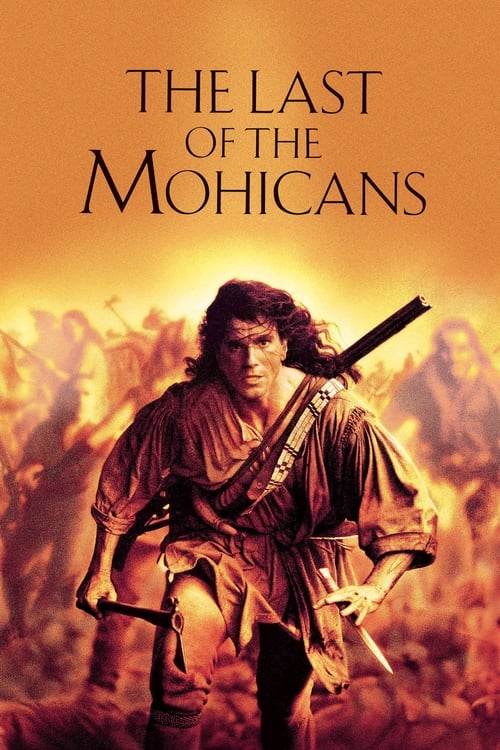
The Last of the Mohicans
1992 · Michael Mann
For when you want to be swept away — grand landscapes, doomed love, thundering action. A big-feelings epic for a night you want your pulse and your heart going at the same time.
What it's about
In 1757, at the height of the war between Britain and France for North America, a colonel's daughter and her party are ambushed by Huron warriors in the wilderness. Their rescuers are three trappers — the Mohican Chingachgook, his son, and his adopted white son Hawkeye — who are pulled into the imperial war, a siege, and a fierce, forbidden love between Hawkeye and the woman he saved, all while a vengeful Huron warrior stalks her family.
The experience
Swooning and ferocious at once — a romance that plays at full heart-on-sleeve intensity, cut with battle scenes of startling speed and physicality. It sweeps you along; by the final stretch it's operating on pure adrenaline and emotion.
Performances
Daniel Day-Lewis threw himself into frontier life to play Hawkeye and it shows in every stride — a romantic action hero of total physical conviction. Madeleine Stowe matches him with steel under the period costume, and Wes Studi is unforgettable as Magua, a villain whose rage has real, wounded roots.
The craft
Michael Mann brings his trademark precision to muskets and forests: battles staged with brutal clarity, mist-hung mountain vistas, and a driving score whose main theme has become iconic on its own. The final act, told almost wordlessly through movement and music, is one of the great sustained action-romance sequences — absolutely a big-screen, good-speakers film.
Why it matters
It proved a director of sleek modern crime stories could master the historical epic, set a new bar for visceral period combat, and its score has echoed through trailers and imitators ever since.
Snapshot
The Last of the Mohicans is Michael Mann's sweeping adaptation of James Fenimore Cooper's 1826 novel, transplanted to the forests of the French and Indian War in 1757. It follows Hawkeye (Daniel Day-Lewis), a white frontiersman raised by the Mohican Chingachgook (Russell Means), as he and his adoptive family are drawn into the imperial contest between Britain and France — and into the protection and eventual love of Cora Munro (Madeleine Stowe), daughter of a British colonel. The film is at once a kinetic action picture, a doomed romance, and an elegy for a vanishing people. Within Mann's filmography it stands as a striking outlier: his only true period piece, made between the contemporary crime worlds of Manhunter (1986) and Heat (1995), yet unmistakably his in its precision, its physicality, and its romantic fatalism. It is among the most visually and aurally muscular of 1990s studio epics, and its central musical theme has long outlived the film's immediate cultural moment.
Industry & production
The film was produced by Morgan Creek Productions and released by Twentieth Century Fox in September 1992. It emerged from an era when major studios were again willing to finance large-scale historical spectacle, and it carried the considerable logistical burden of a wilderness shoot with period costume, large numbers of extras, and elaborately staged battle and chase sequences. Principal photography took place largely in western North Carolina — the Blue Ridge Mountains, Chimney Rock, Lake James, and surrounding old-growth and managed forest — standing in for the colonial frontier of upstate New York. The location work was integral rather than incidental: the unbroken canopy and mountain terrain gave Mann the immersive natural world the story requires.
The production was, by well-documented accounts, demanding and at times contentious, particularly around the music (see Authorship & method below) and the editing schedule leading into release. Mann is known as an exacting, research-driven filmmaker, and the cast underwent extended preparation in frontier and martial skills. Day-Lewis's immersive regimen — learning to track, hunt, shoot and reload a long flintlock rifle on the run, and reportedly living for stretches off the land — became part of the film's lore and of his broader reputation for total commitment. The screen credit acknowledges not only Cooper's novel but Philip Dunne's screenplay for the 1936 film version, signaling that Mann's script (written with Christopher Crowe) descends as much from that earlier Hollywood adaptation as from Cooper directly.
Technology
The Last of the Mohicans was shot photochemically on 35mm film, and its technical ambition lies less in novel apparatus than in the rigorous deployment of established tools under difficult natural conditions. The signature requirement was mobility: cameras that could move with running figures through dense forest, across rivers, and up rock faces, often in available or naturalistic light filtering through canopy. Steadicam and handheld work were essential to the film's celebrated running sequences, in which the frame travels with the characters rather than merely observing them. The sound work — for which the film won the Academy Award for Best Sound — depended on dense, layered design and mixing to render musket volleys, the rush of forest and water, and the score with both clarity and force. The film has also had a notable post-release technical afterlife: Mann revisited the material for a re-edited "Director's Definitive Cut," reflecting his characteristic willingness to continue refining a work in home-video and remastered formats long after theatrical release.
Technique
Cinematography
Dante Spinotti's photography is foundational to the film's power and to its reputation as one of the more beautiful studio films of its decade. Spinotti, who would become one of Mann's most important collaborators (Manhunter, later Heat and The Insider), renders the wilderness as a living, almost sacred space — vast mountain vistas, mist, firelight, and the play of light through trees — without sliding into picture-postcard prettiness. The camera is intensely mobile in the action set pieces and patient and painterly in the romantic and elegiac passages. Faces are frequently lit to register interiority in low light, anticipating the nocturnal expressiveness of Heat. The visual scheme yokes the sublime grandeur of the landscape to the intimacy of the human story, so that the natural world reads simultaneously as a paradise and as something about to be destroyed.
Editing
Cut by Dov Hoenig and Arthur Schmidt, the film balances two editorial registers. The battle and chase sequences are assembled for propulsive momentum and spatial legibility — the forest ambush of the British column and the climactic pursuit across the cliffs are models of action cutting that keep geography and stakes clear even at high velocity. Against this, the romance and the film's mournful final movement are edited with restraint, allowing gesture, landscape, and music to expand. The interplay of these rhythms — driving action giving way to suspended, almost wordless emotion — is central to the film's effect.
Mise-en-scène / staging
Mann's staging treats the frontier as a contested ecosystem of cultures and allegiances rather than a simple wilderness backdrop. Fort William Henry, the British and French encampments, the Huron village, and the open forest are each given distinct spatial and social logic. Costume, weaponry, and bodily comportment are handled with documentary seriousness; the film is attentive to how people of different nations move, fight, and inhabit the land. The famous running figures — bodies hurtling through space toward or away from violence — function as a recurring compositional motif, expressing freedom, urgency, and the collapse of the distance between safety and death.
Sound
Sound is among the film's defining achievements, recognized with its Academy Award. The mix renders the percussive shock of period firearms, the enveloping ambience of forest and river, and the surge of the orchestral-and-synthesizer score as an integrated whole. In the climactic sequences, sound and music frequently displace dialogue entirely, carrying the emotional argument where words would diminish it.
Performance
Day-Lewis anchors the film with a performance of physical conviction and quiet intensity; his Hawkeye is less a swashbuckler than a man wholly continuous with his environment. Madeleine Stowe gives Cora unusual spine and intelligence for a period-romance heroine, making the central love story credible as a meeting of equals. Russell Means — the prominent American Indian Movement activist, here in a celebrated screen role — lends Chingachgook gravity and grief, and delivers the film's closing elegy. Eric Schweig's Uncas and Jodhi May's Alice carry the film's tragic subplot largely through gesture and gaze. Wes Studi's Magua is widely regarded as one of the great screen antagonists of the era: a figure of fury and wounded purpose whose motivation — vengeance rooted in colonial atrocity — gives the villainy moral weight rather than mere menace.
Narrative & dramatic mode
The film operates in the mode of romantic-tragic adventure. Its narrative engine is pursuit and protection: the abduction and rescue of the Munro sisters, the trek through hostile territory, the siege and massacre, and the final mountain chase. Onto this adventure armature Mann grafts a doomed-romance structure and an elegiac frame. The dramatic arc moves from kinetic action toward an almost operatic fatalism, culminating in a near-wordless sequence of deaths and survival staged on the cliffs. The mode privileges feeling and momentum over exposition; large stretches of the climax communicate through movement, landscape, and score, trusting image and music to carry meaning that dialogue would flatten.
Genre & cycle
The Last of the Mohicans sits at the intersection of the historical epic, the frontier/wilderness adventure, and the war film, with the western's DNA running beneath all three. Cooper's Leatherstocking saga is a foundational text of the American frontier myth, and the film participates in that tradition while reshaping it for a more revisionist age — more sympathetic to its Native characters, more candid about colonial violence, and more attentive to romance than the boys'-own adventure template. It belongs as well to the early-1990s cycle of prestige historical spectacle, arriving in the wake of renewed studio appetite for sweeping, frontier-set drama, and it shares that cycle's combination of epic scale, period detail, and elegiac treatment of Native America.
Authorship & method
The film is recognizably authored by Michael Mann, whose signatures — professional competence under pressure, romantic fatalism, immersive environment, the lone man defined by his code — translate intact from the urban crime milieu to the colonial forest. Mann co-wrote the screenplay with Christopher Crowe, building on Philip Dunne's 1936 adaptation as well as Cooper's novel, and brought his hallmark research-driven, perfectionist method to every department.
Key collaborators shape the result decisively. Cinematographer Dante Spinotti establishes the visual language of grandeur-and-intimacy that recurs across his work with Mann. The editing team of Dov Hoenig and Arthur Schmidt governs the film's dual rhythms of action and elegy. The score is the film's most contested and most celebrated creative element: credited to Trevor Jones and Randy Edelman, it was, by well-documented accounts, complicated in its making, with Jones having composed extensively before Edelman was brought in late, producing a combined orchestral-and-electronic soundscape. Its central theme draws on Dougie MacLean's Scottish tune "The Gael," a melody whose Celtic lineage subtly underwrites the film's emotional register and which has since taken on a life of its own in popular culture. The casting of activist Russell Means and the prominence given to Wes Studi and Eric Schweig also reflect a deliberate authorial choice to foreground Native presence and perspective more than earlier versions had.
Movement / national cinema
This is mainstream American studio filmmaking at the high end of early-1990s craft, not a product of any avant-garde or national-cinema movement. Its lineage runs through classical Hollywood adventure and the western, refracted through the auteur-inflected New Hollywood sensibility that Mann carried into the studio system. The film's interest lies in how a director with a strong personal style operates within, and elevates, the commercial epic — and in how it engages a foundational American myth from a vantage point more critical of empire than its Hollywood predecessors.
Era / period
The film is set in 1757, during the French and Indian War (the North American theater of the Seven Years' War), and centers on events surrounding the siege of Fort William Henry. Its period reconstruction — uniforms, fortifications, flintlock weaponry, and the fraught web of British, French, Mohican, Huron, and other allegiances — is rendered with seriousness. Crucially, the film treats the colonial conflict not as mere backdrop but as the engine of its tragedy: imperial rivalry instrumentalizes and ultimately consumes the Native nations caught between the European powers, and Magua's vengeance is shown to grow directly from that violence.
Themes
At its core the film is a meditation on the frontier as a vanishing world. Its dominant themes include the tension between wilderness freedom and the encroaching order of empire and civilization; the destruction of Native peoples and cultures by colonial war, crystallized in the title's elegiac finality; and the possibility of self-determination and love forged outside inherited social hierarchies, embodied in Hawkeye's stateless identity and his union with Cora. Running through these is a Romantic-elegiac sensibility — a sense of a paradise glimpsed at the moment of its loss. The film also engages questions of cultural belonging and hybridity through Hawkeye, the white man raised Mohican, who belongs fully to neither European nor Native society and therefore to the imperilled in-between.
Reception, canon & influence
The Last of the Mohicans was generally well received on release, with particular praise for its visual splendor, its propulsive action, the conviction of Day-Lewis's performance, and the sweep of its score; it won the Academy Award for Best Sound. Critical reservations tended to fall on the romance and on the broad strokes of its historical melodrama, but the film's reputation as a superior studio epic has held firm.
Looking backward, the film draws on Cooper's novel and, explicitly, on the 1936 screen adaptation, as well as on the larger traditions of the western and the Hollywood historical adventure; it is also legible as part of a broader early-1990s reckoning with the frontier myth that sought to grant Native characters greater dignity and agency than classical Hollywood had. Looking forward, its influence is felt in several registers. Within Mann's own career it demonstrated that his style and themes could scale to epic, period material, feeding directly into the visual and emotional ambition of Heat and beyond. Its action grammar — bodies running through landscape, geography rendered legible at speed — has been widely admired and imitated. Its score, and especially the "Gael"-derived main theme, achieved a durable afterlife in trailers, sporting events, and popular culture well beyond the film itself, becoming one of the most recognizable pieces of film music of its era. And it remains a touchstone for the historical action-romance, frequently cited as a benchmark for how to fuse spectacle, emotion, and craft. Where the historical record around the production is genuinely contested — most notably the precise division of labor on the score — this account flags the uncertainty rather than resolving it.
A Deleuzian reading
Three men break from the treeline at a dead sprint, chasing an elk down through the forest, and the very first thing the film teaches you is how to read a running body.
The full Deleuzian reading of The Last of the Mohicans →
Reception
A solid hit in 1992 that many critics filed as a handsome outlier in Michael Mann's career; three decades on it's been reclaimed as one of the great 90s epics, with its wordless mountain finale now routinely called one of the best endings ever put on film.
How The Last of the Mohicans was received, from release to now →
Influences: the films it descends from and the films it influenced
- The Last of the Mohicans (1936) — The direct adaptation source whose Philip Dunne screenplay Mann and Crowe explicitly built upon, inheriting its structural compression of Cooper and its fort-siege set-pieces.
- The Searchers (1956) — Establishes the frontier western's grammar of landscape as legible dramatic geography and the elegiac 'vanishing wilderness' framing that Mann transposes to the French-and-Indian War forest.
- Drums Along the Mohawk (1939) — The template for staging colonial-frontier combat in the same Mohawk-valley terrain, with settler-vs-raid action rendered through wide pursuit staging across cleared land.
- The Wild Bunch (1969) — Pioneers the multi-angle action cutting of bodies moving through space that Dov Hoenig's editing inherits, intercutting running figures to make violence both kinetic and choreographed.
- Lawrence of Arabia (1962) — The model for fusing widescreen landscape spectacle with intimate fatalistic character, the grandeur-and-intimacy axis Spinotti's photography pursues.
- Aguirre, the Wrath of God (1972) — Sets the precedent for shooting in genuinely punishing wilderness so the environment's immersive reality, not studio backlot, becomes the actor's and camera's material.
- Thief (1981) — Mann's own origin point for the lone man defined by a professional code and for the orchestral-electronic score (Tangerine Dream) that prefigures the Jones/Edelman synth-and-strings soundscape.
- Manhunter (1986) — The first Mann–Spinotti collaboration, originating the low-light modeling of faces and the technique of letting score displace dialogue to carry emotional climax.
- Dances with Wolves (1990) — The immediate predecessor in the early-1990s frontier reckoning, granting Native characters subtitled language, interiority and agency that Mann extends through Studi, Means and Schweig.
- The Mission (1986) — Mann builds a colonial-frontier epic around anamorphic wilderness vistas wedded to a soaring, near-continuous score, replicating The Mission's fusion of landscape grandeur and musical sweep.
- The Duellists (1977) — Dante Spinotti's sweeping Romantic-landscape cinematography — Turner-scale wilderness — wedded to an individual-against-history period narrative in Scott's mold.
- Heat (1995) — Directly inherits Mohicans' proof that Mann's style could scale, carrying forward Spinotti's photography and the geography-legible-at-speed action grammar into the urban shootout.
- Braveheart (1995) — Extends the same historical action-romance fused with a Celtic-rooted score and 'vanishing people' pathos, staging running combat across landscape for the same emotional sweep.
- The Insider (1999) — Deepens the Mann–Spinotti low-light-faces idiom and the music-over-dialogue technique, applying Mohicans' romantic-fatalist intimacy to a man trapped by his code.
- Gladiator (2000) — Becomes the next benchmark for fusing historical spectacle with a hummable orchestral-electronic main theme and a fatalistic hero, the template Mohicans helped re-legitimize.
- The New World (2005) — Takes the immersive colonial-forest environment and naturalistic Native presence further, using mobile handheld camera and ambient sound to dissolve narrative into landscape.
- Apocalypto (2006) — Builds an entire film from Mohicans' signature image — figures running through wilderness — turning the geography-at-speed pursuit into the film's whole propulsive structure.
- The Revenant (2015) — Marries Day-Lewis-style total performer immersion to natural-light frontier photography, staging bodies struggling through real wilderness as both spectacle and ordeal.
- The Last Samurai (2003) — Frontier going-native romance built on practical landscape spectacle and immersive sound, a model for the cross-cultural martial protagonist.
- My Left Foot (1989) — Crystallizes Daniel Day-Lewis's total-immersion method — the physical and behavioral inhabiting that he brings to Hawkeye, living rough and mastering period skills on set.
Similar films
- Braveheart (1995) — influence & lineage · same viewing thread
- The Revenant (2015) — influence & lineage · same viewing thread
- Dances with Wolves (1990) — influence & lineage
- Lawrence of Arabia (1962) — influence & lineage
- The Searchers (1956) — influence & lineage
- The New World (2005) — influence & lineage
- The English Patient (1996) — shared sensibility
- Bram Stoker's Dracula (1992) — shared sensibility
All the films related to The Last of the Mohicans →
Watch it with: curated runs of related films
- Against Overwhelming Force — A run for when you want scale and physical punishment — men set against armies, tanks, and the frozen wild, holding a line that by rights should have broken them.