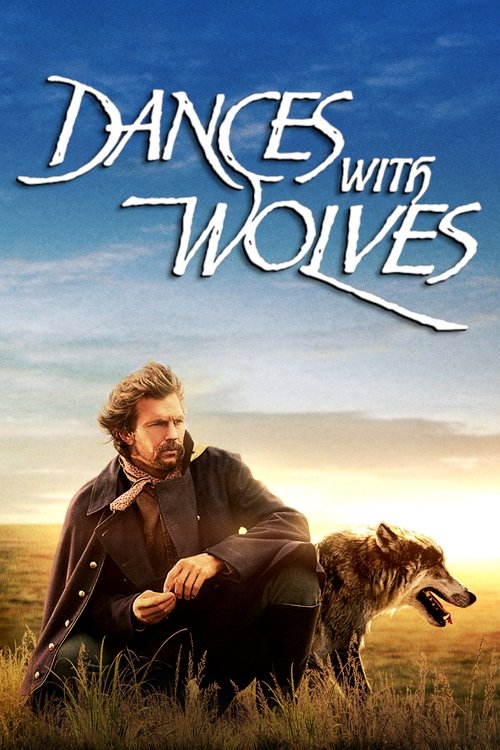
Dances with Wolves
1990 · Kevin Costner
For a long afternoon when you want to be swept away — big skies, big feelings, a proper old-fashioned epic. A comfort watch with a genuine ache in it.
What it's about
A wounded Union lieutenant, hollowed out by the Civil War, requests the remotest posting on the frontier and finds himself utterly alone at an abandoned fort on the Dakota plains. He keeps a journal, befriends a wolf, and slowly makes contact with a neighboring Lakota Sioux band — first as a curiosity, then as a friend, learning their language and way of life as his old loyalties dissolve. It's an epic about a man trading one world for another.
The experience
Unhurried, sincere, and sweeping — three hours that feel like a long exhale, moving from solitude to belonging to heartbreak. It's earnest in a way few big films dare to be, and it earns its emotion.
Performances
Kevin Costner anchors it with easy, open-hearted decency, and the Lakota cast — much of it performing in the Lakota language — gives the film its warmth and gravity, with Graham Greene's wry, watchful Kicking Bird a standout.
The craft
Shot on the real prairie with a magnificent sense of scale — the buffalo hunt remains one of the great practical set pieces in the genre — and carried by John Barry's soaring score. Its extensive use of subtitled Lakota dialogue was quietly radical for a mainstream Hollywood epic, and it looks glorious on a big screen.
Why it matters
It swept the Oscars, including Best Picture and Best Director for Costner, single-handedly revived a genre Hollywood had declared dead, and shifted how mainstream Westerns portrayed Native peoples.
Snapshot
Dances with Wolves is the film with which Kevin Costner, then at the height of his stardom, gambled his standing on a three-hour Western directed by and starring himself — and won, comprehensively, taking the Academy Awards for Best Picture and Best Director and reviving a genre that the industry had all but pronounced dead. Adapted by Michael Blake from his own novel, it follows Lieutenant John Dunbar, a wounded Union officer who, after an act of suicidal despair is mistaken for heroism, requests and receives a posting to a remote and abandoned outpost on the 1860s Dakota frontier. Alone at Fort Sedgwick, Dunbar keeps a journal, befriends a wolf, and gradually enters the life of a neighboring Lakota Sioux band, learning their language and customs until his loyalties shift entirely from the army that sent him to the people who take him in. The film is at once a lyrical frontier reverie, a sweeping spectacle built around a celebrated buffalo hunt, and a deliberately revisionist Western that inverts the genre's traditional sympathies, rendering its Native characters as full human beings speaking their own language — with English subtitles — rather than as the faceless menace of the classical form. Mocked in advance as "Kevin's Gate," a presumed folly, it became one of the most decorated and commercially successful films of its era and a defining text of the Western's late revival.
Industry & production
The film was produced through Tig Productions, Costner's own company, with Jim Wilson as his producing partner; Orion Pictures handled distribution. The project carried an aura of risk that the industry was eager to narrate as hubris. Costner was a major box-office star coming off The Untouchables, No Way Out, Bull Durham, and Field of Dreams, but he had never directed; he was proposing a Western — a genre then considered commercially toxic — at a substantial budget, running roughly three hours, and conducting a large fraction of its dialogue in the Lakota language with subtitles. The widely circulated nickname "Kevin's Gate" invoked Heaven's Gate, Michael Cimino's 1980 Western whose runaway production had helped bankrupt United Artists, and encapsulated the prevailing expectation of disaster. The budget is generally reported at around $18–22 million, modest for the scale on screen but considerable for a first-time director's passion project in an out-of-favor genre.
Michael Blake's path to the screen is part of the film's lore: he had written the story as a screenplay, found no buyers, and on Costner's encouragement reworked it as a novel, which was then adapted back into the film's shooting script. Principal photography took place largely on location in South Dakota, much of it on private ranchland and on the prairie around the Black Hills, with additional work in Wyoming. The production's logistical centerpiece was the buffalo hunt, staged using a large bison herd — including animals from a ranch belonging to the media figure Ted Turner — and requiring extensive coordination, wranglers, and mechanical or animatronic stand-ins for the most dangerous shots. The casting drew substantially on Native American performers, and the production engaged Lakota speakers as language coaches and on-set consultants, a choice central to the film's claim to authenticity.
Technology
Dances with Wolves is, in its means, a traditional 35mm location epic rather than a technological experiment; its innovations are logistical and linguistic rather than optical. The film's most demanding technical achievement was the buffalo-hunt sequence, which combined a genuine stampeding herd, mounted riders, carefully managed camera placements, and a small number of fabricated buffalo and trained animals for the close contact shots that could not be performed with live bison. The sequence's seamlessness — the sense of riders moving amid thousands of charging animals — is a product of staging, long-lens coverage, and editing rather than any digital intervention, the film predating the routine use of computer-generated imagery for such spectacle. Beyond the hunt, the film's technical character is defined by the demands of shooting a large cast and animal action across open prairie in changeable natural light, and by the integration of subtitled Lakota dialogue into a mainstream studio release — a presentational rather than mechanical novelty, but one that shaped how the film could be made and marketed. Costner later assembled a substantially longer cut, running close to four hours, which restores additional material; the existence of both a theatrical and an extended version is itself a notable fact of the film's afterlife.
Technique
Cinematography
The cinematography is by the Australian Dean Semler, who won the Academy Award for his work, and it is the film's most immediately celebrated formal element. Semler photographs the Dakota prairie as a vast, weather-driven landscape of grass, sky, and light, exploiting the open horizon and the changing prairie weather to give the film an epic scale that consciously recalls the classical Western's monumental vistas while turning them toward a more elegiac, naturalistic register. The camera favors wide compositions that situate human figures as small presences within an immense environment, reinforcing the film's themes of solitude and belonging. Set-piece sequences — the buffalo hunt above all, but also the firelit night scenes and the columns of cavalry against open country — are shot for sweep and movement, with the hunt's combination of long lenses, low angles, and tracking coverage generating its visceral momentum. Throughout, Semler keys the imagery to the golden, dust-laden light of the plains, a palette that lends the film its characteristic warmth and its sense of a vanishing world bathed in late, valedictory sunlight.
Editing
The editing, by Neil Travis, also won an Academy Award, a notable recognition for cutting a film of such length without dissipating its momentum. Travis's central task was to give a three-hour narrative the patient, accreting rhythm the story requires — the slow build of trust between Dunbar and the Lakota is measured out in repeated, incremental encounters — while also delivering the kinetic charge of the action sequences. The buffalo hunt is the editing's showcase: the assembly of stampede footage, riders, and contact shots into a coherent and thrilling whole is fundamentally an achievement of the cutting room. Elsewhere the editing is unhurried, allowing landscape, performance, and John Barry's score room to breathe, and trusting the audience to settle into the film's deliberate, immersive tempo rather than hurrying its emotional turns.
Mise-en-scène / staging
The film's staging is organized around a sustained contrast between two worlds and Dunbar's migration from one to the other. The army's spaces — the chaotic field hospital, the ruined and refuse-strewn Fort Sedgwick, the frontier post manned by increasingly degraded soldiers — are rendered as squalid, disordered, and morally exhausted, while the Lakota camp is staged with evident care for the texture of daily life: lodge interiors, communal fires, the rhythms of a functioning society. The production design and costuming, developed with Native consultants, aim for a degree of ethnographic specificity unusual for the genre, and the staging consistently presents the Lakota world as ordered, sociable, and humane against the entropy of the white frontier. Dunbar himself is positioned as an intermediary figure, his gradual adoption of Lakota dress and manner literalizing his shifting allegiance, until by the film's later passages his transformation is visible in his body and bearing.
Sound
The film's sonic identity is dominated by John Barry's symphonic score (discussed below) and by the texture of the prairie — wind, hooves, the lowing of the buffalo herd — that grounds the spectacle in environmental reality. The most consequential sound decision is linguistic: the extensive use of spoken Lakota, subtitled into English, which gives the Native characters a dignity and interiority the genre had historically denied them and forces the audience into the position of learner alongside Dunbar. The film's sound work was recognized with the Academy Award for Best Sound, reflecting the demands of integrating the hunt's complex aural field, the score, and the bilingual dialogue. It should be noted that the Lakota spoken in the film, coached by the educator Doris Leader Charge, has been observed by some Lakota speakers to use grammatical forms inconsistently — a frequently cited point being that male characters at times speak in feminine constructions — a limitation that does not negate the film's pioneering commitment to the language but is part of its documented record.
Performance
Costner's own performance as Dunbar is understated and watchful, an everyman's curiosity and decency serving as the audience's point of entry; he is less the dramatic engine than the still center through which the film's world is revealed. The film's lasting performances belong substantially to its Native cast. Graham Greene, as the thoughtful medicine man Kicking Bird, brings gravity, humor, and intelligence to the role and earned an Academy Award nomination for Best Supporting Actor; Rodney A. Grant's Wind In His Hair charts a memorable arc from hostility to fierce loyalty; and Floyd Red Crow Westerman lends quiet authority to the chief Ten Bears. Mary McDonnell, as Stands With A Fist — a white woman raised by the Lakota who becomes Dunbar's interpreter and love — received a Best Supporting Actress nomination for a performance that negotiates two cultural identities. The ensemble's collective achievement is to render the Lakota band as a community of distinct, fully realized individuals, the precondition for the film's revisionist project.
Narrative & dramatic mode
The film's dramatic mode is the immersive frontier epic structured as a story of conversion. Its engine is not external conflict but Dunbar's gradual transformation: arriving alone at an abandoned post, he moves through stages of solitude, curiosity, tentative contact, friendship, language acquisition, love, and finally complete reorientation of identity and loyalty. The framing device of Dunbar's journal gives the film a reflective, first-person intimacy, positioning the narrative as a record of inner change. The dramatic tension, when it arrives, derives from the collision between Dunbar's new belonging and the army that regards him as a deserter and traitor, and from the encroaching certainty — historically grounded and felt as tragedy throughout — that the Lakota world Dunbar has joined is doomed. The mode is elegiac and romantic rather than ironic: the film asks the viewer to fall in love with a way of life precisely as it is being extinguished, and its emotional power lies in that anticipatory mourning.
Genre & cycle
Dances with Wolves is a revisionist Western, and it is among the most commercially and institutionally successful examples of that strain. Where the classical Western typically figured Native peoples as obstacle or threat and white expansion as destiny, the revisionist Western — gathering force from the late 1960s and 1970s in films such as Little Big Man (1970) and Soldier Blue (1970) — inverted those sympathies, treating the conquest of the West as tragedy and the Native nations as its victims. Costner's film inherits and popularizes that tradition, rendering the Lakota sympathetically and at length, conducting their dialogue in their own subtitled language, and casting the U.S. cavalry as the agents of destruction. Its immediate significance to the genre's cycle was as a revival: the Western had been moribund as a commercial proposition through much of the 1980s, and the film's enormous success is widely credited with reopening the genre, helping clear the path for Clint Eastwood's Unforgiven (1992) and a broader run of Westerns in the early 1990s. At the same time, the film's structure — an outsider who joins and comes to champion an indigenous people — places it within a recognizable narrative lineage that its critics would scrutinize closely.
Authorship & method
The film is unambiguously Kevin Costner's, the controlling vision of a star turned director who staked his career on it, and its authorship is a meeting of his sensibility with a small group of decisive collaborators. Costner's method was one of immersive scale and earnest sincerity: long location shooting on the prairie, a commitment to Native casting and to the Lakota language, and a willingness to let the film run to epic length in pursuit of an enveloping experience. Michael Blake's screenplay, adapted from his own novel, supplied the narrative architecture and its conversion structure, and won the Academy Award for Adapted Screenplay. Cinematographer Dean Semler gave the film its monumental yet intimate landscape vision; editor Neil Travis shaped its patient rhythm and its action; and composer John Barry — the veteran British composer of the James Bond films and Out of Africa — provided a sweeping, romantic symphonic score, also Oscar-winning, that is inseparable from the film's emotional effect and central to its elegiac register. Producer Jim Wilson partnered Costner in bringing the project to the screen against industry skepticism. The fit between Costner's unironic romanticism and the material is the film's defining creative fact; it would overstate the record to assign specific authorial decisions beyond what the credited collaboration documents.
Movement / national cinema
The film belongs to American mainstream studio cinema at a particular juncture — the turn from the 1980s to the 1990s — and represents a reassertion of the prestige historical epic at a time when Hollywood's ambitions ran largely to high-concept spectacle. It is best understood within the American tradition of the Western and specifically within that genre's revisionist phase, a body of work in which Hollywood turned a self-critical eye on the founding national myth of westward expansion. The film's distribution through Orion Pictures — an independent-minded studio responsible for a notable run of acclaimed films before its financial collapse in the early 1990s — situates it at the more ambitious end of the era's studio production. Its engagement with Native American representation, casting, and language also connects it to a broader cultural moment of reassessment, even as the terms of that engagement would become the subject of sustained debate.
Era / period
The film is set in the 1860s, against the backdrop of the American Civil War and the westward expansion that followed, and it depicts a frontier on the cusp of irrevocable transformation. Its historical consciousness is pervasively elegiac: the Lakota world it portrays is shown as already shadowed by the certainty of conquest, the buffalo herds that sustain it threatened by white hunters, and the autonomous Plains life it celebrates poised on the edge of the reservation era. As a product of its own moment — the start of the 1990s — the film reflects a contemporary American willingness to revisit the conquest of the West as national tragedy rather than triumph, and its sympathetic, detailed portrait of Plains Lakota life answered a cultural appetite for reckoning with that history. The closing acknowledgment of the subsequent destruction of the Plains nations frames the entire narrative as a remembrance of a world that was about to end.
Themes
The film's governing theme is belonging and the remaking of identity: Dunbar's journey from alienated soldier to adopted member of the Lakota band dramatizes the possibility of choosing one's people and one's self. Around this orbit several interlocking concerns. There is the theme of nature and harmony — the Lakota life presented as integrated with the land and the buffalo, against the wastefulness and disorder of the encroaching white frontier, epitomized by the slaughter of buffalo left to rot. There is the elegiac theme of a vanishing world, the pervasive sense that the beauty being discovered is also being destroyed. There is the critique of "civilization": the film consistently inverts the genre's moral coordinates, locating savagery in the army and grace among those the army would call savages. And there is the romance of communion across cultural lines, embodied in Dunbar's love for Stands With A Fist and his friendships with Kicking Bird and Wind In His Hair. These themes have also generated the film's most serious critique — the charge that its structure, centering a white protagonist who becomes the Native people's champion, enacts a "white savior" narrative that subordinates the very people it means to honor, a reading advanced forcefully by Native commentators including the scholar-activist Ward Churchill.
Reception, canon & influence
On release, Dances with Wolves was both a major critical success and an extraordinary commercial one, confounding the predictions of folly that had attended its production; it is widely reported to have earned well over $400 million worldwide, an exceptional sum for a long, subtitled Western. Its awards triumph was emphatic: nominated for twelve Academy Awards, it won seven, including Best Picture, Best Director for Costner, Best Adapted Screenplay, Best Cinematography, Best Original Score, Best Film Editing, and Best Sound, with additional acting nominations for Costner, Graham Greene, and Mary McDonnell. It also won the Golden Globe for Best Motion Picture (Drama) and Costner's directing award there. The win for Best Picture over Martin Scorsese's GoodFellas became a lasting point of contention among critics, and over time a revisionist counter-current emerged that found the film earnest to a fault and questioned its racial politics, even as its craft and ambition continued to command respect.
Influences on the film run backward to the revisionist Westerns of the late 1960s and 1970s — Little Big Man and Soldier Blue in particular — which had already reversed the genre's sympathies, and, more distantly, to the classical Western's tradition of landscape spectacle that the film both honors and reorients. The captivity-and-conversion narrative, in which a member of one culture is absorbed into another, draws on a deep strain in American storytelling.
Its influence forward was substantial and twofold. Commercially and generically, it is credited with reviving the Western as a viable form, helping enable Unforgiven (1992), The Last of the Mohicans (1992), Costner's own later Wyatt Earp (1994), and the early-1990s Western resurgence more broadly. Culturally, it raised the profile of Native American performers and of Native-language and Native-perspective storytelling within mainstream cinema, even as it became the central reference point — the canonical example — in subsequent debates about the "white savior" film, a framework critics would later apply to films such as Avatar (2009). For Kevin Costner it represented the summit of his career as a filmmaker, and it remains a defining title of its era: a film whose enormous success, formal achievement, and contested politics have kept it durably in view within both the popular canon and the scholarly conversation about how Hollywood has imagined the American West.
A Deleuzian reading
He rides the length of the line to die.
The full Deleuzian reading of Dances with Wolves →
Reception
A pre-release punchline — a three-hour Western from a first-time director that Hollywood wags dubbed 'Kevin's Gate' — it became a massive hit and swept seven Oscars including Best Picture; today it's more often re-litigated than rewatched, remembered as the film that beat Goodfellas.
How Dances with Wolves was received, from release to now →
Influences: the films it descends from and the films it influenced
- Little Big Man (1970) — Supplied the revisionist template of a white man raised/absorbed into a Native (Cheyenne) community whose domestic warmth is contrasted against cavalry brutality — the inverted sympathies and the depiction of a massacre from the village's side that Costner's conversion plot directly inherits.
- Soldier Blue (1970) — Reoriented the cavalry-vs-Indian set piece into an indictment of the U.S. Army (Sand Creek), establishing the genre's reversed moral axis in which the soldiers, not the 'Indians,' are the aggressors — the political precondition for Dunbar's defection.
- A Man Called Horse (1970) — Pioneered the ethnographic immersion of a white captive learning Sioux/Lakota custom and language with attempted authenticity, the going-native procedural detail (ritual, kinship, daily life) that Costner extends into a feature-length acculturation.
- The Searchers (1956) — The classical Western's monumental landscape grammar — tiny figures against vast horizon, the frontier as widescreen spectacle, built around a captivity narrative — which Semler's prairie cinematography both honors and morally reorients.
- Cheyenne Autumn (1964) — Ford's own late, guilt-tinged attempt to film the Native side sympathetically within his landscape idiom, the elegiac-apology register that Dances with Wolves inherits and fully commits to.
- Lawrence of Arabia (1962) — The model of the wide-gauge epic in which an outsider crosses into and is transformed by another culture across long-form, patiently paced location shooting — the going-native arc staged as monumental landscape spectacle.
- Jeremiah Johnson (1972) — Frontier-immersion film of a solitary man in the wilderness with minimal dialogue, building meaning through landscape, weather and silent ritual rather than plot — the contemplative loner-in-nature texture of Dunbar's solo prairie stretch.
- Out of Africa (1985) — The direct precedent for John Barry's sweeping, romantic symphonic scoring of golden-hour wilderness — the same composer's elegiac string-led main theme over epic landscape that Costner reused as the film's emotional engine.
- The Mission (1986) — Costner's prestige colonial-encounter epic adopts the same sympathetic-European-among-the-doomed-natives structure and tragic-historical register, becoming the defining later case of the white-savior framing The Mission is critiqued for pioneering.
- Dersu Uzala (1975) — Inherits the elegiac long-held wides and telephoto plains, framing indigenous knowledge as a superior reading of the land and ending in the tragedy of an obsolescent world — Dersu's structure transposed to the American frontier.
- The Outlaw Josey Wales (1976) — Extends the improvised cross-racial family and sympathetic Native community — the found-family-among-the-displaced structure Josey pioneered inside the revisionist mode.
- The Big Country (1958) — A people-and-land epic whose John Barry score deploys the wide, lyrical Americana melody in the Moross-descended scoring lineage, over extreme long shots of figures against open plains.
- The Last of the Mohicans (1992) — Rode the same revival into frontier epic, pairing sweeping landscape cinematography with a sweeping romantic orchestral score and a colonial-contact love story — the commercial Western-adjacent epic Costner's success made bankable.
- Wyatt Earp (1994) — Costner's own immediate follow-up epic Western, repeating the long-form, big-canvas, life-spanning structure and widescreen scale he had just legitimized, as star-producer chasing the same monumental register.
- The Last Samurai (2003) — Re-runs the conversion architecture almost beat for beat — a disillusioned soldier absorbed into a 'vanishing' warrior culture, learning its language, then fighting for it against modernity — over a Hans Zimmer symphonic-elegiac score.
- Open Range (2003) — Costner's return to directing the widescreen-landscape Western, reprising his patient long-form pacing and golden-light prairie compositions — the same authorial sensibility applied within the genre he revived.
- The New World (2005) — Pushes the immersion-and-conversion contact story into pure sensory cinema — natural golden-hour light, subtitled/whispered Native-language presence, ethnographic attention to a culture rendered from the inside — an art-film radicalization of Dunbar's two-worlds crossing.
- Avatar (2009) — The canonical narrative heir: an outsider soldier goes native among an indigenous-coded people, masters their language and ways, and leads their defense — the precise conversion/'white savior' structure critics map straight back onto Dances with Wolves.
- Hostiles (2017) — Late revisionist Western that revives Dances' elegiac mourning, subtitled Native-language dialogue and golden-hour landscape grief, tracing a cavalry officer's slow conversion from enmity to kinship across the same dying-frontier register.
- We Were Soldiers (2002) — Dean Semler's amber-saturated, warm-toned anamorphic widescreen palette — developed for the Plains landscape epic — was carried directly into We Were Soldiers by the same DOP, the visual sensibility transposed from prairie grass to Ia Drang's tall-grass clearings with the same thermal register intact.
- Killers of the Flower Moon (2023) — Established the revisionist Western's structural dependence on the sympathetic white outsider as audience surrogate and moral compass — the precise apparatus Killers formally dismantles by locking the camera inside a complicit white perpetrator who cannot function as surrogate.
- Apocalypto (2006) — Shot by Apocalypto DP Dean Semler, it proved subtitled indigenous-language dialogue (Lakota) spoken by a native cast could anchor a mass-audience epic, the exact immersion strategy Gibson extends to Yucatec Maya.
- Tombstone (1993) — Its blockbuster success and lush prestige widescreen photography reopened commercial space for the traditional western and set the burnished visual expectation Tombstone met.
- Spirit: Stallion of the Cimarron (2002) — Codifies the Native-sympathetic revisionist Western framing that Fusco routes into the film's Lakota material and cavalry-as-antagonist staging.
- Unforgiven (1992) — The other prestige revisionist Western of the immediate revival Dances enabled, deglamorizing genre violence and winning Best Picture two years later — a sibling product of the door Costner reopened for the serious adult Western.
- Geronimo: An American Legend (1993) — Revival-era Western built on Native-perspective storytelling and the elegy for a defeated people, extending the post-Dances appetite for sympathetic Apache/Indian-side framing in mainstream studio production.
- Glory (1989) — A contemporaneous prestige historical epic using an officer's journal/epistolary frame and a Union soldier's sympathetic vantage onto a marginalized people, sharing Glory's Hollywood-classicist mode.
Similar films
- Unforgiven (1992) — influence & lineage
- Hostiles (2017) — influence & lineage
- The Last of the Mohicans (1992) — influence & lineage
- The Searchers (1956) — influence & lineage
- The New World (2005) — influence & lineage
- Stagecoach (1939) — shared sensibility
- Silverado (1985) — shared sensibility
- Dersu Uzala (1975) — shared sensibility