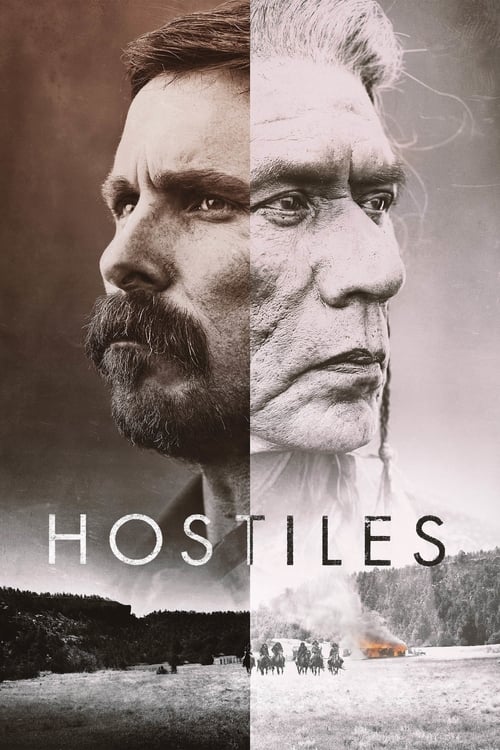
Hostiles
2017 · Scott Cooper
For when you want something somber and serious — a long, contemplative ride through hard country, not a Saturday-afternoon shoot-'em-up. Reach for it when you're ready to be challenged rather than comforted.
What it's about
Montana, 1892. A decorated Army captain who has spent his life fighting and hating Native Americans is ordered, on the eve of retirement, to escort a dying Cheyenne chief and his family from a New Mexico prison back to their homeland. Along the trail the party takes in a widow shattered by frontier violence, and the journey becomes a long, dangerous reckoning between people who have every reason to despise each other.
The experience
Slow-burning, mournful, and punctuated by sudden, brutal violence — this is a Western that sits with grief rather than rushing past it. It's heavy going by design, but the weight is the point: you feel every mile of the journey.
Performances
Christian Bale does some of his most internal work as a man whose hatred is slowly cracking, saying more with a clenched jaw than most actors manage with speeches. Rosamund Pike is harrowing as a woman surviving the unsurvivable, and Wes Studi brings quiet, immovable dignity to the chief.
The craft
Scott Cooper stages the frontier as vast, indifferent, and beautiful — big-sky vistas that dwarf the riders and make the violence feel like a stain on the landscape. The pacing is deliberate, the sound design spare, and the widescreen photography genuinely rewards the biggest screen you can find.
Why it matters
Part of the modern wave of Westerns that turn the genre's old myths inside out, treating the conquest of the West as a wound rather than an adventure — and a key entry in Scott Cooper's run of grim, morally serious American dramas.
Snapshot
Hostiles is a late-period revisionist Western built around a single, deliberately schematic premise: a hardened Army officer who has spent his career killing Native Americans is ordered, against everything in his character, to escort a dying Cheyenne war chief and his family home to Montana. Written and directed by Scott Cooper from a screen story credited to the late screenwriter Donald E. Stewart, the film stars Christian Bale as Captain Joseph J. Blocker, Wes Studi as Chief Yellow Hawk, and Rosamund Pike as Rosalie Quaid, a frontier widow the escort gathers up along the way. Premiering at the Telluride Film Festival in September 2017 and released theatrically in the United States that December and into January 2018, it is a sober, elegiac, often punishingly violent meditation on American racial hatred, grief, and the possibility of moral change. The film is less interested in plot than in the slow, halting transformation of men who have been formed by atrocity, and it wears its thesis openly: it opens on an epigraph from D.H. Lawrence — "The essential American soul is hard, isolate, stoic, and a killer" — and spends its length interrogating that line.
Industry & production
Hostiles sits in the relatively rare contemporary category of the mid-budget adult Western produced largely outside the major-studio system. The project carried an unusual origin: the screen story is credited to Donald E. Stewart, an Oscar-winning screenwriter (Missing, and adaptations of Tom Clancy's Jack Ryan novels) who died in 1999; Cooper developed an existing Stewart manuscript into the finished screenplay. The film was financed and produced independently — Waypoint Entertainment and Bloom are among the production entities associated with it, with Ken Kao and Cooper among the producers — and Bale, a producer's-favorite anchor whose name helps assemble financing for serious-minded material, lent the package its commercial viability.
Distribution fell to Entertainment Studios Motion Pictures, the film arm of Byron Allen's media company, which handled the U.S. release. This is a telling industrial fact: a prestige Western with an A-list lead and festival pedigree landing not at a traditional specialty distributor (Fox Searchlight, Focus, A24) but at a comparatively new entrant signals both the difficulty of placing the Western in the modern marketplace and the genre's continued prestige appeal. I do not have reliable budget or box-office figures to cite here and will not invent them; the film is generally understood to have been a modest theatrical performer that found a larger audience on home and streaming platforms.
Technology
Hostiles is, technically, a film of landscape and weather — it was shot on location across the American Southwest and mountain West (New Mexico, Arizona, and Colorado are among the regions used), trading the soundstage for real altitude, real cold, and real light. The production leaned on natural exteriors and practical conditions rather than effects-heavy spectacle; its violence is staged with squibs, stunt work, and editing rather than digital augmentation, in keeping with the genre's traditional materialism. On the specific capture format — whether cinematographer Masanobu Takayanagi exposed Hostiles on photochemical 35mm or on a digital cinema camera such as the Arri Alexa — I do not have a confident, verifiable answer and will not assert one; what is clear is that the image is engineered for a film-like density of shadow and a wide tonal range suited to dawn, dusk, and overcast mountain light.
Technique
Cinematography
Masanobu Takayanagi, Cooper's recurring director of photography (he had shot Out of the Furnace and Black Mass for the director), gives Hostiles a muted, almost mournful palette — desaturated greens and browns, steel-gray skies, faces lit so that they emerge from darkness in interiors and night scenes. The compositional vocabulary is classical Western: human figures rendered small against enormous land, the frame organized to insist on the indifference and scale of the country. But Takayanagi resists the picture-postcard sublime; the landscapes are beautiful without being inviting, and the violence, when it erupts, is shot with a startling proximity that breaks the painterly distance. The opening massacre of the Quaid family is the film's signature visual set piece — handheld, close, chaotic — establishing a baseline of horror against which the rest of the journey's stillness is measured.
Editing
The film was cut by Tom Cross, the Oscar-winning editor of Whiplash and La La Land, here working in a register far removed from those films' percussive musicality. Hostiles is paced as a procession — long, patient stretches of travel and camp punctuated by sudden, compressed bursts of brutality. Cross's editorial strategy is one of withheld rhythm: the journey scenes breathe, holding on faces and silences, so that the violence detonates without warning and ends quickly, refusing the choreographed catharsis of the action Western. The structure is episodic, organized around a series of encounters — the Comanche raiders, a captured outlaw (played by Ben Foster), a band of fur trappers — each functioning as a moral test and a fresh occasion for death.
Mise-en-scène / staging
Cooper stages the film as a slow erosion of distance — between Blocker and Yellow Hawk, between the soldiers and the family they guard. The blocking repeatedly places former enemies within the same frame, the camp circle and the trail line gradually reorganizing as trust forms. Production and costume design favor a worn, lived-in authenticity: weathered cavalry blue, dirt, the period detail of 1892 rendered without romance. The film's restraint is itself a staging choice — emotion is communicated through posture, distance, and the withholding of words rather than through expansive dramatization.
Sound
Max Richter's score is central to the film's affect. Richter, a composer associated with a spare, minimalist, post-classical idiom, supplies music that is elegiac and restrained — strings and piano figures that underscore grief and endurance rather than heroism. The film's sound design exploits the silence of open country, so that ambient wind, hooves, and the sudden report of gunfire carry enormous weight. The contrast between Richter's mournful sustained tones and the abrupt, dry violence is one of the film's defining sensory tensions.
Performance
Bale's Blocker is a study in suppression — a man whose racism and grief are sedimented into his body, played with clenched jaw, minimal dialogue, and eruptions of feeling that the character visibly fights. It is a performance of interiority, asking the audience to read transformation in micro-gradations. Wes Studi, the veteran Cherokee actor long associated with major Westerns (The Last of the Mohicans, Geronimo: An American Legend, Dances with Wolves), brings gravity and stillness to Yellow Hawk, though the screenplay grants him relatively little dialogue — a limitation critics noted. Rosamund Pike's Rosalie Quaid carries the film's rawest grief, beginning in shock and trauma after the murder of her family. The deep supporting bench — Rory Cochrane as a haunted, near-suicidal sergeant, Ben Foster as a court-martialed killer who functions as Blocker's dark mirror, plus Jesse Plemons, Adam Beach, Q'orianka Kilcher, Timothée Chalamet, and Stephen Lang — fills the procession with worn, specific faces.
Narrative & dramatic mode
The film operates in the mode of the journey-as-moral-passage: a structurally simple A-to-B escort narrative whose real action is internal and ethical. Its dramatic engine is conversion — can a man built by hatred change? — and it pursues this through accumulation rather than incident, layering encounters with death until the characters (and the audience) are worn down toward a kind of exhausted grace. The mode is tragic and elegiac rather than triumphant; nearly every relationship the film builds is broken by violence before the end. Some viewers find this design moving and morally serious; others find it schematic, its thesis delivered too cleanly and its Native characters too thinly written to fully earn the reconciliation the film seeks.
Genre & cycle
Hostiles belongs squarely to the revisionist Western, the post-1960s strain that inverts the classical genre's frontier triumphalism to foreground the dispossession and slaughter of Native peoples and the moral rot beneath the conquest. It is a clear descendant of the elegiac, violence-reckoning Westerns of the 1970s through the 1990s, and it arrived within a small contemporary cycle of serious Westerns — alongside films such as The Revenant (2015), The Hateful Eight (2015), Hell or High Water (2016), and The Sisters Brothers (2018) — that briefly suggested a genre revival for adult audiences. Within that cycle, Hostiles is among the most explicitly penitential, foregrounding white guilt and the question of whether the genocidal foundations of the nation admit any redemption.
Authorship & method
Scott Cooper is a director-writer whose body of work circles damaged, often violent American men and the institutions and landscapes that shape them — from the alcoholic country singer of Crazy Heart (2009, which won Jeff Bridges an Oscar) through the Rust Belt despair of Out of the Furnace (2013) and the gangland portrait Black Mass (2015). An actor before he was a filmmaker, Cooper builds his films around performance and around a brooding, masculine moral seriousness; Hostiles extends his preoccupation with men formed by hardship and complicit in violence onto the largest possible American canvas. His method here is one of restraint and duration, trusting silence and landscape over exposition.
Cooper's key collaborators are essential to the film's identity: cinematographer Masanobu Takayanagi, whose desaturated naturalism had already defined the look of two prior Cooper films; composer Max Richter, whose minimalist score supplies the film's elegiac conscience; editor Tom Cross, whose patient cutting governs its processional rhythm; and the source writer Donald E. Stewart, whose posthumous manuscript Cooper adapted. The authorship is thus genuinely collaborative but unmistakably Cooper's in theme and tone.
Movement / national cinema
This is a thoroughly American film — American in subject (the closing of the frontier, the Indian Wars, the national "soul" of the Lawrence epigraph), in genre (the Western being the most American of forms), and in production. It does not belong to a formal film movement so much as to the long American tradition of self-examining genre cinema, in which popular forms are turned back on the nation's founding crimes. Its closest kin are New Hollywood's revisionist Westerns and the prestige American independent drama of the 2010s.
Era / period
Hostiles is set in 1892, a date chosen with care: it falls just after the 1890 massacre at Wounded Knee and the official "closing" of the frontier, at the twilight of the Indian Wars. The film's characters are men whose entire purpose — and whose capacity for atrocity — is becoming obsolete; Blocker's forced retirement and final assignment mirror the historical exhaustion of the cavalry's genocidal mission. The period is rendered not nostalgically but as an ending, a culture reckoning with what it has done as the era that licensed it expires.
Themes
The film's governing themes are racial hatred and the possibility of its undoing; grief and trauma (every major character is bereaved, and the film treats mourning as a shared human ground that crosses the racial line); violence as the American inheritance (the Lawrence epigraph is the thesis, and the film tests whether the "killer" soul can become something else); masculinity, duty, and moral injury (Cochrane's and Foster's characters embody the psychic cost of a life of state-sanctioned killing); and reconciliation and its limits (the film yearns toward forgiveness while refusing to pretend the slaughter can be cleanly redeemed). Its persistent imagery of burials and the carrying of the dead makes mourning the connective tissue between former enemies.
Reception, canon & influence
Critical reception was substantially divided. Admirers praised the film's seriousness, Takayanagi's imagery, Richter's score, and Bale's interior performance, reading it as a worthy, mournful entry in the revisionist tradition. Detractors found it self-conscious and schematic — a film that centers white moral redemption while granting its Native characters, including Studi's chief, too little voice and agency, thereby reproducing the very marginalization it means to critique. This critique — that Hostiles is a sincere but white-centered reckoning — became the dominant frame in much of the commentary around it, and it is the most important thing to understand about the film's place in the conversation. (I am characterizing the broad shape of the critical response rather than quoting specific reviews or citing aggregate scores, which I cannot verify precisely here.)
Influences on the film (backward): Hostiles draws on the elegiac and revisionist Western lineage — the late, mournful Westerns that reckon with the genre's violence and with Native dispossession — and on the journey/escort structure common to the form. The Lawrence epigraph signals a literary-historical self-consciousness, framing the film as an essay on the American character. Cooper's own prior work supplies the template of the violence-haunted American man.
Legacy / what it shaped (forward): As a recent film, its long influence is not yet legible, and I will not overstate it. Its clearest significance is as a prominent data point in the 2010s adult-Western revival and as a flashpoint in the ongoing critical argument over how — and whether — the white-authored Western can address Native history without re-centering the colonizer. In that sense its most durable contribution may be less stylistic than discursive: it sharpened the question of who gets to narrate the frontier's reckoning, a question that subsequent Westerns and their critics have continued to press.
A Deleuzian reading
Start with Bale's jaw.
The full Deleuzian reading of Hostiles →
Reception
Premiered at Telluride 2017 without a distributor and got a lukewarm 'grim, slow' reception — the Bale awards push fizzled completely. Since then it's become a staple of 'most underrated modern westerns' lists, with Bale's performance regularly reappraised as one of his best.
How Hostiles was received, from release to now →
Influences: the films it descends from and the films it influenced
- The Searchers (1956) — Establishes the figures-against-vast-landscape framing and the racially-hating protagonist whose vengeance quest doubles as a moral reckoning — the template Hostiles consciously inverts.
- Ulzana's Raid (1972) — Supplies the episodic cavalry-pursuit structure and the unsentimental treatment of frontier atrocity as moral injury inflicted on both sides rather than spectacle.
- Little Big Man (1970) — New Hollywood revisionism that re-stages the cavalry massacre from the genre's celebratory stance into indictment, the discursive move Hostiles inherits.
- The Outlaw Josey Wales (1976) — Models the escort-journey that accretes a makeshift family out of former antagonists — the convoy-of-enemies-turned-companions structure Hostiles follows.
- Unforgiven (1992) — Elegiac de-mythologizing of the gunfighter through the violence-haunted aging man, desaturated palette, and violence that is withheld then sudden.
- Dances with Wolves (1990) — Provides the white-protagonist-converted-by-Native-encounter architecture — and the very white-centering of Native history that Hostiles both inherits and is criticized for reproducing.
- The Proposition (2005) — Frontier-violence western structured around colonial moral injury and scored with minimalist drone, prefiguring Hostiles' silence-then-gunfire sound design.
- The Revenant (2015) — Contemporary benchmark for handheld, immersive frontier violence and desaturated naturalist wilderness photography that subordinates the human figure to terrain.
- Out of the Furnace (2013) — Cooper and DP Takayanagi's desaturated naturalism and the portrait of the violence-complicit American man, carried directly into Hostiles' look and theme.
- 3:10 to Yuma (2007) — Cooper's forced-proximity journey narrative places moral antagonists in escalating psychological confinement across an anamorphic widescreen frame lit with the same naturalistic discipline as Papamichael, with slow temporal compression and an ambiguous ending refusing resolution of the masculine honor theme—extending Mangold's post-classical Western grammar into the following decade.
- The Hateful Eight (2015) — Cooper deploys the revisionist Western as an ensemble interrogation of American racial violence and contested historical memory, working directly in the formal and political lineage The Hateful Eight established for serious revisionist Western production post-2015.
- News of the World (2020) — Extends the escort-journey-as-moral-conversion structure: a war-scarred man delivers a child across hostile country and is remade by the passage.
- The Power of the Dog (2021) — Revisionist western of suppressed interiority, withheld editing rhythm, and figures placed against an indifferent landscape — the restraint-over-exposition method Hostiles practices.
- Killers of the Flower Moon (2023) — Directly advances the critical argument Hostiles crystallized — how a white-authored frontier film can narrate Native dispossession without re-centering the colonizer.
- The Assassination of Jesse James by the Coward Robert Ford (2007) — Shares the withheld processional editing rhythm, figures-dwarfed-by-landscape compositions, and a minimalist elegiac score deployed as the film's moral conscience.
- Meek's Cutoff (2010) — Escort-journey western built on silence, duration, and withheld rhythm in place of action, foregrounding the wagon-column processional Hostiles also privileges.
- The Homesman (2014) — Cross-plains escort of the vulnerable rendered as episodic, bleak moral reckoning with figures set against emptied landscape.
- Sicario (2015) — Pairs a minimalist droning score with a silence-then-gunfire rhythm and handheld violence — the contemporary dread-architecture Hostiles' Richter score and sound design echo.
- Wind River (2017) — Western of Native dispossession and grief built on silence-and-gunfire and small figures against vast cold landscape, the same year and register as Hostiles.
Similar films
- Wind River (2017) — influence & lineage
- The Outlaw Josey Wales (1976) — influence & lineage
- Dances with Wolves (1990) — influence & lineage
- The Proposition (2005) — influence & lineage
- The Revenant (2015) — influence & lineage
- Unforgiven (1992) — influence & lineage
- The Assassination of Jesse James by the Coward Robert Ford (2007) — influence & lineage
- The Power of the Dog (2021) — influence & lineage