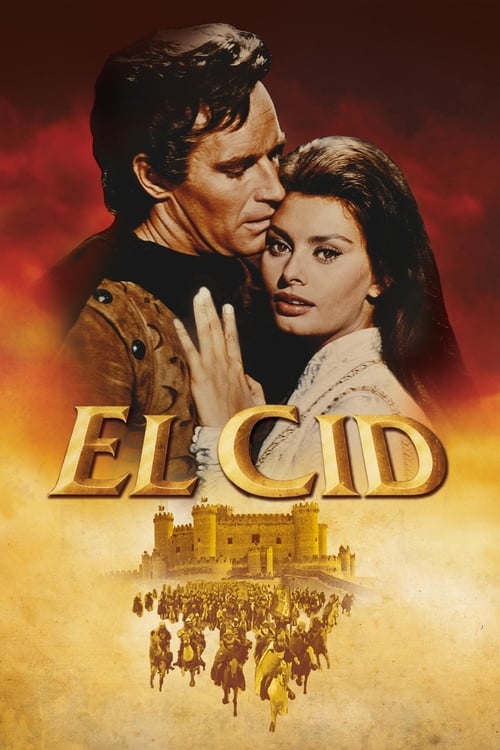
El Cid
1961 · Anthony Mann
For when you want to surrender an afternoon to a huge, old-fashioned epic — armor, romance, destiny, a thundering score — the kind of grandeur modern movies rarely attempt sincerely.
What it's about
Eleventh-century Spain. Rodrigo Díaz de Vivar — 'El Cid' to his followers — rises from accused traitor to legendary warrior, holding to an unbending code of honor while kings, courtiers, and rivals scheme around him, and driving back the Moorish invasion of Spain. Woven through the battles is his stormy, decades-spanning love for Chimene, a woman with reason to hate him.
The experience
Grand and sweeping in the old roadshow style — castles, cavalry charges, and a hero carved out of granite — but with an unusual moral seriousness underneath the spectacle. It's long and stately, and it earns its epic swell.
Performances
Charlton Heston gives one of his most commanding epic performances as Rodrigo, all granite conviction, opposite Sophia Loren as Chimene — two of the biggest stars of their era filling a very big canvas.
The craft
Shot in Spain in Super Technirama 70 by Robert Krasker and scored by Miklós Rózsa at full romantic force, it's a feast for a big screen and good speakers. Anthony Mann composes landscape and battle with real formal intelligence — this is spectacle directed with the eye of a master, not just staged with money.
Why it matters
One of the last great large-format historical epics before the genre collapsed under its own budgets, its reputation has climbed steadily since a 1993 restoration returned it to theaters as a rediscovered classic.
Snapshot
El Cid is the film in which the Hollywood historical epic briefly acquired a serious formal intelligence. Produced by Samuel Bronston in Spain, shot in Super Technirama 70 by Robert Krasker, scored by Miklós Rózsa, and directed by Anthony Mann at the height of his command of landscape and moral geometry, it takes the eleventh-century Castilian warlord Rodrigo Díaz de Vivar and turns him into an emblem of intransigent honor — a man who keeps faith with an abstraction while every institution around him bargains. Released in December 1961 in roadshow engagements, between Ben-Hur (1959) and Lawrence of Arabia (1962), it belongs to the last great wave of large-format historical spectacle before the form collapsed under its own budgets. Its reputation has moved decisively upward since a 1993 restoration and theatrical reissue championed by Martin Scorsese, who has repeatedly named it among the finest epics ever made. What distinguishes it is not scale — every epic had scale — but the austerity with which Mann uses it: a film of enormous armies and almost no rhetorical inflation, ending on one of the most purely iconographic images in the studio era.
Industry & production
El Cid is inseparable from the economics that produced it. Samuel Bronston, an émigré producer with financing assembled from European sources and American investors including the du Pont interests, built a production operation in Spain that exploited favorable exchange conditions, low labor costs, extensive state cooperation, and the ability to build permanent standing sets. Spain under Franco supplied military personnel as extras and access to castles and terrain that no soundstage could counterfeit; the film's crowd and cavalry work draws on manpower an American production could not have afforded domestically. Bronston's Madrid-based operation ran a sequence of pictures — King of Kings (1961), El Cid, 55 Days at Peking (1963), The Fall of the Roman Empire (1964), Circus World (1964) — before overextension and the failure of the later titles brought the company down. The collapse produced an unlikely legal legacy: the bankruptcy proceedings gave rise to Bronston v. United States (1973), still a foundational U.S. Supreme Court decision on the law of perjury.
Locations were the production's real capital. Peñíscola, the fortified coastal town in Castellón, stood in for Valencia, its walls and beach supplying both the siege and the closing ride; Belmonte Castle in Cuenca and other Castilian fortifications furnished the tournament and combat sequences. The strategy was to shoot the epic in Europe rather than reconstruct it, and the film's texture — sun, dust, stone, weather — follows directly from that decision.
Anthony Mann arrived carrying a specific wound. He had been engaged to direct Spartacus (1960) and was removed by Kirk Douglas after roughly a week of shooting. El Cid was his return to the form on his own terms, and it is hard not to read its severity as an argument. The screenplay is credited to Fredric M. Frank and Philip Yordan. Yordan, one of the era's most prolific credited writers, is also well documented as a front for blacklisted colleagues; the blacklisted Ben Barzman contributed to El Cid without credit, an attribution attested in blacklist-era memoir and scholarship. As with much Bronston writing, the credit record should be treated as a legal artifact rather than a reliable account of authorship.
Technology
The film was shot in Technirama and exhibited as Super Technirama 70. Technirama ran 35mm stock horizontally through the camera across eight perforations, combining a large negative area with a modest anamorphic squeeze — an approach that yielded exceptional resolution and comparatively clean, low-distortion widescreen images. Blown up to 70mm for roadshow presentation, it produced a picture of remarkable steadiness and fine detail without the bulk and rigidity of true 65mm camera systems. Prints carried six-track stereophonic magnetic sound, and the film was presented in the full roadshow apparatus: overture, intermission, exit music.
The technical choice matters aesthetically. Technirama's clarity rewards the deep, laterally organized compositions Mann favors — armies distributed across the width of the frame, individual figures legible at distance, architecture and landscape held in the same plane of sharpness as faces. The 1993 restoration, which returned the film to something near its original photographic quality, effectively re-argued the case for the format; much of the film's contemporary reputation dates from audiences finally seeing it as it had been photographed rather than in the faded, cropped television prints that circulated for decades.
Technique
Cinematography
Robert Krasker, best known for the expressionist black-and-white of The Third Man (1949), had already worked in Spain on Alexander the Great (1956), and brings to El Cid a painterly rather than illustrative sense of color. The palette is built from the materials themselves — ochre stone, dust, the saturated reds and blues of heraldic banners and Moorish silks against neutral Castilian ground. Interiors are lit with a candlelit density unusual for the genre; exteriors exploit the low, raking light of Spanish winter and early morning, which models terrain into relief. Krasker resists the flat, evenly illuminated brightness that afflicted much widescreen color photography of the period. The result is an epic that looks weathered rather than upholstered.
Editing
Robert Lawrence — who had cut Spartacus, receiving an Academy Award nomination for it — assembles the film with notable patience. The dominant rhythm is long, held, and architectural; the film trusts the shot. Where the cutting accelerates, it does so functionally, in the tournament and the battle sequences, and it accelerates within a clearly established geography rather than dissolving into the impressionistic churn later epics preferred. The two-part roadshow structure gives the film a genuine hinge: the first movement drives Rodrigo from champion to exile, the second from exile to Valencia and death.
Mise-en-scène / staging
This is where Mann's authorship is unmistakable. His Westerns had established a method of moral topography — placing figures against terrain so that height, distance, and exposure carry ethical weight — and El Cid scales it to armies. The trial by combat, the confrontation at the Santa Gadea oath, the siege of Valencia, and the final battle are all staged as problems of space: who occupies the high ground, who is enclosed, who rides out. Production designers Veniero Colasanti and John Moore, who also designed the costumes, built environments that function as arenas rather than backdrops; their work drew an Academy Award nomination for art direction. Second-unit director Yakima Canutt, veteran of the Ben-Hur chariot race, handled much of the mounted action, and the jousting and cavalry work carry his signature: real horses, real speed, real risk, photographed at ground level.
Sound
The six-track presentation is used with restraint. Battle is built from hooves, iron, and massed voices rather than continuous scoring, and Mann repeatedly cuts scenes to near-silence — the oath sequence, the final vigil — so that Rózsa's re-entry lands as event. Dialogue recording follows international-coproduction practice of the era, with post-synchronization for portions of the multinational cast.
Performance
Charlton Heston's Rodrigo is deliberately monumental: upright, unironic, physically imposing, and emotionally withheld. It is a performance built on stillness and on the refusal of the ingratiating gesture, and it reads either as granite or as stiffness depending on one's tolerance for the mode. Sophia Loren's Chimene carries the film's emotional volatility — grief, vengefulness, and finally reconciliation — and the pairing is temperamentally mismatched in ways the film partly converts into drama. Heston's published journals record friction over Loren's billing and treatment on set, and the on-screen relationship has a certain wariness that may not be entirely designed. The supporting ensemble is exceptionally strong: Herbert Lom's Ben Yusuf as an ideologue of pure will, Geneviève Page's Urraca as coiled dynastic ambition, Raf Vallone's Ordóñez, John Fraser's Alfonso, and Michael Hordern, Douglas Wilmer, and Frank Thring in sharply drawn smaller parts.
Narrative & dramatic mode
The film's dramatic engine is the classical conflict of love and honor inherited from Guillén de Castro's Las mocedades del Cid (1618) and Corneille's Le Cid (1637): Rodrigo kills Chimene's father in a duel of honor, and the marriage that follows is poisoned at its root. This is tragic-heroic material handled in a mode closer to hagiography than to psychological realism. Rodrigo does not develop; he is tested. Everyone around him — kings, courtiers, his own wife — undergoes revision, and the drama consists in the world reorganizing itself around a fixed point.
Structurally the film is a sequence of trials: trial by combat, trial by exile, the extraction of the oath at Santa Gadea, the siege, and finally the trial of death itself. The famous conclusion — the dead Cid strapped upright to his horse Babieca and ridden out at dawn to break the Almoravid army — comes from the later chronicle and legend tradition rather than the Cantar de mio Cid (c. 1200), and the film embraces it precisely because it converts character into pure image. The narrative logic is legend logic: the hero becomes a standard.
Genre & cycle
El Cid sits inside the roadshow historical epic cycle that ran roughly from Quo Vadis (1951) through The Fall of the Roman Empire (1964), and specifically within its European runaway-production phase, when American capital, Italian and Spanish infrastructure, and international casts converged. Within that cycle it is unusual for taking medieval rather than classical or biblical material — a choice that aligns it with a smaller strand including Ivanhoe (1952), Knights of the Round Table (1953), and The Vikings (1958) — and for having no religious-conversion narrative at its center. It is also, formally, one of the least camp entries in the cycle, which partly explains why it aged better than its neighbors.
Authorship & method
Mann's career runs in three distinct phases: the low-budget noirs of the late 1940s (T-Men, Raw Deal, Border Incident, shot with John Alton), the great cycle of 1950s Westerns (five with James Stewart, plus The Man from Laramie and Man of the West), and the epics. The continuity across all three is a preoccupation with obsession, humiliation, and revenge worked out through physical space. El Cid is his Western vocabulary — the exile, the ride, the hard-won town, the man defined against terrain — transposed to Castile and multiplied.
The key collaborators are unusually well matched to that program. Krasker supplies a photographic austerity that resists prettification. Colasanti and Moore build for staging rather than display. Lawrence cuts for legibility. And Rózsa, the composer who had effectively invented the sound of the Hollywood historical epic across Quo Vadis, Ivanhoe, Ben-Hur, and King of Kings, did archival research into medieval Spanish musical sources for this score — an approach he described in his autobiography Double Life — building modal, non-Romantic material into what many consider his finest work. The score and the song "The Falcon and the Dove" (lyrics by Paul Francis Webster) both drew Academy Award nominations; with the art direction nomination, the film received three, winning none.
Movement / national cinema
The film is a genuine hybrid: an American production, made with British and Italian craft personnel, shot in Spain with Spanish state assistance, about a Spanish national myth. This is the "runaway production" as a structural condition rather than an incidental one. The Cid had been thoroughly appropriated by Francoist nationalism as an emblem of Christian Spanish reconquest, and the film could not have been made in Spain without state cooperation. Yet its narrative pointedly rejects the confessional reading: Rodrigo's defining act is to spare Moorish rulers, who become his allies, and the antagonist is not Islam but the Almoravid fanatic Ben Yusuf, whose ideology is presented as a repudiation of Iberian coexistence. Whether the film accommodates Francoist myth or quietly reproaches it is a live question in the scholarship, and both readings are supportable from the text.
Era / period
1961 is late in the studio system's decline and near the peak of the roadshow gamble. Television had eroded the weekly audience; the response was the event picture — reserved seating, higher prices, 70mm, intermissions, souvenir programs. El Cid is a fully realized specimen of that strategy and, unlike Cleopatra (1963), one that worked. Precise figures for Bronston's international accounting are not reliable enough to quote, but the film was a substantial commercial success in its initial release, and its profitability is what enabled the more expensive Bronston pictures that ruined the company.
Themes
The central theme is the cost of incorruptibility. Rodrigo's honor is not a virtue that makes life livable; it destroys his marriage, earns him exile, and eventually kills him. The film is candid that the hero's rigidity is a burden borne largely by others, particularly Chimene, who is required to subordinate a legitimate grievance to a national myth.
Second is the theme of legitimate versus illegitimate authority. The kings in this film — Ferdinand, Sancho, Alfonso — are variously weak, brutal, or compromised, and the drama of the Santa Gadea oath is the spectacle of a subject compelling his sovereign to submit to truth. It is a striking assertion that legitimacy is conditional.
Third is coexistence. The film's Spain is plural, and its villain is the man who cannot tolerate plurality. Whatever its historical liberties — the actual Rodrigo Díaz spent significant portions of his career in the service of Muslim rulers and operated substantially as a mercenary, a dimension the film smooths into idealism — the picture consistently treats fanaticism, not religious difference, as the enemy.
Finally, the theme of the man who becomes an image. The ending literalizes it: the hero's body emptied of life and repurposed as a symbol that wins the battle. It is at once triumphant and quietly chilling.
Reception, canon & influence
Contemporary reviews were respectful and often admiring, particularly of the photography, the production design, and Rózsa's score; the reservations tended to concern length, solemnity, and Heston's monumental register, which some found statuesque to the point of inertia. The film did well commercially and was widely revived, but its critical standing suffered for decades from poor prints and the general disrepute into which the 1960s epic fell.
Two forces reversed that. The first was auteurist reassessment of Mann, driven initially by French critics who had championed his Westerns and who read the epics as continuous with them rather than as a sellout. The second was the 1993 restoration and theatrical reissue, in which Martin Scorsese's advocacy was decisive; Scorsese has consistently placed El Cid among the great epic films, and the restored presentation made the argument on its own.
Looking backward, the film's sources are layered: the Cantar de mio Cid, the chronicle tradition that supplied the dead hero's ride, Guillén de Castro and Corneille for the love-and-honor architecture, Rózsa's own prior epic scores for the musical idiom, and — most importantly — Mann's Westerns for the spatial method. Ben-Hur established the commercial template and lent Yakima Canutt; Spartacus lent its editor and, by way of Mann's firing, its motive.
Looking forward, the influence runs along several channels. Rózsa's medieval research became a reference point for later historical scoring, and the score itself has had an unusually durable concert and recording life. The Bronston model of building epics in Spain shaped the location economics of European production through the 1960s, feeding directly into the Spaghetti Western's use of Almería. Mann's staging of large-scale action in coherent, readable space stands as the counter-tradition to the fragmented battle grammar that later became standard, and the film is regularly invoked by filmmakers and critics arguing for that older clarity. Its thematic terrain — a medieval Iberian or Levantine world in which coexistence is destroyed by imported fanaticism — resurfaces most visibly in Ridley Scott's Kingdom of Heaven (2005), though the relation is better described as a shared inheritance than a documented debt. And the closing image has entered the general iconography of cinema: the dead man on the white horse, riding into the light, an idea the film executes with a directness that no subsequent epic has improved upon.
A Deleuzian reading
A dead man is tied upright into his saddle, and the gate opens.
The full Deleuzian reading of El Cid →
Reception
A big roadshow hit in 1961, it then vanished for decades in the rights limbo of Samuel Bronston's collapsed empire — until Martin Scorsese championed its 1993 restoration and re-release, and it's since been reclaimed as maybe the most respectable of the widescreen epics.
How El Cid was received, from release to now →
How to watch El Cid: what to notice on a first viewing
- Notice who holds the high ground in every confrontation. Mann stages the trial by combat, the oath, and the siege all as problems of space: who is elevated, who is enclosed, who can ride out. Position tells you the outcome before anyone speaks; the ground itself argues who wins.
- Watch how armies spread sideways across the full frame. Krasker and Mann organize Technirama's width laterally and in depth, keeping antagonists pinned at opposite edges with legible space between them. The wide frame is never just spectacle; it keeps every army's position readable at a glance.
- Listen for the silence right before the oath. Mann repeatedly cuts scenes toward near-silence, letting hooves, iron, and massed voices carry the weight instead of continuous scoring. The quiet makes Rozsa's music, when it returns, land as an event rather than wallpaper.
- Watch how still Heston holds his body in every scene. Rodrigo is built on stillness and the refusal of an ingratiating gesture, upright and withheld even when everyone around him reacts. The rigidity is not a failure of acting; it is the film manufacturing a man hard enough for a country to organize around.
- Notice the ochre stone and raking light on the armor. Krasker builds the palette from the materials themselves, exploiting the low winter light of Spain rather than flattening it into even brightness. The result looks weathered rather than upholstered, unusual for a roadshow epic this size.
The whole guide to watching El Cid, with the keys for a rewatch →
Influences: the films it descends from and the films it influenced
- The Naked Spur (1953) — Mann's method of externalizing moral conflict as terrain — every reversal of loyalty staged on a specific gradient, ledge, or river crossing that the camera keeps geographically legible — is the exact procedure transposed to Castile, where Rodrigo's choices are always sited on a bridge, a gate, or a slope.
- The Man from Laramie (1955) — Mann's first CinemaScope film worked out the deep lateral composition El Cid runs on: antagonists pinned at opposite frame edges with usable depth between them, and humiliation (the dragging through fire, the hand shot) staged in one wide unbroken take rather than cut into.
- Man of the West (1958) — Supplies the exile architecture — a man banished by the community he protects, forced back through a corrupt world to be tested serially — which becomes El Cid's hagiographic testing structure, each episode a fresh trial of the same incorruptibility.
- Alexander Nevsky (1938) — Established the two devices El Cid rebuilds: massed cavalry filmed as advancing geometric blocks across a flat horizontal plane so the audience can read troop position at every moment, and a modal, non-Romantic cantata score that treats medieval idiom as structural rather than decorative.
- Henry V (1944) — Robert Krasker's Agincourt — the lateral tracking charge that accelerates with the horses in continuous space, and the flat quattrocento/Book-of-Hours pictorialism of the court scenes — is the visual grammar he brings intact to Valencia and the Vivar exteriors.
- Quo Vadis (1951) — Where Rózsa first replaced Hollywood's generic 'antiquity' idiom with music built from archival musicological research; El Cid extends the same method to medieval Iberian sources, yielding modal melody and open-fifth harmony instead of late-Romantic scoring.
- Ivanhoe (1952) — Fixed the medieval-epic set pieces El Cid inherits and refines — the trial-by-combat joust shot at ground level along the tilt line, and the siege organized around one assaulted wall — while giving Rózsa his first medieval-modal workout, including the trumpet fanfare-as-heraldry device.
- The Big Country (1958) — Technirama's anamorphic-on-horizontal-8-perf negative used specifically for lateral moral distance — Wyler's extreme long shots that shrink two duelists to nothing — plus Heston's stiff, monumental register, both scaled up in El Cid's Super Technirama 70 blow-up.
- Ben-Hur (1959) — Direct personnel debt: Yakima Canutt, whose chariot race proved large action could be shot at real speed with real horses in a continuous readable arena, came to El Cid to stage the Calahorra combat and the tournament falls by the same rule.
- Spartacus (1960) — Mann shot the Libyan quarry opening before being fired; the film also lent El Cid its editor Robert Lawrence, whose cutting-for-legibility — holding the master until the geography is established, entering coverage only after — is what keeps Mann's battles spatially coherent.
- Senso (1954) — Krasker's color historical-epic cinematography extending the large-scale painterly battle-and-pageant photography he developed on Senso.
- The Fall of the Roman Empire (1964) — Mann and Krasker reprise the method at larger scale: the Forum built to full height so debate can be staged in deep lateral tiers, and the final duel fought in a single geographically fixed arena — the same architectural long-take logic as the Valencia gate sequences.
- A Fistful of Dollars (1964) — Inherits the production economy El Cid consolidated — Spanish crews, standing sets, and cheap cavalry extras that pushed European genre shooting into Almería — and with it Mann's habit of resolving conflict through precisely surveyed lateral distance across a single street.
- Waterloo (1970) — The last great argument for Mann's clarity: squares, charges, and flanking movements filmed from consistent vantage points so the viewer always knows which body of men is where — the opposite of the fragmented battle grammar that replaced it.
- Excalibur (1981) — Treats plate armor as a photographic subject the way Krasker did — as a reflective surface lit by available and firelight rather than filled — and stages chivalric combat frontally in unbroken space so weight and exhaustion register physically.
- Conan the Barbarian (1982) — Shot on the Spanish locations El Cid's model opened up, with Basil Poledouris scoring in explicit imitation of Rózsa's modal-archaic method — ostinato, open intervals, no leitmotif sentimentality — under processions staged as slow lateral pageant.
- Kingdom of Heaven (2005) — Rebuilds El Cid's moral architecture — a working convivencia between faiths wrecked by imported zealots on both sides — and stages its siege by the same rule of one comprehensible wall, with the hero defined by the crown and the marriage he refuses.
- Braveheart (1995) — Mann's template of staging large practical cavalry engagements across open terrain — wide establishing shots of formation maneuver cutting to the physical impact of the charge — established the organizational-clarity-before-chaos grammar that Gibson's Battle of Stirling directly inherits.
- King of Kings (1961) — Shot the same year on the same Bronston Madrid infrastructure with Rózsa scoring both: the same austere modal writing, the same refusal of choral bombast at the sacred moments, and the same practice of building sets to be walked through laterally rather than gawked at.
- 55 Days at Peking (1963) — Veniero Colasanti and John Moore repeat their El Cid principle — construct a full-scale, structurally load-bearing environment (the Legation Quarter here, Valencia there) designed for continuous blocking and long takes, not for a single money shot.
- Lawrence of Arabia (1962) — Shot in Super Technirama 70 partly on the same Almería locations used for Lawrence's Aqaba sequences, with Robert Krasker using extreme telephoto focal lengths to monumentalize the protagonist against Castilian plains; Miklós Rózsa's score uses extended silences before orchestral surges in the same structural role Jarre exploits in Lawrence, and the film shares the roadshow epic's interrogation of heroic mythology through physical and psychological dissolution.
- Knights of the Teutonic Order (1960) — Parallel solution to the same anamorphic problem: massed cavalry read as heraldic color-blocks tracked laterally across the wide frame, with banners used as the device that keeps a crowd composition legible at scale.
Similar films
- Ben-Hur (1959) — influence & lineage
- Spartacus (1960) — influence & lineage
- A Fistful of Dollars (1964) — influence & lineage
- Two Women (1960) — shared sensibility
- Rocco and His Brothers (1960) — shared sensibility
- Lawrence of Arabia (1962) — shared sensibility
- The Leopard (1963) — shared sensibility
- Gladiator (2000) — shared sensibility