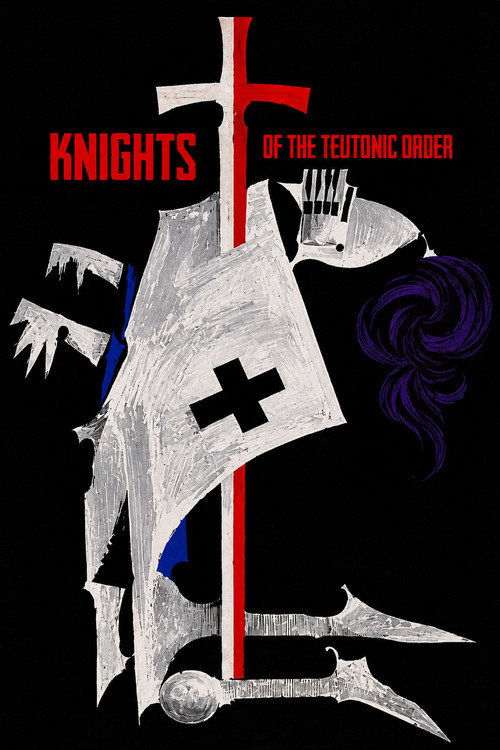
Knights of the Teutonic Order
1960 · Aleksander Ford
For a long afternoon when you want a grand historical epic — armor, banners, romance, and a thundering climax. Comfort viewing for lovers of the big canvas, with real weight underneath.
What it's about
In medieval Poland, a young impoverished knight returns from war against the Teutonic Order, falls in love, and rashly vows to bring his beloved three trophies torn from Teutonic knights' helmets. That oath drags him through humiliation and loss at the Order's hands, on a course toward the massive Battle of Grunwald of 1410, where two armies meet to decide the fate of a nation.
The experience
Old-school epic sweep: castles, courts, oaths, and battlefields, building patiently toward one of the great screen battles. It moves at a stately pace and pays off in scale and pageantry.
The craft
Poland's first widescreen color feature and the most expensive production its film industry had yet mounted, made as a state prestige project for the battle's 550th anniversary. The Grunwald sequence — thousands of extras, cavalry, and carnage staged practically — is the sensory payoff and demands the biggest screen you can find.
Why it matters
One of the most-attended films in Polish history and a cornerstone of the nation's cinema, it fixed the Sienkiewicz novel's images of medieval Poland in the popular imagination for generations.
Snapshot
Krzyżacy — released abroad as Knights of the Teutonic Order and, in some territories, Black Cross — is the monumental Polish historical film: an adaptation of Henryk Sienkiewicz's 1900 novel, made as a state prestige project and timed to the 550th anniversary of the Battle of Grunwald (15 July 1410). It follows Zbyszko of Bogdaniec, a young and impoverished knight, from his rash vow to bring his beloved Danusia three peacock crests torn from the helmets of Teutonic knights, through a chain of humiliations, mutilations and losses inflicted by the Order, to the mass slaughter at Grunwald where the Order's power is broken.
It was Poland's first widescreen color feature, the most costly production the nationalized industry had yet mounted, and — by the attendance figures routinely cited in Polish sources, on the order of thirty-two million admissions — the most-watched Polish film ever made. It is also the film that sits most awkwardly beside the "Polish School" that made Polish cinema internationally famous in exactly these years. Where Wajda and Munk were dismantling the iconography of heroic sacrifice, Ford was rebuilding it in Eastmancolor, at full scale, with the army supplying the cavalry.
Industry & production
The film was produced within the Zespół Filmowy "Studio" — one of the semi-autonomous production units through which the nationalized Polish industry organized itself after 1955 — with Ford himself as the unit's artistic head. That matters: Ford was not a director commissioned from outside but one of the industry's founding administrators using its machinery on himself. He had headed the Polish Army's front-line film crew (Czołówka) during the war, and after 1945 became the first head of Film Polski, the body that built the postwar Polish cinema from nothing. By 1960 he was simultaneously the industry's elder statesman, a professor-figure to the Łódź generation, and — after the banning of his Marek Hłasko adaptation The Eighth Day of the Week (1958) — a director with something to prove to the authorities.
Krzyżacy was conceived as an anniversary film and a millennium film. The 550th anniversary of Grunwald fell in 1960, inside the long official run-up to the millennium of the Polish state, and the Party's use of Grunwald was not subtle. The German Democratic Republic had recognized the Oder–Neisse line; the Federal Republic had not. A national epic in which a Polish–Lithuanian coalition annihilates a German crusading order on what is now Polish territory was, in 1960, an argument about the map. Ford's picture supplied it in the most popular form available.
The scale was without Polish precedent: thousands of extras, cavalry, purpose-built armor and heraldry, months of location work, and the sustained cooperation of the state that only a project of official significance could command. Individual figures for budget, shooting days and extra counts circulate widely in Polish popular accounts and vary between them; the reliable statement is that this was, by consensus, the largest and most expensive Polish production to that date, mounted at the Łódź feature-film studio with resources unavailable to any other picture of its year.
Technology
Krzyżacy was the Polish industry's first color widescreen feature, and its technical interest is inseparable from that fact. Color stock and anamorphic optics were scarce, hard-currency items in the Eastern Bloc; using them on a national epic was a policy decision as much as an aesthetic one. English-language sources are inconsistent about the trade name of the anamorphic system used — this is one of the details on which the documentation is genuinely thin, and it should not be asserted with confidence — but the format's consequences are legible on screen: a wide, shallow frame, color that runs warm in interiors and cool in the battle, and a strong incentive toward horizontal, frieze-like staging.
The technology carried an ideological freight beyond spectacle. Widescreen color was, in 1960, the language of Hollywood and of the Soviet prestige film alike; adopting it announced that Polish cinema could compete on the terrain of the international blockbuster rather than only in the festival category of the small, difficult, black-and-white film. Sound was recorded and released in mono, with dialogue post-synchronised in the studio, standard practice in Polish production of the period and audible in the slightly detached, declamatory quality of the speech.
Technique
Cinematography
Mieczysław Jahoda's photography is the film's most durable achievement, and the least discussed. Jahoda had already shot Wojciech Has's The Noose (1958) and would go on to The Saragossa Manuscript (1965) and The Doll (1968) — a career built on making stylized, artificial worlds look solidly inhabited. Here he treats the anamorphic frame as a horizontal field for heraldry: banners, lances and rows of helmets laid across the width, figures placed in depth so that the crowd reads as an army rather than a foreground of extras. Interiors — the Kraków court, the Order's chambers at Szczytno — are staged in candle-warmed browns and reds against black; exteriors move toward a bleached, dusty palette for the battle, where the visual problem is legibility rather than beauty. The camera is predominantly stable, mounted, and reserved in its movement; when it does travel, it tracks laterally along a line of men, reinforcing the frieze.
Editing
The cutting is classical and unhurried through the first two-thirds — long scenes, generous coverage, dialogue played in sustained two-shots — and then shifts register decisively at Grunwald, where Ford turns to accelerated montage: charges intercut with commanders, hooves, falling standards, and the shrinking geometry of the Teutonic wedge. The contrast is deliberate and is the film's clearest structural idea: narrative time slows and thickens through the years of injury, then collapses into the battle. (Credits for the editing are among the details recorded inconsistently in English-language sources; the analysis here rests on the cutting as it plays, not on an attribution.)
Mise-en-scène / staging
The visual model is explicit and avowedly national: Jan Matejko's vast 1878 canvas The Battle of Grunwald, the single most reproduced image in Polish historical painting, a picture the Nazis hunted for during the occupation and which Poles had hidden at real risk. Ford's battle is composed in Matejko's idiom — the churning press of bodies, the white mantles with black crosses, the Grand Master falling among lances — and the film's most lasting cultural effect is that it fused with the painting in the popular imagination. Much of what Poles now "see" when they think of Grunwald is a composite of Matejko and Ford.
Elsewhere the staging is antiquarian in the best sense: armor, arms, textiles and church interiors reconstructed with a documentary seriousness that had propaganda value (the Polish past as materially real, the Order as an institution rather than a costume). The Teutonic knights are staged as an order in the monastic sense — ranked, robed, ceremonial, their faces framed by mail — which allows Ford to keep individual villains sharply drawn while the collective remains an abstraction of faceless white and black.
Sound
Kazimierz Serocki's score is the film's most unexpected credit. Serocki was a leading figure of the Polish postwar avant-garde and a co-founder of the Warsaw Autumn festival — the institution through which serialism and sonorism entered Polish musical life. Writing for a national epic, he works in a monumental, brass-heavy idiom with archaic and modal inflections rather than in his concert-hall language, but the orchestral thinking is more astringent than the genre normally allows. The score's decisive move is to hand the film's emotional climax not to itself but to Bogurodzica, the medieval Polish hymn that chronicle tradition records the army singing before the battle: at Grunwald the orchestra yields to massed voices, and the film's argument — that this is a sacred national event, not merely a military one — is made in sound before it is made in image.
Performance
The playing is theatrical by design, drawn from a stage-trained ensemble and pitched to the scale of the frame. Mieczysław Kalenik's Zbyszko is deliberately callow — a boy whose vows outrun his judgment — which gives the film's brutal middle section its logic. Grażyna Staniszewska's Danusia is a child-bride figure of near-total passivity; Urszula Modrzyńska (Dorota in Wajda's A Generation) plays Jagienka as her active, earthbound counterweight, and the film is noticeably more alive when she is in it. Aleksander Fogiel's Maćko supplies pragmatic peasant-noble comedy. The performance that survives best is Andrzej Szalawski's Jurand of Spychów, whose journey to Szczytno and mutilation at the Order's hands — blinded, maimed, sent home as an object lesson — is played without any of the rhetorical inflation surrounding it. Emil Karewicz's Jagiełło is a study in monarchic stillness, the still point at the center of the battle.
Narrative & dramatic mode
Sienkiewicz's novel is a chivalric romance with a national thesis, and Ford keeps both halves. The plot machinery is romance: an oath, two women, a captivity, a rescue, a duel, a revenge. The dramatic mode, however, is closer to martyrology. The film's central sequences are not victories but injuries — Zbyszko condemned in Kraków for attacking the Teutonic envoy Kuno von Lichtenstein and saved only when Danusia throws her veil over him and claims him as husband; Danusia abducted and destroyed; Jurand mutilated. Grunwald arrives not as the climax of a campaign but as the discharge of accumulated private grief into public history. That structure — suffering banked, then redeemed at a single national site — is Sienkiewicz's, written under Partition, "for the uplifting of hearts," at a moment when Prussian Germanisation policy made a fifteenth-century German order a legible stand-in for a nineteenth-century one. Ford inherits it and points it at 1960.
Its weakness as drama is the weakness of the source: the Order is granted institutional cunning but almost no interiority, and the film's moral universe has no interesting doubt in it. Its strength is momentum and clarity — three hours that never lose the thread of who owes what to whom.
Genre & cycle
The film belongs to two cycles at once. Internationally, it sits in the postwar wave of widescreen historical spectacle, sharing the decade with the Hollywood epic and the Soviet monumental film, and using the same technology to the same end: the past as mass-audience event. Domestically, it inaugurated the Polish superprodukcja — the big-budget adaptation of canonical national literature — and specifically the postwar Sienkiewicz cycle, which ran through Jerzy Hoffman's Colonel Wolodyjowski (1969) and The Deluge (1974, an Academy Award nominee for Best Foreign Language Film), to With Fire and Sword (1999) and Jerzy Kawalerowicz's Quo Vadis (2001). Kawalerowicz's Pharaoh (1966) is the same industrial impulse turned toward Prus and toward political allegory.
Authorship & method
Ford's method was institutional: he built the film the way he had built the industry, by assembling the best available specialists and imposing a unified, legible plan. The screenplay was developed by Ford with Jerzy Stefan Stawiński, the writer of Kanał, Eroica and Bad Luck — which places the great ironist of Polish war narrative inside the great monument of Polish national narrative, and is the sharpest available illustration of how small and internally contradictory this industry was. Jahoda's camera supplies visual authority; Serocki's score supplies gravity and one moment of genuine strangeness; a stage-trained ensemble supplies scale.
Ford's authorship here is executive rather than confessional, and his career gives that a bitter frame. Born Moszek Lifszyc, formed in the 1930s avant-garde film society START, he had made Border Street (1948) about the Warsaw Ghetto and won a directing prize at Cannes for Five Boys from Barska Street (1954), on which the young Wajda served as assistant. Eight years after Krzyżacy, in the antisemitic purge of March 1968, Ford was expelled from the Party and driven out of Poland; he died in the United States in 1980. That the definitive cinematic monument to Polish national identity was made by a Jewish communist whom the Polish state subsequently expelled is not a footnote to the film — it is the sharpest thing about its production history.
Movement / national cinema
Krzyżacy is the official counter-image to the Polish School. Between 1956 and 1961, Wajda, Munk, Has and Kawalerowicz built Polish cinema's international reputation on skepticism: romantic heroism shown as waste (Kanał, Ashes and Diamonds), patriotic myth shown as farce (Eroica). Ford's film reverses every one of those terms — heroism is efficacious, sacrifice is redeemed, the nation is real and singular — and it outsold all of them combined. Any account of Polish cinema in this period that treats the School as the whole story misses that the mass audience was, in the same years, watching the myth restored rather than dismantled.
Era / period
The film is a document of 1960 in three registers. It is Cold War border politics conducted through the fifteenth century. It is a millennium-era assertion of Polish continuity on the western territories. And it is the Polish industry's declaration that it could work at international technical scale — color, widescreen, mass action — three years before the Party's cultural line tightened again. It also captures a specific post-thaw settlement: the state financing both the skeptical art film and the affirmative epic, and getting national prestige from each.
Themes
Collective survival against an organized, ideological enemy; the transformation of private injury into public reckoning; the Order as the perversion of a religious institution into an apparatus of conquest — the film is careful to attack the Knights as an institution rather than Germans as a people, a distinction that was politically load-bearing in 1960 and that the film honors more consistently than its reputation suggests. Beneath these runs Sienkiewicz's older theme: legitimacy through land and lineage, the impoverished knight who earns his place by service. And, unmistakably, the sacralisation of the nation, sealed by Bogurodzica — a Catholic hymn placed at the emotional summit of a film made under an officially atheist state, one of the period's more revealing accommodations.
Reception, canon & influence
Domestically the film was a phenomenon, and its attendance record — the roughly thirty-two million admissions cited across Polish sources — has never been approached by another Polish production. It circulated widely through the Eastern Bloc and was released in the West in dubbed and, in some territories, shortened versions, where it was received as competent international spectacle rather than as an event. Critically it has always been the more contested of Ford's films: admired for its scale, craftsmanship and battle staging, faulted for illustrative literalism, for treating Sienkiewicz as scripture, and for the political convenience of its timing. Its standing declined further with Ford's own after 1968, and its rehabilitation has come less through auteurist argument than through its sheer persistence in Polish popular memory and television scheduling.
Its backward influences are clear. Sienkiewicz and Matejko supply the story and the pictures. Eisenstein's Alexander Nevsky (1938) supplies the template for filming Teutonic knights as an inhuman crusading machine — helmeted, faceless, annihilated in a single mass engagement, with the score doing the moral work — and the resemblance between the Battle on the Ice and Ford's Grunwald is structural, not incidental. Behind both stands the wider convention of the interwar and postwar monumental historical film.
Forward, its influence is easier to trace in Poland than outside it. It established the commercial viability of the literary national epic and set the template — length, star ensemble, cavalry, canonical text — that Hoffman would follow for three decades. It made Grunwald visually canonical: subsequent Polish representations of the battle argue with Ford's version whether or not they acknowledge it. And it defined, by contrast, what the ambitious historical film would soon reject. Within six years Kawalerowicz's Pharaoh was using the same industrial scale for political disenchantment, and in Soviet cinema Tarkovsky's Andrei Rublev (1966) would treat the medieval past as opaque, cruel and unredeemed by nationhood — the exact inverse of Ford's proposition. Krzyżacy is the last great uncomplicated version of the national epic in Polish cinema, and the fact that nothing quite like it was attempted again in that spirit is the clearest measure of both its success and its moment.
A Deleuzian reading
Three peacock feathers.
The full Deleuzian reading of Knights of the Teutonic Order →
Reception
A colossal popular hit in 1960 Poland — timed to the 550th anniversary of the Battle of Grunwald, it sold 14 million tickets in four years and passed 30 million viewers, still cited as the most-watched film ever screened in Poland. Today it reads more as a national heritage monument and school-screening staple than a living classic, with modern viewers eyeing its Cold War-era anti-German subtext.
How Knights of the Teutonic Order was received, from release to now →
How to watch Knights of the Teutonic Order: what to notice on a first viewing
- Notice how rarely the camera moves throughout the film. Jahoda keeps the camera stable and mounted for most of the film, and when it does move it only tracks sideways along a line of men. The stillness is not timidity. It is banking patience that the film plans to spend all at once, later.
- Watch banners and lances laid out across the frame's width. Jahoda treats the wide frame as a field for heraldry, with figures placed in depth so a crowd reads as an army rather than a handful of extras. The width of the frame is doing the work of a much larger budget than the shot count suggests.
- Notice the warm candlelit interiors against the cool, bleached exteriors. Court and chamber scenes are lit in candle-warmed browns and reds against black, while exteriors move toward a bleached, dusty palette built for legibility, not beauty. You can tell where power is being exercised just from the color of the light in the room.
- Notice how long and unhurried the scenes run early on. For most of the film the cutting is classical and slow, playing dialogue in sustained two-shots rather than rushing between speakers. This slowness is a setup. The film is saving its speed for one place.
- Listen for the score by Kazimierz Serocki, brass-heavy and modal. A leading avant-garde composer writes gravity and archaic color for a national epic, using an idiom far more astringent than the genre usually allows. The score's strangeness is a clue that something more considered than pageantry is happening under the surface.
The whole guide to watching Knights of the Teutonic Order, with the keys for a rewatch →
Influences: the films it descends from and the films it influenced
- Alexander Nevsky (1938) — Supplies the structural template Ford reuses wholesale at Grunwald — the Order filmed as an anonymous helmeted wedge advancing in sustained lateral tracking shots, a long dread-building stasis before contact, and the score rather than dialogue delivering the moral verdict on the annihilation.
- Ivan the Terrible, Part I (1944) — Model for the heraldic frieze: stage-trained actors held in frontal, near-immobile painterly groupings where costume silhouette and banner carry the composition, so that any shift to movement registers as an event.
- Henry V (1944) — Establishes the antiquarian-reconstruction method — armor, camp and livery built from period illumination — and the accelerando cavalry charge cut in progressively shortening shot-lengths against a rising orchestral figure, precisely the tempo-contrast device Ford deploys at Grunwald.
- Kościuszko pod Racławicami (1938) — The pre-war Polish practice of treating a national history canvas as a literal blocking diagram — infantry and cavalry arranged to reproduce a picture the audience already knows — which Ford inherits and industrializes into the Matejko tableau.
- Border Street (1948) — Ford's own martyrological grammar — a community observed through crosscut household units until collective sacrifice consolidates them into a single moral body — transposed from the Warsaw Ghetto tenement to the medieval manor.
- Five Boys from Barska Street (1954) — Establishes Ford's executive authorship in practice: assemble ranking specialists around one legible didactic plan (here his first color unit, with Wajda as assistant), the production model Krzyżacy scales up to superprodukcja size.
- Kanał (1957) — Jerzy Stefan Stawiński's screenplay architecture — a doomed collective tracked through parallel small groups toward a foreknown convergence — is the narrative skeleton the same writer then supplies to Ford, the ironist's structure carried inside the monument.
- Pharaoh (1966) — Turns the identical superprodukcja apparatus — thousands of extras, anamorphic lateral tracking across empty terrain, obsessive material reconstruction — against Ford's proposition, making the same monumentality serve political disenchantment rather than national affirmation.
- Andrei Rublev (1966) — Answers the Nevsky–Ford medieval battle grammar by dismantling it: the sack of Vladimir is staged in long takes with unemblazoned armor, refusing accelerated montage and heraldic silhouette so the past reads as opaque rather than legible.
- Colonel Wolodyjowski (1969) — Direct inheritance of the template Ford proved commercial — canonical Sienkiewicz text, roadshow length, star ensemble, army-supplied cavalry — with the climax built on Ford's tempo contrast between siege stasis and charge.
- The Deluge (1974) — Scales Ford's method to its limit, with military units riding as extras through anamorphic lateral tracking shots, locking in Krzyżacy's equation of the national epic with literal cavalry-count spectacle.
- With Fire and Sword (1999) — Closes the Sienkiewicz cycle Ford opened, restaging the single decisive mass engagement with digital crowd extension while preserving the frieze-then-charge editing structure and the hymn-scored moral cadence.
- Pan Tadeusz (1999) — Extends the literary national epic Ford made commercially viable, again composing set pieces as animated history paintings and staging stage-trained ensemble verse delivery over post-synchronised sound.
- El Cid (1961) — Parallel solution to the same anamorphic problem: massed cavalry read as heraldic color-blocks tracked laterally across the wide frame, with banners used as the device that keeps a crowd composition legible at scale.
- The Saragossa Manuscript (1965) — Mieczysław Jahoda redeploys the same anamorphic deep-focus lateral track — the camera gliding past figures staged in depth like a frieze — for delirium and recursion rather than pageant.
- War and Peace (1966) — The other Eastern Bloc answer to the mass-battle problem built on the same premise that the socialist state can lend a real army: military units as extras, choreographed formations swept by cable- and helicopter-borne lateral moves over the widescreen field.
- Marketa Lazarová (1967) — Pushes antiquarian reconstruction past pageant into ethnography — widescreen black-and-white friezes of a medieval world rebuilt for mud, fur and archaic speech rather than for heraldic legibility.
- The Valley of the Bees (1968) — Films the Teutonic Order with Ford's exact iconography — white mantle, black cross, faceless discipline — but in close, mobile, intimate framing that withholds the mass tableau, rendering the Order as psychology instead of machine.
Similar films
- Alexander Nevsky (1938) — influence & lineage · often watched together
- Marketa Lazarová (1967) — influence & lineage
- El Cid (1961) — influence & lineage
- Kanal (1957) — influence & lineage
- Andrei Rublev (1966) — influence & lineage · often watched together
- The Leopard (1963) — often watched together
- 1900 (1976) — often watched together
- The Fifth Seal (1976) — often watched together