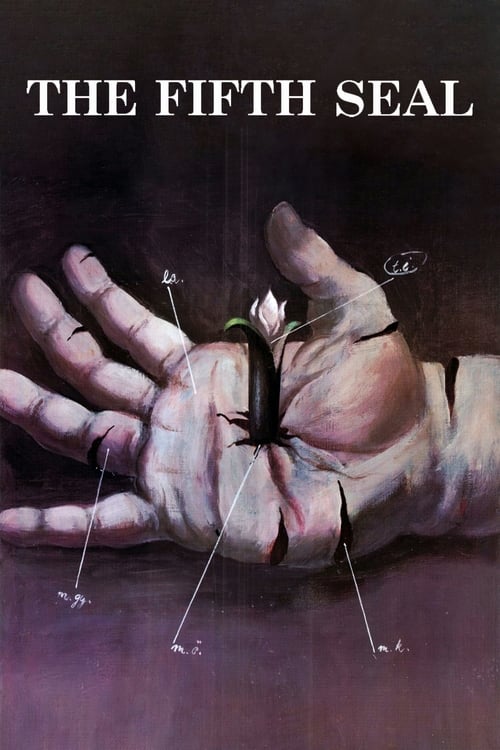
The Fifth Seal
1976 · Zoltán Fábri
For when you want a film that puts a moral question directly to you and won't let you dodge it — this is a challenge, not comfort, and you'll be arguing with yourself for days.
What it's about
Budapest, autumn 1944, with fascist militias running the streets: four friends — a watchmaker, a bookseller, a carpenter, a tavern-keeper — gather in a small pub over wine, joined by a war-wounded photographer. One of them poses a hypothetical question about good and evil, the kind of parlor game you'd forget by morning. Then history walks in and demands each man answer it for real.
The experience
It starts warm — smoky, talky, almost cozy — and tightens by degrees into something genuinely harrowing. You feel the trap closing long before the characters do, and the question they were toying with starts working on you too.
The craft
The structure is the masterstroke: a long, near-theatrical debate in amber lamplight, then a cold plunge into an interrogation cell, so the film's own form enacts the gap between talking about conscience and being tested on it. Fábri shoots faces like a jury would study them, and the pub's warm glow curdles into something sinister in memory.
Why it matters
Widely regarded as one of the summits of Hungarian cinema and a defining reckoning with the country's fascist period, it has become the reference point for films that stage ethics as drama rather than lecture.
Snapshot
The Fifth Seal (Az ötödik pecsét) is a Hungarian moral-philosophical drama set in Budapest in the autumn of 1944, during the Arrow Cross terror that followed Hungary's slide into open fascism late in the Second World War. Adapted from Ferenc Sánta's 1963 novel of the same name, the film gathers a handful of ordinary men — a watchmaker, a bookseller, a carpenter, a tavern-keeper, and a war-crippled photographer who drifts into their company — in a small, amber-lit pub, where a seemingly idle after-hours conversation about good and evil is later answered by history in the cruellest possible terms. Its structure is deliberately bipartite: a long, near-theatrical debate followed by a descent into an Arrow Cross prison, where the abstract question posed over wine becomes a literal test of conscience. Widely regarded as Zoltán Fábri's crowning achievement, the film won the top prize at the Moscow International Film Festival in 1977 and has come, over the decades, to be counted among the essential works of Hungarian cinema. The title is drawn from the Book of Revelation — the fifth seal, beneath which lie "the souls of them that were slain for the word of God."
Industry & production
The film was produced within Hungary's state-socialist film system, centered on the Mafilm studios in Budapest and organized through the semi-autonomous creative "studio" units that structured Hungarian production from the 1960s onward. By 1976 Fábri was among the most senior and internationally decorated figures in that system: a veteran whose career reached back to the 1950s and whose earlier The Boys of Paul Street (1969) had earned a nomination for the Academy Award for Best Foreign Language Film. That standing afforded him the resources and latitude to mount an austere, dialogue-driven adaptation of a serious literary novel — a project with little commercial insurance and considerable ideological delicacy, given its subject.
The production climate matters. The film was made in the mature Kádár era, the period of relative cultural relaxation sometimes called "goulash communism," when Hungarian cinema was permitted to examine the wartime fascist past and the moral ambiguities of survival with a candor rare elsewhere in the Eastern Bloc. Confronting the crimes of the Arrow Cross was ideologically sanctioned; what is striking about The Fifth Seal is how far it pushes past a simple anti-fascist parable into genuinely unsettling ethical territory, refusing the consolations of tidy heroism. Precise budget and box-office figures are not part of the well-documented public record, and I will not invent them; the film's importance was always artistic and critical rather than commercial.
Technology
The Fifth Seal was shot on 35mm color, in the standard studio-based practice of Mafilm in the mid-1970s. Hungarian features of the period frequently worked with Eastern Bloc ORWO color stock, whose characteristically muted, slightly desaturated rendering suited the film's somber palette; I flag this as consistent with the era rather than as a documented technical certainty for this specific title. The film's visual power derives far less from any technological novelty than from old, painterly means — controlled low-key lighting, warm practical sources, and a confined studio-built interior — deployed with unusual discipline. This is a work whose "technology" is essentially that of classical studio filmmaking turned toward the effect of an old-master canvas rather than toward spectacle.
Technique
Cinematography
The photography — the work of György Illés, Fábri's frequent and distinguished cinematographer — is the film's most celebrated formal element. The long opening sequence in the tavern is lit in a deep chiaroscuro of amber and shadow, the faces emerging from darkness in a manner explicitly evocative of Baroque painting; commentators routinely reach for Rembrandt and Georges de La Tour to describe it. This warmth is not merely beautiful but ironic: the golden glow of comradeship and drink is the setting for a conversation about damnation. As the film moves out of the pub and into the streets and the prison, the register cools and hardens, the painterly intimacy giving way to a colder, more clinical light. The camera favours sustained framings and slow, deliberate movement over montage-driven energy, holding on faces long enough for the moral weather to pass across them.
Editing
The cutting — credited, in keeping with Fábri's regular collaborators, to his longtime editor (Ferencné Szécsényi is associated with much of his work of this period, though I note the specific credit here without full certainty) — serves a fundamentally theatrical rhythm. The first movement of the film is edited to sustain a real-time conversational tension, allowing arguments to breathe and pauses to accumulate weight. The structural pivot from tavern to prison is the film's decisive editorial gesture: it withholds catharsis and reorganizes everything that came before, so that remembered lines from the debate return to indict the men who spoke them.
Mise-en-scène / staging
Fábri trained and worked as a stage director and designer, and The Fifth Seal wears that formation openly. The pub is treated almost as a single dramatic chamber — a confined, richly appointed space in which men are arranged and re-arranged around a table like figures in a genre painting. The staging is frankly indebted to visual art: the film draws on the grotesque, hell-haunted imagery of Hieronymus Bosch, whose vision of torment and moral judgment hovers behind the drama and is invoked within the film's own imagery. The prison, by contrast, is staged as a stripped, brutal antithesis to the pub's crowded warmth. This deliberate opposition of two spaces — one of talk, one of consequence — is the architecture on which the film's meaning rests.
Sound
The film is dialogue-first; its power lies in speech, in the accumulation of argument and evasion. The score, which the record associates with the composer and jazz pianist György Vukán, is used sparingly, subordinated to the primacy of the spoken word and the ambient hush of the tavern. Silence — the pause after an unanswerable question, the quiet of the cell — is deployed as pointedly as any music.
Performance
Acting is the film's engine, and the ensemble is uniformly disciplined. Lajos Balázsovits plays the watchmaker Gyurica, the quiet, watchful figure whose apparent evasiveness in the debate conceals the film's deepest moral gravity. Around him the company of the pub — the bookseller, the carpenter, the tavern-keeper Kovács, and the outsider photographer Keszei — is drawn in sharply distinct registers, from bluster to timidity to insinuation. The performances are calibrated to a theatrical scale that never tips into stagey excess: the men argue as ordinary people argue, half in earnest and half in jest, which is precisely what makes their later exposure so devastating. (Individual cast attributions beyond Balázsovits I state with caution, as the ensemble credits are easy to misassign; the principal is securely his.)
Narrative & dramatic mode
The film's narrative mode is that of the philosophical parable married to psychological realism. Its inciting device is a hypothetical: one of the men poses a thought experiment drawn from an imagined antiquity. Would you rather be reborn as Tomoceszkov, a cruel and powerful tyrant who commits monstrous acts yet lives untroubled by conscience, believing himself righteous — or as Gyugyu, his abject slave, endlessly humiliated and abused, yet keeping his soul intact? The question circulates around the table, each man revealing himself in his answer, and the film seems for a time to be a chamber piece of moral debate, closer to Dostoevsky than to the war film.
The dramatic genius of the construction is that the parable is not left as talk. History enters. The men are denounced and arrested, and in the Arrow Cross prison the abstract dilemma is made flesh: confronted with a broken, tortured captive, each man is offered his freedom on a single, degrading condition — a small act of violence against a defenceless victim. The tavern's rhetoric is thereby answered by the body, and the film's most confronting move is its refusal to let the "pure soul" answer stand as easy virtue. The man who seemed most evasive proves to have been living the hardest moral truth all along, precisely because he has something — someone — to protect, and cannot afford the clean conscience of martyrdom. The mode, in the end, is tragic and interrogative: the film poses its question to the audience and declines to absolve them.
Genre & cycle
Nominally The Fifth Seal is a war drama, but the war is almost entirely off-screen; it is felt as pressure and consequence rather than shown as action. The film belongs more truly to the cycle of Central and Eastern European reckonings with fascism, occupation, and complicity that flourished from the 1960s into the 1970s — works preoccupied not with combat but with the moral condition of ordinary people under totalitarian terror. Within that cycle it sits at the philosophical, chamber-drama end: it is a "moral-test" film, kin to the literature of ethical extremity, staging a laboratory situation in which character is stripped to its essence. Its closest generic relatives are less other war films than the tradition of the theatrical moral debate rendered on screen.
Authorship & method
Zoltán Fábri (1917–1994) is the film's decisive author, and The Fifth Seal distils the concerns of a long career. Trained in fine art and theater before entering film, Fábri consistently made humanist dramas centered on individual moral choice under historical duress — from Merry-Go-Round (1956) and Professor Hannibal (1956) through Twenty Hours (1965) and The Boys of Paul Street (1969). His method fused a painter's eye for composition and light with a stage director's command of ensemble and text; The Fifth Seal, adapted for the screen from Sánta's novel (Fábri is credited with the screenplay), is the purest expression of that fusion.
His key collaborators reinforce the achievement. The cinematographer György Illés, a leading figure of Hungarian camerawork and a recurrent Fábri partner, is responsible for the film's Baroque visual signature. The score is associated with György Vukán. The source author Ferenc Sánta supplied not only the plot but the philosophical armature — the Tomoceszkov/Gyugyu parable and the biblical frame of the fifth seal — which Fábri's adaptation preserves as the film's spine. Editing and design credits, in the studio manner, went to Fábri's habitual technical collaborators; where I am not certain of an exact name I have said so rather than guess.
Movement / national cinema
The film is a landmark of Hungarian national cinema, but it is important to place Fábri accurately within it. He belonged to the senior, humanist generation that preceded and stood somewhat apart from the celebrated Hungarian New Wave associated with the Béla Balázs Studio and directors such as Miklós Jancsó, István Szabó, István Gaál, and Ferenc Kósa. Where Jancsó abstracted history into choreographed formal ritual and Szabó probed the psychology of accommodation, Fábri remained committed to legible dramatic realism and direct moral address. The Fifth Seal demonstrates that this older tradition still had major work in it in the mid-1970s: it shares the New Wave's seriousness about the national past — the trauma of fascism, the question of collaboration — while pursuing it through classical rather than modernist means. It stands, in that sense, as a bridge between the postwar humanist cinema and the reckonings of the New Wave.
Era / period
Made in 1976, the film is a product of the mature socialist 1970s in Eastern Europe, a moment when the region's cinemas were licensed to look back on the war years with unusual moral seriousness, and when the Holocaust and the fascist collaboration of local regimes could be examined more directly than in the immediate postwar decades. Its depicted period — Budapest in late 1944, under Arrow Cross rule, with the Soviet army approaching and the deportations and street killings at their height — is among the darkest chapters of Hungarian history, and the film's making three decades later reflects a society still working through that inheritance.
Themes
At its center is the oldest and hardest ethical question: is it better to preserve one's soul in suffering or to prosper with a clear but corrupted conscience — and, more radically, whether a "clean" conscience is even available to those who must live and protect others in a murderous world. The Tomoceszkov/Gyugyu parable frames a meditation on dignity, complicity, and the price of survival. The film interrogates martyrdom, suggesting that the refusal to compromise may be a kind of moral vanity when set against the concrete duty to shield the innocent. It is preoccupied with the ordinary person under totalitarianism — with how fascism recruits complicity not from monsters but from watchmakers and shopkeepers — and with the theology of witness implied by its title, the souls of the slain crying out for justice. Above all it refuses easy answers, leaving the audience holding the question the film has forced open.
Reception, canon & influence
The Fifth Seal was received as a major work. Its most conspicuous laurel was the top prize (the Golden Prize) at the 1977 Moscow International Film Festival, a significant international endorsement within the Eastern Bloc's premier festival. Within Hungary it has long been esteemed as one of Fábri's finest films and a high point of the national cinema, frequently cited in surveys of the country's essential work; in the wider West it remained comparatively little seen for many years, a reputation of the "underseen masterpiece" kind, and its standing has been renewed in recent decades through restoration and revival screenings. I note, without overstating specifics I cannot verify, that its critical reputation has climbed steadily as access to it has improved.
Looking backward, the influences upon the film are legible: Ferenc Sánta's novel supplies the philosophical architecture; the Book of Revelation supplies the frame; Hieronymus Bosch and the Baroque tradition of chiaroscuro painting supply the visual imagination; and the Dostoevskian tradition of the moral-interrogation drama supplies the tone. Fábri's own theatrical training shapes the chamber construction. Looking forward, its direct lineage is harder to trace with confidence — this is an unusually singular film, and I will not manufacture a chain of descent it may not have. Its more secure legacy is as a benchmark within the international cycle of complicity-and-conscience cinema: a demonstration that the war film could be reduced almost entirely to a room, a question, and the human face, and lose none of its power. It remains a touchstone for filmmakers and critics who take seriously the idea that cinema can conduct genuine moral inquiry rather than merely dramatize it.
Reception
A Moscow Golden Prize winner in 1977 and long revered in Hungary, it was nearly invisible to Western audiences for decades — until streaming and Letterboxd word-of-mouth turned it into the ultimate 'why did nobody tell me about this' rediscovery.
How The Fifth Seal was received, from release to now →
How to watch The Fifth Seal: what to notice on a first viewing
- Notice how warm and amber the tavern scenes look. Illés lights the long opening sequence in deep chiaroscuro that recalls Rembrandt and Georges de La Tour, faces emerging slowly out of shadow. The room's warmth becomes the setting for a conversation about damnation, which is the film's first irony.
- Watch how the men get arranged around the table. Fábri stages the pub almost as a single chamber, arranging and rearranging the men like figures posed in a genre painting. The composition makes the pub feel like a stage for a debate.
- Listen for the silence after a question goes unanswered. The film is dialogue-first, and Fábri deploys silence, the pause after an unanswerable question, as pointedly as he deploys any music. What nobody says ends up carrying as much weight as what gets argued out loud.
- Notice the crowded, richly appointed tavern of talk. A crowded tavern where the men argue about good, evil, and what a person owes the world. The room is built for talk, and the film keeps asking what the talk is worth.
- Watch Gyurica hang back from the table's argument. Balázsovits plays the watchmaker quiet and evasive among louder, more certain men, a reticence that could read as caution or as cowardice. His silence is doing something none of the more confident answers around him manage to do.
The whole guide to watching The Fifth Seal, with the keys for a rewatch →
Influences: the films it descends from and the films it influenced
- The Passion of Joan of Arc (1928) — Establishes the template Fábri inherits: martyrdom reduced to an interrogation, staged almost entirely as questioners versus the accused and rendered through the isolated human face rather than spectacle.
- Ivan the Terrible (1944) — The direct precedent for György Illés's photography — faces modeled by hard directional key light against engulfing shadow, compositions built like Old Master canvases, the source of the film's Rembrandt-lit chiaroscuro.
- Ordet (1955) — Codifies the austere chamber drama built from patient long takes inside a single household, where a spiritual/moral test is worked out by a disciplined ensemble with dialogue carrying the whole weight.
- Diary of a Country Priest (1951) — Model for the dialogue-first philosophical parable and pointed silence — conscience examined as spiritual interrogation, drama stripped to spoken thought and withheld reaction.
- Twelve Angry Men (1957) — The purest precedent for compressing an entire moral argument into one room in near-real-time, an ensemble forced to test each member's conscience through talk alone.
- Ashes and Diamonds (1958) — Eastern Bloc conscience cinema shot in expressionist chiaroscuro (Jerzy Wójcik), dramatizing an individual moral choice at war's end as a matter of martyrdom versus survival.
- Professor Hannibal (1956) — Fábri's own earlier articulation of the ordinary man destroyed for refusing to bend his conscience to political pressure — the moral-test structure The Fifth Seal perfects.
- Twenty Hours (1965) — Fábri's multi-voice reckoning with complicity in recent Hungarian history, rehearsing the interrogation-of-conscience method and the burden of collective moral memory.
- Mephisto (1981) — Carries the Hungarian complicity-under-totalitarianism inquiry forward into the artist who collaborates to survive, extending the martyrdom-versus-survival dilemma into a study of self-justifying accommodation.
- Come and See (1985) — Extends the seed's proof that the war film can shed spectacle for the human face and moral horror, holding conscience in extended, near-unbearable close-up.
- The Lives of Others (2006) — Inherits the complicity-under-a-police-state chamber structure and the structural-pivot device — a functionary's conscience turning at a precise dramatic hinge from collaborator to protector.
- Son of Saul (2015) — The Hungarian moral-inquiry tradition pushed to its limit — genuine ethical interrogation conducted rather than dramatized, the Holocaust reduced to one face and a single unyielding moral imperative.
- The Shop on Main Street (1965) — The neighboring Czechoslovak instance of the same cycle — an unremarkable man's complicity under fascism staged as an intimate chamber drama that turns on a single unbearable moral choice.
- The Round-Up (1966) — The Hungarian companion piece on complicity under totalitarian power, built on a two-space opposition of captors and captives and a disciplined ensemble broken down by psychological interrogation.
- Love (1971) — Hungarian humanist chamber drama of the same era — an intimate confined two-hander under Stalinist duress carried by restrained, disciplined performance rather than event.
- The Ascent (1977) — Contemporaneous Eastern Bloc film that stages martyrdom-versus-survival as an explicit moral test between two captured men, with chiaroscuro-lit faces and an overt Christological parable frame.
Similar films
- Mephisto (1981) — influence & lineage · same viewing thread
- Son of Saul (2015) — influence & lineage · same viewing thread
- Ashes and Diamonds (1958) — influence & lineage · often watched together
- A Hidden Life (2019) — same viewing thread · often watched together
- Hitler: A Film from Germany (1978) — same viewing thread · often watched together
- The Marriage of Maria Braun (1979) — same viewing thread
- Schindler's List (1993) — same viewing thread
- The Zone of Interest (2023) — same viewing thread
All the films related to The Fifth Seal →
Watch it with: curated runs of related films
- In the Shadow of the Reich — A run of films about ordinary people inside the Nazi era — surviving it, resisting it, or trying to reckon with how it happened — that rhyme on conscience, complicity, and who chooses to act.