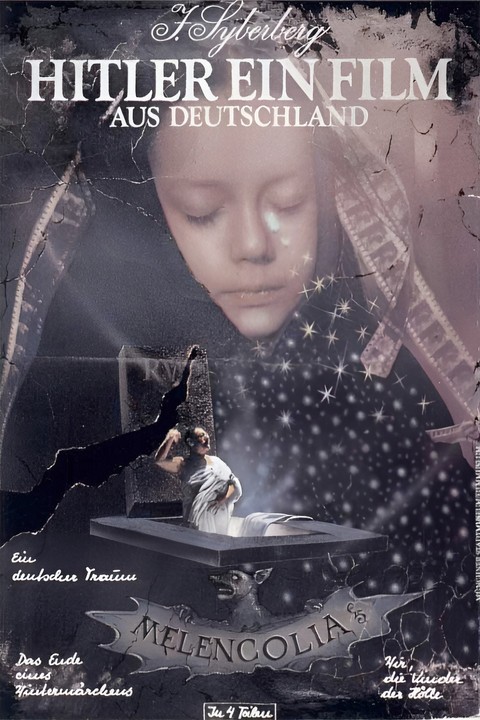
Hitler: A Film from Germany
1978 · Hans-Jürgen Syberberg
For when you want the most challenging thing on the shelf — a film to live inside for a day and argue with for weeks. Absolutely not a casual watch; absolutely singular if you're ready for it.
What it's about
A seven-hour reckoning with Hitler and the Germany that produced him, staged not as biography but as a kind of séance on a single soundstage. There is no dramatized bunker and no actor impersonating the dictator; instead, marionettes and ventriloquist's dummies of the Nazi leadership, back-projected photographs, fairground barkers, long monologues delivered straight to camera, and Wagner's music running underneath it all. Across four movements it asks how propaganda, myth, and Germany's own cultural dreams fed the catastrophe — and what remains of them.
The experience
Hypnotic, funereal, and demanding — closer to an epic requiem or a fever dream than to any conventional movie. It moves at the pace of thought, and if you surrender to it, whole passages land with the force of nightmare.
The craft
Syberberg builds an entire cosmos out of almost nothing: a fog-filled stage, rear projections, puppets, props, and voices, composed into images of eerie, deliberate beauty. The sound design — layered speeches, radio fragments, and Wagner used structurally rather than decoratively — is as important as anything on screen, and rewards good speakers and total attention.
Why it matters
One of the most debated films ever made about Nazism, fiercely championed and fiercely attacked on release, it staked out a position that the Third Reich must be confronted through myth and staging rather than realist re-enactment. It remains the extreme point of that argument.
Snapshot
Roughly seven hours long, staged almost entirely on a single soundstage, and organized in four parts — The Grail, A German Dream, The End of a Winter's Tale, and We, Children of Hell — Hans-Jürgen Syberberg's Hitler, ein Film aus Deutschland is less a film about the Third Reich than a séance conducted over its remains. There is no dramatized biography, no reconstruction of the bunker, no actor "becoming" Hitler in the prosthetic sense. Instead: back-projected photographs, marionettes and ventriloquist's dummies of the Nazi leadership, actors delivering long monologues directly to camera, fairground barkers, an auction of relics, a child wandering through the fog carrying strips of celluloid, and Wagner — endlessly, structurally, accusingly, Wagner.
The title's preposition carries the argument. Not a film about Germany but one from Germany: a work that presents itself as an emanation of the same national imaginary that produced its subject, and therefore as implicated rather than sovereign. Syberberg's central provocation — that Hitler was in some sense the century's greatest filmmaker, that the Reich was a production and the war its release print — makes cinema itself the accused. The film is the third panel of his German trilogy, following Ludwig — Requiem for a Virgin King (1972) and Karl May (1974), and it stands adjacent to his five-hour interview film The Confessions of Winifred Wagner (1975), which supplied the documentary counterweight to the Hitler film's phantasmagoria.
Industry & production
The film exists because of a specific West German funding architecture. The 1974 Film/Fernseh-Abkommen — the agreement binding the public broadcasters to co-finance theatrical features — turned television money into the effective engine of the New German Cinema, and it is what made a seven-hour, four-part, commercially unviable object fundable at all. Hitler was a co-production involving Westdeutscher Rundfunk (WDR), the BBC, and France's Institut National de l'Audiovisuel, alongside Syberberg's own small Munich production outfit. The four-part division is not merely rhetorical; it is a broadcast structure, a work conceived to be serialized as well as screened.
Production was correspondingly austere. The film was shot on a Munich soundstage over a short schedule — accounts commonly cite a matter of weeks, not months — with a small crew and an ensemble drawn substantially from Munich theater and from the orbit of Rainer Werner Fassbinder. Reliable budget figures are not well attested in the English-language record, and no dependable box-office accounting exists; the film played in limited, event-style engagements rather than in general release, and any specific grosses cited for it should be treated skeptically.
Its international life was largely the work of two advocates. Susan Sontag's essay "Syberberg's Hitler," published in The New York Review of Books in early 1980 and collected that year in Under the Sign of Saturn, made the case for it as one of the twentieth century's major works of art. Francis Ford Coppola presented the American release — retitled Our Hitler: A Film from Germany — which opened in New York in January 1980. The English edition of the published script carried a Sontag preface. That combination of a celebrity auteur's imprimatur and a major critic's advocacy is essentially the whole of the film's distribution history; without it, a seven-hour German essay-film would almost certainly have vanished into the archive.
Technology
Technically the film is retrograde by design. Shot on 35mm color stock, it renounces location shooting, optical compositing, and the newsreel-assembly method that dominated the era's Hitler documentaries. Its principal technology is rear projection — slides, photographs, paintings, film loops, cosmic and architectural imagery thrown onto screens behind performers standing in a fog-filled black void. Rear projection was by 1977 an obsolete studio trick, a marker of old Hollywood artifice; Syberberg reclaims it precisely as artifice, so that no image in the film can be mistaken for evidence.
The studio itself is thematized. The space is presented as a version of Edison's Black Maria, the first film studio — the site where cinema was born — so that the birthplace of the medium and the century's catastrophe occupy the same coordinates. The other governing technology is the gramophone and the radio: the soundtrack draws on historical recordings, Nazi-era broadcast material, and the recorded voice as a medium of possession. Where Joachim Fest's contemporaneous Hitler: A Career (1977) trusted the archive to speak, Syberberg treats archival media as haunted equipment.
Technique
Cinematography
The principal camerawork is credited to Dietrich Lohmann, the cinematographer of Fassbinder's early features (Love Is Colder Than Death, Katzelmacher, The Merchant of Four Seasons) who would later work in Hollywood. Detailed crew documentation for Syberberg's productions is sparse and credits were sometimes shared across a very small unit, so precise attributions of individual sequences are not securely established. The style is anti-spectacular: long takes, slow lateral tracks and gentle circling moves, static frontal setups, an almost complete refusal of the analytic cut-in. Depth is theatrical rather than photographic — figure, fog, projected backdrop — and the palette runs to browns, blacks, candlelight, and the sick glow of a projection beam. The camera is a witness that will not intervene.
Editing
The cutting, credited to Jutta Brandstaedter — a longtime Syberberg collaborator across the trilogy — works at the scale of the movement rather than the shot. Within sequences, edits are rare; between them, the film juxtaposes registers with deliberate harshness, moving from a comic monologue to a recitation of camp statistics without transitional cushioning. The structural model is musical: themes stated, abandoned, recapitulated in altered orchestration across the four parts, so that the "Grail" motif introduced at the outset returns transformed at the close. There is no chronology to follow, and the film's refusal of narrative sequence is itself an argument — that the events cannot be causally domesticated into a story with an end.
Mise-en-scène / staging
This is where the film lives. The soundstage is dressed as a junk-shop of German memory: Nazi memorabilia, a stuffed dog standing in for Blondi, model architecture, ventriloquist's dummies of Hitler, Goebbels, Göring, Himmler, Speer, and Eva Braun, which actors operate and argue with. Syberberg's most reproduced image has Hitler rising in a Roman toga from Wagner's grave at Wahnfried — a single tableau compressing the whole thesis about Bayreuth, the Gesamtkunstwerk, and the aestheticized state. A child, played by the director's daughter Amelie Syberberg, moves through the film draped in film stock, an emblem of inheritance and of cinema as the medium of transmission. Objects are handled, sold, and mourned rather than dramatized: the auction of relics stages the postwar traffic in fascination directly.
Sound
There is no original score. The soundtrack is a curated collage in which Wagner — Parsifal above all, with Tristan and the Ring — supplies the film's harmonic spine, joined by Mozart, Beethoven, Mahler, marches, popular songs, and historical speech recordings. Music is not accompaniment; it frequently dominates, drowning or contradicting the speaker, and the mix layers voice, music, and ambient wind so densely that dialogue sometimes surfaces from underneath it. Gilles Deleuze would later single out precisely this dissociation of the sonic from the visual in Syberberg as a defining achievement of modern cinema. Practically, the film is a sound work first: much of it can be followed, and was designed to be followed, as radio with images.
Performance
Performance is presentational, not psychological. Actors address the lens, hold forth for ten or twenty minutes, change roles, and speak as puppets and through puppets. The ensemble includes the Austrian artist André Heller as an interlocutor-narrator, Heinz Schubert in the Hitler role and others, Peter Kern as Hitler's valet Karl Wilhelm Krause — whose extended catalog of the Führer's underwear, meals, and daily routine is one of the film's most notorious passages — along with Harry Baer, Rainer von Artenfels, Martin Sperr, and Peter Moland. Role assignments across the sprawling cast are inconsistently documented and are easy to garble; the ensemble principle matters more than any individual attribution. The valet monologue exemplifies the method: banality delivered with total sincerity, producing not sympathy but a kind of vertigo, the recognition that history's monster had laundry.
Narrative & dramatic mode
The film has no plot and no protagonist in any usable sense. Its modes are borrowed wholesale from pre-cinematic forms: the medieval mystery play and Passion, the Totentanz, the revue, the circus and fairground sideshow, the auction, the séance, the puppet theater, and — governing all of them — Wagnerian music drama. Brecht is the other pole, and Syberberg, who as a teenager filmed the Berliner Ensemble in rehearsal, deploys epic-theater devices throughout: direct address, visible apparatus, titles, actors stepping in and out of role, an unrelenting refusal of absorption.
The two inheritances are contradictory, and the contradiction is the film's engine. Wagner offers total immersion; Brecht demands critical distance. Syberberg builds a Gesamtkunstwerk designed to expose the Gesamtkunstwerk. Whether that operation succeeds or whether the film is finally overwhelmed by the seductions it stages is the central question in its critical literature. The most infamous passage in this respect is the sequence in which a Hitler figure defends himself by claiming paternity of the entire postwar world — arguing that everything since owes its existence to him. The film gives him the floor and does not cut him off.
Genre & cycle
Hitler belongs to the essay film in the lineage of Chris Marker and Alexander Kluge, but its immediate cycle is the West German Hitlerwelle of the mid-1970s — the wave of Hitler books, magazine serials, and films that Syberberg regarded as a second-order fascination reproducing the regime's own imagery. Fest's Hitler: A Career, released the same year, is the explicit negative model: a documentary assembled from Nazi-produced newsreel that Syberberg accused of ceding the frame to the perpetrators' own cinematography.
It also belongs to the durational cinema that the late 1970s made thinkable — Rivette's Out 1, Fassbinder's Berlin Alexanderplatz (1980), Lanzmann's Shoah (1985) — where extreme length is not indulgence but a formal claim that the subject cannot be delivered in ninety minutes.
Authorship & method
Syberberg (b. 1935 in Pomerania, in what became East Germany, and resettled in the West in the early 1950s) is an auteur in the most literal and least collaborative sense: writer, director, designer, and — via the selection of music and archival sound — effectively the composer of the film's texture. His method was to build a single space and then fill it with the entire iconographic residue of a national culture, letting performers occupy it one at a time. Key collaborators are few and consistent: Lohmann on camera, Brandstaedter on the cut, and an ensemble of theater actors willing to hold the screen alone for very long stretches. There is no credited composer; the musical authorship consists of selection and juxtaposition.
The stated intellectual project is Trauerarbeit — mourning-work — drawing on Alexander and Margarete Mitscherlich's The Inability to Mourn (1967), which diagnosed postwar Germany as psychically frozen, unable to grieve either its victims or its lost investment in the Führer. Syberberg's ambition was to make the film that would unfreeze it. He also held a more contentious position: that Hitler had stolen German Romanticism, Wagner, myth, and Heimat, leaving postwar Germans dispossessed of their own imagination, and that art's task was to take them back. That recuperative impulse is what later critics found most troubling.
Movement / national cinema
The film is filed under New German Cinema and sits awkwardly there. The Oberhausen generation — Kluge, Fassbinder, Herzog, Wenders, Schlöndorff — shared a subsidy system and a broad politics with which Syberberg was never at ease; he was Munich-based, older in sensibility, aggressively anti-modernist in his embrace of Wagner and the nineteenth century, and temperamentally isolated. He borrowed Fassbinder's actors while rejecting the movement's realist and melodramatic default modes.
What he shares with his contemporaries is the movement's defining preoccupation: the unavailability of a usable German past. Where Fassbinder pursued that question through the genre of postwar melodrama and Kluge through documentary fragmentation, Syberberg went to myth. His film argues that the German catastrophe was not a political aberration but an aesthetic and spiritual one, and that only an aesthetic reckoning could address it.
Era / period
The film arrives at a hinge. It was made and released across 1977–78, the years of the Deutscher Herbst — the Schleyer kidnapping, the Stammheim deaths, the collective film Germany in Autumn (1978) — when the question of whether the Federal Republic had actually broken with its past was violently live. Shortly after, in January 1979, the American miniseries Holocaust was broadcast in West Germany and reached a mass audience, transforming public discourse in a way no art film could and demonstrating exactly the popular-melodramatic route Syberberg refused. His work also prefigures the terms of the Historikerstreit, the historians' controversy over the singularity of Nazi crimes that erupted in 1986.
Themes
Mourning and its failure; kitsch and death, and the suspicion that fascination with fascism is itself an aesthetic appetite; the aestheticization of politics that Walter Benjamin identified as fascism's signature; the complicity of cinema, born in the same decades as the mass politics it served; Wagner and Bayreuth as the laboratory of total art and total ideology; irrationalism and German Romanticism as both the crime and the confiscated inheritance; Hitler as an internal rather than external phenomenon — "our" Hitler, as the American title made explicit; the dead and the obligation to speak with them; and the child, unwitting inheritor, carrying the film itself.
Reception, canon & influence
Reception split along national lines. In West Germany the response was largely cool to hostile — the film was received as grandiose, self-indulgent, and suspect in its attachment to the very mythology it claimed to exorcise — and Syberberg cultivated a lasting sense of persecution at home. Abroad it was received as a major work. Sontag's advocacy placed it in the international canon almost single-handedly; Coppola's presentation gave it a New York premiere; French intellectual culture took it seriously, and Deleuze devoted substantial attention to Syberberg in Cinema 2: The Time-Image (1985), treating his image-sound disjunction as exemplary of modern cinema's break with the movement-image.
The serious critiques came from Holocaust scholarship. Saul Friedländer's Reflections of Nazism: An Essay on Kitsch and Death (1982) examined Syberberg within the broader postwar aestheticization of Nazism and questioned whether the film reproduces the fascination it anatomizes. Eric Santner's Stranded Objects (1990) mounted the most influential objection: that Syberberg's mourning-work collapses into fetishism, that the grievance about "stolen" German myth centers German loss rather than Jewish death, and that the Holocaust remains, in the film, curiously peripheral to a drama of national dispossession. Anton Kaes's From Hitler to Heimat (1989) gave the film a book chapter and treated it as the fullest instance of history returning as cinema. Syberberg's own later polemical writing, particularly his 1990 book on art in postwar Germany, drew accusations of völkisch and antisemitic rhetoric and retroactively hardened many of these readings.
Backward, the film's inheritances are clear and openly declared: Wagner and the Gesamtkunstwerk; Brecht's epic theater, which Syberberg had observed firsthand in 1953; Heine, whose Deutschland: Ein Wintermärchen names the third part; the Mitscherlichs' psychoanalytic diagnosis; Edison's Black Maria and the primitive cinema of attractions; and the German silent tradition of studio-built expressionist space.
Forward, its influence is diffuse but real. It stands as the great counter-position to Lanzmann's Shoah (1985) — both refuse conventional dramatization, but Lanzmann forbids the archival image entirely while Syberberg drowns in it, and the pairing has structured decades of debate about how the period may be represented. Godard's Histoire(s) du cinéma (1988–98) works the same terrain of cinema's guilt and its failure to record. Christoph Schlingensief's confrontational German trilogy, beginning with 100 Years of Adolf Hitler (1989), reads as an irreverent descendant. Lars von Trier's Europa (1991), with its back-projection and hypnotic address, is frequently linked to it, though the connection is one of affinity rather than documented debt. Syberberg himself continued directly into Parsifal (1982) and then into a series of chamber monologue films with Edith Clever.
The film's present status is genuinely ambiguous. It is canonical and almost unseen — too long for programming, too compromised for uncomplicated advocacy, too formally radical to be superseded. It remains the most extreme attempt anyone has made to answer the question of whether cinema, having helped make the twentieth century, could be turned to account for it.
A Deleuzian reading
A child walks through fog, draped in strips of film.
The full Deleuzian reading of Hitler: A Film from Germany →
Reception
Barely shown in Syberberg's own Germany — where critics and broadcasters kept it at arm's length — it was crowned abroad, above all by Susan Sontag's 1980 essay hailing it as one of the century's great works of art; today it's a monument of the essay film, though Syberberg's later political statements have complicated his standing.
How Hitler: A Film from Germany was received, from release to now →
How to watch Hitler: A Film from Germany: what to notice on a first viewing
- Watch actors hold puppets of Hitler, Goebbels, and Himmler on their laps. Ventriloquist's dummies of the Nazi leadership sit on performers' knees throughout the film's four parts, argued with rather than played as drama. Nazi leadership becomes performance rather than history, so watching feels like a seance, not a documentary reconstruction.
- Listen for Wagner rising until it drowns out the speaker. There is no original score. Wagner, Mozart, Mahler, and marches supply the film's sound, and the music dominates or contradicts whoever is talking rather than backing them. The film treats fascism as something that arrives through sound and spectacle before it arrives as an idea.
- Notice the camera almost never cuts in close. Long, static, frontal takes and slow lateral tracks replace close-ups and cut-ins across all seven hours, so nothing tells you where to look next. You have to read each configuration on screen for yourself instead of being steered from shot to shot.
- Watch the fog and black void behind every performer. There is no realistic set, only black space, fog, and rear-projected photographs or film loops thrown up behind each performer, part by part. The empty stage keeps you from mistaking anything you see for documentary evidence of what actually happened.
- Watch actors delivering monologues straight into the camera. Performers hold the screen alone for ten or twenty minutes at a time, changing roles and speaking as puppets or through them, addressing you directly. The flatness is deliberate. The film wants you to judge what you see, not lose yourself inside a story.
The whole guide to watching Hitler: A Film from Germany, with the keys for a rewatch →
Influences: the films it descends from and the films it influenced
- A Trip to the Moon (1902) — Méliès's glass-house studio practice — frontal proscenium framing against painted backdrops, with the tableau rather than the cut as the unit of construction — is what Syberberg literally rebuilds as his black soundstage, invoking Edison's Black Maria and the cinema of attractions as the primal scene his film returns to.
- Die Nibelungen (1924) — Lang's decision to fabricate an entire mythic Germany inside the Babelsberg studio — no location, only constructed hieratic space and stylized frontal blocking — supplies Syberberg's central premise that German myth is a set, and his film treats Lang's imagery as usable stock in the national iconographic warehouse.
- Kuhle Wampe (1932) — The Brecht-scripted device of arresting the fiction with song, placard and argument so the audience judges rather than identifies is the epic-theater technique Syberberg transposes wholesale: performers step out of character, announce their function, and address the camera as lecturers rather than inhabitants.
- Triumph of the Will (1935) — Riefenstahl's rally-as-total-artwork — architecture, massed bodies, Wagnerian scoring and camera choreography fused into one designed event — is both quoted as footage and structurally reverse-engineered by Syberberg, who dismantles the Gesamtkunstwerk by keeping its music while emptying the frame of crowds.
- The Great Dictator (1940) — Chaplin established Hitler as an impersonable performance rather than a person — the globe-balloon dance turning the dictator into a prop-handler, the closing address delivered straight down the lens — and Syberberg inherits both moves: Hitler as costume passed between actors, and the unbroken direct-address monologue as the film's basic unit.
- Citizen Kane (1941) — The Xanadu warehouse — a life reduced to a catalog of crated objects, and a subject reachable only through serial testimony from those who served him — is the exact armature of Syberberg's relic auction and his parade of valets, adjutants and projectionists who narrate a man who never appears.
- Ivan the Terrible, Part II (1958) — Eisenstein's late operatic method — audiovisual counterpoint in which score and image run as separate, deliberately non-illustrative lines, with actors held in frontal, quasi-liturgical poses — is the technical precedent for Syberberg's dissociation of Wagner and speech from what the camera actually shows.
- Ludwig: Requiem for a Virgin King (1972) — The first part of the German Trilogy invented the working method used here: a single studio void, actors standing before rear-projected paintings and photographs, roles doubled and redistributed, and history delivered as recited text over a music collage.
- The Confessions of Winifred Wagner (1975) — Five hours of an almost immobile frontal camera letting a single witness talk herself into self-incrimination taught Syberberg that duration plus a fixed frame is itself an analytic instrument — the technique underlying the film's long unbroken monologues and its refusal of reaction shots.
- Parsifal (1982) — Syberberg's own direct continuation: the whole opera staged inside a sculpted Wagner death-mask landscape with rear projection, singers replaced on screen by silent actors moving to a pre-recorded track, pushing the body/voice split of the earlier film into its systematic form.
- Histoire(s) du cinéma (1988) — Godard adopts the same procedure of indicting cinema with its own materials — superimposed archival fragments, a soundtrack of music and citation deliberately out of register with the image, and a first-person authorial voice — extending Syberberg's charge that the century's images were made by the medium now judging them.
- 100 Years of Adolf Hitler (1989) — Shot in a single night in a real bunker with hand-held 16mm and actors screaming Nazi iconography into the lens, it takes Syberberg's premise that Hitler can only be approached through grotesque theatrical impersonation and strips the mourning-ritual solemnity from it.
- Europa (1991) — Von Trier constructs postwar Germany almost entirely from rear projection and layered exposures, with a second-person hypnotic narration addressed to the viewer — the same combination of frankly artificial back-projected space and disembodied incantatory voice that governs Syberberg's studio.
- Moloch (1999) — Sokurov stages Hitler as a wheezing domestic bore observed at close range over one banal day, with filtered, near-monochrome imagery flattening the figure into a painted surface — the direct extension of Syberberg's valet's-eye tactic of destroying the myth through household triviality rather than atrocity.
- The Act of Killing (2012) — Perpetrators restage their own killings as studio-built genre spectacle — costumes, playback musical numbers, painted backdrops — so that the aestheticization of mass murder is performed on camera rather than described, which is precisely Syberberg's method of exhibiting the kitsch machinery instead of denouncing it from outside.
- The Death of Maria Malibran (1972) — Schroeter builds the film from static, artificially lit tableaux in which performers mime to opera playback, so the voice never belongs to the body on screen — the same lip-sync-as-estrangement device and kitsch-iconographic staging Syberberg runs at feature-length scale.
- The Patriot (1979) — Kluge assembles German history as an essayistic montage of found footage, intertitles, staged fragments and a commentary track that argues with the images rather than explaining them — the same plotless collage-essay form Syberberg uses, differing mainly in Kluge's irony where Syberberg mounts a requiem.
- Shoah (1985) — The exact structural counter-move: Lanzmann also refuses dramatization and uses extreme duration and the frontally recorded speaking witness as his only event, but bans the archival image entirely where Syberberg buries the screen in it — the two films define the poles of the representation debate on technique, not theme.
Similar films
- Shoah (1985) — influence & lineage · same viewing thread
- Triumph of the Will (1935) — influence & lineage
- The Great Dictator (1940) — influence & lineage
- The Fifth Seal (1976) — same viewing thread · often watched together
- Son of Saul (2015) — same viewing thread
- Never Look Away (2018) — same viewing thread
- The Marriage of Maria Braun (1979) — same viewing thread
- Mephisto (1981) — same viewing thread
All the films related to Hitler: A Film from Germany →
Watch it with: curated runs of related films
- In the Shadow of the Reich — A run of films about ordinary people inside the Nazi era — surviving it, resisting it, or trying to reckon with how it happened — that rhyme on conscience, complicity, and who chooses to act.