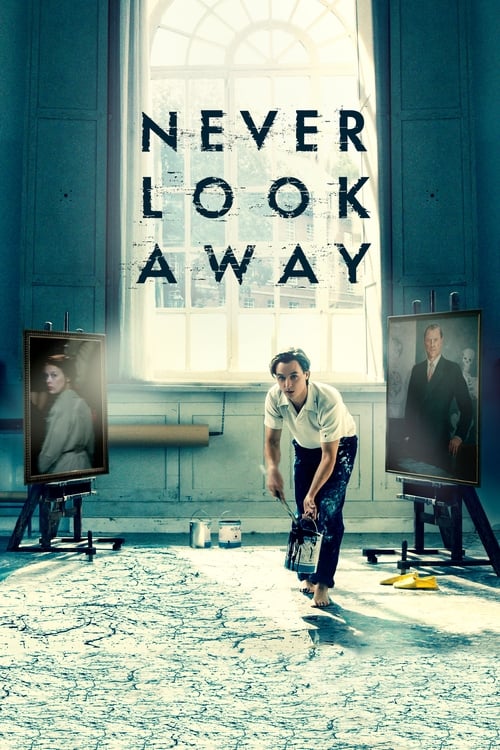
Never Look Away
2018 · Florian Henckel von Donnersmarck
For a long, immersive evening when you want to sink into a big historical saga and come out moved — a film to chew on for days, generous rather than punishing despite its dark passages.
What it's about
A German painter's life unfolds across three regimes: a childhood under the Nazis marked by a beloved, free-spirited aunt and an unspeakable loss; a young adulthood painting state-approved murals in the socialist East; and an escape to the West, where he must discover what his art is actually for. Woven through it is his love for a fellow student — and a family secret, hidden in plain sight, that ties his past to his present in ways he cannot see. The story is loosely drawn from the life of one of Germany's most famous living painters.
The experience
A sweeping, old-fashioned epic — three hours that move with surprising ease, part love story, part historical panorama, part portrait of an artist finding his voice. It's handsome, emotional, and quietly enraging in its portrait of evil that goes unpunished, but it ends up on the side of beauty.
Performances
Tom Schilling anchors the film with watchful restraint as the painter, while Sebastian Koch is chillingly composed as a man whose respectability conceals monstrous acts.
The craft
Von Donnersmarck mounts it on a grand scale — decades of German history rendered in lush, Oscar-nominated cinematography, with the studio and gallery scenes making the act of painting itself genuinely cinematic. The three-hour runtime is used for slow-burn storytelling in the classic epic mold.
Why it matters
An Academy Award nominee for Best Foreign Language Film that reignited international attention on its director — and stirred real-world controversy over how closely, and how loosely, it borrows from Gerhard Richter's life.
Snapshot
Never Look Away (German title Werk ohne Autor, literally "Work Without Author") is Florian Henckel von Donnersmarck's sprawling third feature, a three-hour German-language epic that traces one artist's passage through three successive German regimes: Nazism, the socialist-realist GDR, and the free-market West of the 1960s. Its protagonist, the painter Kurt Barnert (Tom Schilling), is a lightly fictionalized composite drawn from the biography of Gerhard Richter, though the film changes names and invents freely. The narrative pivots on a monstrous coincidence at the heart of Richter's actual life story — that the SS physician implicated in the euthanasia killing of his beloved aunt would later become, unknowingly, his father-in-law — and uses it to argue a thesis about art: that personal truth, pursued without flinching ("never look away"), surfaces in a painter's work even when he does not consciously know what he is painting. Premiering in competition at the 2018 Venice Film Festival and selected as Germany's entry for the Academy Awards, it earned two Oscar nominations — Best Foreign Language Film and Best Cinematography — and became a lightning rod for debate about biographical fiction, the ethics of appropriating a living artist's life, and the film's own middlebrow grandeur.
Industry & production
The film was the long-gestated return of von Donnersmarck to German-language cinema after his English-language Hollywood detour, The Tourist (2010). It is a large-scale German production mounted by Pergamon Film together with Wiedemann & Berg Film (the company behind his debut), with Jan Mojto's Beta Cinema handling international sales. The production is notable for its scale within the German industry: a budget widely reported in the high single-digit millions of euros, an ambitious multi-decade sweep requiring extensive period reconstruction of Dresden before and after its firebombing, the East German art academy, and the Düsseldorf Kunstakademie milieu of the early 1960s. Sony Pictures Classics acquired U.S. distribution, positioning the film squarely within the specialty-arthouse and awards ecosystem where von Donnersmarck's The Lives of Others had triumphed a decade earlier. Two runtimes circulated: a German theatrical version and a marginally trimmed international cut, both around 188–189 minutes — an unusually long running time for a foreign-language awards contender, a commercial risk the production absorbed in service of its epic ambitions. I do not have reliable box-office figures to cite and will not invent them; the film's theatrical performance was modest relative to its length and cost, and its cultural footprint rests more on the Oscar campaign and the surrounding controversy than on ticket sales.
Technology
Never Look Away is a conventionally captured, high-gloss production rather than a technological experiment. It was photographed digitally by Caleb Deschanel — an American cinematographer of the celluloid generation whose work here is engineered to read with the tactility and controlled palette of film. The technological story of the movie is less about capture format than about the enormous apparatus of period illusion: the recreation of pre-war and destroyed Dresden, the fabrication of paintings and artworks at multiple stages of the protagonist's development, and the meticulous reproduction of a specific art-historical moment. The film's most pointed engagement with technology is diegetic and thematic — the photograph as a machine of truth. Kurt's breakthrough, the blurred photo-paintings that mirror Richter's real "photo-painting" (Fotomalerei) technique, dramatizes the mid-century collision between photographic reproduction and painting. The film stages the epiphany that a painter might reclaim the machine-made image by hand, smearing the photograph's mechanical clarity into something that paradoxically discloses a deeper, buried truth.
Technique
Cinematography
Deschanel's photography is the film's most lauded element and its Oscar-nominated calling card. Working in a rich, classical idiom, he lights interiors with a painterly warmth and models the three historical eras through distinct tonal registers — the golden, doomed pre-war Dresden of Kurt's childhood; the flatter, chillier institutional light of the GDR; and the cooler, more open modernism of the West German academy. The camera is patient and composed, favoring elegant, unhurried movement over handheld immediacy, in keeping with the film's operatic scale. Recurring motifs — the aunt's instruction to look, mirrors, windows, the act of framing and focusing — are woven into the visual grammar, and the blurring of the photo-paintings is echoed in the way certain images soften and dissolve. Critics who admired little else in the film frequently singled out Deschanel's work as reason enough to watch.
Editing
Patricia Rommel, who cut The Lives of Others, edits the film. The central technical challenge is architectural: sustaining a three-hour, multi-decade narrative across three regimes without losing propulsion. Rommel structures the film around the slow accumulation of dramatic irony — the audience holds knowledge the characters lack (chiefly the true identity and crimes of Professor Seeband) — and the cutting is calibrated to sustain that suspense across enormous time spans. The pace is deliberately measured, an approach that admirers read as stately and detractors as bloated.
Mise-en-scène / staging
Production design by Silke Buhr grounds the film's argument in physical detail: the euthanasia-era clinics, the bombed city, the socialist-realist mural commissions Kurt executes in the East, and the loft-like freedom of the Düsseldorf academy where a Beuys-inspired professor holds court. The staging repeatedly frames characters within thresholds and reflective surfaces, and von Donnersmarck orchestrates the recurring image of the aunt covering the young Kurt's eyes and then telling him never to look away — a gesture the mise-en-scène returns to as a structuring rhyme.
Sound
Max Richter's score (no relation to the painter) supplies the film's emotional connective tissue, a lush, motif-driven orchestral and minimalist-inflected accompaniment characteristic of the composer's style. The music underlines the film's grand emotional register; it is one of the elements critics cited when charging the film with over-scored sentimentality, and one admirers cited as part of its sweeping romantic power. The sound design otherwise serves realism — the drone of bombers over Dresden, the institutional hush of clinics and studios.
Performance
Tom Schilling anchors the film as Kurt with a watchful, interiorized performance, a passive-seeming protagonist through whom history acts. The film's most commanding presence is Sebastian Koch — who had played the persecuted playwright in The Lives of Others and here inverts to play the villain — as Professor Carl Seeband, the coldly self-preserving Nazi gynecologist who reinvents himself across regimes. Paula Beer plays Ellie, Kurt's wife and Seeband's daughter, and Saskia Rosendahl plays the luminous, doomed Aunt Elisabeth, whose murder under the Nazi euthanasia program haunts the narrative. Oliver Masucci plays the felt-and-fat war-survivor art professor modeled on Joseph Beuys.
Narrative & dramatic mode
The film is a Bildungsroman and a historical melodrama fused: it follows a single sensibility from childhood to artistic self-realization while using that arc as a lens onto twentieth-century German catastrophe. Its dominant dramatic engine is dramatic irony sustained at feature length — the audience knows that Seeband signed off on the killing of Kurt's aunt, and watches, appalled, as the two men are bound together by marriage without Kurt ever consciously learning the truth. The film's climactic pay-off is deliberately non-confrontational: rather than a scene of exposure and accusation, Kurt unknowingly incorporates the buried facts into a photo-painting, and the truth is spoken not by a character but by the artwork itself — the "work without author" of the German title. This is the film's boldest and most contested structural choice, a resolution that is aesthetic rather than juridical.
Genre & cycle
Never Look Away sits within several overlapping traditions: the German historical epic reckoning with the Nazi and GDR pasts (Vergangenheitsbewältigung on screen); the artist biopic; and the prestige international awards drama. It belongs to a cycle of post-reunification German cinema that mines the twin totalitarianisms of the twentieth century — a cycle von Donnersmarck himself helped define with The Lives of Others. As an artist-origin story it converses with the broader biopic tradition, but it deliberately fictionalizes its subject to escape the biopic's fidelity contract, positioning itself as a fable about art rather than a documentary record.
Authorship & method
The film is thoroughly a von Donnersmarck auteur project — he wrote, directed, and shaped it over years of development. His method here is one of extensive research followed by deliberate fictionalization: he drew on the life of Gerhard Richter (reportedly including conversations with the artist) but changed names, invented episodes, and compressed biography into thesis-driven drama. This is the crux of the film's controversy, addressed below. His key collaborators form a deliberate blend of continuity and new blood: editor Patricia Rommel and actor Sebastian Koch carry over from The Lives of Others, while cinematographer Caleb Deschanel and composer Max Richter bring an international prestige sheen. Production designer Silke Buhr executes the period vision. The authorial signature is a marriage of moral seriousness and lush accessibility — a conviction that grave historical material can and should be delivered in a sweeping, emotionally legible, classically beautiful form. That very conviction is what divides his admirers from his critics.
Movement / national cinema
The film is a landmark, if divisive, example of contemporary German national cinema's ongoing confrontation with its history. It is not a product of any avant-garde movement — indeed it stands in near-total opposition to the austere, distanced approach of the earlier Berlin School and to the political modernism of New German Cinema. Its lineage is closer to the internationally legible, well-made prestige film. Yet it engages seriously with a German art-historical movement — the postwar Düsseldorf scene, the Beuysian conception of art as biographical trauma transmuted, and Richter's photo-painting — making German art history itself a subject. The film thus occupies a curious position: formally conservative, thematically it dramatizes the birth of a radical postwar art.
Era / period
The narrative spans roughly three decades. It opens in Dresden in the late 1930s, staging the Nazi persecution of "degenerate" art (the young Kurt is taken to the infamous Entartete Kunst exhibition by his aunt), the Aktion T4 euthanasia program under which the schizophrenic Aunt Elisabeth is sterilized and murdered, and the 1945 firebombing of Dresden. It then moves through the early GDR, where Kurt trains in socialist realism and paints murals, before his escape to the West shortly before the Berlin Wall closes the border. The final movement unfolds in the West German art world of the early 1960s at the Düsseldorf academy. The period reconstruction is central to the film's meaning: each regime demands a different relationship between the artist and truth, and Kurt's journey is the search for a mode of art free from the ideological instrumentalization enforced by both the Nazis and the Communists.
Themes
The film's governing theme is the relationship between truth and art, crystallized in the aunt's twinned maxims — "never look away" and the assertion that everything true is also beautiful. Around this cluster several others: the persistence of the past into the present (Nazi perpetrators surviving, unpunished and successful, into the postwar order, embodied by Seeband's serial reinvention); the tension between ideologically mandated art and authentic creation; guilt, complicity, and the failure of justice; and the idea that a work of art can know and reveal what its maker cannot consciously articulate. The German title, Werk ohne Autor, foregrounds this last theme most sharply — the notion that truth arrives in the artwork impersonally, almost against the artist's will. Coincidence and fate function as structural themes as well, given that the entire plot turns on an appalling accident of history.
Reception, canon & influence
Critical reception was sharply divided — broadly respectful of its craft, especially Deschanel's cinematography, but split on its substance. Admirers embraced its ambition, sweep, and emotional force, treating it as a worthy successor to The Lives of Others; the two Academy Award nominations (Best Foreign Language Film and Best Cinematography) certified its prestige standing. Detractors, however, mounted a pointed critique: that the film is handsome, middlebrow, and morally simplifying, that it aestheticizes atrocity, and that its three-hour length is not matched by commensurate depth. This critique of "Oscar-bait" grandeur became a recurring note in the film's English-language reception.
The most consequential controversy concerned Gerhard Richter himself. Richter, though he had spoken with von Donnersmarck during the film's development, publicly distanced himself from the finished work and expressed discomfort at seeing his life — including the intimate trauma of his aunt's murder and the coincidence of his first father-in-law's Nazi past — turned into melodrama. A widely read New Yorker profile documented this rupture, and the episode became a case study in the ethics of fictionalizing a living person's biography without full endorsement. This tension is arguably the film's most lasting cultural contribution: it sharpened debate about consent, appropriation, and the boundary between inspiration and exploitation in biographical fiction.
Influences on the film (backward): it draws on the real history of Gerhard Richter and his photo-painting; on the biography and mythology of Joseph Beuys (the war-survivor origin story, the felt and fat) for the van Verten character; on the historical record of Aktion T4, the Entartete Kunst exhibition, and the bombing of Dresden; and on von Donnersmarck's own The Lives of Others as a template for morally freighted German historical drama. Legacy (forward): the film's influence is thus far more discursive than stylistic — it did not spawn a formal school, but it intensified an ongoing conversation about the artist biopic and the ethics of using a living subject's life. Its firmest place in the canon is as von Donnersmarck's ambitious, contested second major German statement, permanently paired with The Lives of Others in assessments of his career, and as a touchstone example in debates over how cinema should handle the still-open wounds of twentieth-century German history. Given the film's recency, its long-term canonical standing remains genuinely unsettled, and I will not overstate a legacy that is still forming.
A Deleuzian reading
A hand comes down over a boy's eyes.
The full Deleuzian reading of Never Look Away →
Reception
German critics savaged it as kitsch on release ('Werk ohne Autor' got some of the harshest domestic reviews of 2018), while American critics and the Academy embraced it with two Oscar nominations — and it's since become a word-of-mouth favorite whose audience scores comfortably outrun its critical reputation.
How Never Look Away was received, from release to now →
How to watch Never Look Away: what to notice on a first viewing
- Watch for the aunt's hand covering, then lifting from his eyes. The gesture recurs across the film as a structuring rhyme, first as a childhood moment and then as an idea Kurt keeps carrying into his art. A single small gesture becomes the instruction the whole film keeps testing.
- Notice how the light changes across Nazi Dresden, the GDR, and the West. Deschanel keys pre-war Dresden gold and doomed, the GDR flatter and institutional, and the West German academy cooler and more open. You can feel which political system Kurt is living under from the color alone.
- Watch how a photograph gets dragged and blurred into a painting. Kurt copies a photograph, then pulls a brush through the wet surface until the mechanical clarity softens into something else entirely. The photograph doesn't survive the process; something new stands in its place.
- Watch Seeband's calm, unbothered face in every era he survives. Sebastian Koch plays the same terrible composure whether Seeband is serving the Nazis, the Soviets, or the West German bourgeoisie, the surface never cracking. His steadiness across three regimes is more chilling than any outburst would be.
- Listen for Max Richter's score swelling under the film's big turns. The lush, motif-driven orchestral score rises consistently at moments of emotional weight, giving the film's operatic scale its connective tissue. The music keeps insisting the material is grand, whether or not a given scene has earned it yet.
The whole guide to watching Never Look Away, with the keys for a rewatch →
Influences: the films it descends from and the films it influenced
- The Lives of Others (2006) — Establishes von Donnersmarck's signature engine of sustained dramatic irony — the audience holding decisive knowledge a character lacks — and hands forward collaborators Sebastian Koch (again the compromised authority figure) and editor Patricia Rommel, whose long-arc suspense cutting shapes both films.
- Barry Lyndon (1975) — The template for composing a period drama as a succession of living paintings — natural-source and candle-soft light, symmetrical tableau framing — that Deschanel's painterly lighting for the RAF-fire and Dresden sequences directly extends.
- Lust for Life (1956) — The prototype prestige painter-biopic that keys its color and lighting design to the subject's own canvases, staging the tortured artist's breakthroughs as cinematographically legible emotional climaxes — the middlebrow-beautiful mode von Donnersmarck revives.
- Andrei Rublev (1966) — Supplies the structural conceit of the artist as silent witness carried across historical atrocity, whose eventual work distills accumulated trauma into a single culminating image — mirrored in Kurt's photo-paintings surfacing buried horror.
- The Tin Drum (1979) — The Vergangenheitsbewältigung epic that threads one protagonist through successive German regimes — including Nazi euthanasia and the war's rubble — providing the three-regime sweep von Donnersmarck compresses into a bildungsroman.
- The Black Stallion (1979) — Deschanel's own formative showcase, defining the golden natural-light, luminous-silhouette method he brings intact to Never Look Away's magic-hour interiors and back-lit close-ups.
- Frida (2002) — Demonstrates the tableau-vivant device of paintings dissolving into and out of live action, a way to render the act of image-making cinematic that von Donnersmarck echoes when photographs bleed into Kurt's blurred canvases.
- Mr. Turner (2014) — A painterly artist-biopic where the cinematography (Dick Pope) deliberately imitates the subject's own handling of light and atmosphere — the same fusion of camera style and painter's vision Deschanel attempts for Richter's aesthetic.
- At Eternity's Gate (2018) — A same-year painter biopic that stages the artist's subjective perception directly through handheld, smeared, split-focus camerawork — the opposite formal solution to Never Look Away's polished distance, framing the debate over how to film a painter's inner sight.
- Big Eyes (2014) — Built around the 'work without author' problem — a dispute over who truly made the paintings — the same authorship-and-attribution question von Donnersmarck abstracts into thesis form.
- The White Ribbon (2009) — A sibling German reckoning tracing the seeds of twentieth-century atrocity, whose austere painterly monochrome and withheld moral verdict stand as the rigorous counter-model to von Donnersmarck's legible, emotionally resolved treatment of the same guilt.
- Phoenix (2014) — Post-war German cinema's study of buried Nazi complicity and reconstructed identity, sharing the Vergangenheitsbewältigung project but resolving it through a single devastating withheld reveal rather than three-hour sweep.
- Pollock (2000) — The process-of-creation biopic organized around watching an artist grope toward his signature method, the same dramatic beat von Donnersmarck builds toward in Kurt's discovery of the blurred photo-painting.
- Séraphine (2008) — A restrained French outsider-artist biopic set against war and institutional cruelty, sharing the painterly-light staging of the solitary painter at work and the linkage of art to psychic wounding.
- Woman in Gold (2015) — A prestige-awards drama built on Nazi-looted art and the Entartete Kunst legacy, sharing Never Look Away's project of routing German twentieth-century trauma through the fate of specific artworks.
- The Danish Girl (2015) — A contemporaneous prestige biopic of a painter that faced the same critique von Donnersmarck drew — that lush, awards-calibrated beauty aestheticizes and smooths its subject's real pain — marking the shared middlebrow artist-biopic mode of the decade.
Similar films
- The Lives of Others (2006) — influence & lineage
- At Eternity's Gate (2018) — influence & lineage
- The Tin Drum (1979) — influence & lineage
- The White Ribbon (2009) — influence & lineage
- A Hidden Life (2019) — same viewing thread
- Hitler: A Film from Germany (1978) — same viewing thread
- The Marriage of Maria Braun (1979) — same viewing thread
- The Zone of Interest (2023) — same viewing thread
All the films related to Never Look Away →
Watch it with: curated runs of related films
- In the Shadow of the Reich — A run of films about ordinary people inside the Nazi era — surviving it, resisting it, or trying to reckon with how it happened — that rhyme on conscience, complicity, and who chooses to act.