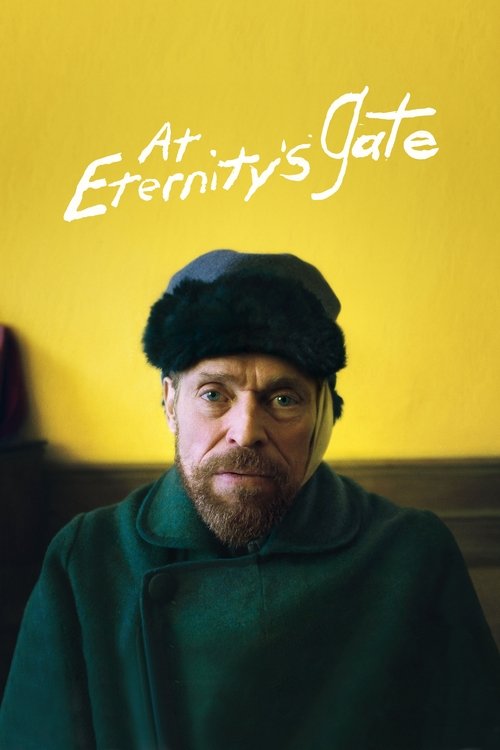
At Eternity's Gate
2018 · Julian Schnabel
For when you want to slow all the way down and look at things — a meditative evening, not a plot-driven one. Reach for it when you're in the mood to feel what making art costs, and to be moved without being manipulated.
What it's about
The last two years of Vincent van Gogh's life, spent painting in the fields around Arles and later in an asylum at Saint-Rémy. Willem Dafoe plays the painter not as a rising genius but as a man already at the end — broke, mocked by locals, sustained by his brother Theo and by an almost physical hunger for light and landscape. There's no childhood, no origin story; just a man walking, looking, and putting paint on canvas while the world decides he's mad.
The experience
Immersive and disorienting in a deliberate way — the handheld camera walks beside van Gogh at eye level, the bottom of the frame sometimes blurring, so you feel the world the way he might have seen it. It's slow, sun-drenched, and quietly devastating, closer to spending time inside a consciousness than watching a story unfold.
Performances
Willem Dafoe, playing van Gogh decades older than the painter actually lived to be, earned an Oscar nomination for a performance that's all presence — you watch him look at a landscape and believe he sees something you don't.
The craft
Julian Schnabel is a painter himself, and it shows: this is a film about the act of painting made by someone who knows what a loaded brush feels like. The camerawork is radical for a biopic — jittery, first-person, with smeared and split-focus images that put you inside an unstable way of seeing. The light of Provence is a character; it rewards the biggest, brightest screen you can find.
Why it matters
It reframed what an artist biopic could be — perception over biography — and gave Dafoe one of the defining roles of his late career, debuting in competition at Venice.
Snapshot
A painter's film about a painter. Julian Schnabel's fourth feature about a doomed artist takes the last two years of Vincent van Gogh's life — Arles, the asylum at Saint-Rémy, the final weeks at Auvers-sur-Oise — and refuses almost every convention of the biographical picture that would ordinarily organize such material. There is no childhood, no rise, no explanatory trauma, no scene in which a dealer recognizes genius. Instead there is a man in his sixties (Willem Dafoe, roughly twenty-five years older than van Gogh was at his death) walking through fields, looking at light, and putting paint on canvas in real time, while the camera stumbles along beside him at eye level with a filter that blurs the bottom of the frame.
The film premiered in competition at the 75th Venice International Film Festival in September 2018 — the edition Alfonso Cuarón's Roma won — where Dafoe took the Volpi Cup for Best Actor. CBS Films released it in the United States that November, and Dafoe received his fourth Academy Award nomination, for Best Actor, the following February. The screenplay is credited to Jean-Claude Carrière, Schnabel, and Louise Kugelberg; it was among the last work of Carrière's sixty-year career, which began with Jacques Tati and Luis Buñuel. Willem Dafoe learned to paint for the role, and the canvases seen on screen were made by Schnabel himself.
What the film wants is not the life but the seeing: what it might have been like to be inside a sensorium that converted a wheat field into that. Whether it succeeds is the argument the reviews had. That it is a genuinely strange, unfashionable object — an artist's essay wearing the costume of a prestige drama — is not in dispute.
Industry & production
At Eternity's Gate is a France–United Kingdom–United States co-production, assembled the way mid-budget adult drama had to be assembled by the late 2010s: European soft money and co-production partners underwriting an American-authored art film with an internationally bankable cast, then sold at market and picked up for domestic release. Jon Kilik, Schnabel's producer since Basquiat (1996) and Before Night Falls (2000), produced; the financing structure drew on French and British partners, and the picture was shot largely on the actual ground van Gogh worked — in and around Arles, Saint-Rémy-de-Provence, Auvers-sur-Oise, and the Bouches-du-Rhône.
The cast is the co-production's other visible signature: Oscar Isaac as Paul Gauguin, Rupert Friend as Theo van Gogh, Mads Mikkelsen as the priest who interviews Vincent at the asylum, Mathieu Amalric as Dr. Paul Gachet, Emmanuelle Seigner as Madame Ginoux, Niels Arestrup as a fellow inmate. This is a French art-cinema bench stiffened with American and Danish names — precisely the roster that makes a picture financeable across three territories at once.
The economics were never going to be generous. By 2018 the specialty theatrical market for a two-hour subjective drama about a painter had contracted sharply; CBS Films gave the film a platform release into a crowded awards corridor, and it performed as such films performed — modestly, sustained by Dafoe's campaign rather than by demand. Detailed budget and grosses are not something the public record establishes with any reliability, and it would be false precision to supply figures.
The more interesting production fact is authorial: Schnabel, a painter with an established market of his own, was not making this film to break in. He has been explicit in interviews that he did not consider it a biopic and that he made it as a painter's account of painting. That freedom is legible in the finished object, which contains long passages a producer with leverage would have cut.
Technology
Benoît Delhomme shot the film digitally on a small, lightweight body he could carry and operate himself — the point was not a particular sensor but the elimination of the crew apparatus between the camera and Dafoe. Reports of the exact camera package vary and I would not stake a claim on the model; what is well attested is the working method: Delhomme operating handheld, close, often walking backwards through terrain, with minimal lighting and a heavy reliance on the actual Provençal sun.
The film's most discussed technological choice is an optical one, and it is deliberately crude: a filter treated so that the lower portion of the image is blurred and warmed while the upper portion stays clear. It functions like a bifocal lens worn by the audience. In a landscape shot, the sky and horizon read sharp while the field in the foreground smears into pigment. This is not a digital effect added later; it is glass in front of the lens, and its physicality matters — the smear moves with the camera, it cannot be stabilized, and it reasserts itself every time Vincent looks down at his own hands or at the ground he is walking over.
Digital acquisition also enabled the shooting ratio the method required. Delhomme could run long, follow Dafoe improvisationally through uncontrolled exteriors, and shoot in the narrow windows of light that Provence offers at each end of the day, without the reloading and metering discipline film would have imposed. The film's grain-free, sometimes video-flat rendering of light is a consequence some viewers read as a limitation and others as an appropriate refusal of heritage-cinema burnish.
Technique
Cinematography
Delhomme's camera has three registers and moves between them without transition. The first is the handheld follow: Vincent walking, the frame swinging, the horizon tilting, boots and grass in the blurred lower band. The second is the direct portrait: Dafoe's face filling the frame in close-up, sometimes looking straight into the lens, which collapses the distance between subject and viewer in a way conventional coverage never does. The third — deployed sparingly and to great effect — is the near-static long take, most famously in the asylum interview.
The color is sun-driven and unglamorized: yellows that go acid rather than golden, greens that flatten in midday, the specific bleached quality of Provençal light at noon that painters complain about and van Gogh made a career from. Delhomme is himself a painter, and the film reads as a cinematographer working out a problem about pigment and light with the tools he has. His earlier credits — The Scent of Green Papaya (1993), The Proposition (2005), A Most Wanted Man (2014), The Theory of Everything (2014) — show a range from hothouse control to gray naturalism; nothing in them predicts this.
Editing
Schnabel cut the film with Louise Kugelberg. The structure is elliptical and associative rather than causal: sequences begin mid-action and end before resolution, and the connective tissue a conventional biopic would supply is simply absent. Jump cuts appear inside dialogue scenes, so a conversation stutters forward in a way that reads as both memory and mental instability. Yet the editing is not uniformly restless — the film's most confident decision is to hold, at length, on two men in a room talking, after an hour of visual agitation. The contrast is the argument.
Mise-en-scène / staging
Shooting in the actual locations gives the film an authority no reconstruction could buy, and Schnabel largely declines to dress them into period picturesqueness. Interiors are sparse, underlit, and shabby. The staging privileges process: we watch canvases get primed, paint get squeezed and mixed, brushes get loaded. Dafoe's hands do the work on camera, and the paintings he is producing — Schnabel's — accumulate in rooms as physical clutter rather than as icons. The film's climactic funeral sequence, in which mourners take the paintings off the walls, works only because those objects have been established as junk that a man made, not as treasures.
Sound
The score by Tatiana Lisovskaya is piano-forward, built from repeating figures that circle rather than develop, and it is used in blocks — long stretches with no music at all, then insistent passages that push past comfort. Around it, Schnabel builds an unstable sound field: wind in the fields, footsteps, and, crucially, a treatment of voice in which lines of dialogue are doubled, layered, and repeated on the track, so that Vincent's interior monologue and the world's speech contaminate each other. It is the film's most economical rendering of a disordered mind — cheaper and more effective than any visual distortion, and largely a sound-design achievement rather than a scripted one.
Performance
Dafoe's performance is the film's reason to exist and the source of its most obvious vulnerability. He is plainly too old for the part, and the film neither disguises this nor apologizes; the casting reframes van Gogh from a young man cut down to a man worn out, which is a real interpretive choice with consequences. Dafoe plays him quietly — gentle, socially unequipped, occasionally luminous with pleasure at what he is seeing, and only intermittently frightening. The physical work is specific: how he holds a brush, the loping walk, the way he handles a canvas as a piece of furniture.
The two-handers give the film its spine. Oscar Isaac's Gauguin is the professional's rebuke — arguing for slowness, for painting from memory, for a career — against Vincent's compulsive plein-air speed. Mads Mikkelsen's priest, in the asylum sequence, conducts something between a psychiatric assessment and an aesthetic trial, pressing Vincent on whether the paintings are simply unpleasant. Both scenes are invented, and both are better than most documented dialogue would be.
Narrative & dramatic mode
The film is a subjective portrait organized as a series of encounters, not a plot. It covers roughly the last two years and assumes the audience knows the outline — the ear, the asylum, the death — well enough that it need not be explained. The mutilation happens off screen; we get the aftermath. The famous paintings appear glancingly, as work in progress rather than as reveals.
Its one genuinely contentious narrative decision concerns the death. Rather than staging a suicide in the wheat field, the film aligns itself with the revisionist account advanced by Steven Naifeh and Gregory White Smith in their 2011 biography Van Gogh: The Life — that van Gogh was shot by others, possibly by local boys, and chose not to accuse them. Schnabel stages the shooting ambiguously and lets Vincent absorb the event without protest. Historians of the artist have not accepted this account as settled, and the film does not pretend to prove it; what the choice buys dramatically is a Vincent who is a victim of the world rather than an executor of his own myth.
The mode throughout is confessional and present-tense. Voiceover drawn from the letters to Theo runs beneath the images, but it functions less as narration than as a second interior track competing with the first.
Genre & cycle
Formally this is an artist biopic, and it takes its position against the genre's dominant example. Vincente Minnelli's Lust for Life (1956), with Kirk Douglas and Anthony Quinn's Oscar-winning Gauguin, is the studio template: Technicolor, Cinemascope, torment legible as behavior. Robert Altman's Vincent & Theo (1990) reframed the life as a story about money and brotherhood. Maurice Pialat's Van Gogh (1991) — the most severe of the group — stripped the Auvers period of all mysticism and refused to let the paintings appear as explanation. Akira Kurosawa's Dreams (1990) had already put Martin Scorsese in the role for a segment that stepped inside the canvases. And a year before Schnabel's film, Loving Vincent (2017) rendered the story in hand-painted oil animation, making 2017–18 a small van Gogh cycle by accident.
Against these, At Eternity's Gate belongs to a narrower tradition of films that treat making as the subject: Rivette's La Belle Noiseuse (1991), Mike Leigh's Mr. Turner (2014), Tarkovsky's Andrei Rublev (1966). It also belongs to Schnabel's own cycle. Basquiat, Before Night Falls, and The Diving Bell and the Butterfly (2007) all concern an artist whose expressive capacity is under physical or political siege; this is the fourth panel.
Authorship & method
Schnabel's authorship here is unusually literal — he made the paintings, and he taught his lead to paint. The continuity with The Diving Bell and the Butterfly is the key to the method. That film, shot by Janusz Kamiński, spent its first act locked inside the point of view of a man with locked-in syndrome, using distorted focus, blinking blackouts, and voiceover to make subjectivity a camera problem. At Eternity's Gate applies the same procedure to a different kind of confinement — a sensorium that sees too much rather than too little — and Delhomme's bifocal filter is the direct descendant of Kamiński's smeared, half-shut frame.
Jean-Claude Carrière's contribution is the film's dialectical backbone. The writer of Belle de Jour, The Discreet Charm of the Bourgeoisie, The Tin Drum, and Peter Brook's Mahābhārata brings a Buñuelian comfort with abrupt tonal breaks and with dialogue that argues ideas without sounding like an essay; the Gauguin and priest scenes have his fingerprints. Carrière died in 2021, and this stands among his final produced screenplays. Louise Kugelberg — an artist and designer, Schnabel's partner — co-wrote and co-edited, a combination of credits that helps explain why the film's structure feels written in the cutting room. Tatiana Lisovskaya's piano score completes the small circle of collaborators, most of whom were working outside the industrial norms of their departments.
Movement / national cinema
The film sits awkwardly and productively between traditions. Its financing and locations are French; its temperament is closer to American independent art cinema of the Schnabel–Kilik lineage; its formal ambition descends from European modernist subjectivity. Against French heritage cinema — the well-appointed, well-lit period film — it is a deliberate affront: no production-design showcase, no orchestral swell, no attempt to make the nineteenth century look inhabitable. In that refusal it is Pialat's heir, though Pialat's naturalism and Schnabel's expressionism are opposite means to the same anti-heritage end.
It is also a specimen of the late-2010s international co-production: an auteur film that exists because three territories each took a slice, cast to travel, premiered at a festival that had become the reliable launchpad for the American awards season.
Era / period
Venice 2018 is the relevant frame. That festival launched Roma, The Favourite, and A Star Is Born; it was the year the streaming platforms and the prestige circuit fused publicly, and the year the theatrical mid-budget adult drama's decline became impossible to argue with. At Eternity's Gate is a film from the losing side of that shift, made and released as though the specialty market of 2007 still existed.
The period also frames Dafoe's presence. Following The Florida Project (2017), he was in the middle of a late-career run that the industry was disposed to reward; the Volpi Cup and the Oscar nomination are as much artifacts of that narrative as of the performance. And the film's revisionist take on the death arrived while van Gogh's institutional reputation was at a commercial peak, in an era of blockbuster exhibitions and immersive projection shows — a context in which a deliberately unbeautiful film about the man reads as a corrective.
Themes
The governing theme is perception as labor. The film's proposition is that van Gogh's paintings are not distortions of the visible world but accurate reports on an unusual one, and nearly every formal choice serves that claim — the blurred lower frame, the direct-address close-ups, the sun flaring into the lens.
Second is the question of audience across time. The film gives Vincent the conviction that he is painting for people not yet born, that his work is addressed to a future that will be able to read it. This reframes the standard tragedy of the unrecognized artist as something closer to a wager, and it is the film's answer to the priest's challenge that the paintings are simply bad.
Third is speed versus deliberation — the Gauguin argument — which doubles as an argument about Schnabel's own practice and, implicitly, about the film we are watching, which was made fast and rough.
Fourth is madness, handled with more restraint than the genre's history would suggest. The film declines to diagnose. It shows a man who is frequently lucid and occasionally not, who is punished disproportionately by the town, and whose illness is never offered as the source of the work. The elision of the ear-cutting is the clearest signal of that policy.
Reception, canon & influence
Critical reception was favorable but divided along a clean line: near-unanimous admiration for Dafoe, and genuine disagreement about the camerawork. Reviewers who took the film on its terms described it as the rare film that conveys what it feels like to make a painting; reviewers who did not found the handheld agitation and the bifocal filter literal-minded, gimmicky, and in some cases physically unpleasant to watch. Both readings are defensible and both were widely published. Objections were also raised on historical grounds, to the age of the casting and to the film's adoption of the shooting theory as fact. The awards record is the durable summary: the Volpi Cup at Venice and a Best Actor nomination at the 91st Academy Awards, Dafoe's fourth, with no nominations in the craft categories that the film's own priorities would have favored.
Backward, the lines of influence are clear. Schnabel's Diving Bell is the direct formal ancestor. Pialat's Van Gogh set the terms for treating the Auvers period without mysticism; Minnelli's Lust for Life is the antagonist; Kurosawa's Dreams segment established the idea of entering the paintings that Schnabel and Delhomme translate into optics rather than production design. The letters to Theo remain the primary text, as they have been for every van Gogh film. Carrière imports the Buñuel lineage, and Delhomme's painting practice supplies the eye.
Forward, the honest position is that it is too early to trace much. A film released in late 2018 has not yet accumulated a legacy, and claiming one would be invention. What can be said is narrower: the film consolidated a first-person, sensory approach to the artist portrait as a viable arthouse mode, extending a method Schnabel had been developing for a decade; it contributed to the wider re-examination of van Gogh's death by putting the Naifeh–Smith account in front of a general audience; and it functioned as a significant chapter in Dafoe's late-career reappraisal. Whether the bifocal filter finds imitators or remains a one-film experiment is not yet decidable, and the record does not support a stronger claim than that.
A Deleuzian reading
The bottom third of the frame is smeared.
The full Deleuzian reading of At Eternity's Gate →
Reception
Premiered at Venice 2018 to a split verdict — Willem Dafoe's performance was instantly beloved (Volpi Cup, then an Oscar nomination), while Schnabel's woozy handheld, smeared-lens camerawork had critics calling it either transcendent or migraine-inducing. It's since settled as the arthouse Van Gogh film of choice, usually discussed as a great performance wrapped in a divisive style.
How At Eternity's Gate was received, from release to now →
How to watch At Eternity's Gate: what to notice on a first viewing
- Watch the bottom of the frame blur while he walks. A treated filter melts grass, boots, and hands into warm color while the sky and horizon stay clear, sliding whenever the camera does. The camera is not just showing him; it is catching his particular way of seeing.
- Notice when Dafoe looks directly into the lens. Several close-ups have him gaze straight at the camera, collapsing the usual distance between a face on screen and the person watching it. This direct address makes you the one being looked at, not just the one looking.
- Watch his hands prime a canvas and load a brush. The film stays with the physical process of painting, priming, squeezing paint, loading a brush, rather than cutting straight to a finished picture. You learn who he is from his posture and hands, not from any explained psychology.
- Listen for dialogue that repeats or doubles on the soundtrack. Lines are layered and echoed on the track, so his interior thoughts and the world's speech seem to bleed into each other. This is a cheap, effective way to put a disordered mind on the soundtrack without any visual trick.
- Notice how sparse and shabby the rooms he lives in look. Schnabel shoots the actual locations undressed of period polish, interiors underlit and plain rather than picturesque. The ordinary setting keeps insisting that this is a working life, not a museum diorama.
The whole guide to watching At Eternity's Gate, with the keys for a rewatch →
Influences: the films it descends from and the films it influenced
- The Diving Bell and the Butterfly (2007) — Kamiński's locked-in first act — smeared focus, a lens that blinks shut with the eyelid, interior monologue carrying the exposition — is the exact procedure Schnabel and Delhomme invert here, swapping a sensorium that sees too little for one that sees too much, with the split-diopter blur standing in for the half-shut frame.
- Basquiat (1996) — Establishes Schnabel's literal painter-director authorship — he made the canvases seen on screen and shot the act of applying paint as the dramatic event rather than cutting to a finished picture, the same painting-as-process logic that has Dafoe actually laying down impasto in Provence.
- Before Night Falls (2000) — Builds the artist-portrait from handheld sensory fragments and first-person voiceover drawn from the subject's own writing, the structural template that At Eternity's Gate refills with the letters to Theo.
- Van Gogh (1991) — Set the terms for shooting the Auvers months in unforced natural light with long, unhurried takes and a Vincent who is socially ordinary rather than visionary — the de-mystified register Schnabel adopts even while rejecting Pialat's observational camera distance.
- Vincent & Theo (1990) — Structures the life around the brothers' financial dependency and the correspondence between them, making the letters a dramatic ledger rather than lyric narration — the two-hander Theo scenes here are its direct inheritance.
- Lust for Life (1956) — The antagonist text: Ansco Color and CinemaScope compositions calibrated to reproduce the finished canvases as tableaux, with a psychiatric-case narrative arc — every formal choice in At Eternity's Gate is a refusal of one of these, replacing reproduction with optics and diagnosis with subjectivity.
- Dreams (1990) — The 'Crows' segment invented the conceit of physically entering van Gogh's canvases via built sets and optical compositing; Schnabel keeps the conceit but relocates it from production design to the lens, letting the bifocal filter distort the actual Provençal wheat into brushwork.
- Edvard Munch (1974) — The template for the painter film built on direct address — Munch and his circle turn and speak into the lens — plus obsessively repeated associative fragments in place of scene-to-scene causality, which is precisely the elliptical cutting and to-camera close-up grammar Schnabel and Kugelberg use.
- The Passion of Joan of Arc (1928) — The interrogation of a visionary staged as a shot/reverse-shot war of enormous faces against blank ground, the camera slightly off-axis and the ecclesiastical questioner pressed into the same frame scale — the model for the asylum priest two-hander and its direct-address close-ups.
- Belle de Jour (1967) — Carrière's screenwriting method arrives from here: unmarked cuts between fact and interior projection with no signaling device, and characters who argue positions in plain conversational speech without the dialogue turning into essay — the Gauguin debate is written on this principle.
- La Belle Noiseuse (1991) — Devotes sustained real-time takes to the hand, the brush and the resistance of the surface, insisting that watching paint be made is dramatic — the source of the film's long unbroken painting passages set against its otherwise fragmentary cutting.
- Breathless (1960) — Legitimized excising frames from the middle of a continuous conversation so that a speaker jolts within a single setup; the jump cuts inside the Gauguin and priest exchanges are that device used to make thought feel discontinuous rather than to compress time.
- Spencer (2021) — Extends the first-person anti-biopic Schnabel consolidated: Claire Mathon's handheld 16mm follows one figure through a few compressed days, dissolves the boundary between hallucination and event without marking it, and abandons any explanatory chronology of the life.
- Mr. Turner (2014) — Dick Pope keys the location photography to the painter's own light — hazy backlit horizons, sun sitting directly in frame — and Leigh has Spall physically work the surface with spit and pigment, the same conviction that a painter film must reproduce the eye and the labor, not the finished object.
- Final Portrait (2017) — Confines an artist portrait almost entirely to studio two-handers between painter and interlocutor, letting the sitting itself — repainting, scraping back, arguing while working — carry the drama in place of biographical incident.
- Jackie (2016) — Fontaine's 16mm camera rides a single consciousness in shallow-focus close-up, cutting associatively across time and letting a framing interview supply the subject's self-account — the same anti-biopic architecture where a historical figure is filmed from inside rather than explained.
- Never Look Away (2018) — Stages a painter's optical signature — Richter's smeared photo-blur — as the film's own image, using defocus as the moment of artistic discovery, the closest contemporaneous parallel to treating the bifocal filter as the painter's way of seeing made literal.
Similar films
- The Diving Bell and the Butterfly (2007) — influence & lineage · often watched together
- Loving Vincent (2017) — influence & lineage
- Basquiat (1996) — influence & lineage
- Never Look Away (2018) — influence & lineage
- Dreams (1990) — influence & lineage
- La Belle Noiseuse (1991) — influence & lineage
- Before Night Falls (2000) — influence & lineage
- Edvard Munch (1974) — influence & lineage