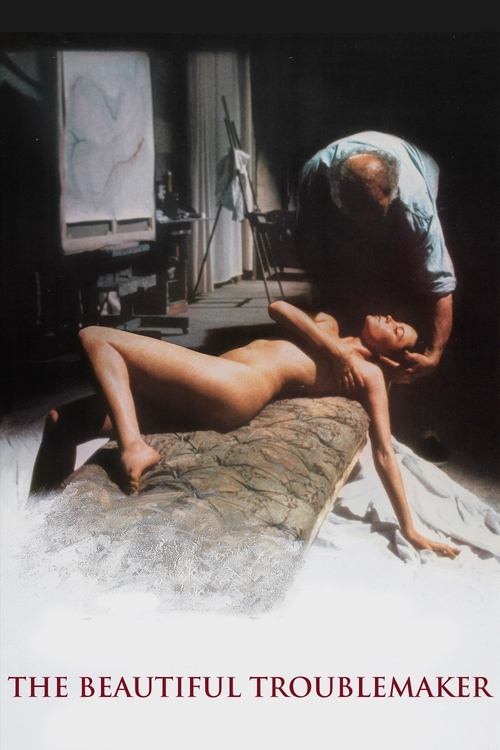
La Belle Noiseuse
1991 · Jacques Rivette
For when you have a whole evening to surrender and want to sink into something slow, sensual, and absorbing — a deep-focus watch for a patient night, not background viewing.
What it's about
In a stone manor in Provence, Frenhofer, a famous painter long retired into comfortable silence, is goaded by a visiting young artist into resuming a canvas he abandoned years ago — the legendary, never-finished 'La Belle Noiseuse.' He takes the young man's girlfriend, Marianne, as his model, and the sessions in his studio become a duel: his pen and brush against her refusal to be merely looked at, while both couples' relationships strain under the work.
The experience
Four hours, much of it spent watching a hand actually draw, and it's hypnotic rather than dull — the scratch of pen on paper becomes as tense as any standoff. It's a film about labor and power that earns its length; you come out feeling like you've lived through the making of something.
Performances
Michel Piccoli gives Frenhofer a lion-in-winter gravity, all silence and sudden appetite, while Emmanuelle Béart does something remarkable: nude for much of the film, she makes the model the strongest person in the room, turning being seen into an act of will.
The craft
Jacques Rivette shoots the studio sessions in real time and at full length, so you watch drawings actually come into being — the sound design is practically all nib-scratch, breath, and shifting paper. Few films have ever made the physical work of art-making this concrete, and the quiet demands good speakers and zero distractions.
Why it matters
Winner of the Grand Prix at Cannes in 1991, it became the definitive film about the artist-model relationship and a late-career peak for Rivette, proof that duration itself can be a dramatic tool.
Snapshot
Four hours in a stone manor in the French south, most of it spent watching a hand draw. Jacques Rivette's La Belle Noiseuse takes Balzac's 1831 novella Le Chef-d'œuvre inconnu — the tale of the painter Frenhofer and the masterpiece nobody is allowed to see — and strips it of period costume, art-historical name-dropping and most of its plot, leaving the one thing Balzac could only gesture at: the labor itself. Michel Piccoli's Frenhofer, long since retired into a comfortable silence, is goaded by a visiting young painter into resuming an abandoned canvas, and takes the visitor's girlfriend (Emmanuelle Béart) as his model. What follows is less a drama than a siege, conducted in a studio, in real time, between a man with a pen and a woman with nothing to hide behind.
The film premiered at Cannes in 1991 and took the Grand Prix — the festival's runner-up prize, in a year when the Palme went to Barton Fink. It became, almost immediately, the reference point for a whole category of cinema: the film that actually shows the work.
Industry & production
By 1991 Rivette was in his early sixties and occupied an unusual position in French cinema: a founding Cahiers du cinéma critic and Nouvelle Vague director whose films had almost never been commercially viable, sustained instead by a small, durable production apparatus. That apparatus was principally Martine Marignac's Pierre Grise Productions, which produced most of his work from the 1980s until his death. French television money (the Fonds de soutien system and broadcaster co-production, which underwrote a great deal of auteur cinema in this period) made a four-hour art film about painting financeable in a way it would not have been in almost any other national industry.
The commercial logic was thin but not absent. Emmanuelle Béart had become a genuine star after Manon des Sources (1986), and her casting — in a role requiring extended, unglamorous nudity across most of the running time — gave the film a commercial hook and a press narrative. Piccoli brought the opposite kind of capital: four decades of authority stretching from Buñuel and Godard's Le Mépris through Sautet, an actor whose presence certified the project as serious.
The film's length was never treated as a fixable problem. Rivette had already released a twelve-hour film (Out 1, 1971) and a four-hour one (L'Amour fou, 1969); duration was method, not indulgence. What he did do, in 1993, was assemble a second, shorter film from the same shoot — La Belle Noiseuse: Divertimento, roughly two hours — using different takes and different coverage rather than simply trimming the long version. He was explicit that it was another film, not a digest. Detailed budget and box-office figures for the production are not reliably in the public record; the film's economics are best described as art-house at every stage.
Technology
Shot on 35mm color negative in a modest 1.66:1 frame, with direct sound and no post-synchronization of the studio scenes. The technology is conspicuously ordinary, and that is the point — the film has no interest in a cinematic apparatus that might compete with the pictorial one.
Two material facts shape the film more than any aesthetic decision. First, the drawings and paintings are real and are made on camera by a real painter: Bernard Dufour, a French artist then in his late sixties, whose hands and forearms stand in for Piccoli's. The images accumulate across the film in the order we see them made; there is no faking, no cutaway to a finished prop. Second, a 35mm magazine holds about eleven minutes of film. The drawing sequences are therefore built from takes bounded by a physical limit, and the film's rhythm — long, uninterrupted stretches broken at intervals — carries the shape of that constraint rather than disguising it.
The shooting ratio was evidently large enough to yield a second feature from alternate takes, which tells us something about the method: Rivette covered the sessions repeatedly, from varying positions, treating each as a performance to be re-run rather than a scene to be matched.
Technique
Cinematography
William Lubtchansky, Rivette's regular cinematographer from the early 1980s onward and a key figure of the period's rigorous French image-making — he also shot for Straub-Huillet and worked on Lanzmann's Shoah — lights the film with a near-total commitment to available and naturalistic sources. The studio is a high, dusty, north-lit room; the house is shuttered against southern heat; exteriors are flat and hot. There is no beautification of Béart's body and no chiaroscuro romance around Piccoli. Color is desaturated toward stone, plaster, paper and skin.
The camera's chief work is deciding where to stand during the sittings. It attends to three things in rotation — the hand and the paper, the model's body, the painter's face — and the cutting between them constitutes the film's argument about what looking is. Crucially, the camera declines the obvious pleasure of showing us the model as the painter sees her; we rarely get an eyeline match that would let us occupy Frenhofer's gaze. We watch the transaction from outside it.
Editing
Nicole Lubtchansky, Rivette's long-standing editor, cuts against every instinct trained by the montage sequence. There is no compression of process into highlights, no music-driven acceleration, no dissolve from blank paper to finished drawing. The film's most radical formal decision is simply to let the drawings take the time they take. Elsewhere — the meals, the walks, the conversations in the garden and the corridors — the cutting is unhurried but conventional, which throws the studio scenes into relief: the rest of the film is paced, the studio is endured.
Mise-en-scène / staging
Rivette's cinema is a cinema of buildings, and the manor is staged as a set of communicating rooms with a locked one at the center. Characters are constantly arriving, overhearing, waiting outside doors. The studio is a stage with two players and a shifting audience of eavesdroppers; the house is the wings.
Within the studio, staging is a matter of the body under instruction. Frenhofer poses Marianne, adjusts a limb, tells her to hold, tells her the pose is wrong, discards the drawing. The postures become progressively more strained and less classical — twisted, crouched, held past comfort. What begins as a painter's routine reads increasingly as a contest of wills conducted through the arrangement of a person in space.
Sound
The film's soundtrack is one of its great achievements and its least discussed. With no ambient score to smooth the surface, the studio sequences are carried by the scrape of pen and ink on paper, the drag of charcoal, the creak of an easel, breathing, and the sound of a body shifting on cold stone. Outside, cicadas and wind. The amplified friction of mark-making gives the drawing scenes their almost physical suspense — you hear the risk in each line.
Music is used with extreme parsimony; the credited music is Stravinsky, deployed sparingly rather than as a score. Rivette's general practice was to distrust non-diegetic music as an instrument of emotional instruction, and the film honors that.
Performance
Piccoli plays Frenhofer as a man of enormous charm and casual cruelty, whose courtesy is a working tool. He is not a tortured genius; he is an old professional who has decided to be ruthless again and finds it easy. Béart's performance is the harder and more remarkable one: exposed for hours of screen time, she has to act with the only instrument left to her — attention. Marianne begins compliant, becomes furious, then combative, and finally arrives at a kind of authority; she stops being the subject of the painting and becomes its co-author, and Béart makes that shift legible almost entirely through posture and gaze.
Jane Birkin, as Frenhofer's wife Liz — the model for the abandoned original canvas, and therefore the woman being replaced — supplies the film's grief. Her scenes with Piccoli carry a decade of unspoken accounting. David Bursztein's Nicolas, who effectively barters his girlfriend for proximity to greatness, and Marianne Denicourt as his sister give the surrounding drama its slightly sour social comedy, and Gilles Arbona plays the dealer Porbus — a painter in Balzac, a middleman here, which is a pointed modernization.
Narrative & dramatic mode
The film's dramatic mode is the sitting: a recurring, ritualized encounter whose terms are renegotiated each time. Plot in the usual sense is minimal and largely arranged in advance — a visit, a proposal, a resumption, a completion, a concealment. What accumulates instead is pressure between four people who all want incompatible things from the same canvas.
Rivette's model here is theatrical rehearsal, the structure he had used since L'Amour fou: the same material worked over and over until something breaks. The film is honest about the fact that the breakage is the goal. Frenhofer is not trying to render Marianne accurately; he is trying to get at something she will only surrender under duress, and the film neither endorses nor exonerates this. Its ending is a deliberate refusal of Balzac's. In the novella, Frenhofer's masterpiece is unveiled as an unreadable chaos of paint with one perfect foot surviving in the corner, and he destroys his work and dies. Rivette's Frenhofer instead bricks the finished canvas into the studio wall — Liz marks it first with a small cross, a private act of witness — and presents a different, lesser painting to the world under the same title. The masterpiece exists and is unseen; the art world takes delivery of a substitute and is satisfied. What the film withholds from us, it withholds on principle.
Genre & cycle
Nominally a drama; functionally an entry in the small, stubborn genre of the artist-at-work film, and arguably its founding text in narrative cinema. Most films about painters are biopics organized around suffering and recognition. La Belle Noiseuse has no biography, no career arc, no critical vindication, and it belongs less with Lust for Life than with process documentaries — Clouzot's Le Mystère Picasso (1956), which put a camera behind the canvas, is its clearest ancestor. Victor Erice's The Quince Tree Sun (1992), which watches Antonio López García fail to finish a painting of a quince tree, arrived a year later and is best understood as a parallel discovery rather than a descendant.
Within Rivette's own cycles, it sits with the "art and its accomplices" films — Paris nous appartient, L'Amour fou, Out 1, La Bande des quatre — where a group organizes itself around a work that may or may not exist.
Authorship & method
Rivette wrote with Pascal Bonitzer and Christine Laurent, the pairing that scripted nearly all his late work. Bonitzer, a former Cahiers critic and theorist, brought analytic structure; Laurent, a playwright and director, brought the theatrical sense of scene-as-encounter. Rivette's practice across his career involved a written framework and a large zone left to the shooting floor; here the surrounding dialogue scenes are clearly composed, while the studio sessions are constructed as events to be discovered on camera.
The decisive collaborator, though, is Dufour. Handing the film's central creative act to an actual painter — and shooting it uncut — is an authorship decision as consequential as any script choice. Rivette effectively subcontracts the masterpiece to someone who can really make one, and organizes the film around waiting to see what he does. With William Lubtchansky on camera, Nicole Lubtchansky cutting, and Marignac producing, the film is the product of an unusually stable long-term company; the Divertimento recut is that company thinking out loud about its own footage.
Movement / national cinema
Rivette is the least assimilable of the Nouvelle Vague's core group, and by 1991 he was the last of them still making films on the movement's original terms: modest means, direct sound, real locations, actors as collaborators, duration as a formal instrument. Where Godard had gone into essayistic video and Truffaut had died in 1984, Rivette simply kept extending the same experiment.
La Belle Noiseuse is also, unmistakably, a French film about the French relationship to painting — to the atelier, the model, the dealer, and the national myth of the artist. Its intertext is not only Balzac but the entire nineteenth-century apparatus of the studio, and behind that Cézanne, who famously identified himself with Frenhofer, and Picasso, who illustrated a 1931 edition of the novella and later worked in a studio on the Paris street where Balzac had set it.
Era / period
Made at the end of a decade in which French cinema's dominant commercial mode had been the glossy, well-upholstered heritage picture, the film reads as a rebuke to that entire tendency: contemporary dress, no music, no period, no consolation. It also arrived at the last moment when a four-hour 35mm film could expect a serious theatrical life on the international art-house circuit. Its subject — whether an artwork should be shown at all — lands differently in an era of total image circulation than it did in 1991, and this has probably increased rather than dated its force.
Themes
The film's core subject is the cost of the work, and its accounting is unsentimental: the painting gets made, it may well be great, and three lives are damaged to produce it. Rivette declines to settle whether the trade is worth it.
Around that sit several related concerns. Looking as power — the film anatomizes the painter's gaze as an instrument of control, decades before that reading became a critical commonplace, and then complicates it by allowing Marianne to look back and eventually to dictate terms. Labor — the insistence that art is physical work, repetitive, failed more often than not, performed by an aging body. The substitution of women — Liz displaced by Marianne, both of them turned into the same painting. Concealment — the bricked-up canvas argues that a work's completion and its exhibition are separate events, and that the second may betray the first. Complicity — nobody in the film is merely a victim; Nicolas offers Marianne up, Marianne chooses to stay, Liz permits it, Porbus waits to sell.
Reception, canon & influence
Reception. The Cannes Grand Prix in 1991 gave the film immediate international standing, and critical response was strong and durable, particularly in the English-language press, where Rivette had long been more admired than seen. It became the Rivette film that non-specialists actually watched — a strange fate for a four-hour work, and largely a function of Béart's presence and of the sheer novelty of the drawing sequences. Reservations, where they came, concerned length and the ethics of the extended nudity; the film's defenders generally answered that the discomfort is the film's subject rather than its byproduct. Jonathan Rosenbaum's sustained advocacy was central to Rivette's Anglophone reputation in these years.
Influences on the film (backward). Balzac's Le Chef-d'œuvre inconnu is the direct source, though Rivette keeps the premise and discards the outcome. Behind it stands the Cézanne–Picasso reception of that novella, which made Frenhofer the patron saint of modernist failure. Cinematically, Clouzot's Le Mystère Picasso established that the act of drawing could hold a screen. Within Rivette's own filmography, L'Amour fou is the essential precursor: a long film about a rehearsal that consumes a marriage, with the same structure of repeated sessions and the same faith in duration.
Legacy (forward). La Belle Noiseuse became the standard against which later films about making art are measured, and its influence is visible less in imitation than in permission — the sense that a film may simply watch someone work. Mike Leigh's Mr. Turner (2014) and Stanley Tucci's Final Portrait (2017), the latter built entirely on the ordeal of sitting for Giacometti, operate in territory Rivette mapped. Céline Sciamma's Portrait of a Lady on Fire (2019) is now routinely discussed against it, as a deliberate inversion: the same painter-and-model chamber structure with the gaze made reciprocal and the power asymmetry dismantled. That is a critical conversation rather than a documented line of descent, but it is the conversation the film keeps generating.
Its other legacy is procedural. The Divertimento recut stands as a rare demonstration that a shoot can yield two genuinely different films — an idea taken up by later directors interested in variant versions. And for Rivette himself, the film opened his most productive late period: Jeanne la Pucelle (1994), Va savoir (2001), and Histoire de Marie et Julien (2003), which brought Béart back to him a dozen years on, again playing a woman whose image is the thing at stake.
A Deleuzian reading
A nib touches paper and catches.
The full Deleuzian reading of La Belle Noiseuse →
Reception
No reappraisal needed — it took the Grand Prix at Cannes in 1991 and was hailed instantly as one of the great films about making art. Three decades on, its stature has only hardened: the four-hour runtime went from 'daunting' to a badge of honor.
How La Belle Noiseuse was received, from release to now →
How to watch La Belle Noiseuse: what to notice on a first viewing
- Listen for the scrape of pen and charcoal on paper. With almost no score, the studio scenes run on the sound of mark-making itself, the drag of charcoal, the creak of an easel, breathing. The sound carries the suspense a score would normally supply, so you hear the risk in each line.
- Watch the camera rotate between the hand, the body, the face. The film attends to these three in turn and rarely lets you see Marianne the way Frenhofer sees her, no eyeline match into his gaze. You watch the transaction of looking from outside it, not from inside the painter's eyes.
- Watch how Frenhofer physically adjusts Marianne's limbs and posture. He poses her, tells her to hold, calls a pose wrong, discards the drawing, and the postures grow more strained as the sittings continue. The posing is doing the work dialogue usually does, showing you a relationship through how a body is arranged.
- Notice how long each drawing is allowed to take on screen. There is no dissolve from blank paper to finished work; Lubtchansky's cutting lets the drawings take the actual time they take. The waiting is not padding. It is the labor the film is actually showing you.
- Notice people arriving, overhearing, or waiting outside the studio door. The manor is staged as communicating rooms with a locked one at the center, and the house functions as the wings to the studio's stage. Everyone outside the door is calculating what the sitting will cost them.
The whole guide to watching La Belle Noiseuse, with the keys for a rewatch →
Influences: the films it descends from and the films it influenced
- Le Mystère Picasso (1956) — Clouzot's ink-through-translucent-support rig proved a screen could be held by the mark appearing alone, and Rivette takes the premise while restoring the apparatus Clouzot hid — Bernard Dufour's hand, the sheet, the nib's scrape — inside one unbroken frame.
- L'Amour fou (1969) — The direct template: a marriage dismantled across repeated rehearsal sessions, with duration used not as scale but as the mechanism by which the work being made eats the people making it.
- Out 1 (1971) — Establishes both the tolerance for extreme running time built from actor-generated exercises and, in the parallel existence of the 13-hour cut and Spectre, the two-versions-from-one-shoot practice that produces Divertimento.
- Céline and Julie Go Boating (1974) — The house as a set of communicating rooms the camera and bodies traverse on foot — adjacent spaces held in continuity so eavesdropping, arrival and interruption become the editing logic rather than cutaways.
- Chronicle of Anna Magdalena Bach (1968) — Performance recorded live and whole with direct sound rather than playback-and-mime, so the physical noise of the instrument is the score — exactly the contract Rivette makes with charcoal on paper and the near-total absence of nondiegetic music.
- Pickpocket (1959) — Hands isolated as autonomous performers with the sound of the gesture pushed forward in the mix; Rivette's drawing inserts are Bressonian hand-shots, not a montage of inspiration.
- Andrei Rublev (1966) — The bell-founding episode makes the fabrication of an object — pit, clay, pouring, failure risk — carry the dramatic weight for a whole movement, deferring the finished work until the very end, the same withholding structure Rivette runs for four hours.
- Jeanne Dielman, 23 quai du Commerce, 1080 Bruxelles (1975) — Labor filmed in real time without ellipsis from a fixed, unhurried frame, establishing duration as an ethical position toward a woman's body performing repetitive work under observation.
- Chikamatsu Monogatari (1954) — Rivette, Mizoguchi's most eloquent Cahiers champion, extends the sustained-take ethic in which duration itself becomes the camera's mode of moral attention.
- Gerhard Richter Painting (2011) — The camera simply waits in the studio while the painter works and visibly resents being watched, making the observed artist's self-consciousness the film's actual event — the documentary form La Belle Noiseuse licensed.
- Va savoir (2001) — The late-period model reopened by La Belle Noiseuse: a Bonitzer–Laurent script that frames a theatrical rehearsal as the film's spine and stages the private drama across communicating rooms and backstage passages.
- Histoire de Marie et Julien (2003) — Returns Béart to Rivette a dozen years on in the same problem — a woman whose image is the thing at stake — and again governs the film by what the camera and the man refuse to show or meet directly.
- Pollock (2000) — Harris trained for years so the drip sequences could be shot as genuine unbroken takes of the actor painting, adopting Rivette's rule that the art-making must actually occur in front of the lens rather than be assembled in the cut.
- Mr. Turner (2014) — Timothy Spall spent two years learning to paint so the studio scenes could show the physical, grunting labor of application in real time, arrived at through Leigh's months-long rehearsal-improvisation method — Rivette's process discipline transposed to a British biography.
- Final Portrait (2017) — Built entirely from repeated sittings in one studio, with the sitter's boredom, stiffness and canceled departures as the plot — the most literal extension of Rivette's session-by-session architecture and its ordeal of posing.
- Portrait of a Lady on Fire (2019) — Keeps the painter-and-model chamber structure, on-camera painting by a real artist (Hélène Delmaire) and the near-total absence of nondiegetic music, while inverting Rivette's withheld eyeline into a reciprocal, negotiated look between the two women.
- Girl with a Pearl Earring (2003) — Renders the artist-and-model dyad in real-time long takes where the duration of looking and posing is the suspense, the long-take/cinema-of-the-gaze blueprint.
- At Eternity's Gate (2018) — Devotes sustained real-time takes to the hand, the brush and the resistance of the surface, insisting that watching paint be made is dramatic — the source of the film's long unbroken painting passages set against its otherwise fragmentary cutting.
- Van Gogh (1991) — Released the same season with painting executed on camera and captured in direct sound, and with the painter-model relation played as ordinary domestic irritation rather than biopic epiphany — the same refusal of the crescendo score at the moment of creation.
- La Maman et la Putain (1973) — Post-New-Wave chamber cinema at three-and-a-half hours built from long direct-sound takes in a few rooms, where the running time is the form and the audience's endurance is part of the transaction.
- Model (1981) — An entire documentary on bodies held under instruction — repeated takes, posture corrected by a voice off-frame, the studio's ambient sound intact — which is the anthropology Rivette dramatizes in the Béart–Piccoli sessions.
- Out 1 (1990) — Four hours of real-time observation of artistic creation — the painter's hand actually working — making durational process, not plot, the film's true subject.
Similar films
- Céline and Julie Go Boating (1974) — influence & lineage · often watched together
- L'Amour fou (1969) — influence & lineage
- Portrait of a Lady on Fire (2019) — influence & lineage
- The Mother and the Whore (1973) — influence & lineage
- Pickpocket (1959) — influence & lineage
- The Hypothesis of the Stolen Painting (1978) — often watched together
- Vivre Sa Vie (1962) — often watched together
- Pierrot le Fou (1965) — often watched together