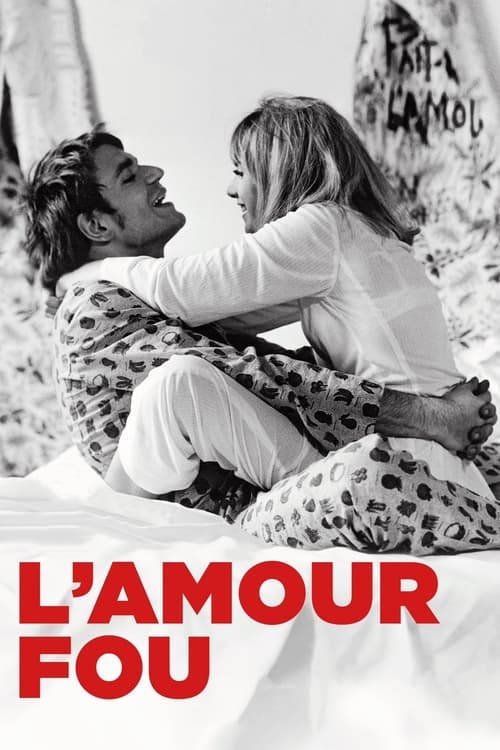
L'Amour fou
1969 · Jacques Rivette
For when you have a whole evening and the appetite for total immersion — a film about love curdling that asks for your patience and repays it with an intensity few breakup films ever reach. Firmly a challenge, not a comfort.
What it's about
A theater director is staging Racine's tragedy Andromaque; his wife, an actress, quits the lead role in the opening minutes and retreats to their apartment. Over four hours the film tracks two collapses at once — the play struggling toward opening night, and the marriage coming apart behind closed doors — while a television crew films the rehearsals, their grainy 16mm footage cut directly into the movie itself. Rehearsal room and bedroom slowly become mirrors of each other, jealousy and performance feeding back until it's hard to say where the play ends and the marriage begins.
The experience
Long, raw, and hypnotic — it moves at the pace of real rehearsal and real domestic breakdown, with stretches of tedium that suddenly crack open into scenes of startling intimacy and violence of feeling. You come out feeling like you've lived inside this couple, not just watched them.
Performances
Bulle Ogier and Jean-Pierre Kalfon worked partly through improvisation, and it shows in the best way — their scenes together have the unguarded, dangerous texture of a real couple circling each other, tenderness and cruelty arriving in the same breath.
The craft
Rivette's great formal gamble is the double camera: his own 35mm film interwoven with the 16mm of a documentary crew shooting the same rehearsals, so the film constantly shifts between fiction and something close to documented life. The four-hour length isn't indulgence — it's the point, letting processes (a production, a marriage) unravel in something like real time.
Why it matters
A landmark of the French New Wave's radical wing, it opened the door to Rivette's later marathon experiments and became a touchstone for filmmakers interested in improvisation, duration, and the porous line between performance and life.
Snapshot
Rivette's third feature is a four-hour black-and-white study of two simultaneous collapses: a theater director's production of Racine's Andromaque, and his marriage. Jean-Pierre Kalfon plays Sébastien, who is mounting the play; Bulle Ogier plays Claire, his wife, who withdraws from the role of Hermione in the opening minutes and spends the rest of the film disintegrating in their apartment. The film's governing device is a doubling of apparatus as well as of subject: a television crew, headed by a director played by the critic and documentarian André S. Labarthe, is filming the rehearsals in 16mm, and that 16mm footage is cut directly into Rivette's own 35mm film. What results is neither a fiction about theater nor a documentary about actors but a sustained experiment in filming a process while it is still unresolved — the decisive break between Rivette the adapter of Diderot and Rivette the maker of Out 1, Céline et Julie vont en bateau, and the long improvised works that followed. It is also, for the same reasons, one of the least-seen major films of its moment: the full 252-minute version was effectively withdrawn from circulation for decades and only returned properly in the 2010s.
Industry & production
L'Amour fou was made in the immediate aftermath of the most damaging episode of Rivette's career. His adaptation of Diderot, Suzanne Simonin, la Religieuse de Diderot (1966), had been banned by the French Minister of Information before release under pressure from Catholic groups — a scandal that made Rivette briefly famous and commercially radioactive, and that cost his producer, Georges de Beauregard, real money. Beauregard is generally credited as the producer of L'Amour fou as well; the film was made cheaply, on a small crew, and the surviving production record is thinner than for the era's better-documented New Wave titles.
The reaction against La Religieuse is legible in every decision. Rivette abandoned the prestige literary adaptation, the period reconstruction, and the fully written screenplay. The script credit is shared with Marilù Parolini — a Cahiers du cinéma associate and photographer who would also work on Out 1 and Céline et Julie — but what was written functioned as a situation and a set of relations rather than as dialogue. The rehearsal material was substantially generated by the actors, with Kalfon given genuine authority over the staging of the Racine, so that the Andromaque being rehearsed on screen was a real (if never completed) theatrical undertaking rather than a mimed one.
The casting drew on an existing collective. Kalfon, Ogier and Michèle Moretti had all worked in Marc'O's theater company, whose milieu had already been filmed in Les Idoles (1968); Kalfon had also appeared in Godard's Week-end. Rivette was therefore not assembling strangers but pointing a camera at a troupe that already had its own working habits and internal frictions — a method he would extend enormously in Out 1. For Ogier the film was a breakthrough, and it established the register of nervous, watchful interiority she would carry through the next two decades of French cinema.
The release was the film's second crisis. At 252 minutes it was commercially unexhibitable by ordinary standards, and a shortened version of roughly two hours was put into circulation; Rivette repudiated the long-term consequences of that cut, though accounts differ on how much he was involved in making it. The full version surfaced only intermittently for years afterward. Restoration work in the 2010s, in the wake of the Out 1 restoration, returned it to festivals, retrospectives and eventually home video. Reliable figures for its original commercial performance are not in general circulation, and I will not invent any.
Technology
The film is a direct product of the lightweight sync-sound apparatus that matured in the early 1960s: reflex 16mm cameras of the Éclair type, quiet enough to run with live sound and light enough to be handheld for long stretches, paired with portable Nagra recorders and crystal synchronization that freed camera and recorder from a physical cable. That equipment had already produced Rouch's ethnographic and Parisian work and the American direct cinema films; Rivette had used it himself on Jean Renoir, le patron (1966), the documentary he made for Labarthe and Janine Bazin's television series Cinéastes de notre temps, and that experience is the technical bridge to L'Amour fou.
What is unusual is that Rivette did not choose between formats. The 35mm camera and the 16mm camera ran on the same events, and the finished film keeps the difference visible: the 16mm inserts are grainier, more mobile, less securely lit, and carry a rougher sound signature. Blown up for 35mm release prints, that discrepancy became a texture rather than a defect. Cheap 16mm stock also changed the film's economics of duration — a high shooting ratio was affordable, scenes could be allowed to run past their dramatic use, and the resulting mass of material is what made a four-hour edit conceivable in the first place. Black-and-white was likewise a budget decision that became an aesthetic one, flattening the apartment and the rehearsal room into the same gray continuum.
Technique
Cinematography
Two cinematographers, two formats, two attitudes. Alain Levent shot the 35mm material; Étienne Becker, a documentary cameraman, shot the 16mm. The 35mm passages are not conventionally composed so much as patiently positioned: the camera finds a vantage and holds it while behavior accumulates, reframing rather than cutting, tolerating dead air and awkward blocking. The 16mm passages are reactive, hunting for a face, losing it, catching a gesture at the edge of frame. Neither is privileged as truth. The film's most unsettling effect is that the "documentary" images are no more revealing than the "fiction" ones — both record the same opacity from different distances.
The apartment sequences exploit a real, cramped domestic space: low ceilings, doorways used as frames within frames, a camera that is physically too close to two people who have run out of room. As the marriage decomposes, the space is progressively wrecked, and the cinematography simply keeps recording the same rooms in worsening condition, which is far more disturbing than any expressive lighting scheme would be.
Editing
Nicole Lubtchansky's cut is the film's principal act of authorship, and it is a reductive rather than a constructive one. The basic rhythm is alternation — theater, apartment, theater, apartment — and the drama of the edit is the slow shift in that ratio: the collective, public, productive world thins out while the dyadic, private, destructive one swells until it consumes the last long movement of the film. Within scenes, the cutting is conspicuously unhurried, preserving the beginnings and ends of actions that classical editing would trim. Between the two formats, the cuts are unannounced and often mid-action, so that the viewer is repeatedly re-oriented as to which camera is watching. Lubtchansky went on to cut Out 1 and Céline et Julie, and the durational logic she works out here becomes the house style of Rivette's mature period.
Mise-en-scène / staging
The film's central intelligence is that theatrical rehearsal and marital cohabitation are the same activity conducted under different rules. Sébastien's rehearsal method — physical exercises, group games, repetition, exhaustion, the pursuit of a state rather than a reading — belongs to the late-1960s European avant-garde formed by Artaud's legacy, Grotowski's poor theater, and the Living Theatre's presence in France. Rivette films this work at length and largely without irony, letting the tedium and the small humiliations register. The apartment scenes then replay the same procedures without a text or a director: improvisation with no score, exercises with no purpose, repetition that cannot be stopped by a call for a break.
Racine is the third term. Andromaque is a machine of unreciprocated desire — a chain in which each figure loves someone who loves another — culminating in Hermione's vengeance and Oreste's madness. That Claire abandons Hermione, the jealous and abandoned woman, and is then progressively possessed by exactly Hermione's condition, is the film's clearest structural rhyme, and one that criticism has drawn out consistently. Rivette does not underline it; the alexandrines are simply heard in one space and enacted, in degraded prose and gesture, in the other.
Sound
Direct sound throughout, with all its liabilities preserved: overlapping speech, ambient intrusion, dialogue that is hard to catch. The two recording chains have audibly different qualities, so the soundtrack carries the same doubling as the image. Music is used sparingly; the credited score is by Jean-Claude Eloy, a composer trained in the post-serial idiom, and much of what is heard in the apartment is diegetic — records and radio, playing into rooms whose occupants are no longer listening to each other. The famous sustained destruction sequence derives much of its force from sound: tearing, breaking, and the long silences between.
Performance
The acting is the film's real subject and its real risk. Kalfon plays a director whose authority is genuine and whose reserves of attention are finite; Ogier plays a withdrawal that is never given a diagnosis. Because so much was improvised over long takes, the performances have the quality of behavior under duration — actors visibly deciding what to do next, arriving at intensity by accident rather than by design, and occasionally failing to arrive at all. The film keeps the failures. Josée Destoop as Marta, who takes over Hermione, and Michèle Moretti within the company, supply the surrounding social texture that keeps the couple from becoming a two-hander abstraction. Labarthe, playing a television director, is essentially performing his own profession, which further blurs the boundary the film is testing.
Narrative & dramatic mode
L'Amour fou has a story that could be told in a paragraph and a duration that refuses to let it be. It is a process film: causality is loose, motivation is withheld, and the events that would be dramatic peaks elsewhere — a departure, a betrayal, a breakdown — occur without preparation and are not explained afterward. The mode is closer to observation with an embedded fiction than to melodrama, though the underlying material (jealousy, sexual humiliation, self-destruction) is melodrama's. Duration does the work that plot usually does: we come to know these people the way one knows housemates, by accumulation rather than revelation. The convergence of the two collapses — production abandoned, marriage unsalvageable — is the film's only structural climax, and Rivette declines to resolve either into meaning.
Genre & cycle
The film belongs to no genre and to two cycles. The first is the backstage or rehearsal film, which Rivette had already entered with Paris nous appartient (1961), built around a doomed staging of Pericles, and which he would work for the rest of his life — Out 1, L'Amour par terre, Va savoir. The second is the late-1960s art-cinema cycle of marriage in ruins alongside a classical text: Godard's Le Mépris (1963), where a couple disintegrates around a production of the Odyssey, is the closest structural sibling. Bergman's Persona (1966) shares the actress-in-collapse and the doubling; Cassavetes's Faces (1968), shot in 16mm and blown up, shares the improvisational method and the domestic cruelty. The affinities are real, but they are convergences within a shared moment rather than demonstrable borrowings.
Authorship & method
This is the film in which Rivette's method becomes his subject. The move was principled: after censorship punished him for a faithful, fully written adaptation, he abandoned the position of author-who-knows in favour of author-as-designer-of-situations. He set up a dispositif — a play, a company, a marriage, two cameras — and filmed what it produced, reserving authorship for the two ends of the process: the design of the conditions, and the edit.
The collaborators are correspondingly central rather than subordinate. Marilù Parolini shares the writing credit for a text that had to be provisional. Alain Levent and Étienne Becker are not interchangeable technicians but the film's two competing epistemologies. Nicole Lubtchansky, given an enormous and shapeless mass of material, determined the film's proportions and therefore its meaning. Jean-Claude Eloy's music refuses the consolations of scoring. André S. Labarthe, co-creator of Cinéastes de notre temps, imported the ethics of a television series about how films are made into a fiction about how a play is made. And Kalfon, handed real directorial authority over the Racine, is a co-author of everything that happens in the rehearsal room.
Movement / national cinema
L'Amour fou is a post-New Wave French film in the strict sense: made by a founding Cahiers critic a decade after the wave broke, at the point where its members were dispersing into incompatible projects. Rivette's direction of travel was toward duration, improvisation and the collective — the opposite of the industrial reconciliation that other New Wave figures were making at the time.
It also sits exactly on the 1968 hinge. Rivette was among the Cahiers group who mobilized over the removal of Henri Langlois from the Cinémathèque française in February 1968, the agitation that fed directly into the shutdown of the Cannes festival in May. The film's preoccupations — collective work and its authority problem, self-management, the exhaustion of inherited forms, the suspicion that a director is simply a boss — are the preoccupations of that spring, arrived at through theater rather than through politics. Alongside it sits the French underground of the same years, the Zanzibar films and Marc'O's troupe, from which Rivette drew his cast.
Era / period
The film reads now as a late-1960s document in the least flattering and most valuable sense. It records the period's belief that a group working intensively enough could produce something true, and it records that belief failing under observation. Its couple is the bourgeois marriage in its terminal phase — no children, no economy, no external obligations, nothing left to organize the relation except desire and surveillance. Its chemistry of pills and alcohol, its unstructured days, its available Paris apartment in which two people can afford to come apart for a week: these are period-specific conditions, and the film neither romanticizes nor condemns them.
Themes
Possession is the master theme — of a role, of a spouse, of a company by its director, of a person by an image of another person. Racine supplies the formal statement of it and the couple supplies the demonstration. Around that: the impossibility of separating performance from being, since neither Claire nor Sébastien can stop directing themselves; the ethics of watching, made explicit by the 16mm crew and implicated in our own four-hour attention; work as both salvation and destruction, since the play is what keeps Sébastien intact and what makes Claire disposable; and madness not as pathology but as a shared project, a folie à deux the couple undertakes together and with something like commitment. The title shared with André Breton's 1937 book places all of this in a surrealist lineage — amour fou as an absolute and annihilating condition rather than a symptom — a lineage Rivette would take up again more playfully in the 1970s.
Reception, canon & influence
Contemporary reception was divided along predictable lines and complicated by the two-version problem: many who wrote about the film in 1969 and after had seen the shortened cut, and the critical record is correspondingly unreliable. Rivette's Cahiers milieu and the emerging cinephile press treated the long version as a major work; general audiences and much of the mainstream press found it punishing. Because the full version was so hard to see for so long, the film's canonical standing was for decades secondhand — a title invoked more than watched, its reputation resting on Out 1's legend. The restorations of the 2010s changed that, and it now reads clearly as the pivot of Rivette's career rather than as a rumor.
Looking backward, the film's debts are traceable and mostly acknowledged in his practice: Rouch's participatory documentary and the direct-cinema apparatus; Renoir's belief in performance discovered rather than dictated, which Rivette had spent 1966 filming at close range; Racine as a formal model of desire; the Artaud–Grotowski–Living Theatre current in 1960s stage practice; and his own Paris nous appartient, whose failed Pericles is the seed.
Looking forward, its influence runs first through Rivette himself: Out 1 (1971) is L'Amour fou enlarged past all reason — two companies rehearsing Aeschylus, twelve and a half hours, improvisation as the organizing principle — and the rehearsal film recurs through L'Amour par terre and Va savoir. Beyond that, it belongs to the durational turn in art cinema that made long-form, real-time, process-based work legitimate, a development usually credited to Akerman, Straub–Huillet and Rivette in parallel rather than in sequence. Its more specific descendant is the film that takes acting as its subject and rehearsal as its structure: critics have repeatedly drawn the line from L'Amour fou to Assayas, to Desplechin's theater-inflected ensembles, and to Ryusuke Hamaguchi's Happy Hour and Drive My Car, whose lengthy rehearsal sequences work the same seam. Those are best described as affinities and inheritances within a tradition Rivette largely founded, rather than as documented borrowings; where a filmmaker has not said so, the honest claim is lineage, not debt.
A Deleuzian reading
The picture coarsens mid-gesture.
The full Deleuzian reading of L'Amour fou →
Reception
Hailed in 1969 France as Rivette's breakthrough into long-form filmmaking, it then spent decades as a near-impossible-to-see holy grail — no proper home release — until its recent restoration finally let a new generation confirm the legend.
How L'Amour fou was received, from release to now →
How to watch L'Amour fou: what to notice on a first viewing
- Notice the grain change mid-scene without any warning. Rivette cuts from smooth 35mm to rougher 16mm footage inside the same rehearsal, using two different cameras shooting the same real events. Neither texture is ever marked as the true one, so you stop trusting grain to tell you what's real.
- Notice how abruptly the film switches cameras mid-action. The cuts between the two formats land with no warning and often in the middle of a gesture, so you have to work out which camera is watching. The edit refuses to explain the switch, leaving the connection for you to make each time.
- Watch how the apartment frames people inside doorways. The camera stays physically close in a low ceilinged flat, using doorways as frames within the frame for two people who have run out of room. The cramped architecture makes the marriage's claustrophobia something you feel in the space itself, not just in the dialogue.
- Listen for records and radio nobody is listening to. Diegetic music plays into the apartment rooms while the direct sound also catches overlapping speech and ambient intrusion, dialogue that is sometimes hard to catch. The sound stays as messy and unattended as the people occupying the room, refusing any tidy score.
- Watch the actors run physical exercises before they speak lines. Sébastien's rehearsal method is exercises, group games, and repetition to exhaustion, filmed at length before any text of Racine is even attempted. Watching bodies get tired and arranged tells you as much about authority in the room as any line of verse.
The whole guide to watching L'Amour fou, with the keys for a rewatch →
Influences: the films it descends from and the films it influenced
- Paris nous appartient (1961) — The abortive amateur *Pericles* rehearsal is the literal prototype: a theater company used as the film's clock and social unit, with rehearsal filmed as unresolved process rather than as inserts illustrating a plot.
- Le Carrosse d'or (1952) — Renoir's commedia troupe gives Rivette the structural device of treating stage and life as one continuous playing area, making the performer's métier — not her psychology — the object of the camera's attention.
- Jean Renoir, le patron (1967) — Rivette's own *Cinéastes de notre temps* portrait is where he learned the apparatus he reuses: a lightweight sync-sound crew watching a director coax performance out of actors in real time, holding on the work instead of cutting to the result.
- Chronique d'un été (1961) — Supplies the participatory-documentary rig wholesale — Nagra-synced portable direct sound plus non-actors performing versions of themselves for a camera they openly acknowledge, with the filmmakers' provocation admitted as method.
- Moi, un noir (1958) — Establishes non-actor self-casting as a production principle: subjects play themselves under their own names and improvise their own commentary, so the fiction is generated by the people filmed rather than imposed on them.
- Chelsea Girls (1966) — Formal precedent for duration as the organizing principle — unbroken camera-roll takes left uncut and two image streams running in parallel, so the spectator's choice of where to look becomes part of the work; Rivette rationalizes this into 35mm/16mm crosscutting across four hours.
- Le Plaisir (1952) — Rivette extends Le Plaisir's long-take-as-punctuation principle to its logical extreme in a four-hour exploration of rehearsal space, replacing the cut with endurance as the film's formal unit and enacting the argument that Ophüls's sustained mise-en-scène duration is itself the expressive content.
- The Life of Oharu (1952) — Rivette, Mizoguchi's most fervent Cahiers champion, built a cinema of duration on the principle Oharu taught him — the unbroken take as an act of patient observation where real time and performance are inseparable.
- Out 1 (1971) — The dispositif enlarged past reason: two companies rehearsing Aeschylus instead of one rehearsing Racine, twelve and a half hours instead of four, and improvisation promoted from technique to the sole generative rule.
- La Maman et la putain (1973) — Inherits the apartment method whole — three and a half hours of direct sound in cramped Paris rooms, monologues held at unbroken length, a couple's disintegration measured by running time rather than incident — while reversing Rivette's improvisation into a rigidly written text.
- Opening Night (1977) — Extends the rehearsal film's core device by dissolving the boundary between run-through, performance and private life, staging an actress's collapse inside the actual working conditions of a production rather than in dramatized privacy.
- La Belle Noiseuse (1991) — Rivette re-runs the method on painting: four hours in which the labor of making — Bernard Dufour's hand drawing in unbroken real time — is the event, with the painter/model relation substituted for director/actor.
- Vanya on 42nd Street (1994) — The purest inheritance of rehearsal-as-form — street clothes, a derelict theater, no costume or set change, the camera treating a workshop run-through of Chekhov as the finished film with no cutaway to a staged production.
- Irma Vep (1996) — Restages the film-within-a-film as a working method: handheld observational shooting of an actual shoot, an actor cast under her own name and identity, and the director's breakdown left in the cut as material rather than resolved as plot.
- Happy Hour (2015) — Five-plus hours built from a non-professional cast developed through acting workshops, with an extended workshop sequence placed at the center as the film's structural spine — Rivette's rehearsal-as-engine transposed to Kobe.
- Drive My Car (2021) — Multilingual table-read rehearsals of *Uncle Vanya* are repeated at length and uncut, so the slow assimilation of a classical text by a company becomes the film's narrative clock — the Racine rehearsal method fifty years on.
- Rendez-vous (1985) — Rivette's interleaving of a theatrical rehearsal with the lovers' real disintegration establishes rehearsal-as-method and the elliptical braiding of staged art and lived collapse that Rendez-vous compresses.
- Out 1 (1990) — The immediate predecessor: a four-hour film built by shooting a theatrical rehearsal in real duration, mixing 16mm and 35mm and letting improvisation dictate length.
- Céline and Julie Go Boating (1974) — Rivette's own prior use of a theatrical rehearsal as the film's load-bearing structure, with real-time duration earning the emotional rupture, is the immediate rehearsal-as-form precedent.
- Clouds of Sils Maria (2014) — The founding French rehearsal-drama method — an Andromaque rehearsal filmed at real length in parallel with a private collapse, letting the classical text's lines land as accusations in the room; Assayas compresses this into the outdoor hiking rehearsals.
- La Chinoise (1967) — The same problem solved a year earlier — a company of young people working a text inside a single apartment, shot in direct sound with recitations left at full length and the production apparatus (clapperboard, offscreen interviewer) admitted into the frame.
- Symbiopsychotaxiplasm: Take One (1968) — Independently arrives at Rivette's two-camera epistemology: one unit shoots the acted scene, a second shoots the crew shooting it, and the disagreement between the two viewpoints becomes the film's actual content.
- Chronik der Anna Magdalena Bach (1968) — The other 1968 argument for direct sound as an ethic — performances recorded live and whole within a single set-up, refusing post-synchronisation and refusing added score, the position Eloy's unconsoling music and Rivette's Nagra takes stake out from the fiction side.
- Faces (1968) — Demonstrates in the same year that a marriage can be dismantled at feature length by handheld 16mm working at close range in cramped domestic rooms, with performance built from rehearsed improvisation rather than delivered dialogue.
- Jeanne Dielman, 23 quai du Commerce, 1080 Bruxelles (1975) — Parallel rather than derivative, but the same wager: real-time domestic labor filmed at a length that makes duration the carrier of meaning, so the edit's proportions — Lubtchansky's decision in Rivette's case — do the interpretive work.
Similar films
- La Belle Noiseuse (1991) — influence & lineage
- The Mother and the Whore (1973) — influence & lineage
- Faces (1968) — influence & lineage
- Out 1 (1990) — shared sensibility
- Amour (2012) — shared sensibility
- Céline and Julie Go Boating (1974) — shared sensibility
- Pierrot le Fou (1965) — shared sensibility
- Hiroshima Mon Amour (1959) — shared sensibility