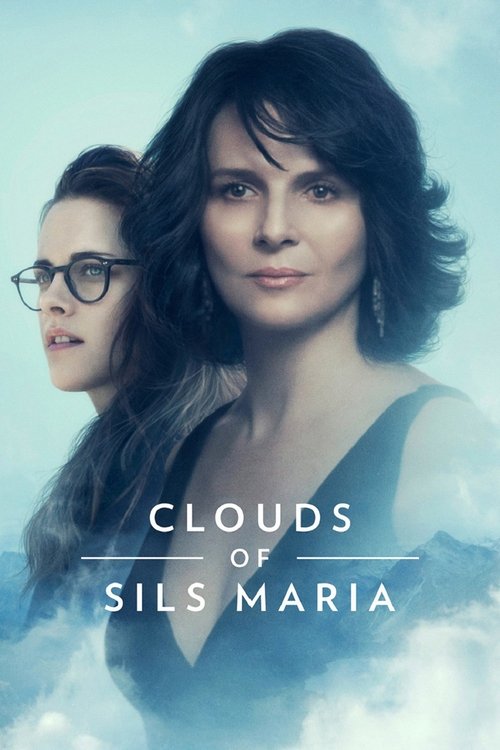
Clouds of Sils Maria
2014 · Olivier Assayas
For when you want a film to chew on for days — ideally with someone to argue about it with afterward. Reach for it when you're in the mood for smart, adult conversation as drama, not plot.
What it's about
Maria Enders, an actress of international standing, made her name at eighteen playing a ruthless young woman who destroys her older employer in a two-hander called 'Maloja Snake.' Twenty years later she's asked to join a revival — this time as the older woman. In a house in the Swiss Alps she rehearses with Valentine, her sharp American assistant, running lines until the play, their relationship, and her own past start to blur, while a scandal-prone Hollywood starlet circles the role that used to be hers.
The experience
Talky, intelligent, and slyly slippery — long rehearsal scenes keep dissolving the line between script and life until you're pleasantly unsure which conversation you're watching. It's absorbing rather than tense, with mountain air and dry wit throughout.
Performances
Juliette Binoche is magnificent as a woman negotiating with her own legend, but the revelation is Kristen Stewart, whose loose, needling naturalism as the assistant won her a César and permanently changed how people saw her. Chloë Grace Moretz has wicked fun as the tabloid-baiting ingénue.
The craft
Assayas builds the whole film out of two women reading lines in rooms and on mountain trails, and makes that endlessly dramatic — the writing is the special effect. The Engadine valley locations, with the famous snake of cloud pouring through the pass, give it an eerie, time-haunted grandeur.
Why it matters
A touchstone of the actress-and-her-double tradition and the film that redefined Kristen Stewart's career, beginning her celebrated collaboration with Assayas.
Snapshot
Clouds of Sils Maria is Olivier Assayas's chamber film about an actress, her assistant, and a play — and about the way time rewrites a person's relationship to their own work. Maria Enders (Juliette Binoche), a star of international standing, is asked to appear in a revival of Maloja Snake, the two-hander that made her at eighteen. Then she played Sigrid, the young woman whose ruthless magnetism destroys her older employer Helena; now she is invited to play Helena. She rehearses in the Engadine valley of eastern Switzerland with her American assistant Valentine (Kristen Stewart), running lines in the mountains above Sils Maria while a Hollywood ingénue, Jo-Ann Ellis (Chloë Grace Moretz), circles the role of Sigrid.
The film's central formal wager is that rehearsal is dramatically sufficient — that two women reading a script aloud on a hiking trail can carry the weight of a feature. Assayas repeatedly withholds the visual punctuation (a cut, a reverse angle, a scene marker) that would tell us where the play ends and the conversation resumes. The result is a film that is simultaneously very legible as story and slippery as experience: a mise en abyme in which Binoche, an actress who was herself a young sensation of the mid-1980s, plays an actress confronting the young sensation she used to be, opposite a co-star then best known as the lead of a global franchise.
It premiered in competition at the 2014 Cannes Film Festival and became, over the following year, the film that decisively recast Kristen Stewart's critical standing — she won the César for Best Supporting Actress, the first American actor to win a César in the award's history. The film also completes a loose trilogy of Assayas's inquiries into performance, image circulation, and the actress as a figure: Irma Vep (1996), Demonlover (2002) in a more paranoid register, and this.
Industry & production
The film is a European co-production — principally French, German, and Swiss, with CAB Productions, Pallas Film and Vortex Sutra among the entities involved, and Charles Gillibert as producer through CG Cinéma. This is the standard architecture for an Assayas film of this scale: a mid-budget art-house feature financed across borders, with regional funds attached to the Engadine shooting locations, sold internationally on the strength of its director and cast. IFC Films handled the U.S. release in April 2015, nearly a year after the Cannes premiere — a long window typical for a subtitled-adjacent (here mostly English-language) auteur title being positioned for a slow platform rollout rather than a wide launch.
Two industrial facts matter to how the film reads. First, it is largely in English, with French and German woven through — a language strategy that reflects both the multinational financing and the film's subject, since the international art-cinema actress of Maria's stature works across languages as a matter of course. Assayas has shot in English before (demonlover, Boarding Gate, Carlos), and the language choice here is diegetically motivated: Valentine is American, the play is being staged by a German director, and the Hollywood machinery around Jo-Ann speaks English by default.
Second, the casting is itself an industrial statement. Binoche had, by 2014, three decades of standing as one of the defining faces of French cinema's post-Nouvelle Vague generation; she had worked with Assayas as an actor on Summer Hours (2008) and, further back, was in his orbit from the period when he was writing for Cahiers du cinéma and beginning to direct. Stewart came to the film immediately after the Twilight franchise (2008–2012), which had made her one of the most visible and most critically dismissed young actors in the world. Moretz, likewise, arrived with a résumé of studio genre work. The film's premise — established star, tabloid-inflected young star, franchise machinery — is legible as a commentary on the very casting sheet that produced it, and Assayas has been open that the project began from conversations with Binoche about what it means to be an actress at a particular point in a career.
The production shot on location in the Engadine, in and around Sils Maria and the Maloja Pass, with additional work in Zurich and elsewhere. The Maloja Snake itself — the cloud formation that noses through the pass like a serpent — is a real meteorological phenomenon, and the film incorporates footage of it, including reference to Arnold Fanck's 1924 silent Das Wolkenphänomen von Maloja, a mountain-film document of the same cloud. That citation is not decorative: it anchors the film's title and its central metaphor in an actual piece of early cinema history, and it links Assayas's modern chamber drama to the Bergfilm tradition.
Technology
The film was shot on 35mm — a choice that by 2014 had become a deliberate, cost-bearing decision rather than a default, in a year when the majority of comparable productions had moved to digital capture. Assayas and cinematographer Yorick Le Saux use film's rendering of the Alpine landscape (haze, altitude light, the gradations of gray in cloud) as a substantive element rather than a texture effect; the mountain material would look categorically different on the digital sensors of the period.
Within the fiction, the film is acutely attentive to consumer image technology as a social fact. Valentine's job is conducted almost entirely through devices: she manages Maria's professional life on a smartphone and tablet, screens gossip, cues up YouTube clips of Jo-Ann's tabloid meltdowns and viral appearances, and — in one of the film's most quietly precise sequences — shows Maria a clip of Jo-Ann's science-fiction blockbuster on a laptop. The film registers, without editorializing much, that the reputation of a performer is now assembled from fragments circulating on screens of different sizes and resolutions, and that this circulation is a genuinely different regime from the one Maria entered at eighteen. Assayas had been working this seam since demonlover and Boarding Gate, but here the technological anxiety is domesticated: it lives in a rented chalet, in the small screen a young woman holds up to an older one.
The Maloja Snake footage — the 1924 Fanck material — enters the film as an artifact of an older imaging technology, silent and monochrome, set against the digital-video and 35mm registers around it. The film is thus quietly organized as a comparison of image regimes across a century.
Technique
Cinematography
Yorick Le Saux, who had shot Carlos (2010) for Assayas, works in a mode that is mobile but unshowy. The camera favors medium and medium-long framings that keep two bodies in a single shot; it walks with the characters on trails, keeps up in cars, drifts in interiors. Handheld work is used for proximity rather than agitation — there is very little of the destabilizing camera Assayas deployed in his thriller mode.
The crucial cinematographic decision concerns coverage. In the rehearsal scenes, Assayas and Le Saux frequently hold Maria and Valentine in the same frame, in profile or three-quarter, walking or seated, rather than cutting to isolating singles. This has a specific effect: because we can see both faces at once, and because neither actor signals a shift into "performance," we lose the ability to tell whether a line belongs to the play or to the women. The two-shot is the film's argument made visible.
The landscape photography does double duty. The Engadine is shot with real topographic specificity — the light at altitude, the scale of the valley against the two small figures — but the mountain footage is not sublime in the Romantic sense so much as indifferent. The Maloja Snake sequence, in which the cloud pours through the pass, is the film's one moment of pure spectacle, and Assayas earns it by having withheld anything comparable.
Editing
Marion Monnier, Assayas's regular editor since the early 2000s, cuts the film with two distinct grammars. The rehearsal material is cut long and permissively, letting takes run so that the ambiguity between text and speech has room to operate. Elsewhere the film uses abrupt fade-to-black transitions between scenes, giving the narrative a chaptered, almost theatrical rhythm — blackouts that function like curtain drops, appropriate to a film about a play.
The most discussed editorial decision is structural: the film is formally divided into two parts and an epilogue, with the section break arriving at a point of rupture that the film declines to dramatize. Valentine's disappearance during a hike is presented as an ellipsis — she is simply, suddenly, not there, and the film moves on. There is no discovery scene, no explanation, no body. The refusal is Monnier and Assayas withholding the conventional payoff, and it converts the second half into a study of absence.
Mise-en-scène / staging
The film's staging is organized around thresholds and doubled spaces. Trains, cars, hotel corridors, the terraces of chalets, the trails above the tree line — Maria is almost always in transit or in temporary accommodation, and the one place that reads as a home (the house at Sils Maria, associated with the dead playwright Wilhelm Melchior) is borrowed.
Assayas stages the rehearsals in wide outdoor spaces rather than the black-box interior a viewer might expect, and this is the film's key mise-en-scène decision. Putting the play's interior chamber drama out on a mountainside strips it of theatrical framing; without a stage, a proscenium, or lighting cues, the text has nothing to mark it as text. When the two women sit on rocks and read, the natural environment becomes a neutral ground on which the play and the life can be superimposed.
Costume reinforces the argument in the plainest terms: Valentine's practical, boyish clothing against Maria's more composed presentation, and later, at a fashion event, the film's brief foray into the surfaces of the image industry.
Sound
The film's soundscape is dominated by location ambience — wind at altitude, footfall on scree, the acoustic dryness of open air — which contributes materially to the rehearsal scenes' plainness. The music is drawn largely from pre-existing classical repertoire rather than a composed score, with Handel's Water Music used prominently, alongside other selections including material associated with Pachelbel. Assayas has for years favored needle-drop and repertoire selections over conventional scoring; the choice of Baroque here is unusually formal for him, and it lends the mountain material a stately, almost ceremonial cast that plays against the naturalism of the dialogue.
The film also uses the sound of screens — the tinny audio of a laptop clip, a phone ringing at the wrong moment — as intrusions of one world into another. Valentine's phone is, structurally, an antagonist.
Performance
Binoche gives a performance built on visible resistance: Maria is a woman arguing, mostly with herself, against a reading of a text she cannot escape. The work is largest in the scenes where Maria refuses to concede Helena's interiority — insisting the character is weak, contemptible, a woman she cannot inhabit — and the performance's intelligence lies in showing that the refusal is self-protective rather than critical.
Stewart's Valentine is the film's engine. Her characteristic register — deflected eye contact, a nervy physicality, sentences that trail off — is used here as a dramatic asset rather than an actorly tic: Valentine is smarter than her position permits her to be, and her insistence that Jo-Ann's blockbuster and Sigrid's cruelty are worth taking seriously constitutes the film's counter-argument. Playing scenes opposite Binoche, an actor of the highest technical polish, Stewart's looser idiom reads as generational difference made audible.
Moretz has fewer scenes but a precise task: Jo-Ann must be simultaneously a tabloid cliché and genuinely, disconcertingly good. The film's most cutting joke is that she is talented.
Narrative & dramatic mode
The dominant mode is the rehearsal drama, a form in which the ostensible subject (staging a play) is the vehicle for a subject the characters cannot address directly. Assayas layers this with mise en abyme: Maloja Snake the play mirrors the film's Maria/Valentine relationship, which mirrors the Binoche/Stewart relationship, which mirrors a real generational dynamic in the film industry. Each layer comments on the others without any of them being fully reducible to the others.
The dramatic engine is not conflict in the conventional sense. Maria and Valentine argue, but about interpretation — whether Helena is pathetic or tragic, whether a superhero film can contain real feeling, whether Sigrid's cruelty is a moral failing or a life force. These arguments are the plot. What makes the film work is that both positions are strong, and that the film gives the better lines, often, to the assistant.
The two-part structure plus epilogue, with its Ibsen-like chapter division, marks a mode shift: the first part is a duet, the second a study of a woman without her interlocutor, the epilogue a coda at the theater in London. The unexplained disappearance sits at the hinge, and the film's refusal to resolve it converts a naturalistic drama into something closer to an uncanny one — a genre move made with the lightest possible touch.
Genre & cycle
The film belongs to a durable line of backstage and actress films: All About Eve (1950), Persona (1966), Opening Night (1977), The Player and its satirical relatives, and Assayas's own Irma Vep. Its closest structural relative is All About Eve inverted — where Mankiewicz's film watches the ingénue's ascent from outside, Assayas keeps us with the older woman and denies us the satisfaction of a villain. The Bergman comparison is unavoidable and was widely made at release: two women in an isolated landscape, identities beginning to blur, a relationship that is professional, maternal, and erotic at once without ever settling into one.
It also participates in the doppelgänger tradition and in a distinctly European mountain-cinema lineage via the Fanck citation. And it sits inside a small 2014–2015 cluster of films about aging performers and the anxiety of relevance — Birdman (2014) most conspicuously, and Maps to the Stars (2014) from Cronenberg, which also premiered at Cannes that year. Assayas's contribution to that cluster is the least satirical and the most interested in the actual labor of acting.
Within Assayas's own body of work, it is the middle term of an informal actress trilogy that continues with Personal Shopper (2016), his second film with Stewart, which pushes the same material toward the supernatural.
Authorship & method
Assayas wrote the screenplay himself, as he does. His authorship is characterized by a set of persistent concerns: the transnational circulation of images and capital; work as the primary site of identity; the dissolving boundary between a performer and their roles; and a distrust of stable narrative closure inherited partly from his years as a Cahiers du cinéma critic before he began directing in the mid-1980s. He has written extensively on Hong Kong cinema and on Guy Debord, and both interests are legible here — the former in his kinetic, non-classical approach to shooting bodies in space, the latter in the film's treatment of the spectacle as an environment rather than an argument.
His method with actors is well documented as being organized around trust and duration rather than exhaustive direction, and this film's construction — long rehearsal takes, two-shots, dialogue that permits overlap and hesitation — is inseparable from that method. The film reportedly grew out of his working relationship with Binoche and their conversations about her career; whatever the exact provenance, the material is unusually tailored to a specific performer.
Key collaborators: Yorick Le Saux (cinematography), a DP who also shot for Ozon, Jarmusch (Only Lovers Left Alive), and Luca Guadagnino (I Am Love, A Bigger Splash), and whose facility with both landscape and intimate handheld suits the film's dual scale. Marion Monnier (editing), Assayas's long-term editor across Clean, Summer Hours, Carlos, and later films, whose fade-to-black punctuation is a recognizable authorial signature at this point. There is no composed original score in the conventional sense; the music supervision is a curatorial rather than compositional contribution. Jürgen Doering and the costume department handle the film's careful class and generational signaling through dress.
Movement / national cinema
Assayas belongs to a post-Nouvelle Vague French generation formed by criticism — he wrote for Cahiers in the late 1970s and 1980s, in the period when the magazine was reassessing genre cinema and non-Western film — and his work has always been more internationalist than most of his contemporaries'. Clouds of Sils Maria is French cinema in its financing, its lead actress, and its intellectual formation, but it is not a French film in the sense that a Desplechin or a Guiraudie film is: it is set in Switzerland, spoken mostly in English, and concerned with an industry that has no nation.
That deterritorialization is itself the point, and it places the film within a broader tendency in 2000s–2010s European art cinema toward multilingual, multi-territory co-productions about people whose work makes them stateless. It also connects, through the Fanck reference, to German mountain cinema of the 1920s — a lineage the film cites without irony.
Era / period
Set contemporaneously, the film is precisely of the mid-2010s: the era of the franchise as the dominant form of studio filmmaking, of celebrity news distributed through social feeds rather than print, of the superhero picture's ascendancy to critical respectability contested. The Jo-Ann material — a young star whose private life is public property and whose blockbuster work is condescended to — is a specific 2014 phenomenon, and one that Stewart's own career made impossible to read abstractly.
The film's argument about this period is generous rather than declinist: Valentine's defense of the science-fiction film as capable of real feeling is given real weight, and Maria's contempt for it is framed as a failure of imagination and a symptom of her broader refusal to age.
Themes
Time and the self as a stranger. The film's core is not vanity but discontinuity: Maria cannot access the eighteen-year-old who played Sigrid, and the play forces her to confront that person as a separate being with separate convictions. The horror is not of getting older but of discovering that the earlier self was someone else.
Interpretation as the site of ethics. Every substantive argument in the film is about how to read a text — Helena's weakness, Sigrid's cruelty, a blockbuster's sincerity. Assayas treats interpretive generosity as a moral capacity, and its absence as a form of cowardice.
Labor and intimacy. Valentine is an employee, and the film never lets us forget it. The relationship's warmth exists inside a wage relation, and the asymmetry — who can walk away, who is being paid to listen — is the unspoken pressure behind every scene. Assayas's persistent interest in work as the ground of identity is nowhere more precisely realized.
The image as environment. Screens, gossip, viral clips, paparazzi: the film treats the mediated image not as a topic but as weather, something the characters live inside.
Doubling and dissolution. Maria/Helena, Valentine/Sigrid, Binoche/Maria, Stewart/Valentine — and the cloud that takes the shape of a snake, a natural phenomenon read as a figure. The film's title names its method.
Reception, canon & influence
Clouds of Sils Maria premiered in competition at Cannes in 2014 and did not take a prize there, but its reception grew over the following year rather than diminishing. Critical response was strongly positive, with particular attention to the Binoche–Stewart dynamic and to the film's formal handling of the rehearsal material; it appeared on numerous year-end lists in 2015. Stewart's César for Best Supporting Actress in February 2015 was the film's signal award and a genuine historical first for an American performer; it functioned as a critical reappraisal of her entire career, and the shift in how she was written about after it is one of the clearest cases of a single art-house performance resetting a public reputation.
Commercially the film performed as a specialty release — respectable art-house returns rather than a crossover. Precise figures are not something I'll assert here.
Backward influences. The most direct is Bergman's Persona, in the two-women-in-isolation structure and the identity-blurring, though Assayas keeps his film more socially grounded. All About Eve supplies the backstage-rivalry skeleton that the film systematically declines to use. Cassavetes's Opening Night is a closer temperamental relative — an actress unable to accept a role about aging, working through it in rehearsal. Assayas's own Irma Vep provides the reflexive apparatus: a film about the making of a performance, with a star playing a version of herself. Fanck's Das Wolkenphänomen von Maloja (1924) is cited outright. Rainer Werner Fassbinder's The Bitter Tears of Petra von Kant (1972) hovers over the employer/assistant dynamic, and Assayas's German playwright-and-two-actresses material has a distinctly Fassbinderian cast.
Forward legacy. The film's most immediate consequence was Personal Shopper (2016), Assayas and Stewart's second collaboration, which took the same interest in a young woman working in the service of a wealthy employer and pushed it toward the ghost story; the two films are now generally read as a pair. More broadly, Clouds of Sils Maria is a reference point in the 2010s cycle of reflexive films about performance and aging, and it has become a standard text in critical discussion of the actress film. Its rehearsal-scene technique — withholding the cues that would distinguish text from life — has been widely admired and is cited in discussions of how to shoot a play within a film.
Its most measurable influence, though, remains on careers rather than on style: it changed the terms on which Kristen Stewart was discussed, gave Binoche one of the defining late-career roles of a career full of them, and confirmed Assayas's standing as the contemporary French director most acutely attuned to how images circulate and what that circulation costs the people inside them.
A Deleuzian reading
Two women sit on a rock above the Engadine with a script between them.
The full Deleuzian reading of Clouds of Sils Maria →
Reception
At Cannes 2014 it played as a well-reviewed but prize-less curiosity, half-covered as 'the Kristen Stewart art film'; a decade on it's the film that flipped the Stewart conversation entirely and now reads as the opening act of one of the great actor-director pairings (Assayas–Stewart, continued in Personal Shopper).
How Clouds of Sils Maria was received, from release to now →
How to watch Clouds of Sils Maria: what to notice on a first viewing
- Watch how rarely the camera cuts away from both faces. Assayas and Le Saux hold Maria and Valentine together in a single frame during rehearsal, in profile or three quarter, instead of cutting to isolated close ups of each. Keeping both faces in one shot is why you can never quite tell if a line belongs to the play or to the women themselves.
- Notice the rehearsals happen outdoors, never on a stage. Maria and Valentine read the play on hiking trails and rocks above the valley, with no proscenium, lighting cue, or black box to mark where the text begins. With nothing to announce that a scene has started, the mountain becomes a place where the play and the two women's actual lives can overlap.
- Listen for Baroque music arriving during the mountain scenes. Handel's Water Music and other Baroque selections play over the Engadine footage, an unusually formal, ceremonial choice against the plain, naturalistic dialogue of the rehearsals. The music treats the mountain almost like a ceremony, which sits strangely and deliberately against how ordinary the talk sounds.
- Watch Valentine's eyes drift away when she is talking. Stewart plays Valentine with deflected eye contact and sentences that trail off, a looser idiom than Binoche's polish that reads as a real generational gap between them. Her loose, unfinished way of talking is doing real work here, not just texture, since her position in the argument keeps being underestimated.
- Track how often Maria is in a train, car, or hallway. Trains, cars, hotel corridors, and chalet terraces recur constantly, and even the one house that reads as home belongs to a dead playwright, not to her. Nothing around Maria actually belongs to her, which leaves her unusually open to being taken over by somebody else's old text.
The whole guide to watching Clouds of Sils Maria, with the keys for a rewatch →
Influences: the films it descends from and the films it influenced
- Persona (1966) — Supplies the structural engine Assayas reuses wholesale: two women sequestered in a remote house where the caretaker's biography gets absorbed into the performer's, staged in sustained two-shots that refuse to assign the frame's authority to either face.
- Opening Night (1977) — The direct model for shooting rehearsal as unbounded duration — Rowlands' Myrtle refusing a role written about her aging, with takes long enough that the actress's resistance to the text and the character's resistance become the same event on camera.
- After the Rehearsal (1984) — The prototype for the film's central scene grammar: an empty stage, an aging actress and a young one circling the same part, and dialogue that switches between the play's text and the speakers' lives without any cut, lighting change, or vocal cue marking the boundary.
- All About Eve (1950) — Provides the backstage-usurpation armature — aging star, ascendant ingenue, the revival that recasts the older woman in the older role — which Assayas builds and then structurally declines to pay off, using the withheld climax as the film's principal formal gesture.
- The Bitter Tears of Petra von Kant (1972) — Establishes the employer/assistant blocking Assayas inherits: the silent laboring attendant kept inside the frame as furniture, so that dominance is read off body position and who is permitted to leave the shot rather than off dialogue.
- Das Wolkenphänomen von Maloja (1924) — Quoted outright inside the film — its time-lapse of the Maloja Snake cloud inversion supplies both the projected found-footage insert and the template for Le Saux's own alpine plates, where landscape is filmed as a recurring performance rather than as setting.
- Irma Vep (1996) — Assayas's own reflexive apparatus, tested first: a star playing a metabolized version of herself inside a production that keeps failing, shot handheld on the working set so that the labor of making the performance is the visible subject.
- L'Amour fou (1969) — The founding French rehearsal-drama method — an Andromaque rehearsal filmed at real length in parallel with a private collapse, letting the classical text's lines land as accusations in the room; Assayas compresses this into the outdoor hiking rehearsals.
- Mulholland Drive (2001) — The audition scene where the same pages are played twice and the second reading turns predatory is the exact device Assayas systematizes: a scripted exchange whose register shifts mid-take, forcing the viewer to retroactively re-sort text from life.
- Certified Copy (2010) — Binoche in a two-hander built on the same refusal — a relationship that may be enacted or lived, held in long sustained two-shots and car interiors, with the reveal permanently withheld so that ambiguity becomes the film's structure rather than its twist.
- Summer Hours (2008) — Reprises Binoche-against-type within a naturalistic ensemble to interrogate transmission, aging, and the survival value of art across generations.
- Rendez-vous (1985) — Closes the Téchiné–Assayas–Binoche circle: Binoche as an aging actress rehearsing a role that mirrors her life makes the art-and-life, theater-as-method theme explicit, three decades on from her breakthrough here.
- Personal Shopper (2016) — The declared companion piece: same director, star, and DP, carrying over the assistant-to-a-wealthy-employer labor and pushing the screen-mediation motif to its limit in the extended texting sequence, where suspense is generated entirely by typing indicators and delay.
- Bergman Island (2021) — Takes the two-part construction and the film-inside-the-film literally — a script we watch being written and then enacted, shot on 35mm by Denis Lenoir, Assayas's longtime cinematographer, on a landscape treated as a working artists' colony rather than as scenery.
- The Souvenir Part II (2021) — Extends the rehearsal-as-truth-procedure into re-enactment: a young woman directs actors through her own recent life on a built set, with the cut between the staged version and the remembered one deliberately unmarked.
- Tár (2022) — Inherits both halves of the method — very long unbroken two-shots between an aging artist and the assistant whose labor and ambition she cannot see, and a career dismantled by circulating video, with the fade-punctuated late chapters leaving the fall unexplained.
- Swimming Pool (2003) — Le Saux's earlier version of the same photographic problem — an older woman and a young interloper in a borrowed European house, shot in available light with the younger body used as an image the older woman is composing, resolved by an ellipsis that unmakes the preceding hour.
- Non-Fiction (2018) — Strips the method to its skeleton — Le Saux shooting overlapping, interruption-heavy talk in loose two-shots across restaurants and apartments, with the argument about how images and texts now circulate carried by editing rhythm rather than by plot.
- A Bigger Splash (2015) — Le Saux again on an island retreat: a famous woman in enforced silence, her entourage's power games blocked into landscape long shots and edited against blaring music cues, the needle-drop deployed as an intrusion on location ambience exactly as Assayas uses Handel and Pachelbel.
- The Currents (2025) — A transnational art-cinema study of a woman's inner life via doubling and weather/landscape motif (the cloud-river of the title), carried by a restrained two-hander performance.
Similar films
- Personal Shopper (2016) — influence & lineage
- Certified Copy (2010) — influence & lineage
- Irma Vep (1996) — influence & lineage
- Bergman Island (2021) — influence & lineage
- The Ice Tower (2025) — shared sensibility
- Speak (2004) — shared sensibility
- Melancholia (2011) — shared sensibility
- Rendez-vous (1985) — shared sensibility