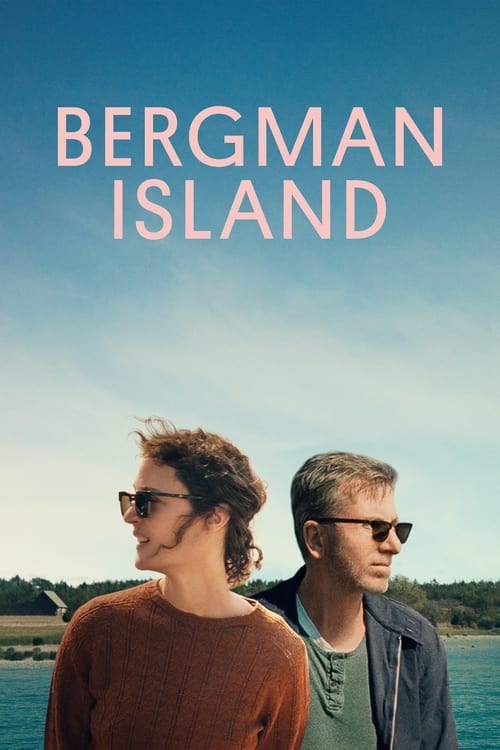
Bergman Island
2021 · Mia Hansen-Løve
For a slow, warm evening when you want something gentle that still gives you plenty to turn over afterward — a thinking-person's summer film, comfort on the surface with a quiet ache underneath.
What it's about
A filmmaking couple — she quieter and still finding her footing, he established and comfortable with his audience — spend a summer on Fårö, the remote Swedish island where Ingmar Bergman lived and worked, each trying to write a screenplay. As Chris drifts through the island's windswept landscape and its cottage industry of Bergman tours and archives, the story she's writing begins to unfold on screen alongside her own: two former lovers reunited at a wedding on that same island. The film moves between the couple's summer and the fiction growing out of it, until the two start to shimmer into each other.
The experience
Unhurried, sunlit, and quietly loaded — it feels like a vacation with an undertow. The tension is all beneath the surface: a marriage measured in small silences, a story used to say what can't be said aloud. It sneaks up on you and lingers.
Performances
Vicky Krieps carries the film with a watchful, understated restlessness, playing off Tim Roth's easy, slightly maddening assurance; Mia Wasikowska brings raw, open-hearted longing to the story-within-the-story.
The craft
Mia Hansen-Løve directs with a feather-light touch — long summer days, natural light, the Baltic landscape doing half the emotional work — and builds an elegant nested structure that never announces itself as clever. The film-within-a-film is handled so casually that when the levels blur, it feels like weather changing rather than a trick.
Why it matters
Hansen-Løve's first English-language film and her first in Cannes competition, it marked her arrival to a wider international audience and stands as one of the defining recent films about women making art inside relationships with more celebrated men.
Snapshot
An English-German filmmaking couple, Chris (Vicky Krieps) and Tony (Tim Roth), take a summer residency on Fårö — the Baltic island where Ingmar Bergman lived and shot much of his late work — to write their next screenplays. Tony, the more established of the two, moves easily through the island's Bergman economy: the tours, the Q&As, the archive. Chris drifts, resists, and eventually reads her unfinished script aloud to him; the film then simply becomes that script, following Amy (Mia Wasikowska) and Joseph (Anders Danielsen Lie), former lovers reunited on the same island for a wedding. By the end the two levels have quietly stopped being separable.
The film is Mia Hansen-Løve's seventh feature and her first in English, her first shot outside her usual French milieu, and her first selected for the Cannes Competition (July 2021, the pandemic-delayed edition), where it took no prize. Its interest is less in the mystery of "what is real" than in a specific and unfashionable question: what does it cost a woman to want the kind of artistic life that Bergman was permitted to have, and what is the appropriate posture toward a shrine? Hansen-Løve's answer is neither reverence nor demolition. It is a sunlit, mobile, secular film made on the exact locations of the most punishing chamber cinema in the European canon — an aesthetic argument conducted entirely in tone.
Industry & production
Bergman Island is a European co-production of the standard art-cinema type, assembled across several territories to finance an English-language film with no domestic market of its own. It was produced by Charles Gillibert's CG Cinéma, Hansen-Løve's producer since Eden (2014), with partners in Sweden, Germany and Belgium — including Plattform Produktion, the Gothenburg company associated with Ruben Östlund — and support from French television and regional funds of the kind that underwrite most auteur production in France. IFC Films handled the United States release in October 2021 following a Cannes premiere.
Two production facts shape the finished film more than any financing structure. The first is that it was shot on Fårö itself, in and around Bergman's actual properties — the house at Hammars, the private screening room, the church and churchyard where he is buried, the raukar (limestone sea stacks) at Langhammars — under the auspices of the residency culture that has grown up there since Bergman's death in 2007. Hansen-Løve had been to the island herself, including during the annual Bergman Week, and wrote from inside the situation the film depicts. The second is that production was interrupted and reassembled: the shoot was split across two summers in order to hold the Baltic light, and the cast changed in the interval. Greta Gerwig was widely reported as the original Chris and departed the project; Vicky Krieps replaced her, and Tim Roth came in opposite. The delay is legible in the finished object, since the frame story and the embedded story were photographed a year apart — a division that, by accident, hardens the seam the film then spends its second half dissolving.
Technology
Hansen-Løve has worked photochemically throughout her career, and Bergman Island was shot on film by Denis Lenoir rather than captured digitally — a choice that matters here beyond texture, since the film is set among people who watch 35mm prints in a private cinema and argue about a body of work that exists as celluloid. The palette is high-summer and daylight-dependent: the Baltic in July gives long, low, extended golden hours and very little true darkness, and the production organized itself around that rather than around lighting units. Interiors are largely available-light or lightly supplemented, with practicals and windows doing the work.
The relevant technological point is negative. Almost every apparatus that defines Bergman's Fårö films — the controlled black-and-white contrast of Sven Nykvist, the sculpted close-up isolated against neutral ground, the studio-built interiors of Persona — is deliberately unavailable to this film. Hansen-Løve shoots the same rooms in color, with sun in them, in a register closer to documentary observation than to expressive lighting. The house that produced Scenes from a Marriage is here just a rental with a bed in it, and the film photographs it accordingly.
Technique
Cinematography
Lenoir — a cinematographer with a long career in French cinema including work for Olivier Assayas, and Hansen-Løve's collaborator since Eden — shoots in her established idiom: fluid, unshowy camera movement, medium and medium-long framings, walking scenes covered in traveling shots rather than in shot/reverse-shot, and a general refusal of the analytic close-up at moments of emotional pressure. The camera tends to accompany rather than interrogate. Landscape is given generous, unhurried wide shots — the sea stacks, the sheep pastures, the ferry crossings — but never treated as sublime; it is a place where people ride bicycles and get sunburned.
The most pointed cinematographic decision is the near-total absence of Bergmanian visual rhetoric on Bergmanian ground. Where Bergman would isolate a face against blackness, Hansen-Løve and Lenoir keep the face in its environment, in daylight, at conversational distance. The film's formal politeness toward its characters is its argument.
Editing
Marion Monnier, Hansen-Løve's editor across most of her filmography (and an editor for Assayas, including Clouds of Sils Maria), builds the film out of ellipsis. Scenes begin after their beginnings and end before their ends; days pass without markers; a large amount of narrative time is elided in cuts that feel casual rather than emphatic. This is the "novelistic" cutting Hansen-Løve has practiced since Father of My Children — chronicle rather than dramatic escalation.
The film's central formal event is an edit: Chris narrates her screenplay to Tony, and the film cuts to Amy stepping off the ferry. What is striking is how little the transition is dressed. There is no dissolve, no stylistic shift, no change of stock or grade to mark the fiction as fiction. Consequently, when the levels later begin to interpenetrate — when figures from one stratum appear in the other and the film declines to explain it — the audience has no formal handrail to grab. The ambiguity is produced by an editing decision taken twenty minutes earlier.
Mise-en-scène / staging
Real locations do most of the work: the actual Bergman house, the actual "Bergman Safari" minibus, the actual Bergman Center exhibition, the actual churchyard. Hansen-Løve stages her characters as tourists inside a heritage site, and much of the film's comedy comes from the friction between institutional Bergman (guides, merchandise, the reverent audience at Tony's Q&A) and private need. Costume is minimal and functional — Chris in loose summer clothes, Amy in the white dress that gives the embedded screenplay its title. Blocking favours groups in motion: bikes, walks, the crossing to Langhammars, a wedding party.
Sound
There is no original score, which is Hansen-Løve's standing practice: she uses pre-existing music diegetically or near-diegetically, and lets ambience carry the rest. Here that ambience is specific and constant — wind across open ground, gravel, gulls, the Baltic. The soundtrack's best-known cue is ABBA's "The Winner Takes It All," deployed in the embedded story with a mixture of sincerity and irony that is characteristic of the film's whole method: a Swedish pop song about a marriage ending, playing on Bergman's island, inside a fiction written by a woman whose own relationship is dissolving. The soundscape is also multilingual — English, Swedish, French and German circulate without subtitled ceremony, marking the characters as professionals of a transnational film culture.
Performance
Krieps plays Chris with a productive opacity: watchful, evasive, frequently withholding her own reactions from Tony and from us. Roth's Tony is the film's quiet coup — not a monster, not a portrait of male tyranny, but a genially self-enclosed professional whose ease in the world is itself the problem. Wasikowska gives Amy a raw, undefended quality that contrasts with Krieps's guardedness, and Danielsen Lie — who appeared at the same Cannes in Joachim Trier's The Worst Person in the World — brings his particular gift for men who are affectionate and unavailable at once. The register throughout is low-affect naturalism, the exact opposite of the psychological extremity the location is famous for.
Narrative & dramatic mode
The film operates by mise en abyme: a fiction inside a fiction, with the outer level authored by a character in it. But Hansen-Løve is not making a puzzle film. There is no key, no reveal, no moment at which the architecture snaps into place. The embedded story is not a coded confession to be decrypted, and the film's late permeability between levels — a character from the script appearing in the frame, a daughter arriving into the wrong stratum — is offered as an emotional condition rather than a twist.
Dramatically the film is anti-climactic on principle. The confrontation scene that a conventional version would build toward never arrives; Chris and Tony do not have the fight. Instead the film accumulates: conversations, drives, readings, a fantasy of escape with a Swedish film student, a wedding. What replaces catharsis is the act of writing itself, presented as the thing that both metabolizes the marriage and consumes it.
Genre & cycle
It sits at the intersection of three lines. First, the film-about-filmmaking, from Day for Night through Assayas's Irma Vep and Clouds of Sils Maria — the latter an unavoidable comparison, another film about a woman in a landscape retreat rehearsing a text that begins to eat her life. Second, the cinephile-pilgrimage film, in which characters travel to a site of cinematic memory and find it stubbornly ordinary. Third, the couple-abroad drama descending from Rossellini's Journey to Italy, where landscape and tourism become the solvent in which a marriage's real condition becomes visible.
Its nearest living cousin is Hong Sang-soo, whose films routinely feature filmmakers on retreat, doubled or nested episodes, and unmarked slippages between levels. Hansen-Løve's version is warmer and less structurally severe, but the family resemblance is real.
Authorship & method
Hansen-Løve came to directing from criticism — she wrote for Cahiers du cinéma in the early 2000s — and from acting in Olivier Assayas's films as a teenager. Her method has been consistent since All Is Forgiven (2007): autobiographically sourced material handled without confessional heat, chronicle structure, ellipsis, non-professional temporal rhythm, and endings that resolve nothing but move on. Father of My Children (2009) fictionalized the death of producer Humbert Balsan; Eden (2014) drew on her brother's career in French house music; Things to Come (2016), which won her the Silver Bear for Best Director at Berlin, drew on her parents.
Bergman Island is the most exposed instance of the method, since Hansen-Løve's long relationship with Assayas — an older, more established filmmaker, with a child in common — maps onto Chris and Tony closely enough that no critic failed to notice. Hansen-Løve has acknowledged the autobiographical ground in interviews while resisting one-to-one reading, and the film's structure defends that position formally: it makes the act of transposing life into fiction its actual subject, so that any attempt to read backward through it to a biographical original simply repeats what Chris is doing on screen.
Her core collaborators are stable and consequential. Lenoir supplies the daylight-realist photography; Monnier supplies the elliptical cutting that constitutes the house style more than any single image does. There is no composer, and the absence is a position, not an economy: Hansen-Løve consistently gives musical authority to songs the characters could plausibly be hearing.
Movement / national cinema
Institutionally this is French auteur cinema in its post-New Wave, Cahiers-descended, state-and-television-supported form: a director-writer with final control, a producer who carries her across features, an aesthetic of restraint inherited from Rohmer, Pialat and Assayas. Culturally it is something less classifiable — an English-language European art film shot in Sweden by a French director with a Luxembourgish-German lead, a British lead, an Australian lead and a Norwegian lead, financed across four countries. That configuration is itself a portrait of 2020s European production, in which the "national" element survives mainly in the funding paperwork.
Against the Swedish tradition it invokes, the film is a visitor and says so. It does not attempt Bergman's idiom; it films the infrastructure that idiom has become.
Era / period
Released in 2021 into a film culture actively renegotiating its relationship with the great male auteur. Bergman's centenary in 2018 had already produced a wave of reappraisal, and 2021 also brought Hagai Levi's HBO remake of Scenes from a Marriage — the Bergman work most directly haunting Hansen-Løve's film. The post-#MeToo discourse about separating art from artist runs through Bergman Island explicitly: characters discuss Bergman's nine children by six women and his conspicuous absence as a father, and Chris presses the obvious asymmetry — that a woman who arranged her life that way would not be forgiven, and probably would not have been able to arrange it at all.
Hansen-Løve declines the two available conclusions. The film neither cancels Bergman nor absolves him. It observes that the conditions of his greatness were subsidized by other people, that those conditions are gendered, and that the work remains — and then goes back to the question of whether Chris can finish her script.
Themes
The dominant theme is the extraction rate of art: what making it takes from the people around the maker, and who has historically been permitted to pay that price with other people's lives. Adjacent to it runs a theme of inheritance and pilgrimage — what it means to visit the physical site of an artistic authority you did not choose and cannot quite refuse. Third, the film is about asymmetry inside a couple, where the imbalance is not cruelty but reputation, fluency, and who is expected to be interruptible.
Underneath these is a subtler concern that recurs across Hansen-Løve's filmography: fiction as the technology by which experience becomes survivable. Chris does not resolve her marriage; she writes a story in which two people fail to be together on this same island, and the writing is the resolution. The film's final dissolution of levels is best read not as a supernatural or metafictional gag but as a description of what happens to a writer whose material is her own life.
Reception, canon & influence
Critical reception. Reviews from Cannes 2021 onward were broadly positive, with particular praise for Krieps and for the film's lightness of touch on ground that invites solemnity. The recurring reservation — voiced sympathetically as often as not — was that the film's grace makes it feel slight, that its refusal of confrontation reads to some viewers as evasion, and that the embedded romance is more conventional than the frame that produces it. It won nothing at Cannes and was not a significant commercial performer; the record here is genuinely modest, and it would be misleading to inflate it.
Influences on the film (backward). Bergman first and inescapably: Through a Glass Darkly (1961), the first of the Fårö films; Persona (1966); Hour of the Wolf and Shame (1968); The Passion of Anna (1969); the Fårö Document films (1970, 1979); and above all Scenes from a Marriage (1973), whose bed the characters sleep in and whose reputation for producing divorces the film jokes about. (The title also echoes Marie Nyreröd's Swedish documentary series on Bergman released internationally as Bergman Island in 2006 — a coincidence that positions Hansen-Løve's film as a fiction sharing a name with the documentary record.) Beyond Bergman: Rossellini's Journey to Italy for the marriage-in-a-landscape structure; Assayas's Clouds of Sils Maria for the retreat, the text-within-the-text and the erosion of the boundary; Truffaut and Fellini for the filmmaking-about-filmmaking tradition; and Hong Sang-soo for the nested, doubled, undeclared slippage.
Legacy (forward). The film is recent enough that claims of influence should be made cautiously. What can be said is that it belongs to — and helped articulate — a 2020s current of European autofiction cinema in which women directors work openly from their own lives without adopting confessional form: Hansen-Løve's own One Fine Morning (2022), and adjacent work by Rebecca Zlotowski, Joachim Trier and Charlotte Wells, all of which share an interest in memory, holiday time and unstable narrative levels. It also contributed to the reframing of Vicky Krieps as a lead capable of carrying interiority without exposition, a persona consolidated the following year in Corsage. Whether it enters the canon as a major film or as a minor, unusually intelligent one remains an open question; its clearest durable contribution is a method — approaching a monumental predecessor neither as disciple nor prosecutor, but as a working colleague with her own deadline.
A Deleuzian reading
The bed is the joke, and the joke is the method.
The full Deleuzian reading of Bergman Island →
Reception
Premiered in competition at Cannes 2021 to warm if unspectacular notices and left without prizes, but it's aged into one of the quiet cinephile favorites of the decade — the cozy 'movie about making movies' people keep returning to and putting on best-of-2021 lists.
How Bergman Island was received, from release to now →
How to watch Bergman Island: what to notice on a first viewing
- Watch how far the camera stays from faces during tense moments. Where Bergman would isolate a face against blackness on this same island, Lenoir keeps faces in daylight, in their surroundings, at conversational distance. The camera's politeness toward its characters is the film's whole argument about how to look at people.
- Watch the real Bergman house, tour bus, and gift shop. Hansen-Løve shoots her characters as tourists inside an actual heritage site, guided tours and merchandise and all, on Bergman's real properties. The monument stays ordinary furniture the whole time, which is exactly the film's point about reverence.
- Listen for how the music always comes from somewhere inside the scene. There is no original score. Hansen-Løve uses pre-existing songs the characters could plausibly be hearing, including ABBA's 'The Winner Takes It All.' Without a score telling you how to feel, you are left reading the scene the way the characters have to.
- Watch Chris hold back her reactions from Tony throughout the film. Krieps plays Chris as watchful and withholding, while Roth's Tony stays genially at ease, fluent wherever he goes. The imbalance between them is visible in how much each one lets you see, long before anything is said.
- Watch the couple move mostly by bike, ferry, and open road. The film keeps its characters in motion across the island rather than settled into confrontation, wide unhurried shots of pastures, sea stacks, and crossings. The trip itself becomes the shape of the film instead of a series of scenes building to a fight.
The whole guide to watching Bergman Island, with the keys for a rewatch →
Influences: the films it descends from and the films it influenced
- Through a Glass Darkly (1961) — Established the Fårö grammar Hansen-Løve shoots inside — Nykvist's flat northern daylight on bare stone and grass, a four-hander confined to one summer house, no scored underscoring — so that Bergman Island's own location work reads as re-photographing an existing set.
- Persona (1966) — Supplies the device of two women whose identities and narrative levels bleed without a marked transition; Hansen-Løve borrows the undeclared slippage but strips the modernist rupture, letting Chris walk out of her life and into Amy's story on a continuous cut.
- Hour of the Wolf (1968) — The template for the artist's island as haunted workspace — a blocked creator's sketchbook and insomnia staged in the same Hammars landscape now sold as a Bergman Safari, which Hansen-Løve films as literal heritage-site tourism.
- Scenes from a Marriage (1973) — Its two-hander method — long unhurried takes of a couple talking in domestic rooms, camera withholding the reaction close-up — is both cited as prop (the characters sleep in its bed) and structurally refused, since Chris and Tony never get the confrontation scene the form promises.
- Journey to Italy (1954) — Invented the marriage-in-a-landscape structure Hansen-Løve runs: a couple's estrangement measured not by dialogue but by their separate itineraries through monuments and ruins, shot on real locations with the tourist visit as the scene unit.
- Contempt (1963) — The couple-abroad-on-a-production film — a screenwriter, a villa, a shoot in the background — with the lateral tracking shot through architecture doing the work of psychology; Hansen-Løve keeps the traveling coverage and drops the score's operatic commentary.
- 8½ (1963) — The founding mise-en-abyme of the blocked director whose unmade film is the film we're watching, including the retreat-as-production-limbo; Hansen-Løve inverts its gender and its register, replacing spectacle with a woman narrating her draft aloud at a kitchen table.
- Day for Night (1973) — Set the convention of embedding the fictional film's footage inside the making-of frame with no stylistic marker separating the two, which Bergman Island escalates by never returning us cleanly from Amy's story to Chris's.
- The Green Ray (1986) — The holiday-time chronicle built from small undramatic scenes, natural light, no non-diegetic score and performances pitched below theatrical affect — the exact tonal calibration Hansen-Løve uses to keep a week on Fårö from becoming a crisis narrative.
- In Another Country (2012) — A screenwriter at a seaside resort drafts variant stories that we watch as though they were the film's present tense, with zooms and repeated locations as the only markers — the undeclared nesting logic Bergman Island adopts and then refuses to unwind.
- Clouds of Sils Maria (2014) — The immediate model for the retreat structure: a text being worked on inside a mountain house, rehearsed dialogue that stops being distinguishable from lived dialogue, and a boundary between the two women that erodes through editing rather than announcement.
- Things to Come (2016) — Consolidated the house style Bergman Island runs on — Denis Lenoir's available-light 35mm, Marion Monnier's elliptical cutting across weeks with no dissolve or title, source-only music — applied to autobiographical material handled without confessional heat.
- One Fine Morning (2022) — Takes the same Lenoir/Monnier apparatus straight from Fårö to Paris: elliptical chronicle of a woman's parallel obligations, needle-drops and ambient sound instead of score, and an ending that resolves nothing but keeps walking.
- Aftersun (2022) — Extends the unstable-narrative-level holiday film: a remembered vacation shot in unglamorous daylight, where the levels of memory, video footage and present tense are never verbally announced and must be inferred from cutting.
- Other People's Children (2022) — Works the same French autofiction register — a woman's creative and reproductive time filmed in observational medium shots, low-affect performance, source music only — and shares the refusal to convert a woman's private cost into a dramatic climax.
- The Souvenir Part II (2021) — The other 2021 film that makes a woman director's reconstruction of her own past into its literal plot, shooting the film-within-the-film with the same undramatized wide staging and refused close-up as the frame narrative.
- The Worst Person in the World (2021) — Shares the chronicle method of building a life from discrete elided episodes with the transitions and turning points cut out, and a lead performance that carries interiority through behavior rather than expository dialogue.
- Corsage (2022) — Consolidates the Krieps technique Bergman Island exposed: sustaining a character's withheld interiority across long takes with almost no explanatory dialogue, the face doing the narration the script declines to supply.
- Dogville (2003) — Hansen-Løve's nested story-within-story self-reflexivity about authorship and constraint extends the meta-narrative distanciation of a director foregrounding the artifice of his own moral fiction.
- Sentimental Value (2025) — A film-within-a-film about filmmakers whose fiction and reality interpenetrate, in the same novelistic-realist register and explicitly in dialogue with the Bergman chamber tradition both films descend from.
Similar films
- Through a Glass Darkly (1961) — influence & lineage
- The Worst Person in the World (2021) — influence & lineage
- Aftersun (2022) — influence & lineage
- Hour of the Wolf (1968) — influence & lineage
- Summer with Monika (1953) — shared sensibility
- White Mangrove (2020) — shared sensibility
- Dreams (2024) — shared sensibility
- Touch (2024) — shared sensibility