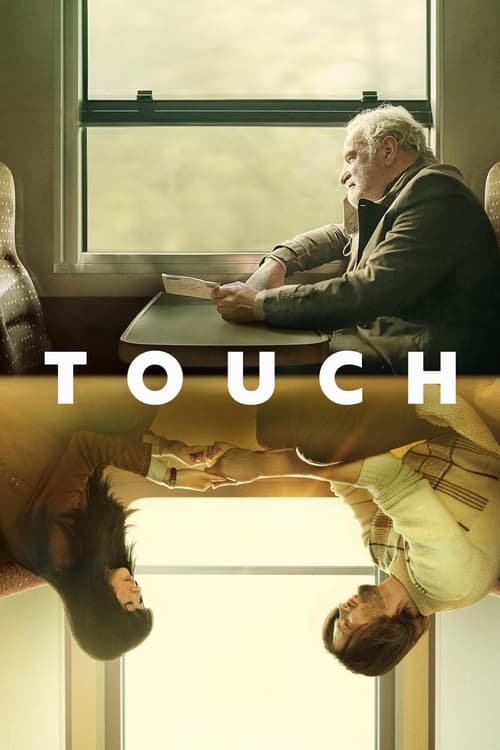
Touch
2024 · Baltasar Kormákur
For a reflective evening when you want to be moved rather than thrilled — the film equivalent of an old letter you finally open. Bring someone you love, or a memory of someone.
What it's about
As the pandemic shuts the world down, Kristófer — an elderly Icelandic widower who has just learned his memory is beginning to fail — decides he can't wait any longer to answer the question that has shadowed his life: what happened to Miko, the Japanese woman he loved in London fifty years ago, who vanished without a trace from the restaurant where they both worked. The film moves between his present-day search and the late-1960s London romance he's trying to reclaim before it fades.
The experience
Unhurried, wistful, and quietly aching — a slow-burn mystery wrapped in a love story, with the ticking clocks of memory and mortality giving the gentleness real urgency. It builds to a payoff that earns the patience.
The craft
Baltasar Kormákur, better known for survival thrillers, works in a much softer register here, adapting Ólafur Jóhann Ólafsson's novel with the author himself. The braided structure — pandemic-era present against lushly recreated 1960s London — is handled with patience, and the period sequences have a warm, romantic glow that carries the film's sense of a life interrupted.
Why it matters
A notable change of pace for Iceland's most internationally established director, and part of a wave of films reckoning with the long, quiet aftermath of Hiroshima through personal rather than historical storytelling.
Snapshot
Touch is a decades-spanning romance built as a memory quest. Kristófer, an elderly Icelandic widower newly diagnosed with early-stage dementia and moving through the opening months of the COVID-19 pandemic, sets out to find Miko, the Japanese woman he loved and lost in London some fifty years earlier, when she vanished from the restaurant where they both worked. Adapted by Baltasar Kormákur and novelist Ólafur Jóhann Ólafsson from Ólafsson's 2022 novel Snerting, the film braids a present-tense race against a closing window of both memory and mortality with a lushly recalled late-1960s London first love. Beneath the romance sits a historical wound: Miko is a hibakusha, a survivor of the Hiroshima atomic bombing, and the stigma carried by survivors and their families is the hidden engine of her disappearance. Running 121 minutes across English, Japanese, and Icelandic, and released by Focus Features in the United States and Universal internationally, Touch is a chamber-scaled, restrained work from a director better known abroad for muscular survival cinema. It became Iceland's official submission for the Best International Feature Oscar and reached the fifteen-title shortlist.
Industry & production
Touch is a co-production between Kormákur's own RVK Studios in Reykjavík and the UK's Good Chaos, with Kormákur, Agnes Johansen, and Mike Goodridge credited as producers. The distribution architecture is telling: Focus Features, Universal's specialty label, handled the United States, and Universal Pictures took international territories. That places a modestly budgeted, trilingual Icelandic-led drama inside a major-studio specialty pipeline — a route Kormákur has cultivated through his prior studio work (Everest, Adrift, Beast) and the reputational capital of RVK Studios, which he built into Iceland's flagship production house and the base for the international hit series Trapped/Ófærð.
Principal photography began on 9 October 2022, with London documented as a principal location; the narrative also ranges to Iceland and Japan, though the public production record foregrounds the London shoot and is thin on granular detail about the Japanese and Icelandic units. The film opened first in Iceland on 29 May 2024 and rolled out in a US limited release on 12 July 2024, a platform pattern consistent with awards-adjacent specialty titles. Precise budget and box-office figures are not part of the reliably established record and are not asserted here.
Technology
The public technical record for Touch is comparatively sparse, and specific camera and lens packages are not documented in the sources consulted; that gap is worth stating plainly rather than filling with conjecture. What can be said is contextual. The film was produced and finished within a contemporary digital-capture and digital-intermediate workflow standard for a 2022–2024 specialty feature, and its two-timeline structure places a real demand on the color pipeline: the present-day pandemic passages and the late-1960s London flashbacks must be legible as distinct temporal registers through grade, texture, and palette rather than through overt optical gimmickry. The trilingual sound design likewise depends on clean multilingual production recording and post to let English, Japanese, and Icelandic coexist without the flattening that dubbing would impose. Any more specific technological claims would be invention.
Technique
Cinematography
Photographed by Bergsteinn Björgúlfsson — a long-standing Kormákur collaborator whose credits with the director include The Deep and the Trapped series — the film's images favor warmth and intimacy over spectacle. The dominant visual problem is temporal: distinguishing the remembered London of fifty years ago from the grayer, more constricted present without resorting to cliché. Reviews consistently characterize the flashback material as glowing and sensuous and the present-day frame as cooler and more contained, a contrast carried through lighting and color rather than aspect-ratio tricks. Björgúlfsson's compositions lean on the tactile — the title, Touch/Snerting, is enacted in how the camera attends to hands, food, skin, and the small physical rituals of the restaurant kitchen where the lovers meet.
Editing
Cut by Sigurður Eyþórsson, the film's editorial task is the cross-cutting logic of a memory film: the elderly Kristófer's search continually summons, and is answered by, the younger man's romance. The structure is associative as much as chronological, with the present-tense journey triggering the past. Critics generally found the film measured and unhurried — a deliberate, contemplative rhythm suited to a story about recollection slipping away — rather than briskly plotted. The editing's success is bound up with the film's restraint: it withholds the full truth of Miko's disappearance until late, pacing revelation against Kristófer's failing memory.
Mise-en-scène / staging
Period recreation of a late-1960s London Japanese restaurant anchors the flashback world — a self-contained milieu of kitchen, dining room, and the cramped rooms above it, where much of the romance is staged in close quarters. The staging is chamber-like, built on two-handers and small groupings rather than crowds. The present-day pandemic setting supplies its own mise-en-scène of masks, distance, and emptied public space, quietly rhyming the isolation of lockdown with the older isolation the film ultimately excavates in Hiroshima. Domestic and service spaces — tables, counters, thresholds — do the dramatic work.
Sound
Högni Egilsson's score underpins the melancholy register, and the film's trilingual sound world is itself a formal choice: language barriers between the young Icelandic Kristófer and the Japanese-speaking milieu he enters are part of the romance's texture, and the film lets untranslated feeling carry weight. The soundscape moves between the enclosed warmth of the restaurant and the hushed, depopulated ambience of pandemic streets.
Performance
The performances are the film's most praised dimension and turn on a doubling: Kristófer is played in old age by the veteran Icelandic actor-musician Egill Ólafsson and in youth by Palmi Kormákur, the director's son, while Miko is played young by Kōki (Mitsuki Kimura) and, in the framing present, by Yoko Narahashi. Masahiro Motoki appears as Takahashi-san, the restaurant's proprietor and Miko's father. The acting is pitched toward understatement; Ólafsson in particular anchors the film in weathered restraint, and the young leads carry the tentative, cross-cultural courtship. This ensemble delicacy is central to why critics described the film as absorbing without being sentimental.
Narrative & dramatic mode
Touch operates in the mode of the memory-quest melodrama: a dual-timeline structure in which a present-day journey retrieves and reconstructs a buried past. The framing device — an old man racing a dementia diagnosis and a pandemic to solve the central mystery of his life — supplies both urgency and pathos, and doubles as a meditation on how memory itself authors the stories we live by. Dramatically, the film is a slow-burn revelation: the question of why Miko disappeared is withheld and gradually reframed, so that what begins as a romance of lost love resolves into a historical reckoning with Hiroshima and its lifelong aftershocks. The mode is elegiac and restrained rather than sweeping; its emotional payoff depends on accumulation and delayed disclosure rather than incident.
Genre & cycle
The film sits squarely in the tradition of the epic, time-crossing romantic drama — the lovers-parted-by-history strain of the genre — while belonging to two more specific contemporary cycles. First, it is an entry in the small but distinct wave of pandemic-set narratives that use COVID-19 lockdown less as topical backdrop than as a metaphor for isolation and finitude; here the pandemic frame motivates the whole quest. Second, it participates in the enduring cycle of atomic-memory cinema — films that reckon with Hiroshima and Nagasaki and the experience of the hibakusha — a lineage that reaches back to works such as Hiroshima mon amour and Japanese cinema's own atomic reckonings. Touch fuses these strands: an intercultural romance whose secret heart is nuclear trauma.
Authorship & method
Baltasar Kormákur is among the most internationally prominent Icelandic filmmakers, with a career that spans intimate national cinema (101 Reykjavík, Jar City/Mýrin, The Deep/Djúpið) and Hollywood genre work (Everest, Adrift, Beast), alongside the globally exported series Trapped. Within that body of work Touch reads as a return to a more personal, chamber scale after a run of survival spectacles — a pivot underscored by his casting of his son Palmi in a lead role and his co-authorship of the screenplay with the source novelist.
That collaboration is the defining authorial fact of the project. Ólafur Jóhann Ólafsson — an Icelandic novelist with a parallel career as a technology and media executive — wrote the 2022 novel Snerting and co-wrote the adaptation, giving the film unusually direct continuity between literary source and screen. The key craft collaborators are longtime members of Kormákur's Icelandic circle: cinematographer Bergsteinn Björgúlfsson and composer Högni Egilsson, with Sigurður Eyþórsson editing. The method, then, is one of a national-cinema author-producer marshalling a trusted home crew and his own studio (RVK) to mount an international, multilingual production under a major-studio specialty banner — a hybrid of auteur intimacy and industrial reach.
Movement / national cinema
Touch is best understood as a work of contemporary Icelandic cinema operating on a transnational stage. Icelandic film has punched above its demographic weight for decades, and Kormákur has been central to its international visibility, both as director and as the proprietor of RVK Studios. Yet the film is deliberately un-parochial: much of it unfolds in London and Japan, in English and Japanese as much as Icelandic, and its production and distribution are international. It thus exemplifies a mode of small-nation cinema that travels — rooted in Icelandic authorship and financing but structured as a cross-cultural, multi-territory production. Its selection as Iceland's Academy Award submission confirms its standing as a national-cinema flagship even as its story reaches well beyond Iceland's borders.
Era / period
The film is doubly period. Its present-tense frame is precisely dated to the early COVID-19 pandemic — an era-marker that is not incidental but structural, supplying the mortality-clock premise. Its flashback world reconstructs late-1960s London, with the mise-en-scène and milieu of a period Japanese restaurant and a young Icelander abroad in that moment. Behind both lies a third, unseen historical stratum: 1945 Hiroshima, which the film approaches as inherited trauma rather than as depicted spectacle. The interplay of these periods — pandemic present, swinging-era London, atomic past — is the film's temporal architecture.
Themes
The governing themes are memory and its loss, mortality, and the persistence of first love across a lifetime. The dementia diagnosis literalizes memory as something the protagonist must act on before it disappears, making the whole film an argument about recollection as an urgent, fragile act of meaning-making. Braided through the romance are themes of cultural difference and belonging — an Icelandic outsider inside a Japanese diasporic world — and, most weightily, historical trauma and stigma: Miko's status as a hibakusha and the social shame borne by atomic-bomb survivors and their descendants, which the film presents as the true cause of a private heartbreak. The pandemic frame adds a theme of isolation and the reckoning that enforced solitude can compel. Touch itself — physical contact, the sensory, the tactile intimacies of cooking and of hands — is the recurring motif that gives the film and its source novel their title.
Reception, canon & influence
Critical reception was warm. On Rotten Tomatoes the film registered a strongly positive critics' score (reported at 92% across 63 reviews, with an average near 7.6/10), the site's consensus describing it as a "wistful reverie on life itself"; Metacritic reported a "generally favorable" 74/100 across 21 critics. Trade reviews from Variety, The Hollywood Reporter, Deadline, and Screen Daily converged on a shared reading: a familiar lost-love premise elevated by restraint, strong performances, and the late-breaking historical dimension. Where reviews demurred, it was on the score of familiarity — the observation that the film's structure and beats are well-worn — rather than on execution. On the awards circuit it won the Audience Award at the Tromsø International Film Festival in January 2025 and was chosen as Iceland's official Oscar submission for Best International Feature at the 97th Academy Awards, advancing to the fifteen-film shortlist but not securing a nomination. (Specific individual critic quotations beyond the aggregated consensus are not reproduced here, as they are not established in the sources at hand.)
Influences on the film are twofold and clear. It descends, first, from the great tradition of cross-cultural atomic-memory cinema — the lineage in which Hiroshima's aftermath is refracted through intimate romance — and, second, from the memory-quest melodrama of lovers parted by history and reunited, or sought, across decades. Its most immediate source is singular and literary: Ólafur Jóhann Ólafsson's novel Snerting, co-adapted by its author, which makes the film an unusually faithful transposition rather than a loose reworking.
Its forward legacy is, as of this writing, still forming and should not be overstated. As a recent release, Touch has not yet accrued a measurable body of films or filmmakers shaped by it. Its more durable significance is likely to lie in its consolidation of a pattern rather than the founding of one: it is a prominent example of small-nation, author-led cinema mounting a multilingual, multi-territory production through a major studio's specialty arm, and a notable instance of the emerging cycle of pandemic-set drama that treats COVID-era isolation as a frame for reckoning rather than as topical decoration. Whether it becomes a reference point for that cycle will depend on how the era's cinema is canonized in the years ahead.
Sources: Wikipedia: Touch (2024 film)) · Variety review · The Hollywood Reporter review · Deadline review · Screen Daily review
Reception
A quiet climb rather than a splashy debut: it opened small in summer 2024, became the year's biggest homegrown hit in Iceland, and rode word-of-mouth all the way to the Oscars' international-feature shortlist.
How Touch was received, from release to now →
Influences: the films it descends from and the films it influenced
- Hiroshima mon amour (1959) — Its associative crosscutting welds tactile intimacy to catastrophe — intercutting a lover's caressed skin with documentary atomic-aftermath imagery — the exact device by which Touch refracts Hiroshima through a private romance.
- Last Year at Marienbad (1961) — Elliptical editing that dissolves the boundary between remembered and present event, staging memory as an unstable, re-entered space — the grammar behind Touch's slow-burn associative retrieval.
- Rhapsody in August (1991) — Filters the Nagasaki bombing through an intergenerational, cross-cultural family reckoning rather than spectacle, the atomic-memory-through-intimacy mode Touch inherits.
- Black Rain (1989) — Uses monochrome flashback to surface Hiroshima survivors' latent trauma decades after the blast, treating historical catastrophe as a delayed detonation revealed by slow burn.
- The English Patient (1996) — Dual-timeline construction that cross-cuts a wartime love affair against a dying man's present recollection, using mortality as the frame that gates memory retrieval — Touch's structural architecture.
- In the Mood for Love (2000) — Choreographs near-touch and withheld contact — bodies that almost but never meet — as the engine of longing, the direct source of Touch's tactility motif and restraint.
- Wild Strawberries (1957) — An aging man's literal journey becomes passage into his own past, staging present self and remembered self within a single spatial frame — the elderly memory-quest template.
- Cinema Paradiso (1988) — The return-across-decades structure in which an older man revisits the site of a formative youthful love, using young/old dual-casting to bridge the two eras.
- The Notebook (2004) — Deploys the same dual-casting device — separate young and old actors for one pair of lovers — with a present-day framing narrator that meters out a late reveal, mirroring Touch's construction.
- Away from Her (2006) — Chamber-scale study of memory dissolving in old age, holding tactile restraint between long-married partners in the elegiac register Touch works within.
- Lost in Translation (2003) — Renders cross-cultural dislocation in Japan through mood, silence, and untranslated language rather than plot — the cross-cultural-belonging texture and multilingual estrangement Touch designs into its trilingual sound.
- Past Lives (2023) — Lovers parted by migration and reunited across decades, the drama held in restraint and near-touch with a present frame reflecting on the past — the contemporary memory-quest melodrama Touch shares.
- Drive My Car (2021) — Layers multilingual performance and sound design so grief is mediated across languages, in a slow, faithful literary adaptation — kin to Touch's trilingual design and author-co-adapted fidelity.
- Aftersun (2022) — Reconstructs a lost relationship through associative editing of fragmentary remembered images, letting gesture and tactility stand in for narrated memory.
- 2046 (2004) — A man's serial return to a single unrecoverable love across time renders memory as a room repeatedly revisited — the memory-quest as melancholy recurrence.
- Brooklyn (2015) — Builds an immigrant cross-cultural romance on period-precise restraint and the ache of belonging split between two countries, the divided-belonging structure Touch also runs.
Similar films
- Drive My Car (2021) — influence & lineage
- Past Lives (2023) — influence & lineage
- My Sunshine (2024) — same viewing thread
- Remarkably Bright Creatures (2026) — same viewing thread
- The Son of a Thousand Men (2025) — same viewing thread
- Close Your Eyes (2023) — shared sensibility
- The Love That Remains (2025) — shared sensibility
- Crossing (2024) — shared sensibility
All the films related to Touch →
Watch it with: curated runs of related films
- The Quiet Thaw of Grief — A run of hushed, big-hearted films where a widow, a widower, or a withdrawn child is coaxed back toward life by one unlikely bond — watch them near each other when you want to be moved, not wrung out.