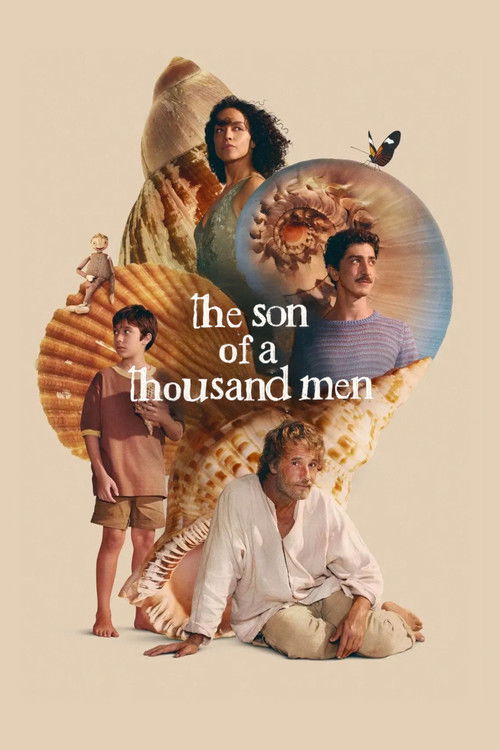
The Son of a Thousand Men
2025 · Daniel Rezende
For a gentle, contemplative evening when you want to feel less alone — comfort viewing with an ache in it, not a challenge. Reach for it when loud movies feel like too much.
What it's about
In a small fishing village, Crisóstomo, a solitary man around forty, carries the ache of the son he never had. When a strange, tender light draws him toward other lonely souls — each guarding secrets they've buried for years — an improvised family slowly begins to gather around him. It's a story about the family you choose, told at the scale of one modest coastline.
The experience
Slow, lyrical, and quietly moving, closer to a fable than a plot-driven drama. It sits with longing and lets warmth accumulate gradually, and it's likely to leave you soft-hearted rather than wrecked.
The craft
Daniel Rezende, an editor by training, favors patient rhythms and painterly coastal imagery, letting sea, light, and weathered faces do much of the storytelling. The literary source — Valter Hugo Mãe's novel — gives it a poetic, incantatory shape rather than a conventional three-act one.
Why it matters
It brings a beloved Portuguese-language novel about chosen family to the screen, part of a wave of Brazilian dramas reaching international audiences through streaming.
Snapshot
The Son of a Thousand Men (O Filho de Mil Homens) is a 2025 Brazilian drama directed by Daniel Rezende, adapted from the 2011 novel of the same title by the Portuguese writer Valter Hugo Mãe. Its premise is deceptively small: Crisóstomo, a fisherman of about forty, is consumed by the ache of childlessness — the felt absence of a son he has never had — and out of that longing an unlikely, improvised family gradually assembles itself around him. The film belongs to a lineage of lyrical, fable-inflected realism in which a modest coastal or village setting becomes the stage for a meditation on loneliness, belonging, and the family one chooses rather than inherits. The TMDB grounding synopsis foregrounds an "ethereal light" that connects the fisherman to others and to their buried secrets; this framing points to a more overtly magical-realist register than the novel's quiet lyricism strictly requires, and I flag the discrepancy rather than resolve it — the reader should treat the "light" motif as a promotional distillation until the finished film's imagery can be confirmed. What is firmly established is the source, the director, and the tradition; much of the granular production record for this recent title is thin, and I mark those gaps explicitly below rather than fill them with invention.
Industry & production
The film's most secure production fact is its authorship at two removes: a Brazilian filmmaker adapting a canonical work of contemporary Lusophone literature. Valter Hugo Mãe is among the most decorated Portuguese novelists of his generation, and O Filho de Mil Homens is one of his best-known books, prized for a prose voice that is incantatory, deliberately unpunctuated in places, and tender toward society's outcasts. Bringing that voice to the screen is an inherently literary undertaking, and the project sits within the broader, well-documented traffic between Brazilian and Portuguese cinema — shared language, overlapping festival circuits, and co-production frameworks that have long made adaptations of Portuguese fiction attractive to Brazilian producers, and vice versa.
Beyond this, I will not manufacture specifics. I cannot reliably confirm the production companies, the financing structure, the shooting locations, the budget, the distribution pathway (streaming versus theatrical), or festival premiere details, and inventing any of these would violate the standard this dossier holds itself to. Given Rezende's industry standing and the profile of the source material, a mid-budget prestige production with festival ambitions is the plausible shape of the thing — but "plausible" is not "documented," and I present it as inference, not fact. Where a major film's dossier would normally itemize backers and release strategy, here the honest entry is: the record available to me is genuinely sparse, and the reliable anchor is the pairing of a respected director with a respected novel.
Technology
I have no verified information about the specific camera systems, lenses, capture format, or post-production pipeline used on The Son of a Thousand Men, and I will not fabricate a technical spec sheet. What can be said responsibly is contextual. By the mid-2020s, Brazilian feature production of this scale had standardized on digital acquisition, typically large-format or Super-35 digital cinema cameras, with color and finishing handled in a digital-intermediate workflow. A literary, interior-driven drama of this kind rarely leans on visual-effects spectacle; if the "ethereal light" of the synopsis is realized as an on-screen phenomenon, it would most likely be achieved through practical lighting and restrained digital compositing rather than heavy CGI, in keeping with the intimate scale the material implies. These are informed expectations grounded in the technological norms of the moment and the genre, not claims about this production's actual toolchain.
Technique
Cinematography
Specific credits and shot-level description cannot be verified here, so this section reasons from the material and the director's sensibility rather than from confirmed footage. Mãe's novel is built on faces, thresholds, water, and the domestic interior — the fisherman's boat and the sea, the house that slowly fills with strangers who become kin. A faithful cinematographic treatment would favor patient framing, natural and source-motivated light, and a palette keyed to coast and hearth. The synopsis's emphasis on light suggests luminosity may function as a structuring visual idea — the difference between a solitary figure in flat, cool daylight and the warmth that arrives with company. Whether the film pursues that contrast is something the finished images would have to confirm; I offer it as the reading the source most naturally invites, not as a description of specific setups.
Editing
This is the one craft area where the director's own biography is genuinely illuminating, because Daniel Rezende came to directing from a distinguished career as a film editor. His editorial background is the most concrete lens available for anticipating the film's construction. Editors-turned-directors tend to think in terms of rhythm, ellipsis, and the emotional weight of a cut — knowing precisely how long to hold a face, when to withhold a reverse angle, how to let a scene breathe or clip it short. A story about the slow accretion of a chosen family is, structurally, an editing problem: it must render the passage of time and the gradual softening of solitary lives without lurching. One would expect Rezende to handle that accretion with control and unshowy precision. I cannot confirm who cut the film or whether Rezende participated in the edit, but his formation makes the editorial dimension the reasonable place to expect the film's greatest technical assurance.
Mise-en-scène / staging
The novel's drama is fundamentally spatial — a house that begins empty and fills, a boat that carries one man and later, figuratively, many. Staging that arc means choreographing bodies into a space: the single place-setting that becomes several, the room reorganized around new occupants, the physical vocabulary of people learning to live together. This is the terrain the material stakes out, and a faithful adaptation would make the household itself a character. Again, absent verified set descriptions I present this as the logic of the source rather than a report on the film's design.
Sound
I have no confirmed information about the film's sound design or music credits. Contextually, an intimate literary drama of this kind typically relies on a restrained, atmospheric soundscape — sea, wind, domestic quiet — with a score used sparingly to mark emotional turns rather than to underscore continuously. Mãe's prose has a distinct musicality, and any voiceover or narration drawn from the novel would carry significant sonic weight; whether the adaptation uses narration is not something I can verify.
Performance
Casting and performances cannot be responsibly detailed without confirmation, and I will not attribute the central role to any actor. What the material demands is clear enough: Crisóstomo is a role of interiority and restraint, a man whose defining trait is an unspoken want, surrounded by a gallery of outsiders — figures marked in the novel by difference, shame, or exclusion — who each require empathetic, unsentimental playing to avoid caricature. The ensemble nature of the chosen-family story means the film likely lives or dies on the calibration of that group dynamic rather than on a single star turn.
Narrative & dramatic mode
The dramatic mode is that of the lyrical fable grounded in social realism — a small human unit forming against a backdrop of loneliness and marginalization. The novel's engine is not plot in the conventional sense but accumulation: solitary people, each carrying a private wound, drawn into orbit around one another until they constitute a family that biology never provided. The narrative is elliptical and emotionally weighted rather than event-driven, closer to a parable than to a thriller, even as the synopsis's language about "long-buried secrets" hints the film may thread in stronger elements of revelation and suspense than the book's contemplative surface suggests. If so, the adaptation would be translating Mãe's inwardness into more externalized dramatic beats — a common and legitimate move in literary adaptation, and one worth watching for.
Genre & cycle
Nominally a drama, the film sits at the intersection of the literary adaptation, the magical-realist or fable tradition, and the "found family" narrative — a durable and cross-cultural cycle in which unrelated outsiders assemble a kinship of choice. Lusophone literature and cinema have a strong strain of this lyrical humanism, and Mãe's novel is a signal example. The synopsis's "ethereal light" would nudge the film toward the magical-realist end of that spectrum, where the ordinary and the numinous coexist without the narrative pausing to explain the marvel. Placed against the broader landscape of 2020s cinema, the chosen-family drama has been a persistent and internationally resonant mode, and this film joins that conversation from a specifically Brazilian-Portuguese vantage.
Authorship & method
The authorial center of gravity is Daniel Rezende. His trajectory is the essential context: he built an international reputation as one of Brazil's foremost film editors before moving into directing, work that placed him at the heart of the Brazilian cinema that broke through globally in the early 2000s. That editorial pedigree shapes reasonable expectations for his direction — an emphasis on rhythm, structural control, and the emotional precision of assembly. His move into feature directing marks him as a craftsman-turned-author whose method is likely rooted in construction and performance-shaping rather than in overt visual flamboyance.
The other decisive author here is Valter Hugo Mãe, whose novel supplies not just the plot but the sensibility — the tenderness toward the excluded, the fable logic, the incantatory voice. In a very real sense the film is a dialogue between an editor's structural intelligence and a novelist's lyrical one.
Regarding the key below-the-line collaborators the brief asks me to name — cinematographer, composer, editor, screenwriter — I do not have verified credits and will not invent names or attributions. The screenwriting credit in particular matters, since adapting Mãe's distinctive prose is a substantial authorial act, but I cannot responsibly assign it. This is a genuine and important gap in the available record.
Movement / national cinema
The film belongs to contemporary Brazilian cinema, and specifically to its tradition of internationally legible, literary-humanist filmmaking. Brazilian cinema's modern global standing was consolidated by a wave of acclaimed features around the turn of the millennium, and Rezende is a product and beneficiary of that ecosystem. At the same time, by drawing on a Portuguese novel the film reaches across the Lusophone world, participating in the long-standing cultural and industrial exchange between Brazilian and Portuguese cinema. It is best understood not as an avant-garde or movement statement but as mainstream art-house work within a confident national industry — cinema that travels on the strength of story, performance, and literary prestige.
Era / period
As a 2025 release, the film lands in a post-pandemic, streaming-shaped moment for Brazilian and global cinema, in which prestige literary adaptations remain a reliable vehicle for both festival visibility and platform acquisition. The chosen-family theme has particular resonance in this era's cultural conversation around kinship, care, and belonging beyond the biological unit. Without confirmed distribution details I cannot situate the film precisely within release patterns, but its type — the mid-scale literary drama — is characteristic of what national industries of this period produce to bridge domestic cultural ambition and international reach.
Themes
The governing theme is loneliness and its cure through chosen kinship. Crisóstomo's longing for a son is the specific form of a universal ache — the need to belong to someone — and the novel's insight is that family can be assembled from strangers, that love is a decision as much as an inheritance. Radiating from this are the film's likely secondary concerns: the dignity of the marginalized and the excluded, given that Mãe populates the story with figures society has cast off; shame and its dissolution, as isolated people learn to be seen; and the tension between biological and elective bonds. If the "ethereal light" and "long-buried secrets" of the synopsis are load-bearing, the film may also foreground hidden histories and the labor of revelation — the idea that intimacy requires the surfacing of what has been concealed. Taken together these themes place the film squarely in a humanist, redemptive tradition: not a story about damage, but about repair.
Reception, canon & influence
I do not have verified critical reception, awards, box-office figures, or audience data for The Son of a Thousand Men, and I will not fabricate reviews, quotations, or numbers. Any account of how the film was received must await the documented record.
What can be traced with confidence are its backward influences — the currents that flow into the film. The primary one is Valter Hugo Mãe's novel and, behind it, the tradition of lyrical, fable-like Lusophone fiction that dignifies the outcast. Cinematically, the film inherits the humanist realism of contemporary Brazilian cinema and the broader international lineage of the "found family" drama and magical realism, in which the marvelous is folded quietly into everyday life. Rezende's own formation in the editing room is itself a kind of influence, carrying the structural sensibility of the acclaimed Brazilian films he helped shape into his work as a director.
Its forward influence — what it may shape — cannot yet be assessed for a film this recent; legacy is a function of time the title has not had. The honest scholarly position is that the film's place in the canon is unwritten. What it demonstrably contributes now is another entry in the ongoing cinematic dialogue between Brazil and Portugal, and another test of whether one of Brazilian cinema's most accomplished editors can translate a beloved novel's interior music into the grammar of the screen. On that question, and on the reception that will answer it, the record remains open.
Reception
Released straight into Netflix's global top ranks in late 2025, it was instantly split down the middle: Brazilian press hailed it as one of the country's big screen events of the year, while skeptics filed it under handsome streaming melodrama — the reappraisal window hasn't even opened yet.
How The Son of a Thousand Men was received, from release to now →
Influences: the films it descends from and the films it influenced
- City of God (2002) — Rezende's own Oscar-nominated cut here forged the fragmentary, ellipsis-driven assembly — jumping across time and character in compressed bursts — that is the structural signature he now brings to directing.
- The Motorcycle Diaries (2004) — As editor, Rezende learned to shape an episodic, elliptical journey out of loosely connected encounters, letting performance and rhythm rather than plot mechanics carry the emotional throughline.
- The Tree of Life (2011) — Rezende was one of its editors, absorbing Malick's associative, non-linear cutting that renders memory and interiority as musical rhythm — precisely the 'interior music' his adaptation attempts to translate to screen.
- Blindness (2008) — Rezende edited this Lusophone literary adaptation (Saramago), training him to convert an author's incantatory prose voice into image-flow — the exact task Valter Hugo Mãe's fable demands of him as director.
- Central Station (1998) — Sets the Brazilian humanist template of chosen kinship forming between an unmoored adult and a child, using restrained realism to earn sentiment without melodrama.
- Like Water for Chocolate (1992) — Models the magical-realist grammar of folding the marvelous quietly into domestic household life, treating the supernatural as an unremarked extension of everyday feeling.
- Pan's Labyrinth (2006) — Braids fable logic into harsh material reality to dignify a marginalized child, letting the marvelous function as the psychic truth of the outcast rather than escapism.
- Tabu (2012) — Exemplifies the Portuguese lyrical mode of an incantatory storytelling voice governing structure, the Lusophone fable register the film inherits through Mãe's prose.
- Shoplifters (2018) — Builds a found family from society's discarded, structured around shame-and-revelation reversals and ensemble interiority staged within a household treated as its own character.
- Nobody Knows (2004) — Uses patient elliptical, observational editing to watch children assemble a self-sufficient kinship, eliding dramatic peaks to privilege accumulated small gestures.
- The Second Mother (2015) — A contemporary Brazilian drama of class marginalization and surrogate kinship staged almost entirely inside one home, where domestic space encodes the characters' social position.
- Aquarius (2016) — Extends the same contemporary-Brazilian move of making the household a living character — a repository of memory and identity — rather than mere setting.
- Beasts of the Southern Wild (2012) — Filters a marginalized community through a child's-eye fable where magical-realist imagery dignifies the outcast, matching the film's fable-logic tenderness toward the excluded.
- Cold War (2018) — A masterclass in ellipsis-rhythm editing, leaping across years in hard cuts so the gaps themselves carry the emotion — the same elliptical grammar central to Rezende's craft.
- Roma (2018) — Centers a marginalized domestic worker absorbed into a family, using the household-as-character and ensemble interiority to trace chosen kinship across class lines.
- Bingo: The King of the Mornings (2017) — Rezende's own editor-turned-director debut, establishing his authorial method of structural control and performance-shaping over visual flamboyance that he carries into this film.
Similar films
- Touch (2024) — same viewing thread
- Mars One (2022) — shared sensibility
- To the Left of the Father (2001) — shared sensibility
- The Currents (2025) — shared sensibility
- White Mangrove (2020) — shared sensibility
- The Mysterious Gaze of the Flamingo (2025) — shared sensibility
- The Metamorphosis of Birds (2021) — shared sensibility
- Limite (1931) — shared sensibility
All the films related to The Son of a Thousand Men →
Watch it with: curated runs of related films
- The Quiet Thaw of Grief — A run of hushed, big-hearted films where a widow, a widower, or a withdrawn child is coaxed back toward life by one unlikely bond — watch them near each other when you want to be moved, not wrung out.