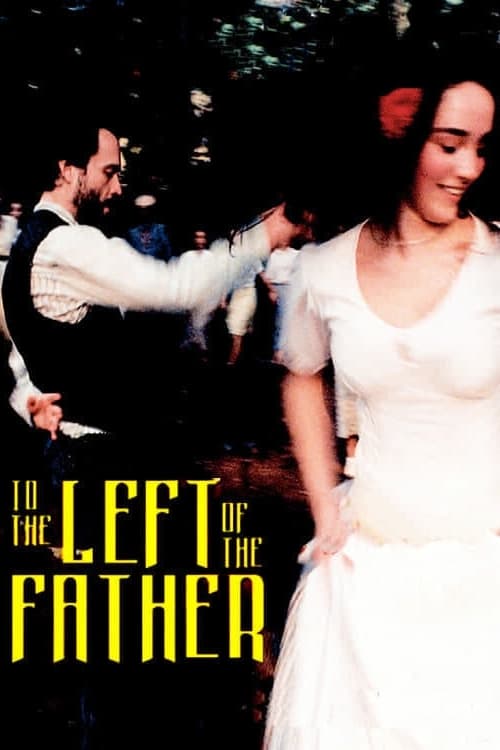
To the Left of the Father
2001 · Luiz Fernando Carvalho
For when you want cinema as total immersion — a challenging, ravishing film to surrender an evening to and chew on for days. Not a casual watch; save it for when you have patience and full attention to give.
What it's about
A prodigal son returns to a patriarchal rural family of Lebanese immigrant descent in mid-century Brazil. Pedro is sent to retrieve his estranged brother André, who fled a household ruled by a domineering father's sermons and smothered by a mother's love — and whose forbidden feelings for their sister Ana hang over everything. The homecoming sets the family's ancient order on a collision course with everything it cannot say aloud.
The experience
Sensuous and incantatory — closer to fever dream than conventional drama, with language that pours out like scripture and images thick with earth, grain, and skin. It's slow, hypnotic, and emotionally overwhelming; you don't follow it so much as submit to it.
Performances
Selton Mello is ferocious as André, delivering torrential monologues at full burn, and Raul Cortez gives the father a granite, Old Testament authority that makes the household's suffocation palpable.
The craft
Luiz Fernando Carvalho's debut feature is one of the most aesthetically ambitious Brazilian films of its era: painterly, tactile cinematography, a trance-like rhythm, and a script that keeps the incantatory prose of Raduan Nassar's novel intact rather than taming it. It's a film of textures — wheat, candlelight, sweat — that begs for the biggest screen you can find.
Why it matters
Widely regarded as a high-water mark of the cinema da retomada, Brazil's late-90s filmmaking revival, and the announcement of Carvalho as one of the country's major visual stylists.
Snapshot
Known in Brazil by the title of its source novel, Lavoura Arcaica ("Archaic Tillage" or "To the Left of the Father" in its international release), this is a sensuous, incantatory adaptation of Raduan Nassar's celebrated 1975 novel of the same name. It marked the feature-film debut of Luiz Fernando Carvalho, a director already established in Brazilian television, and it is generally regarded as one of the most aesthetically ambitious works of the cinema da retomada, the revival of Brazilian filmmaking in the mid-to-late 1990s. The film dramatizes the return of a prodigal son to a patriarchal rural family of Lebanese immigrant descent, and the catastrophe that his transgressive love for his sister precipitates. The TMDB synopsis supplied for grounding — "1940s São Paulo, Romance" — is a serviceable but reductive label: the film's temporal and geographic setting is deliberately unfixed and pastoral, closer to a timeless agrarian parable than to a dated period piece, and its register is tragic rather than romantic. What is not in doubt is the film's reputation as a landmark of literary adaptation and of a painterly, corporeal style of image-making rarely attempted at this scale in Brazilian cinema.
Industry & production
The film emerged from the institutional conditions of the retomada, the period in which Brazilian production, gutted by the dismantling of the state film agency Embrafilme at the start of the 1990s, was rebuilt through fiscal-incentive laws (the Lei Rouanet and the Lei do Audiovisual) that channeled corporate tax money into cinema. By 2001, that recovery had already produced internationally visible successes — most conspicuously Walter Salles's Central Station (1998) — and Lavoura Arcaica belongs to the more auteurist, less export-calibrated wing of that wave. Carvalho came to the project from a long apprenticeship in television at TV Globo, where he directed prestige literary miniseries; the film reflects both the resources and the craftsmanship of that background while pursuing an avowedly art-cinema idiom.
The production is remembered above all for Carvalho's immersive, theater-derived working method. Rather than shooting quickly, he subjected his cast to a long period of preparation and communal living, using workshops and rehearsal to fuse the actors into a family unit before the camera turned. This laboratory approach — treating the shoot as the culmination of an extended process of embodiment — is central to the film's lore and to its texture, and it aligns Carvalho with a tradition of ensemble-building more familiar from the stage than from commercial cinema. Precise budget figures and box-office returns are not something I can state reliably, and I will not invent them; the film was, by any account, a critical rather than a commercial event, circulating through festivals and cinephile channels more than through wide release.
Technology
Lavoura Arcaica was made on photochemical film, in the era just before digital acquisition began to reshape production, and its images are conceived for the grain, latitude, and color response of 35mm stock. The film's technological signature is not novelty but the exacting orchestration of traditional resources — natural and practical light sources, long takes, and camera movement executed on physical rigs — in the service of a painterly image. Its ambitions lie in cinematography and duration rather than in effects or apparatus. The runtime is long — on the order of two and three-quarter hours (roughly 163–171 minutes by various listings; I flag the exact figure as uncertain) — which is itself a kind of technical-formal commitment: the film asks the projection and exhibition apparatus to sustain a slow, accumulating rhythm.
Technique
Cinematography
The cinematography, by Walter Carvalho — one of Brazil's most distinguished directors of photography, and the cinematographer of Central Station — is the film's most celebrated element. (He shares a surname with the director but the two are not, to my knowledge, closely related; I note this only to avoid confusion.) Walter Carvalho works in a register of chiaroscuro and burnished, low-key light that has repeatedly been compared to painting: interiors lit as if by candle and hearth, faces and hands emerging from darkness, skin and cloth and grain rendered with tactile warmth. The camera is mobile and searching — circling, drifting, sometimes spinning — so that movement itself becomes an expressive instrument, translating the narrator's fevered, ecstatic subjectivity into optical terms. The imagery is frankly sensual, attentive to bodies, food, dust, and light, and it privileges texture over legibility. This is a film in which the photography is not illustration but argument.
Editing
The editing organizes the film around the novel's first-person, retrospective consciousness rather than around conventional continuity. Time is treated elastically: the narrative folds present return into remembered childhood, and sequences are built to swell and subside rather than to advance briskly. The cutting tolerates long duration, letting shots breathe and letting the spoken text carry the momentum, and it reserves acceleration for moments of crisis and delirium — most famously the vertiginous dance. I cannot confirm the editor's credit with certainty and will not guess at a name; what is describable with confidence is the editorial sensibility, which is lyrical and subjective, closer to the rhythm of prose and music than to the beat of plot.
Mise-en-scène / staging
Staging is dominated by the family table, the film's ritual and moral center, where the patriarch delivers his sermons on order, patience, and the household economy. Carvalho composes these gatherings as tableaux — bodies arranged in hierarchical relation to the father — and then disrupts them with the eruptions of desire that the film charts. The rural farmhouse, the fields, and the outbuildings function less as realistic locations than as a moral topography: the ordered space of the father versus the disordered, sensual space to which André retreats. Props carry symbolic weight — bread, wine, oil, the objects of an agrarian and quasi-liturgical life — and the film's title, evoking archaic husbandry, is literalized in this world of tillage, harvest, and inherited labor.
Sound
Sound is worked as intensively as image. The film leans heavily on voiceover — the narrator's dense, poetic monologue adapted from Nassar's prose — which threads through the images as an interior stream. Against this, the sound design foregrounds the family's Lebanese heritage through Middle Eastern music and, in the film's most famous set piece, an ecstatic dance scene in which the sister Ana whirls to Arabic song; the sequence is a peak of sensory delirium in which music, movement, and camera fuse. I am not able to confirm the composer or specific music credits with certainty and will not attribute them; what can be said reliably is that the score and source music are integral, and that the film's Arab-Brazilian musical texture is one of its defining and most-discussed features.
Performance
Performance is where Carvalho's immersive method pays off. Selton Mello, as the tormented André, gives a career-defining, physically and emotionally exposed performance, sustaining the film's near-continuous interior monologue and its extremes of longing and shame. Raul Cortez, one of Brazil's most respected actors, plays the father Iohána as an oratorical patriarch whose authority is expressed through the measured cadences of his table sermons. Simone Spoladore plays the sister Ana, and Juliana Carneiro da Cunha — an actress with deep roots in French experimental theater — plays the mother; Leonardo Medeiros plays the elder brother Pedro, dispatched to retrieve André. The ensemble performs less as a set of individuals than as a single organism of blood and hierarchy, which is precisely the effect Carvalho's preparation was designed to produce.
Narrative & dramatic mode
The film's dramatic mode is confessional and tragic. Its armature is the parable of the prodigal son, inverted and darkened: André has fled the paternal household, Pedro is sent to bring him home, and the return that should restore order instead detonates the family. The narration is retrospective and subjective throughout — we are inside André's remembering, grieving mind — so the film unfolds as an act of anguished recollection rather than as forward-driving plot. The central transgression, the incestuous bond between André and Ana, is treated not as sensational incident but as the tragic collision of desire with an archaic moral order embodied by the father. The dramaturgy is built on the tension between the father's word — patience, waiting, submission to time and law — and the son's body, which cannot wait. The ending fulfills the tragic logic the premise sets in motion, closing the circle of transgression and paternal violence.
Genre & cycle
Generically, the film is best understood as a literary art-film and a family tragedy — a domestic drama pitched at the level of myth. It sits within several overlapping cycles: the tradition of Brazilian literary adaptation; the international art-cinema lineage of slow, painterly, interiorized family dramas; and, more specifically, a strain of the retomada concerned with memory, patriarchy, and the rural interior. The "Romance/Drama" tag from the grounding synopsis undersells this: the romance is incestuous and doomed, and the governing mode is closer to tragedy and lyric than to any conventional love story.
Authorship & method
The dominant author is Luiz Fernando Carvalho, whose method — long immersion, ensemble fusion, and a conception of cinema as sensory and musical rather than merely narrative — shapes every level of the film. His authorship is inseparable from three collaborations. First, the source: Raduan Nassar, whose 1975 novel supplies not only the story but the very language of the voiceover; the film is unusually faithful to the novel's poetic diction, treating the prose as a score to be spoken. Second, the cinematographer Walter Carvalho, whose chiaroscuro imagery is co-equal with the direction in defining the film's identity. Third, the lead actor Selton Mello, whose performance carries the subjective burden of the adaptation. The composer and editor are collaborators I cannot name with confidence, and I decline to guess; their contributions are nonetheless audible and visible in the film's musical structure and elastic sense of time. The through-line of the authorship is a belief that cinema can render literary interiority through image, body, and sound rather than through plot.
Movement / national cinema
The film is a Brazilian production and a signal work of the cinema da retomada. Where much of that revival gravitated toward social realism and the urban margins — the favela, the sertão of hunger, the road movie of a searching nation — Lavoura Arcaica represents the movement's aestheticist, interiorized pole. It turns inward and backward, toward family, land, immigrant memory, and the archaic, and it insists on beauty and duration as values. In doing so it connects the retomada both to the older Brazilian project of adapting the national literature to the screen and to a broader world art cinema of sensuous, contemplative form. It is frequently cited as evidence that the revived Brazilian cinema could sustain high auteurist ambition and not only social urgency.
Era / period
Released in 2001, the film belongs to the closing moment of the fully photochemical era and to a high point of international attention on Brazilian cinema in the wake of Central Station. It is a product of the fiscal-incentive financing model that structured Brazilian production in that period, and of a filmmaking culture in which television craft (Carvalho's background) and cinema ambition were increasingly intertwined. Within the director's own career, it stands as the debut feature of a filmmaker who would continue to pursue a distinctive, aestheticized approach across film and television.
Themes
The film's themes are patriarchy and its law; time, patience, and the violence of waiting; tradition against desire; and the sacred and profane dimensions of family life. The father's sermons make the household into a theology of order, and the drama tests that order against the ungovernable body. Incest functions as the ultimate figure of transgression — desire turned inward upon the family itself, collapsing the very distinctions on which the patriarchal order depends. Immigrant memory and heritage run beneath the surface: the family's Lebanese roots surface in music, ritual, and food, binding the archaic to an experience of displacement and belonging. The title's "archaic tillage" points to the deepest theme — inheritance itself, the transmission of land, labor, faith, and prohibition from father to son, and the catastrophe that follows when that transmission fails.
Reception, canon & influence
Critically, Lavoura Arcaica was received as a major, demanding achievement — praised especially for Walter Carvalho's cinematography, for Selton Mello's performance, and for the audacity of adapting a novel long considered nearly unfilmable. It garnered festival attention and awards recognition, though I will not enumerate specific prizes I cannot verify; the safe and accurate statement is that it was widely honored within Brazilian film culture and respectfully received abroad on the festival circuit. Over time it has settled into the canon of the retomada and is regularly named among the most beautiful and formally serious Brazilian films of its era, frequently taught and revisited.
Its influences, read backward, are threefold: Nassar's novel above all, whose language and structure the film inherits; the tradition of chiaroscuro painting and the world art-cinema of interiorized, painterly duration; and the immigrant-family and agrarian imaginary of Brazilian literature. Read forward, its legacy lies less in imitators — its method is too singular and labor-intensive to spawn a school — than in its demonstration of possibility: proof that Brazilian cinema of the revival could sustain lyric, sensuous, literary filmmaking at the highest level of craft. It consolidated Selton Mello's stature as a leading actor (and later director), reaffirmed Walter Carvalho's standing as a preeminent cinematographer, and established Carvalho's immersive, ensemble-based method as a distinctive authorial signature. Where the record of its specific commercial and awards history is thin or beyond what I can confirm, I have said so rather than invent; the film's importance rests securely on its form, its performances, and its place in the story of Brazilian cinema's rebirth.
Reception
It premiered in 2001 as an art-house outlier — a nearly three-hour tone poem from a director known for Brazilian TV — swept festival prizes, then spent years as a mostly Brazilian secret. Letterboxd changed that: international cinephiles now discover it as one of the platform's highest-rated Brazilian films.
How To the Left of the Father was received, from release to now →
How to watch To the Left of the Father: what to notice on a first viewing
- Watch how faces and hands emerge out of near darkness. Walter Carvalho lights interiors as if by candle and hearth, so skin and cloth catch warmth while the rest of the frame stays in shadow. The low light gives the family's world a painted, almost sacred texture before anything is said.
- Notice when the camera starts to circle or drift instead of holding still. The camera moves searchingly, sometimes spinning, translating a fevered inner state into movement rather than staying locked down. The camera's own motion is how the film puts you inside a character's remembering rather than watching it from outside.
- Watch how the family is arranged at the dinner table. Carvalho composes these gatherings as tableaux, with bodies placed in fixed hierarchical relation to the father as he speaks. The seating itself states the household's order before the father's words do.
- Listen for the voiceover running under the images. A dense, poetic monologue threads continuously through the film, adapted closely from the novel's own language. The narration keeps you inside one person's memory rather than inside a scene unfolding in real time.
- Watch for bread, wine, and oil whenever they appear on screen. These objects of daily agrarian and religious life recur across the film's rooms and rituals. The props root an almost mythic family drama in the physical labor of the land its title names.
The whole guide to watching To the Left of the Father, with the keys for a rewatch →
Influences: the films it descends from and the films it influenced
- The Mirror (1975) — Supplies the core method Carvalho inherits: retrospective-subjective montage that dissolves chronology into memory while a poetic voiceover recites literary text as a musical score laid over the image rather than as plot exposition.
- Nostalghia (1983) — Models the sacral long take of near-static duration in low, candle-and-window chiaroscuro, treating a single sustained shot as a spiritual event — the pace and light logic of Carvalho's interiors.
- Andrei Rublev (1966) — Establishes the immersive, ensemble-fusion working method — long physical immersion of actors into a period and landscape organized as chaptered panels — that Carvalho adopts as his directorial signature.
- The Color of Pomegranates (1969) — Precedent for frontal tableau staging built from symbolic props and hand-arranged objects, where narrative is carried by emblematic composition rather than dramatic action.
- The Gospel According to St. Matthew (1964) — Renders a sacred parable through chiaroscuro-lit non-professional faces and an agrarian, biblical austerity — the template for filming a prodigal-son scripture as sensuous, reverent image.
- Medea (1969) — Fuses ritual tableau, archaic costume and sun-baked agrarian ethnography into myth, the model for treating family-tragedy as pre-modern rite staged as living painting.
- Cries and Whispers (1972) — Crimson-saturated chiaroscuro interiors and whispered confessional voiceover turn a family's tragedy into a chamber of intimate close-ups — the palette and confessional register Carvalho pushes further.
- Days of Heaven (1978) — Pairs a magic-hour mobile camera gliding through agrarian labor with a first-person subjective voiceover, proving lyric image plus interior narration can override conventional plot — Carvalho's exact formal wager.
- Vidas Secas (1963) — Founds the Brazilian agrarian-family imaginary Carvalho descends from, filming the immigrant/rural household's hardship through hard sertão light and near-silent bodies.
- Black God, White Devil (1964) — The Cinema Novo mobile, handheld sertão parable whose lineage the Retomada explicitly revives — Carvalho's film is the movement's answer in a lyric, painterly key.
- The Spirit of the Beehive (1973) — Golden, Vermeer-like interior light and a child's subjective interiorization of a hushed family house model the painterly, duration-based rendering of a young psyche Carvalho pursues.
- The Clown (2011) — Selton Mello, the immersive lead of Lavoura Arcaica, carries Carvalho's ensemble-fusion and itinerant-family lyricism into his own direction, filming a father-son troupe as warm, memory-toned tableau.
- Mother and Son (1997) — Contemporary parallel in painterly, lens-distorted tableau and elastic slowed time devoted to a single filial bond, sharing the conviction that duration and texture are the drama.
- Central Station (1998) — Shot by the same cinematographer, Walter Carvalho, whose expressive naturalist Retomada camera and Brazilian-landscape eye are co-equal author here as in Lavoura Arcaica.
- Behind the Sun (2001) — Made the same year with DP Walter Carvalho: an agrarian blood-feud family tragedy in sun-scorched, ochre chiaroscuro — the twin of Lavoura Arcaica's patriarchal-household rural tragedy.
- Madame Satã (2002) — Walter Carvalho's immediately following work: sweaty, body-close chiaroscuro and immersive sensory texture extend the same cinematographic method into a different milieu.
- Mango Yellow (2002) — Walter Carvalho's tactile, sensuous cinematography of skin, light, and decay made just prior — the same DP translating bodily texture into a saturated, oppressive atmosphere.
Similar films
- Barren Lives (1963) — influence & lineage
- Black God, White Devil (1964) — influence & lineage
- The Son of a Thousand Men (2025) — shared sensibility
- Post Tenebras Lux (2012) — shared sensibility
- Limite (1931) — shared sensibility
- Entranced Earth (1967) — shared sensibility
- Mango Yellow (2002) — shared sensibility
- The Secret Agent (2025) — shared sensibility