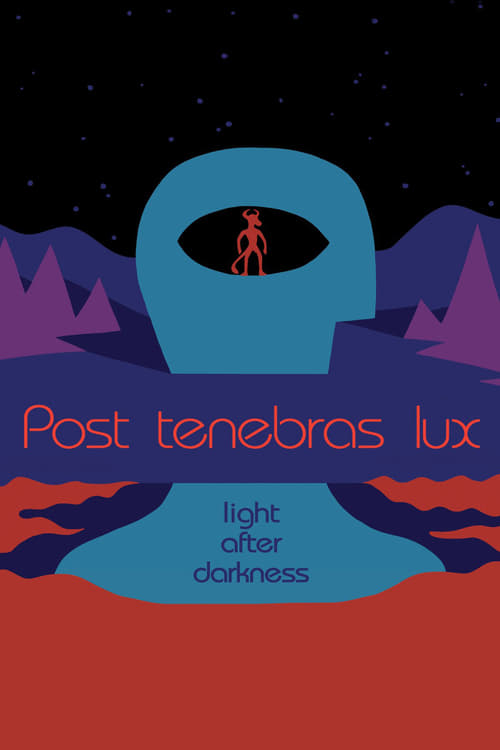
Post Tenebras Lux
2012 · Carlos Reygadas
For when you want a film to surrender to rather than follow — something to puzzle over for days, best met with patience and an open mind. This is challenge viewing, closer to visual poetry than storytelling.
What it's about
An affluent, city-educated man moves his wife and two small children to a house in the Mexican countryside, among rural laborers whose lives brush against his family's without ever joining them. What follows is less a plot than a field of scenes — domestic tenderness, class friction, violence, dreams, even a glowing visitor that may be the devil — circling questions of marriage, privilege, and whether light really follows darkness.
The experience
Disorienting and hypnotic: time jumps, dream and reality blur, and images of overwhelming beauty sit next to moments of sudden brutality. It works on you like a half-remembered dream — frustrating in the moment, then impossible to shake.
The craft
Reygadas shoots in a boxy frame with a lens that blurs and doubles the edges of the image, so the world seems seen through a haze of memory; an opening sequence of a small child wandering a twilight field among animals and gathering storm is one of the most extraordinary passages in recent cinema. Sound and landscape do as much work as dialogue, and it demands the biggest, darkest screen you can find.
Why it matters
It won Reygadas the Best Director prize at Cannes amid walkouts and boos, cementing his reputation as one of world cinema's most divisive and visionary figures.
Snapshot
Post Tenebras Lux is Carlos Reygadas's fourth feature and the film in which his cinema turns decisively inward — away from the anthropological remove of Japón (2002), Battle in Heaven (2005), and Silent Light (2007) and toward something closer to autobiography refracted through dream. Its Latin title, "After Darkness, Light," is a Reformation motto (and the motto of Geneva), and the film treats it less as promise than as question: the darkness is domestic, class-bound, and interior, and the light that follows is uncertain, partial, and sometimes hallucinated.
The nominal situation is what the synopsis states: Juan, an affluent, urban-educated Mexican, has moved his wife Natalia and two small children to a house in the Morelos countryside, among rural laborers whose lives touch his without joining them. But the film refuses to organize this material into a story. It opens with a small girl (Reygadas's own daughter) wandering a muddy field at dusk among cattle and dogs as a storm gathers — a sequence of several minutes with no dialogue, only weather and animal sound — and then delivers, without transition or explanation, the image that became its signature: a glowing, translucent red devil, animated, horned, carrying a toolbox, walking into a darkened house at night while a small boy watches. From there the film proceeds by association: a rural tree-felling, a marital sex scene in a European bathhouse whose rooms are labeled with the names of philosophers, an AA-style confession in a village meeting, an English rugby match, a Christmas gathering, a beach, a decapitation that may be literal or metaphorical, a self-inflicted violence at the close.
Almost every frame is shot with a lens that produces a hard central image ringed by a doubled, blurred, refracted halo — as though each shot were being viewed through a flawed pane of glass, or through memory. It won Reygadas the Best Director prize at Cannes in 2012 and was, by common account, one of the most divisively received films in that competition's recent history. The film is best understood not as a puzzle with a solution but as an attempt to film the texture of a consciousness — memory, dream, anticipation, shame — without the connective tissue that narrative normally supplies.
Industry & production
Reygadas has built his career outside the Mexican commercial industry and largely outside its state-supported mainstream, financing through European co-production, festival capital, and his own company. He founded Mantarraya with Jaime Romandía, and Post Tenebras Lux was produced through that infrastructure alongside international partners — the film carries Mexican, French, Dutch, and German co-production credit, a configuration typical of the art-cinema financing circuit (French and Dutch funds, in particular, have long been the lifeline for directors of Reygadas's profile). The budget was small by any industrial standard; the film's production values derive from time, location access, and lens choice rather than expenditure.
The most consequential production decisions were about casting and location. Reygadas cast almost entirely non-professionals, as he had in every previous feature, and drew heavily on his own circle: Adolfo Jiménez Castro as Juan and Nathalia Acevedo as Natalia were not career actors, and the children in the film are Reygadas's own children, Rut and Eleazar, playing versions of themselves under their own names. The film was shot in and around Reygadas's own rural property in Morelos, the region where he lives. This collapsing of the distance between filmmaker and material is the film's central production fact: the house is his house, the landscape is his landscape, the children are his children, and the anxieties about class, sex, violence, and paternity that the film circles are staged in the physical setting where the director actually lives them.
Reygadas has been candid, in interviews around the film's release, that the material is personal and memory-derived without being straightforwardly autobiographical — that the images arrived as images rather than as encoded incidents. The record on the film's precise production chronology and budget is thinner than for studio-scaled work, and figures circulating informally should not be treated as documented; what is well established is the shooting geography, the non-professional casting, and the Mantarraya/European co-production structure.
Technology
The film's technology is inseparable from its look. Post Tenebras Lux was shot on 35mm film in the Academy ratio (1.37:1) — a boxy, near-square frame that in 2012 read as a deliberate refusal of both widescreen and the digital sheen then becoming standard. The choice of Academy is doubly pointed: it is the ratio of pre-1950s cinema and of the home-movie imagination, and it forces the landscape material — which would seem to demand scope — into a vertical, compressed, portrait-like field.
The signature optical effect comes from a specialized lens producing a doubled, refracted halo around the edges of the frame: the center of the image is sharp, and toward the periphery the picture ghosts, splits, and smears into a secondary, softer duplicate. The effect is in-camera and optical, not a post-production filter, and it was achieved with a rare, non-standard lens element rather than a conventional cinema prime. Reygadas and cinematographer Alexis Zabé have described the effect as bound up with subjective vision — the way peripheral perception degrades, or the way memory holds one thing in focus and lets the rest bloom. The specific technical provenance of the lens has been described in various ways in interviews and trade coverage, and I will not assert a single sourcing story as documented fact; what is verifiable from the images themselves is that the doubling is optical, consistent, and centered.
Two further technological facts matter. First, the film was shot with available and practical light to a degree unusual even in art cinema — the storm sequence, the night interiors lit by domestic fixtures, the dusk exteriors — which pushes the 35mm stock hard and produces the grain and color instability that give the film its texture. Second, the devil is a digital animation composited into live-action photography, a rendered, semi-transparent figure with a visible internal glow. The collision of that clean CGI object with grainy, optically-degraded 35mm is not a failure of integration; the seam is the point. The devil is legible as an image rather than as a creature in the room.
Technique
Cinematography
Alexis Zabé, who had shot Silent Light for Reygadas, returns here and does the defining work. Two strategies dominate. The first is the long, patient, weather-driven take — the opening field sequence, in which the toddler wanders among animals as light drains and a storm advances, is a nearly unrepeatable piece of documentary attentiveness, with the camera moving with the child rather than framing her, and with dogs, cattle, mud, thunder, and failing light doing the dramatic work. The second is the haloed frame described above, applied almost universally, which converts every image into something recalled rather than witnessed.
Zabé's palette runs to saturated, storm-lit greens and browns in the Morelos material and to cooler, flatter registers in the European and English sequences, and the film repeatedly stages light as an event: rain-light, firelight, the animated devil's internal red glow, the blown-out whites of a beach. The Academy frame keeps figures close to the edges and gives the landscape a compressed, oppressive verticality. The camera is frequently at child height, and the film's most sustained subjectivity is arguably the children's — the boy who watches the devil enter the house, the girl in the field.
Editing
Cut by Natalia López (a longtime Reygadas collaborator, who edited Silent Light and later became a director in her own right with Fogo and Manto acuífero), the film's editing is its most radical dimension. There is no chronological spine. Sequences are joined by rhyme, mood, weather, and dread rather than causality: the film moves from Morelos to a European bathhouse to an English rugby pitch to a beach without transitional signposting, and it stages events — a beheading, a death — whose ontological status (real? feared? remembered? dreamed?) is never adjudicated. Reygadas has spoken of wanting a structure closer to how consciousness actually assembles itself, and the cutting delivers exactly that: not flashback with its implied hierarchy of "now" and "then," but a flat present in which everything happens at the same level of reality.
The film's most famous formal joke and threat — the devil walking into the house, and later reappearing — depends on editing that treats a fantastical figure with the same evenness as a tree being felled. López never signals a shift in register. The result is a film in which the viewer is never granted the reassurance of knowing which world they are in.
Mise-en-scène / staging
Reygadas stages the class relation spatially. The house is glass-walled, modern, and porous — the family is always visible from outside and always looking out — while the workers' lives happen in kitchens, forest, and village halls that the film enters as a guest. The tree-felling sequence, in which a group of men bring down a large tree with chainsaws, is staged as labor rather than as metaphor, at length, with the physical difficulty foregrounded; the film respects the work as work before it lets any symbolism accrue.
The bathhouse sequence — rooms named for philosophers (the Hegel room, among others), couples having sex in an anonymous, institutional European setting — is the film's most schematically ironic staging: European intellectual tradition rendered as a sex club, with Juan and Natalia's marital crisis literalized as an exchange of partners in rooms bearing the names of the thinkers whose culture they inherited. The AA-confession scene in a village hall, by contrast, is staged with near-documentary plainness, a man narrating addiction and shame to a circle of listeners in a bare room.
Sound
The sound design is dense, naturalistic, and almost oppressively present: rain, thunder, dog barks, cattle, chainsaws, wind. Reygadas has never used score conventionally, and Post Tenebras Lux has no continuous composed underscore. It uses pre-existing music placed as event — most notoriously Neil Young's "It's a Dream," which arrives in a domestic gathering scene and lands with a bluntness that is either devastating or unbearable depending on the viewer. The absence of scored emotional guidance is a structural choice: without music telling the audience how to feel about a beheading or a confession, those events sit in the frame unmediated.
Performance
The non-professional performances are deliberately affectless by conventional standards. Adolfo Jiménez Castro's Juan is opaque, sullen, and rarely legible — the film gives him a violent outburst against a dog and a sexual jealousy without granting him the interiority that would make either explicable. Nathalia Acevedo's Natalia carries the film's most exposed material, including the bathhouse sequence, with a stillness that resists the psychological reading the situation invites. The children, being actual children of the director, are simply present rather than performing, and the film's most alive passages are the ones in which their unmanaged behavior — running, wandering, reacting to animals — sets the rhythm. Reygadas's method here is closer to Bresson's "models" than to naturalist acting: bodies and faces used as material, withheld from expressive service.
Narrative & dramatic mode
The film is non-linear, associative, and ontologically unstable. It has characters and a situation but no plot in the causal sense; its mode is closer to lyric poetry or to a dream journal than to drama. Events do not build; they recur, rhyme, and interrupt. Crucially, the film includes at least two sequences that appear to depict a death or maiming of a central figure and then continues as though nothing definitive has occurred — the ending, in which a man tears at his own head, is staged as literal action but reads as metaphor, and the film supplies no key.
The dramatic mode is best described as confessional without disclosure. Everything in the film points toward a personal reckoning — with class guilt, with sexual failure, with fatherhood, with violence latent in a comfortable man — but the reckoning is never articulated. What the film offers instead is the sensorium of a mind in that condition: peripheral vision blurred, memory intruding, the domestic and the demonic occupying the same room.
Genre & cycle
Formally the film sits in the tradition of the art-cinema puzzle film and the rural-metaphysical drama, but it belongs most precisely to a specific 2000s–2010s cycle: the slow-cinema festival auteur film, with its long takes, non-professional casts, landscape immersion, and refusal of exposition. Within that cycle it is unusual for its willingness to be ugly and vulgar — the sex club, the animated devil, the dog violence — where the cycle's dominant register (Tarr, Ceylan, Alonso, Diaz) is austere.
It also participates in the cycle of autofictional art cinema that gathered force in the 2010s: films in which directors cast their own families and film their own houses. And it belongs to a Mexican strain of films about the encounter between the urban educated class and the rural poor, a subject Reygadas had already worked in Japón and would return to in Our Time (2018), which again cast Reygadas himself and his family on a Mexican ranch.
Authorship & method
Carlos Reygadas (b. 1971) came to filmmaking after training as a lawyer and working in international law before turning to cinema in his late twenties. His method is consistent across films: non-professional casts drawn from the locations he shoots in, extremely long preparation and shooting periods, in-camera solutions over post-production, no conventional score, and a refusal to explain. He has been open about the influence of Tarkovsky, Dreyer, and Bresson, and Silent Light famously reworked the ending of Dreyer's Ordet. What separates Post Tenebras Lux from its predecessors is the abandonment of a legible narrative frame: Japón, Battle in Heaven, and Silent Light all have stories that can be summarized, and this one does not.
His key collaborators here are the ones who have shaped his cinema throughout. Alexis Zabé (cinematographer) had shot Silent Light and would go on to shoot The Florida Project for Sean Baker — his sensitivity to natural light and to non-professional bodies in real spaces is central to both. Natalia López (editor) had cut Silent Light and is arguably the co-author of this film's structure; her subsequent directing career (Fogo, 2012, made in the same period; Manto acuífero, 2019) confirms an authorial sensibility of her own. Jaime Romandía (producer, Mantarraya) built the financing infrastructure that made Reygadas's uncompromising method economically possible across four features. There is no credited composer in the conventional sense; the film's music is sourced.
Reygadas wrote the screenplay himself, as he has on all his features. His writing method for this film, by his own account, proceeded from images and memories rather than from structure — which is precisely what the finished film demonstrates.
Movement / national cinema
Reygadas is the central figure of the post-2000 Mexican art-cinema wave that runs parallel to, and in deliberate opposition to, the internationally successful commercial Mexican cinema of Cuarón, del Toro, and Iñárritu. Where those directors moved to Hollywood, Reygadas stayed, financed through Europe, shot in Mexican countryside with non-actors, and built (through Mantarraya and the distributor NDM) an infrastructure that supported a cohort of like-minded filmmakers — Amat Escalante (Heli, The Untamed), Nicolás Pereda, and others associated with what critics have loosely called the "new Mexican cinema" or, less usefully, the "Nuevo Cine Mexicano" of the 2000s. Escalante's career in particular was enabled by Reygadas's production support, and the two directors' work shares a preoccupation with rural violence and class.
Internationally, Reygadas is grouped with the festival slow-cinema constellation — Béla Tarr, Nuri Bilge Ceylan, Lisandro Alonso, Apichatpong Weerasethakul, Bruno Dumont — and Post Tenebras Lux is among the most formally extreme entries in that grouping. The film also sits within a longer Mexican tradition of the rural fantastic, from Buñuel's Mexican period through Juan Rulfo's literary influence, in which the countryside is simultaneously material and haunted.
Era / period
2012 is a specific moment. Digital capture had become the default; shooting 35mm in Academy ratio was, by then, a legible aesthetic statement rather than a neutral technical choice, in the same period that saw scattered high-profile returns to film. The festival circuit was in a phase of rewarding formal extremity, and Cannes 2012 — the year Amour took the Palme — was a competition unusually stocked with difficult work.
The film also arrives at a moment of acute anxiety in Mexico: the drug war of the Calderón years had made rural violence a national subject, and Mexican films of the period (Escalante's Heli, released the following year, most directly) engaged it head-on. Post Tenebras Lux does not address the drug war explicitly, but its atmosphere of unaccountable, ambient menace — the sense that violence can arrive in a house without narrative preparation — is legible against that background, and several critics read it that way.
Themes
Class as unbridgeable proximity. The film's core situation is a wealthy family living among people who work for them, with genuine affection and total structural separation. Reygadas neither romanticizes the rural workers nor condemns Juan; he films the gap.
The devil as domestic fact. The red figure with a toolbox is the film's most discussed image. It is not a supernatural threat in the horror sense — it walks in like a repairman, is seen by a child, and departs. Read as evil made ordinary, or as a child's perception of adult malignancy in the house, it makes the film's moral atmosphere visible without narrativizing it.
Vision and its failure. The haloed lens is the theme's formal embodiment: we see clearly only at the center, and everything at the edges of attention is doubled and unreliable. The film is about the limits of what a person can perceive about their own life.
Sex, shame, and marriage. The bathhouse sequence and the marital tension around it treat sexual life as a site of humiliation and negotiation rather than of liberation.
Violence as latent. Juan's cruelty to a dog, the felling of the tree, the beheading, the ending — the film insists that violence is continuous with ordinary life rather than an interruption of it.
Light after darkness, as an open question. The title promises resolution; the film provides a sunlit beach, children, and a self-destruction. Whether the light arrives is left to the viewer.
Reception, canon & influence
The film premiered in competition at Cannes in May 2012, where it was met with loud, well-documented division — booing and walkouts alongside strong advocacy — and where the jury (presided over by Nanni Moretti) awarded Reygadas Best Director. The gap between the audience reaction and the prize became part of the film's identity. Critical response split along a clear line: detractors found it self-indulgent, obscurantist, and pleased with its own obscurity, treating the philosopher-named sex rooms and the CGI devil as evidence of a director indulging himself without discipline; defenders found it the most formally adventurous film of its year and read the incoherence as achieved rather than accidental, a genuine attempt to film subjectivity without narrative crutches. Its aggregate critical standing has remained mixed-to-positive rather than consensus-canonical, and it is more often cited as important than as beloved.
Over the following decade the film's reputation has stabilized upward among cinephile critics, and it appears regularly on "best of the 2010s" lists compiled by writers oriented toward art cinema, though it remains absent from broader popular canons. It circulated through Strand Releasing in the U.S. and comparable art-house distributors elsewhere, with an audience measured in the tens of thousands rather than more.
Influences on the film (backward): Tarkovsky above all — the weather, the children, the willingness to let an image stand without explanation, the flooded and rain-soaked landscapes. Dreyer, whose Ordet Reygadas had explicitly reworked in Silent Light, remains present in the treatment of the miraculous as ordinary. Bresson's use of non-professional models. Buñuel's Mexican films, and the surrealist tradition's insistence that the irrational image needs no justification. Structurally, the film's associative drift has affinities with the modernist European cinema of the 1960s — Fellini's 8½ in its treatment of memory and fantasy as coequal with the present, Resnais in its refusal of temporal hierarchy — though Reygadas goes further than either in withholding a stabilizing frame.
Legacy (forward): The film's most concrete influence has been on the permissible: it demonstrated that a director could dispense with narrative legibility entirely and still be honored at the highest level of the festival system, which mattered to a generation of art-cinema filmmakers. Its use of the director's own family and property anticipated a broader autofictional turn in 2010s art cinema, and Reygadas pushed it further in Our Time (2018). Alexis Zabé's work here fed directly into a subsequent career — his naturalistic, non-professional-friendly cinematography for The Florida Project (2017) reached a far larger audience with a related sensibility. Natalia López's editing sensibility carried into her own directorial work. And within Mexican cinema, Reygadas's model of European-financed, festival-oriented, industrially independent production remains the template for the country's art-film sector, with Escalante the clearest inheritor.
The film's single most durable artifact is the devil: a glowing red figure with a toolbox entering a house at night has become one of the most reproduced images of 2010s art cinema, cited far beyond the number of people who have seen the film that contains it.
A Deleuzian reading
A small girl walks through a muddy field at dusk.
The full Deleuzian reading of Post Tenebras Lux →
Reception
Booed at its Cannes premiere in 2012 — and then won Reygadas Best Director anyway, one of the great jury-vs-audience trolls of the decade. It's since settled into 'misunderstood masterpiece' territory for a devoted slow-cinema crowd, though the walkout contingent never fully surrendered.
How Post Tenebras Lux was received, from release to now →
How to watch Post Tenebras Lux: what to notice on a first viewing
- Watch the blurred, doubled ring around every image's sharp center. Almost every frame is shot through a lens that leaves a hard clear center surrounded by a refracted halo, as if you were watching through flawed glass. Everything on screen looks recalled rather than witnessed, which changes how much you trust any single image.
- Listen to rain, thunder, and animal noise with no music at all. The opening minutes run on weather and animals alone, with a small girl wandering a muddy field as a storm gathers, and no score arrives to guide your reaction. You are simply left in the weather with her, feeling the storm build in real time instead of being told what to feel.
- Notice the house's glass walls, always visible from outside. The family's modern home is built transparent, so they are always seeable and seeing, while the workers around them live in kitchens, forest, and village halls the film visits only briefly. The architecture itself stages the gap between this family and the people whose labor surrounds them.
- Watch the non-professional cast move without visible acting effort. Reygadas casts people, including his own children, who are simply present in front of the camera rather than performing in any conventional dramatic sense. Their flatness makes even ordinary scenes feel slightly unreadable, which is exactly the discomfort the film seems to want.
- Watch a glowing red figure with a toolbox walk into the house. The animated devil enters like an ordinary repairman, seen only by a small boy, and the film treats the moment with exactly the same evenness as any other domestic event. Nothing in the staging tells you to be afraid, which makes the image stranger, not safer.
The whole guide to watching Post Tenebras Lux, with the keys for a rewatch →
Influences: the films it descends from and the films it influenced
- Mirror (1975) — The template for cutting memory, dream and present tense into a single associative chain with no dissolves, titles or tonal markers to rank them — plus the shared device of a child alone in a wind-raked open landscape as an unexplained standing image.
- Nostalghia (1983) — Weather admitted into interiors — rain falling inside ruined rooms, standing water on floors — which Reygadas restages as storm, mud and flooded ground pressed against the glass-walled house.
- Ordet (1955) — Establishes the grammar of filming the supernatural in the same flat, unmarked register as the domestic — no lighting shift, no score cue, no reaction shot to authorize it — the exact treatment Reygadas gives the glowing devil crossing the hallway; he had already remade Ordet's ending in Silent Light.
- Au hasard Balthazar (1966) — The 'model' method Reygadas works from directly: non-professionals cast for physiognomy and cadence, drained of interpretive acting, with sound kept strictly diegetic and no score to carry emotion.
- Los Olvidados (1950) — Mexican-set neorealist surface punctured by an unannounced oneiric insert (the raw-meat dream) that is neither framed nor resolved — the local precedent for dropping irrational images into a documentary-textured Mexican landscape.
- Simon of the Desert (1965) — The devil rendered as a banal, physically present visitor rather than an effect — arriving, doing something mundane, leaving — which is precisely the register of Reygadas's red figure carrying a toolbox up a staircase.
- 8½ (1963) — Fantasy, childhood and present-tense scene given equal ontological weight in one continuous edit, and the bathhouse/harem as an architecture where desire is organized into named rooms — the structural rhyme with the philosopher-labeled sex chambers.
- Last Year at Marienbad (1961) — The refusal of temporal hierarchy as a construction principle: repeated and contradictory versions of an event with no cue as to which occurred, leaving the viewer without a stabilizing 'now' to return to.
- Mother and Son (1997) — Optical distortion built physically in front of the lens — painted glass and angled mirrors bending the frame edges into a pictorial smear — the direct precedent for the doubled, haloed refraction ringing every Post Tenebras Lux composition.
- Japón (2002) — Reygadas's own first working method: non-professionals cast from the shooting location itself, available light in real rural interiors, and long takes that move around a subject rather than cut to him.
- Silent Light (2007) — The Alexis Zabé partnership formed here — natural-light long takes anchored by the opening sunrise and closing sunset shot in single continuous moves — plus the total absence of score and a cast of Mennonite non-actors, all carried forward intact.
- Heli (2013) — The clearest inheritor of Reygadas's production model — European-financed, festival-routed, industrially independent Mexican film shot with non-professionals from the location — extending it to unbroken static takes of violence held past comfort; Reygadas had produced Escalante's debut.
- The Florida Project (2017) — Alexis Zabé carries the same toolkit to a much wider audience: available-light 35mm exteriors, low camera height keyed to children, and framing loose enough for non-professionals to move freely inside the take.
- Our Time (2018) — Pushes the autofictional device past Post Tenebras Lux by casting himself and his wife as the leads and shooting on his own ranch, using the same 1.33-adjacent boxed framing and diegetic-only sound field.
- Robe of Gems (2022) — Reygadas's editor turned director, transplanting her own cutting logic — scenes withheld from causal sequence, characters exchanged mid-strand, duration held until narrative orientation dissolves — into a first feature.
- Long Day's Journey Into Night (2018) — Extends the post-2012 license Reygadas won at Cannes: dream logic with no stabilizing frame, a shift into an ontologically unmoored second half whose long takes never confirm whether the images are remembered, dreamt or occurring.
- The Tree of Life (2011) — Contemporaneous solution to the same problem: a household of the director's own recollection edited as fragments in fluid, magic-hour handheld coverage, with digressive non-narrative passages inserted without transition and the film's spine carried by editing rhythm instead of plot.
- Uncle Boonmee Who Can Recall His Past Lives (2010) — Apparitions — red-eyed monkey ghosts — walk into a lit domestic scene as deliberately cheap, near-practical figures, an anti-illusionist compositing ethic that matches Reygadas's frankly artificial CGI devil rather than hiding the seam.
- Güeros (2014) — New Mexican Cinema's formal experimentation with academy-adjacent framing and image distortion — the same movement's push toward self-conscious aspect-ratio and texture as expressive device.
- The Headless Woman (2008) — Latin American descendant pushing Martel's subjective shallow focus to a formal extreme — optically distorted, blurred-edge framing that makes a bourgeois protagonist's guilt-ridden consciousness the organizing principle of the image.
Similar films
- Silent Light (2007) — influence & lineage
- The Tree of Life (2011) — influence & lineage
- The Young and the Damned (1950) — influence & lineage
- To the Left of the Father (2001) — shared sensibility
- The Mysterious Gaze of the Flamingo (2025) — shared sensibility
- Memoria (2021) — shared sensibility
- Biutiful (2010) — shared sensibility
- La Ciénaga (2001) — shared sensibility