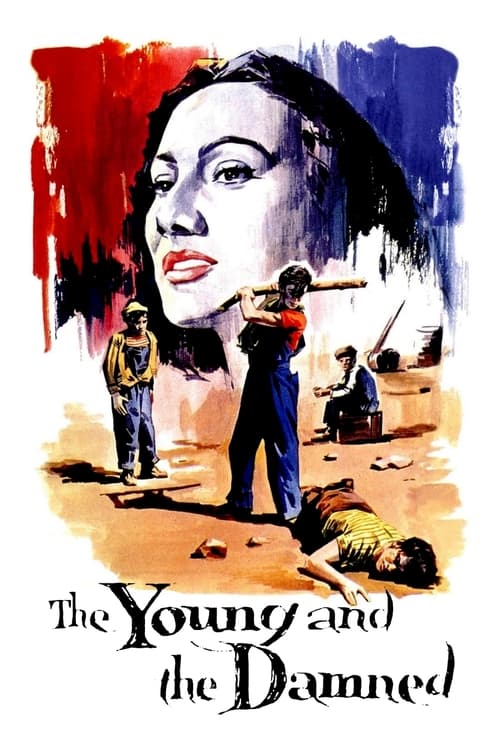
The Young and the Damned
1950 · Luis Buñuel
For when you're ready to be shaken — a serious, confrontational watch for a night when you want cinema that tells the truth rather than makes you feel better. Definitely challenge, not comfort.
What it's about
In the slums of Mexico City, a gang of abandoned kids survives by petty crime and cruelty. At the center is Pedro, a boy who genuinely wants to be good, and Jaibo, an older delinquent fresh out of reform school who keeps pulling him back under. It's a portrait of childhood in a place that offers children nothing to hold onto — with no rescuer coming.
The experience
Harrowing and unsentimental, with sudden flashes of dreamlike strangeness that make the realism cut deeper. It refuses every comfort you expect from a story about poor kids, and that refusal is what makes it unforgettable.
The craft
Buñuel shoots the slums with documentary bluntness, then detonates it with one of cinema's most famous dream sequences — raw social realism laced with nightmare imagery only a former surrealist would dare. Shot fast and cheap, and all the more ferocious for it.
Why it matters
Reviled in Mexico on release, then vindicated internationally, it resurrected Buñuel's career after years in the wilderness and became a landmark of world cinema's unflinching treatment of poverty and childhood.
Snapshot
Known almost everywhere by its Spanish title Los Olvidados — "the forgotten ones" — and circulated in English as The Young and the Damned, this is the film that resurrected Luis Buñuel's career after nearly two decades of obscurity and exile. Shot quickly and cheaply in Mexico City for the producer Óscar Dancigers, it takes the materials of the social-problem picture — slum children, juvenile delinquency, poverty as a breeding ground for crime — and refuses every consolation the genre conventionally offers. There is no reformer who saves the boys, no sociological lesson that redeems their suffering, no sentimental uplift. Pedro, a child who wants to be good, is dragged down and destroyed by the older delinquent Jaibo and by an environment that offers him nothing to hold onto. The film was reviled in Mexico on release and then vindicated abroad: Buñuel won Best Director at Cannes in 1951, and the picture is now widely regarded as one of the supreme achievements of Mexican cinema and a cornerstone of Buñuel's mature work. It sits at the hinge between his early Surrealist provocations and the great films of his later career, proving that the moral ferocity of L'Âge d'or could survive inside a commercial narrative.
Industry & production
Los Olvidados was a product of the Mexican studio system at the height of its postwar "Golden Age," when Mexico City was a major center of Spanish-language production. Buñuel had landed in Mexico after years of marginal employment in the United States and France, his Surrealist reputation a liability rather than an asset. The producer Óscar Dancigers, a Russian-French émigré who had given Buñuel his first Mexican commercial assignments (Gran Casino, El gran calavero), agreed to back a more personal project on the condition that it be made within commercial parameters — a tight schedule, a modest budget, and recognizable genre footing.
The film was produced through Dancigers's Ultramar Films and shot largely on location in the poor districts and on the ragged urban edges of Mexico City, supplemented by studio work. Accounts of the production consistently describe a short shooting schedule of roughly three weeks, a constraint that shaped the film's lean, unadorned manner. Buñuel reportedly researched the milieu in advance, drawing on reformatory case files and newspaper accounts of child crime, and incorporated documentary observation of the slums into the fiction — a method that aligns the film with the period's appetite for "torn-from-the-headlines" realism while bending it toward something far harsher.
Crucially, the production negotiated commercial pressure over the film's bleakness. Buñuel later recounted that, at the producer's or distributor's insistence, he shot an alternative, more reassuring ending in which Pedro survives, as a hedge against the catastrophe of the real one; the despairing version is the one that reached the screen. Whatever the exact mechanics, the episode captures the film's situation: a genuinely subversive vision smuggled out through a studio apparatus that expected uplift.
Technology
Technologically the film is conventional for its time and place: 35mm black-and-white photography, standard Academy ratio, optical post-production, and post-synchronized sound in the manner of the Mexican studios. There is no technical innovation to claim, and to invent one would falsify the record. What matters is how Buñuel and his collaborators deployed ordinary tools against the grain of their usual application. The same black-and-white stock and studio lighting that Gabriel Figueroa had used to make Mexican landscapes and faces monumentally beautiful are here turned toward dust, rubble, and squalor. The film's one moment of overt technical flourish — a brief passage of slow motion in Pedro's dream — is achieved with the simplest means and is all the more startling for arriving inside an otherwise hard, naturalistic surface.
Technique
Cinematography
The cinematography is by Gabriel Figueroa, the most celebrated Mexican cameraman of the era, renowned for the sculptural cloudscapes and luminous compositions he created with directors like Emilio Fernández. The collaboration with Buñuel is famous precisely for its tension: Figueroa's instinct toward pictorial grandeur was deliberately curbed in the service of a flatter, more documentary harshness. The result is a photography that retains a strong sense of deep, careful composition and dramatic contrast while withholding beauty's usual comforts — the light falls on broken walls and waste ground rather than on heroic skies. Figueroa's craft is unmistakable in the precision of the framing and the depth of the black-and-white tonal range, but it is disciplined toward cruelty. The picture's most quoted gesture against pictorialism is the moment in the dream sequence when an object hurled toward the lens seems to strike the camera itself, splattering it — a violation of the polished image that announces the film's refusal of the picturesque.
Editing
Carlos Savage edited the film. The cutting is mostly direct and economical, suited to the compressed schedule and the realist register, advancing the narrative through clear cause and consequence. Its boldest stroke is the rupture of that realism in Pedro's nightmare, where slow motion and dreamlike continuity break the documentary surface to render guilt, hunger, and longing for the mother in frankly Surrealist terms before snapping back to waking misery. The juxtaposition — naturalist reportage interrupted by the eruption of the unconscious — is the film's signature formal idea, and it is realized as much in the editing as in the staging.
Mise-en-scène / staging
The staging fuses observed documentary detail with a tight dramatic geometry. Vacant lots, half-built structures, market stalls, and tenement courtyards become an arena in which the children circle, prey on the weak, and turn on one another. Buñuel populates the frame with charged objects and animals — a chicken, a dog, mud, a building site — that recur with an almost ritual insistence, lending the realism an undertow of obsession. The notorious scene in which the boys attack and rob the legless beggar, or torment the blind musician Don Carmelo, is staged with a flat, unblinking directness that denies the audience any rescuing point of view. The dream sequence is the great exception: Pedro's mother glides toward him offering a slab of raw meat, the décor turned uncanny, desire and dread made literal.
Sound
The sound design is functional within the conventions of post-synchronized studio production, and the record on its specifics is thin; the film's force lies in image and performance rather than in any innovative use of the soundtrack. The score — discussed below — is used sparingly, and the film often lets the rough ambient texture of the streets carry scenes that a more conventional melodrama would have swathed in music.
Performance
Buñuel drew flinty, unsentimental performances from a young and largely unstarry cast. Alfonso Mejía's Pedro is the emotional center — a boy whose flickers of conscience and tenderness make his ruin unbearable — played without the cloying appeal that child-victim roles usually invite. Roberto Cobo's Jaibo is the film's dark engine: charismatic, cruel, sexually predatory, and finally pitiable, a portrait of corruption that never collapses into simple villainy. Estela Inda as Pedro's hardened mother, Miguel Inclán as the blind Don Carmelo, and Alma Delia Fuentes as the girl Meche fill out a world in which adults are as compromised as the children. The acting's refusal of pathos is essential to the film's ethics: these are people, not symbols of innocence to be pitied.
Narrative & dramatic mode
The dramatic mode is tragic naturalism shot through with Surrealist intrusion. The narrative follows a downward arc with the inevitability of classical tragedy: Pedro, wanting to escape Jaibo's orbit and earn his mother's love, is repeatedly thwarted by chance, malice, and institutional indifference until the trap closes. Buñuel structures the film around a chain of betrayals and reprisals — a killing witnessed, a theft blamed on the innocent, a reformatory that cannot reach the boy — that feels both socially observed and fatalistically authored. Against this realist causality the dream sequence opens a second register, exposing the desires and terrors beneath the surface action. The famous ending — Pedro's body dumped, unmourned, on a refuse heap, his death unknown to those who might have cared — denies catharsis entirely. The "forgotten ones" are forgotten even in the moment of their destruction.
Genre & cycle
The film belongs nominally to the social-problem and juvenile-delinquency cycle that flourished internationally after the war, and it is in obvious dialogue with Italian neorealism — nonprofessional textures, location shooting, the poor as subject. But it stands deliberately athwart that cycle. Where neorealism (and its Hollywood and Mexican cousins) tended toward humanist sympathy and the implication that understanding might lead to reform, Buñuel withholds redemption and refuses to make poverty ennobling. He himself distanced the film from neorealist piety. It can also be read against the grain of the Mexican Golden Age's sentimental melodramas of the poor; Los Olvidados takes their milieu and strips out the consolation. The result is less a genre entry than a critique of the genre's reassurances.
Authorship & method
This is a Buñuel film in the fullest sense — the work in which his authorial signature reasserts itself after years of suppression. He co-wrote the screenplay with Luis Alcoriza, who would become a frequent and important collaborator across the Mexican period; the dialogue and local texture also drew on Mexican writing talent, with Pedro de Urdimalas associated with the script's vernacular. The cinematography by Gabriel Figueroa and the editing by Carlos Savage are discussed above. The music is credited to the Spanish émigré composer Rodolfo Halffter, working from themes by Gustavo Pittaluga — an exile network mirroring Buñuel's own, the score deployed with restraint rather than melodramatic underlining.
Buñuel's method here is the controlled collision of documentary observation and unconscious eruption. He grounds the film in researched social fact, then detonates that realism with images drawn straight from the Surrealist lexicon — the floating mother, the raw meat, the splattered lens — insisting that hunger and cruelty have a dream life. It is the same sensibility that produced Un chien andalou and L'Âge d'or a generation earlier, now disciplined to serve a narrative and a social subject without losing its capacity to shock.
Movement / national cinema
Los Olvidados occupies a double position. It is a landmark of Mexican national cinema — arguably the single most internationally esteemed film of that industry's Golden Age — made by the era's defining cinematographer within its studio system. Yet it is also a Spanish exile's film and a late, decisive flowering of the Surrealist movement transplanted to the Americas. Buñuel belonged to the Spanish diaspora scattered by the Civil War and Franco's victory; his presence in Mexico, like Halffter's, was part of a larger migration of Republican artists. The film thus bridges Mexican realism and European Surrealism, and it stands at the head of the remarkable Mexican period in which Buñuel made some of his finest work.
Era / period
The film is a document of its postwar moment: a rapidly urbanizing Mexico City whose growth outran its capacity to absorb the rural poor, and an international cinema newly preoccupied with poverty, displacement, and the aftermath of catastrophe. It speaks to anxieties about youth, criminality, and the failure of social institutions that animated many national cinemas around 1950. But Buñuel's period-consciousness is mordant rather than reformist — he frames the slum not as a problem awaiting a policy solution but as a permanent condition of human cruelty, refusing the era's faith in progress and rehabilitation.
Themes
At its core the film concerns the corruption of innocence and the indifference of the social order to those it discards. Hunger — literal and emotional — runs through every relationship: the boys steal to eat, and Pedro starves for his mother's love. Cruelty is shown as contagious and structural, passed from the strong to the weak in an unbroken chain, with the predatory Jaibo and his eventual victims locked in the same machinery. The figures of the blind man and the legless beggar refuse easy sympathy, dramatizing Buñuel's lifelong suspicion of sentimental charity. Sexuality, desire, and the unconscious surge beneath the social surface, most explicitly in the dream. And over everything hangs the theme named by the title: a society that forgets its children, and a death that goes unmourned and unrecorded.
Reception, canon & influence
The film's reception is one of the famous reversals in cinema history. On its Mexican release it provoked outrage — many took it as a slander on the nation, and it was pulled from exhibition after a very short run. Its rescue came from abroad: at the 1951 Cannes Film Festival it won Buñuel the prize for Best Director and drew passionate critical advocacy, with the poet Octavio Paz among its celebrated defenders. International acclaim forced a domestic reappraisal, and the film became a point of national pride rather than shame. Its standing has only grown; UNESCO inscribed Los Olvidados on its Memory of the World register in 2003, recognizing its documentary and artistic significance.
Looking backward, the film draws on Italian neorealism's location aesthetics and the international juvenile-delinquency cycle, on Buñuel's own Surrealist formation, and on the craft of the Mexican Golden Age embodied by Figueroa — even as it turns each of these against its conventional ends. Looking forward, it relaunched Buñuel into the extraordinary run of Mexican and later French and Spanish films that secured his place among the cinema's great directors, demonstrating that his radicalism could thrive inside narrative. More broadly, its unsentimental gaze at slum childhood and its fusion of social realism with the irruptions of the unconscious anticipate later traditions of unflinching cinema about the urban poor and dispossessed youth across world cinema. It remains a touchstone for filmmakers seeking to depict poverty without piety and cruelty without alibi.
A Deleuzian reading
Start with the egg.
The full Deleuzian reading of The Young and the Damned →
Reception
Mexico hated it in 1950 — it was yanked from theaters within days amid accusations that Buñuel had slandered the nation — then Cannes 1951 handed him Best Director, and the same film came home a triumph; it's now inscribed in UNESCO's Memory of the World Register.
How The Young and the Damned was received, from release to now →
Influences: the films it descends from and the films it influenced
- Un Chien Andalou (1929) — Supplies the splattered-lens, raw-meat shock image and the dream-logic cut that Buñuel detonates inside Los Olvidados' realism — the same Surrealist montage grammar, now harnessed to narrative.
- L'Âge d'Or (1930) — Establishes Buñuel's rendering of desire and aggression through irrational object-fetish images, the method behind Pedro's slow-motion dream of the floating mother and raw meat.
- Land Without Bread (Las Hurdes) (1933) — Buñuel's own deadpan ethnographic documentary of abject poverty pioneers the anti-pitying, alibi-free gaze at the destitute that he carries into the slum.
- Zero for Conduct (1933) — The oneiric slow-motion dormitory procession is the direct formal model for Olvidados' slow-motion dream insert — children's inner life staged through decelerated motion.
- Dead End (1937) — Gregg Toland's deep-focus staging of slum geography and the gang-of-boys 'Dead End Kids' template seed both Figueroa's deep composition and the film's juvenile ecosystem.
- Angels with Dirty Faces (1938) — The Warner social-problem delinquency cycle's logic — environment breeds crime, the charismatic gangster as a boy's doomed role model — is reworked in Jaibo's grip on Pedro.
- Shoeshine (1946) — Zavattini's neorealist study of boys ground down by a punitive justice/reformatory system, ending in betrayal and death rather than redemption, prefigures the anti-cathartic arc.
- Bicycle Thieves (1948) — Donates the neorealist toolkit Buñuel borrows then corrodes: real-location shooting, non-professional casting, and the child positioned as witness to adult moral failure.
- María Candelaria (1944) — Codifies the Figueroa Golden-Age idiom — low horizons, monumental clouded skies, sculptural deep-focus — the exact lyrical style Buñuel hires Figueroa to deploy and then inverts toward squalor.
- Aniki-Bóbó (1942) — Non-professional street children, a watchful punitive adult order, and the tension between transgression and conscience play out in real Mexico City streets shot with near-documentary observation.
- Enamorada (1946) — Buñuel hired Figueroa and then forbade the Fernández apparatus — no polarized skies, no low-angle ennobling of the poor — defining Mexican modernism as the deliberate negation of Enamorada's picturesque frame.
- The 400 Blows (1959) — Inherits the unsentimental delinquent-boy portrait and the suspended anti-cathartic ending (the freeze-frame echoing Buñuel's refusal of closure) grounded in real urban locations.
- Pixote (1980) — The most direct heir: slum childhood shot on location with non-professional kids, depicting poverty without piety and a doomed boy trapped in a predatory adult underworld.
- Salaam Bombay! (1988) — Carries forward the documentary-grounded, non-actor study of street children, observing exploitation and survival without melodramatic underlining or rescue fantasy.
- City of God (2002) — Extends Olvidados' ecosystem of delinquent youth — the gangster as aspirational model, violence as environment — cast largely from non-professional favela kids and refusing redemptive uplift.
- Amores Perros (2000) — Buñuel's use of actual Mexico City vecindades and street children as locations and non-professional performance adjacency established the foundational grammar for treating urban poverty as cinematic subject through found environments — the direct precedent for Iñárritu's location-only methodology and refusal of redemptive narrative for the underclass.
- Y Tu Mamá También (2001) — Buñuel's insistence on holding the camera on Mexico City's dispossessed after the middle-class gaze has moved on — staging class blindness through the gap between what the narrative follows and what the frame witnesses — is the specific ethical-camera grammar Cuarón's narrator deploys when the film pauses at roadside corpses.
- El Norte (1983) — Buñuel's technique of embedding surrealist dream sequences within a rigorously social-realist structure — so the oneiric register emerges from and returns to the material world without rupturing the film's political credibility — is the direct formal precedent for El Norte's magical-realism integration.
- The Exterminating Angel (1962) — Established the anthropological camera detachment of Buñuel's Mexican period — flat, uninflected observation of social behavior without moral commentary — carried directly into Exterminating Angel's visual severity.
- Roma (2018) — Gabriel Figueroa's deep-focus, high-contrast black-and-white cinematography for Buñuel — strong lateral shadow, wide compositions anchored in Mexico City urban poverty — establishes the aesthetic grammar Cuarón consciously invokes as the founding visual tradition of Mexican cinema his own monochrome photography enters into dialogue with.
- The Tin Drum (1979) — Establishes the template of puncturing child-poverty realism with surrealist-grotesque dream inserts — the very Buñuelian register Carrière carries into Oskar's fabulist world.
- Kes (1970) — Pioneered the unsentimental child's-eye realism of poverty — keeping the camera observational rather than pitying and refusing redemptive uplift, the bleak refusal Kes adopts for Billy's ending.
- Viridiana (1962) — Perfects the realist-surface-with-dream-eruption method—a single oneiric insert puncturing documentary naturalism—that becomes Viridiana's structural blueprint.
- Germany Year Zero (1948) — Rossellini tracks a child through a ruined city to an unredeemed, anti-cathartic death — the same refusal of consolation Buñuel applies to Pedro's body on the garbage heap.
- Forbidden Games (1952) — Observes children's intimacy with death matter-of-factly, treating cruelty without sentiment — the contemporaneous European counterpart to Buñuel's non-sentimental child.
- Nazarín (1959) — Extends Buñuel's signature method from Olvidados: a disciplined realist Mexican narrative repeatedly punctured by irruptions of the irrational and the cruel.
- Macario (1960) — Figueroa photographed Buñuel's Mexican poverty with the same austere deep focus, marrying Golden Age craft to an unsentimental social vision like Macario's.
- Victims of Sin (1951) — Figueroa in the same year applying the same deep-focus, low-angle monumentality to Mexico City's vacant lots and rubbish heaps — the sacralized refuse of Fernández's trash-can foundling, filmed as the place where the city deposits its children.
Similar films
- Pixote (1980) — influence & lineage · same viewing thread · often watched together
- The 400 Blows (1959) — influence & lineage · same viewing thread · often watched together
- City of God (2002) — influence & lineage · same viewing thread
- Un Chien Andalou (1929) — influence & lineage · often watched together
- Bicycle Thieves (1948) — influence & lineage · often watched together
- L'Âge d'or (1930) — influence & lineage
- Nazarín (1959) — influence & lineage
- Salaam Bombay! (1988) — influence & lineage · same viewing thread
All the films related to The Young and the Damned →
Watch it with: curated runs of related films
- Cinema of the Dispossessed — A run of slum-and-favela dramas — Rio, Mexico City, Mumbai, the Paris banlieue — where children survive by their wits and the city itself is the antagonist.