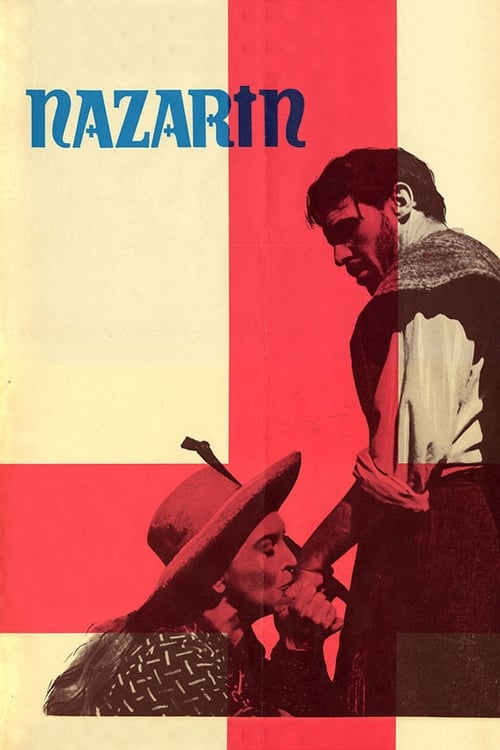
Nazarín
1959 · Luis Buñuel
For when you want a film to chew on for days and wrestle with — a challenge, not a comfort, ideal if you like your dramas morally thorny and your questions left open.
What it's about
Father Nazario is a poor priest in turn-of-the-century Mexico who tries to live the Gospel to the letter — giving away what little he owns, sheltering a fugitive prostitute, turning the other cheek. The world answers his charity with suspicion, scandal and ruin, until he's cast out to wander the roads as a beggar, trailed by two women who take him for something like a saint.
The experience
Austere, dry and quietly devastating — Buñuel tells it straight, without music swelling or sermonizing, and lets the irony accumulate until it cuts. It leaves you unsettled and arguing with yourself.
Performances
Francisco Rabal plays Nazario with an unworldly stillness that keeps you guessing whether he's a holy man or a fool — the film's whole ambiguity rests on him and he carries it.
The craft
Adapted from Galdós's novel and shot with stark, unadorned realism, it's Buñuel at his most restrained: no surreal flourishes, just a pitiless clarity of framing that makes every small catastrophe land harder. The restraint is the style.
Why it matters
One of the crowning works of Buñuel's Mexican period, admired by believers and skeptics alike — famously readable as both an attack on religion and a portrait of true Christianity, which is exactly its power.
Snapshot
Nazarín is Luis Buñuel's austere, corrosive parable of a priest who tries to live the Gospel literally and is defeated by the world he means to save. Adapted from Benito Pérez Galdós's 1895 novel and transplanted from Spain to the Mexico of the Porfiriato (the long dictatorship of Porfirio Díaz, roughly the turn of the twentieth century), it follows Father Nazario — a poor, unworldly cleric played by Francisco Rabal — as he gives away what little he has, shelters a fugitive prostitute, and is finally cast out onto the road as a wandering mendicant. Two women attach themselves to him as disciples; a chain of small catastrophes follows in his wake. Made deep inside Buñuel's long Mexican exile, the film is at once his most restrained and one of his most philosophically loaded works: a study of Christian charity pushed to its logical extreme, where sanctity and social ruin become indistinguishable. It won the International Prize at the 1959 Cannes Film Festival and stands as the first panel of the loose trilogy on grace and its impossibility that continues in Viridiana (1961) and Simón del desierto (1965).
Industry & production
Nazarín belongs to Buñuel's Mexican period, the extraordinary run of commercial and personal films he made after settling in Mexico City in the late 1940s following years of professional limbo. By 1958 he was an established, efficient director within the Mexican studio system, capable of shooting quickly and cheaply on tight schedules. The film was produced by Manuel Barbachano Ponce, a producer associated with more ambitious, artistically minded Mexican projects than the standard studio melodrama, which gave Buñuel latitude to pursue difficult material. Production was based in the Mexican studio apparatus centered on Estudios Churubusco, with location work supplying the dusty villages, roads, and construction sites that give the film its documentary-inflected texture.
The project sits at the meeting point of Buñuel's two working modes: the disciplined studio craftsman and the surrealist provocateur. Galdós — a canonical nineteenth-century Spanish novelist whom Buñuel admired and returned to again in Tristana (1970) — supplied a respectable literary source that could pass censorship and attract backing, while allowing Buñuel to smuggle in his lifelong anticlericalism and his skepticism about religious idealism. The screenplay is credited to Buñuel and Julio Alejandro, the Spanish playwright who became one of his most important Mexican-period collaborators. Budgets and grosses for the film are not reliably documented in the standard English-language sources, and I won't invent them; what is clear is that this was a modestly scaled production whose prestige came from Cannes rather than from the box office.
Technology
Nazarín was shot on 35mm black-and-white film in the standard Academy aspect ratio, with monaural optical sound — the conventional technical package of a late-1950s Mexican studio feature. There is nothing technologically experimental about the film; Buñuel's interest lay in the plainest possible means. The black-and-white stock and Academy frame were by then slightly old-fashioned choices relative to the widescreen color spectaculars dominating international markets, and that plainness is expressive: the film's stripped-down materiality matches its subject. The most distinctive "technology" in the film is arguably pre-cinematic — the sound of the ceremonial drums of Calanda, the Good Friday drum ritual of Buñuel's Aragonese birthplace, whose relentless percussion he had used before and would use again, and which erupts on the soundtrack at the close.
Technique
Cinematography
The photography is by Gabriel Figueroa, the towering Mexican cinematographer whose deep-focus, sculpturally lit compositions and vast skies had defined the "golden age" look of Mexican cinema in his work with Emilio Fernández. Buñuel and Figueroa had a productive, sometimes friction-laden partnership precisely because Buñuel resisted Figueroa's instinct toward the beautiful. In Nazarín the imagery is deliberately less operatic than Figueroa's Fernández work: fewer monumental cloudscapes, more grinding, dust-level observation of poverty. Where the frame does turn overtly composed — the tableau-like arrangements of figures, the odd surrealist intrusion — it is usually to unsettle rather than to ennoble. The result is a photographic register held in tension between Figueroa's native lyricism and Buffuel's ascetic pull toward the flat and unadorned.
Editing
The cutting, by Carlos Savage (a frequent Buñuel editor in this period), is functional and unshowy, in keeping with Buñuel's famous dislike of virtuoso technique. Buñuel constructs meaning through juxtaposition of incident rather than through montage flourish: episodes are laid end to end in a picaresque chain, each self-contained, so that the film accrues its argument cumulatively. The editing rhythm is even and observational, refusing the emotional underlining that conventional continuity cutting supplies; this deadpan neutrality is central to the film's irony.
Mise-en-scène / staging
Buñuel stages Nazarín as a road film organized around a series of encounters, each dramatizing a collision between Nazario's absolute charity and the interests of the ordinary world. The staging favors the unglamorous middle distance and the crowded, incident-filled frame — sickrooms, jail cells, work sites, village streets. Objects and gestures carry the surrealist charge that the smooth surface otherwise suppresses: the sudden, inexplicable images and fetishized details that erupt into an ostensibly realist fabric are pure Buñuel. His mise-en-scène refuses to console; even scenes of tenderness are framed so that their futility or ambiguity remains visible.
Sound
The soundtrack is notably spare. Buñuel disliked wall-to-wall scoring and, as in much of his work, leaves long stretches carried by ambient and diegetic sound. The single most powerful sonic gesture is the intrusion of the Calanda drums over the final sequence — a non-diegetic pulse that swells as Nazario walks on, transforming a quiet human exchange into something overwhelming. Precise music credits for the film are not something I can confirm from memory with confidence, and I won't attribute a score falsely; what matters dramatically is the drum, deployed as an almost physical force rather than as melody.
Performance
Francisco Rabal, in the first of his collaborations with Buñuel (he would return in Viridiana and Belle de jour), plays Nazario with a grave, still interiority. He resists the obvious hagiographic notes: his Nazario is gentle, stubborn, occasionally obtuse, and finally shaken — a man whose goodness is real but whose comprehension of the world is fatally incomplete. Around him, Rita Macedo plays Andara, the violent, earthy prostitute whose crime sets the plot in motion, and Marga López plays Beatriz, the jilted, hysteria-prone woman drawn to Nazario with an ardor that is not entirely spiritual. Both women complicate the film's saintliness by loving Nazario in ways that are confused, possessive, and human. Ignacio López Tarso has a memorable turn as a sacrilegious prisoner whose blunt worldliness rebukes Nazario's faith, and Jesús Fernández appears as the dwarf Ujo, whose hopeless devotion to Andara supplies one of the film's tenderest and strangest threads.
Narrative & dramatic mode
The film's mode is picaresque and episodic, closer to Don Quixote than to the well-made drama — and the Quixote parallel is deliberate, Nazario being a holy fool whose ideals shatter against reality exactly as the knight's do. Structurally it is a road narrative: expelled from his lodging after Andara, hiding from the law, burns it, Nazario takes to the highways as a beggar-pilgrim, trailed by his two would-be disciples. Each stop stages a moral experiment. In one, he offers to work for free out of charity and so undercuts the paid laborers, provoking a brawl — charity itself becomes socially destructive. In another, tending the victims of a typhus epidemic, he is helpless before death. In a devastating scene, a dying woman rejects the consolation of heaven and cries only for her earthly lover — a wholly Buñuelian refusal of religious comfort. The dramatic engine is irony: every attempt at pure good produces harm, humiliation, or indifference, and the narrative withholds any redemptive resolution.
Genre & cycle
Nominally a religious drama and a literary adaptation, Nazarín is better understood as an anticlerical philosophical fable in realist dress. It belongs to a recognizable cycle within Buñuel's own filmography — the sustained interrogation of Catholic sanctity that runs through Nazarín, Viridiana, and Simón del desierto, each testing a figure who tries to embody Christian virtue and each ending in failure, absurdity, or worldly defeat. Within Mexican cinema it can be read against the grain of the pious religious melodramas of the period, whose conventions it invokes only to dismantle. It is also, in its road structure and its ironic view of a delusional idealist, a distant cousin of the Quixotic tradition in Spanish-language art.
Authorship & method
Nazarín is a signature Buñuel work despite its literary source and its studio origins. Buñuel's method here is one of surface restraint concealing subversive intent: he lets a respectable Galdós novel and a competent commercial crew carry material that is, at its core, a demolition of religious idealism. His key collaborators are essential to the effect. Cinematographer Gabriel Figueroa supplies a visual grandeur that Buñuel deliberately curbs, producing the film's characteristic tension between beauty and austerity. Screenwriter Julio Alejandro helped Buñuel shape Galdós into a taut episodic structure and would remain a crucial partner through Viridiana, Simón del desierto, and Tristana. Editor Carlos Savage gives the film its cool, unemphatic rhythm. Buñuel's own authorial fingerprints are unmistakable: the anticlericalism, the surrealist eruptions within realist scenes, the fetishized objects, the refusal of catharsis, and the famous ambiguity of the ending, which he seeded so that neither believer nor atheist could claim an easy victory.
Movement / national cinema
The film stands at the intersection of two traditions. It is a product of Mexican cinema — its crew, studios, landscapes, and its greatest cinematographer are all Mexican, and it carries the technical polish of that industry's golden age. But it is equally a work of the displaced Spanish surrealist, Buñuel, whose sensibility was forged in the 1920s avant-garde alongside Un chien andalou and L'Âge d'or. Nazarín is thus a hybrid: Mexican in body, Buñuelian and Spanish in spirit, adapting a canonical Spanish novel about faith and poverty. It marks a moment when Buñuel's Mexican-period craftsmanship and his surrealist-anticlerical convictions fused into fully achieved art cinema, positioning him for the international auteur recognition that would define his final European decades.
Era / period
Produced in 1958–59, Nazarín arrives as international cinema was turning toward the modernist auteur — the years of the French New Wave's emergence and the rising prestige of festival cinema. Its Cannes prize belongs to that shifting landscape, in which a director's personal vision and philosophical ambition were becoming the coin of critical value. The film also comes near the end of Buñuel's most prolific Mexican stretch and just before his triumphant, scandal-courting return to European production. Diegetically, it is set decades earlier, in the impoverished Mexico of the Díaz dictatorship, a world of epidemics, prisons, day-laborers, and beggars that Buñuel renders with unsentimental specificity.
Themes
The film's governing theme is the impossibility — or the social danger — of literal Christian charity in a fallen world. Nazario embodies the Gospel without compromise, and the film patiently demonstrates that pure goodness, unaccompanied by understanding of the world's mechanisms, produces disorder: it undercuts wages, attracts exploitation, inspires false miracles, and leaves suffering untouched. Buñuel's abiding anticlericalism runs beneath this, but the film is more interrogation than polemic; it takes Nazario's sincerity seriously even as it dismantles his premises. Related themes proliferate: the confusion of spiritual and erotic devotion in the two women; the rejection of heavenly consolation for earthly love; the parallel between saint and madman, Christ figure and Don Quixote. The celebrated ending — in which Nazario, marched along as a prisoner, is offered a pineapple by a stranger and, after hesitation, accepts it as the drums thunder — is deliberately open. It has been read as a crack in his faith, an awakening to purely human solidarity, or a first stirring of pride; Buñuel constructed it to resist any single reading.
Reception, canon & influence
Nazarín was received as a major work on the festival circuit, winning the International Prize at Cannes in 1959 and consolidating Buñuel's reputation as a serious artist rather than a genre journeyman. A well-known irony of its reception is that some Catholic observers were tempted to embrace it as a devout film — Buñuel, an unrepentant unbeliever, was reportedly bemused by the prospect of ecclesiastical honors for a work he intended as a critique. (The precise institutional details of that episode vary across accounts, so I'll flag the record as somewhat anecdotal.)
Backward, the film draws on Galdós's realist novel, on the Quixotic tradition of the deluded idealist, on Buñuel's own surrealist formation, and on the visual grammar of Mexican golden-age cinema embodied by Figueroa. Forward, its influence is felt most directly within Buñuel's own subsequent career: Nazarín opens the sequence of films on failed sanctity that culminates in the Palme d'Or–winning Viridiana and the mordant Simón del desierto, and it inaugurated the collaborations (with Julio Alejandro, and with Rabal) that shaped his late masterpieces. More broadly it belongs to the modern lineage of films that treat holiness as a problem rather than a comfort — a lineage that runs through the spiritually severe art cinema of the following decades. It has been admired by later filmmakers drawn to Buñuel's fusion of realism and the irrational; the frequently cited esteem of directors such as Andrei Tarkovsky for Buñuel's work speaks to that reach, though specific attributions should be treated with the caution any secondhand quotation deserves. Today Nazarín is firmly canonized as one of the essential achievements of Buñuel's Mexican years and a keystone of his lifelong meditation on faith, charity, and their limits.
A Deleuzian reading
A priest walks onto a construction site and offers to work for free.
The full Deleuzian reading of Nazarín →
Reception
A Cannes International Prize winner in 1959 that put Buñuel's Mexican period on the world-cinema map, it was long overshadowed by Viridiana — but cinephiles have steadily reclaimed it as one of his very best, a view Buñuel himself shared.
How Nazarín was received, from release to now →
How to watch Nazarín: what to notice on a first viewing
- Count how many separate stops Nazario makes on the road. Buñuel strings the story together as a chain of self-contained encounters, one village or job site after another, joined by the road rather than by rising stakes. Each stop is a fresh test of his charity, not a step toward a goal.
- Track what happens each time Nazario tries to help. Every act of charity Nazario offers, free labor, shelter, a blessing, sets off some new trouble instead of the relief he intends, again and again across the film. His will keeps acting perfectly and the results keep going wrong anyway.
- Notice the wide skies give way to dust-level views. Gabriel Figueroa's camera is capable of the monumental clouds he shot for Emilio Fernández, but here he mostly stays low, in grinding, ground-level poverty instead. Buñuel keeps the camera from making this poverty look beautiful.
- Listen for how little music plays under most scenes. Buñuel leaves long stretches of the film carried by ambient and diegetic sound alone, without a score to tell you how to feel about what you see. The quiet keeps you judging events on your own, without music steering you.
- Watch Rabal's face stay calm no matter what happens. Francisco Rabal plays Nazario with a grave, still interiority, rarely raising his voice or his expression even as the world around him turns chaotic. His calm reads as goodness, but it also keeps him from understanding what he causes.
The whole guide to watching Nazarín, with the keys for a rewatch →
Influences: the films it descends from and the films it influenced
- Un Chien Andalou (1929) — Establishes Buñuel's signature device of the irrational image erupting without warning inside an otherwise legible scene, the surrealist intrusion technique Nazarín smuggles into a realist frame.
- L'Age d'Or (1930) — Codifies Buñuel's deadpan anticlerical fable — sacrilege delivered in a flat, neutral register rather than as caricature — the exact tonal method Nazarín uses to demolish religious idealism from the inside.
- María Candelaria (1943) — Cinematographer Gabriel Figueroa's monumental deep-focus black-and-white grandeur of the Mexican golden age supplies the very visual language Buñuel hires him to reproduce and then deliberately curbs in Nazarín.
- Bicycle Thieves (1948) — Its neorealist device of an ordinary protagonist drifting through discrete street-level episodes with no redemptive payoff models the picaresque, ironically anticlimactic march that organizes Nazarín.
- The Flowers of St. Francis (1950) — Renders the holy fool through humble, discrete comic-devotional vignettes in a plain documentary register, the episodic sanctity structure Nazarín secularizes into ironic Quixotic wandering.
- Enamorada (1946) — Retains Figueroa's deep focus but flattens it into frontal, unfiltered compositions, and inverts the crowd-as-chorus so the village mocks the sanctified figure instead of consecrating them.
- Viridiana (1961) — The direct sequel in Buñuel's failed-sanctity cycle, extending Nazarín's collaboration with screenwriter Julio Alejandro and the demolition of a would-be saint's charity into open blasphemous parody (the beggars' Last Supper).
- Simón del desierto (1965) — Closes the grace trilogy using the same Julio Alejandro–scripted holy-fool-in-the-desert premise and the abrupt ironic ending Buñuel seeded in Nazarín so faith is neither vindicated nor refuted.
- The Milky Way (1969) — Reworks Nazarín's road-film-as-theological-picaresque into a full pilgrimage structure, chaining doctrinal episodes with the same surrealist temporal intrusions and deadpan anticlerical irony.
- Tristana (1970) — Continues the Buñuel–Galdós–Julio Alejandro adaptation method begun with Nazarín, distilling a realist novel into a taut episodic structure whose fetishized objects and cool cruelty are pure late Buñuel.
- Au hasard Balthazar (1966) — Advances the holy-innocent-passed-through-a-cruel-world structure across discrete abusive encounters ending in unresolved suffering, the ironic picaresque of failed grace Nazarín pioneered.
- Andrei Rublev (1966) — By a filmmaker on record admiring Buñuel, it builds faith-as-problem from loosely linked episodes of a saintly artist tested by a brutal world, extending Nazarín's treatment of holiness as burden rather than comfort.
- Theorem (1968) — Buñuel constructs a serial episodic structure in which a Christ-figure catalyst moves through successive encounters, each shattering the recipient while the sacred figure remains unchanged and uncontaminated — the direct structural template for Teorema's pentagonal architecture of five visits and five divergent devastations.
- Miracle (1982) — Choreographs failed miracles and processions of the destitute following a holy figure, modeling the anatomy of desperate faith trailing after a supposed healer.
- Castle of Purity (1973) — Supplies the self-justifying protagonist whose rigid doctrine of purity makes his cruelty internally coherent rather than cartoonish villainy.
- Man Facing Southeast (1987) — Roots the Ibero-American Christ-figure holy fool who wanders among the destitute and exposes institutional hypocrisy, rendered in deadpan realism that refuses to confirm or deny the sacred.
- The Given Word (1962) — The Christ-allegory of a holy fool whose Christian charity is rejected and punished by the very society and Church he serves — Latin American martyrdom-of-the-poor parable.
- The Young One (1960) — Immediately prior Buñuel–Figueroa collaboration whose luminous but austere black-and-white and its protagonist-as-tested-moral-experiment carry directly into the following film.
- Los Olvidados (1950) — Buñuel and Figueroa's earlier Mexican collaboration pioneers the same fusion of unsentimental street realism with sudden surreal/dream eruptions that Nazarín carries into its episodic road structure.
- Diary of a Country Priest (1951) — Treats a priest's grace as an unresolved formal problem through austere framing and refusal of catharsis, the same treatment of holiness-as-difficulty that Nazarín pursues by other means.
- Ordet (1955) — Stages faith and the miracle as a genuine open question via severe, sparse mise-en-scène, sharing Nazarín's strategy of leaving belief unadjudicated so no viewer can claim easy victory.
- The Gospel According to St. Matthew (1964) — Films sanctity in a stark, unsentimental neorealist idiom with nonprofessional-flavored faces and deadpan neutrality, sharing Nazarín's refusal to romanticize the figure of the man of God.
- Winter Light (1963) — Uses sparse diegetic sound and stripped, unadorned staging to dramatize a clergyman's collapsing faith, part of the same severe post-Nazarín art cinema that makes belief a crisis rather than a solace.
- Macario (1960) — A Figueroa-shot moral fable released a year earlier that likewise critiques clerical power through an ascetic protagonist moving across a structure of episodic encounters.
Similar films
- Simon of the Desert (1965) — influence & lineage · same viewing thread
- Tristana (1970) — influence & lineage · same viewing thread
- The Young and the Damned (1950) — influence & lineage
- Au Hasard Balthazar (1966) — influence & lineage
- The Flowers of St. Francis (1950) — influence & lineage
- Diary of a Country Priest (1951) — influence & lineage
- Viridiana (1962) — same viewing thread
- The Exterminating Angel (1962) — same viewing thread
All the films related to Nazarín →
Watch it with: curated runs of related films
- Buñuel and the Bourgeoisie — A run of surrealist provocations where every dinner, prayer, and marriage bed hides an appetite polite society can't admit — watch them together for the way Buñuel (and Pasolini's Theorem) keep pulling the tablecloth out from under the well-heeled.