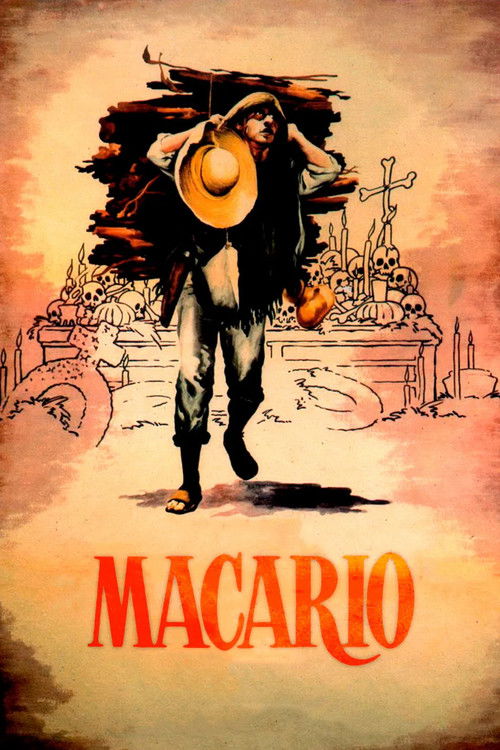
Macario
1960 · Roberto Gavaldón
When you want a story with the weight of an old folk tale — something to watch slowly and think about after, especially around Día de Muertos. More spellbinding than scary, but it will follow you to bed.
What it's about
Macario is a woodcutter in colonial Mexico so poor he has never once eaten his fill, and on the Day of the Dead he makes a single stubborn vow: to eat one whole turkey alone, sharing with no one. When his wife finally gets him that turkey, three visitors appear in the forest — the Devil, God, and Death — each asking for a portion. The one he chooses to share with repays him with a strange gift, and his fortunes begin to turn in ways the village, and the Inquisition, cannot ignore.
The experience
It plays like a fable told by candlelight — stately, hushed, and increasingly eerie, with black-and-white images that feel carved rather than photographed. Wry and humane on the surface, it builds toward something genuinely haunting.
The craft
Gabriel Figueroa, the most celebrated Mexican cinematographer of his era, gives every frame a monumental beauty — forests, candles, and skulls composed like engravings. Gavaldón directs with a storyteller's discipline, letting the fantastical arrive matter-of-factly, and the candlelit imagery of the later stretches is among the most famous in Mexican cinema.
Why it matters
A crowning work of Mexico's studio Golden Age and the first Mexican film nominated for the Best Foreign Language Film Oscar, it remains a Day of the Dead touchstone that generations in Mexico rewatch ritually.
Snapshot
Macario is a black-and-white morality fable from the twilight of Mexico's studio Golden Age, in which a starving woodcutter's single selfish wish — to eat a whole turkey alone, without sharing — opens onto an encounter with Death and a parable about mortality, hunger, and the limits of what the poor may keep for themselves. Adapted from a novel by the pseudonymous author B. Traven, itself a transposition of the Brothers Grimm tale "Godfather Death" into colonial New Spain, the film pairs director Roberto Gavaldón's disciplined literary sensibility with the monumental cinematography of Gabriel Figueroa, the most internationally celebrated Mexican image-maker of the era. It is historically notable as the first Mexican feature nominated for the Academy Award for Best Foreign Language Film (at the ceremony honoring films of 1960) and as an official selection at the Cannes Film Festival that same year — a rare instance of a Mexican art film penetrating the Cold War–era Euro-American festival circuit. Its reputation rests on a fusion of folk-Catholic iconography, Day of the Dead imagery, and a grave, fatalistic humanism.
Industry & production
Macario was produced within the mature Mexican studio system centered on Estudios Churubusco in Mexico City, the industrial apparatus that had powered the país's época de oro (Golden Age) through the 1940s and 1950s. By 1960 that system was contracting — competition from television, the decline of the wartime export boom that had made Mexico the dominant Spanish-language producer, and creative exhaustion were all pressing on the industry — so Macario belongs to a late, more self-consciously "prestige" phase, when Mexican producers periodically mounted literary adaptations aimed at festivals and international recognition rather than the domestic genre market of comedies, melodramas, and rancheras.
Gavaldón was by this point an established, commercially reliable director with a reputation for well-crafted, novelistically constructed dramas, which made him a natural choice for adapting demanding source material. The decision to shoot in austere black-and-white — at a moment when color was increasingly a marker of ambition elsewhere — was aesthetically motivated rather than merely economic, aligning the film with Figueroa's monochrome tradition and with the graphic, high-contrast idiom of Mexican printmaking. Precise budget and box-office figures for the production are not well documented in the accessible record, and I will not invent them; what is securely established is the film's festival trajectory and its Oscar nomination, which signal that it was positioned from conception as an international showcase for Mexican cinema.
Technology
Technically, Macario is a conventionally equipped studio-era production: 35mm black-and-white photography in the standard Academy frame, combining constructed studio interiors at Churubusco with location work in the Mexican landscape and, most famously, a cavern setting used for the film's climactic vision of human lives as burning candles. The film's technological interest lies less in novel apparatus than in the refined deployment of established tools. Figueroa's images depend on the era's panchromatic stock pushed toward extreme tonal separation, on filtration to darken skies and sculpt clouds, and on deep-focus lens work that keeps foreground figures and vast backgrounds simultaneously legible. The candle-cave sequence is the film's most demanding technical set piece, requiring the lighting and control of a large field of individual flames as a coherent, navigable pictorial space — an effect achieved through in-camera staging and precise exposure rather than optical trickery. The available record does not support detailed claims about specific cameras or lenses used, so those specifics are left open here.
Technique
Cinematography
The cinematography is the film's defining achievement and the primary reason for its enduring reputation. Gabriel Figueroa — whose career spanned collaborations with Emilio "El Indio" Fernández, Luis Buñuel, John Ford, and John Huston — brought to Macario his signature repertoire: luminous, deeply modeled skies; low horizons that dwarf human figures beneath towering cloudscapes; chiaroscuro lighting that carves faces out of darkness; and a painterly organization of the frame indebted both to Mexican muralism and to the compositional lessons of Sergei Eisenstein's Mexican footage and Gregg Toland's deep focus. In Macario this idiom is bent toward the metaphysical: the peasant's world is rendered with a grave, sculptural monumentality, and the supernatural encounters are staged in spaces of stark tonal extremity. The visual conception draws heavily on Day of the Dead iconography and on the graphic tradition of the calavera print associated with José Guadalupe Posada, translating folk-Catholic imagery of death into high-contrast cinematic form.
Editing
The film's cutting is measured and classical, subordinated to performance, composition, and the unfolding of the parable rather than to rhythmic display. Scenes are allowed to breathe, giving Figueroa's compositions time to register as images and letting the moral fable accumulate weight. The editing's most conspicuous task is the management of the fantastical passages — the appearances of the Devil, God, and Death, and the candle-cave revelation — where cutting must integrate the naturalistic and the visionary without rupturing the film's sober tone. I have not been able to confirm a specific editor from the reliable record, and I will not attribute the work to a name I cannot verify.
Mise-en-scène / staging
Macario is staged as a period piece set in colonial New Spain, and its production design foregrounds poverty as material texture: the woodcutter's bare dwelling, the coarse clothing, the ritual foods of the Day of the Dead. The staging repeatedly opposes scales — the small human figure against immense landscape or cavern — to dramatize mortality and social smallness. The turkey itself becomes a charged object, the fulcrum of the plot and a concentrated emblem of scarcity and desire. The colonial setting also enables the mise-en-scène of ecclesiastical power: the apparatus of the Inquisition, which enters as Macario's miraculous cures attract suspicion, is rendered as an oppressive institutional architecture bearing down on the peasant.
Sound
The score by Raúl Lavista supports the film's solemn, fable-like register, underscoring the supernatural episodes and the fatalistic arc without overwhelming them. Beyond the music, the film's soundscape leans on the textures of village and ritual life. Detailed technical documentation of the sound recording and mix is thin in the accessible record; the safest characterization is that sound serves the film's grave tone functionally rather than experimentally.
Performance
Ignacio López Tarso, one of the most respected Mexican stage and screen actors of his generation, anchors the film as Macario, giving the woodcutter a weathered dignity and an inwardness that keeps the parable from tipping into allegorical abstraction. His restraint — the hunger, the stubbornness, the dawning terror before Death's arithmetic — grounds the fantastical material in a recognizable human face. Pina Pellicer, in a career-launching role as his wife, brings a delicate gravity; she would shortly appear internationally opposite Marlon Brando in One-Eyed Jacks before her early death, which lends her presence here a retrospective poignancy. Enrique Lucero's Death is played not as a ghoul but as a calm, almost companionable figure of inevitability, a casting and performance choice central to the film's meaning.
Narrative & dramatic mode
The film operates in the mode of the moral fable or cuento, structured around a folk-tale logic of the triple encounter: three supernatural beings — the Devil, God, and Death — each ask the starving Macario to share his hard-won turkey, and he grants only Death, reasoning that the Devil is a liar, that God already feeds so many so poorly, and that Death alone is honest and universal. Death's gift — healing water that works only when Death stands at the patient's head, not their feet — sets up the film's tragic engine: Macario rises from destitution to wealth and renown as a healer, but the same power that enriches him marks him as a threat to Church and doctor alike, and the logic of the gift ultimately closes around him. The dramatic mode is thus tragic-parabolic, its ending governed by the ironclad symmetry characteristic of the fairy-tale source, in which death cannot be cheated and the terms of the bargain cannot be broken.
Genre & cycle
Macario sits at the intersection of drama and fantasy, and more specifically within a tradition of literary and folkloric fable-films. Within Mexican cinema it belongs to the prestige-adaptation cycle of the industry's late Golden Age — films that turned to serious literary sources and festival ambitions — and to a distinctively Mexican strain of death-haunted, folk-Catholic cinema saturated with Day of the Dead imagery. Internationally it can be located within the broader mid-century vein of allegorical films that personify Death and stage mortality as encounter, a lineage most famously represented by Ingmar Bergman's The Seventh Seal (1957); Macario is a Mexican, colonial, and specifically class-conscious inflection of that impulse, rooting the universal reckoning with death in the concrete fact of peasant hunger.
Authorship & method
The film is best understood as a collaboration between two strong authorial sensibilities. Roberto Gavaldón, the director, was known for a literate, tightly controlled cinema built on well-made scripts and dramatic rigor; his method favored strong source material shaped into coherent moral architecture, and Macario is often regarded as the summit of his career. The screenplay was written by Gavaldón with Emilio Carballido, one of the major Mexican playwrights of the twentieth century, whose dramatic craftsmanship helped translate Traven's prose into a taut, stage-inflected structure of encounters and reversals. Gabriel Figueroa, the cinematographer, functions as a co-author of the film's meaning: his monumental visual style is inseparable from the film's identity, and Macario is frequently cited among his finest achievements. Raúl Lavista provided the score. The underlying literary author, B. Traven — the famously secretive writer also responsible for the source of The Treasure of the Sierra Madre — supplies the fatalistic, socially attuned worldview, while his own source, the Grimm tale "Godfather Death," supplies the fable's skeleton. The identity of the film's editor is not something I can verify with confidence and is left unattributed rather than guessed.
Movement / national cinema
Macario is a late flowering of the Golden Age of Mexican cinema (época de oro), the roughly 1930s–1950s period in which Mexico became the preeminent film industry of the Spanish-speaking world. Figueroa is one of the central figures of the national visual style forged in that era — a style that synthesized Mexican muralism, revolutionary-era iconography, and international modernist technique into a recognizable "Mexican" image. By 1960 that movement was ebbing, and Macario stands as one of its most artistically self-aware capstones, consciously mobilizing the national idiom of landscape, folk ritual, and death imagery for an international audience. It is also a landmark in the international profile of Mexican cinema, as the first Mexican film to earn an Academy Award nomination for Best Foreign Language Film.
Era / period
The film is doubly period-marked. Diegetically, it is set in the colonial past of New Spain, a choice that activates the Inquisition and the caste hierarchies of viceregal Mexico as instruments of the drama. Historically, it is a product of 1960 — a hinge moment when the industrial studio model that made it possible was already declining, and when Mexican filmmakers were beginning to reckon with the exhaustion of Golden Age formulas. Macario thus reads simultaneously as a summation of an ending tradition and, in its gravity and international address, as a bid for the more author-driven, festival-oriented cinema that would follow.
Themes
At its center Macario is a meditation on death as the great equalizer and on the moral meaning of hunger. The woodcutter's refusal to share his turkey — the fable's inciting scandal — is not simple greed but the desperate assertion of a starving man's right to one uncompromised pleasure, which the film treats with unusual sympathy. From this springs a cluster of themes: the honesty of Death against the deceptions of Devil and Church; the fragility of poverty's brief ascent into wealth and the class resentment and institutional suspicion that ascent provokes; the impossibility of cheating fate, encoded in the strict rules of Death's gift; and the folk-Catholic understanding of mortality embodied in Day of the Dead ritual. Running beneath is a critique of power — clerical, medical, colonial — that punishes the poor man precisely for possessing something the powerful cannot control.
Reception, canon & influence
Critically, Macario has long been regarded as one of the high points of both Gavaldón's career and Figueroa's, and as a canonical work of Mexican cinema; its Oscar nomination and Cannes selection secured its status as a landmark of the national industry's international reach. Its influences flow backward through a clear chain: from the Brothers Grimm's "Godfather Death," through B. Traven's novelistic adaptation, into a distinctly Mexican colonial setting, and visually through the traditions of Posada's calavera prints, Mexican muralism, and the Eisenstein-and-Toland-inflected deep-focus style that Figueroa had spent decades refining, notably in his work with Emilio Fernández. Its forward legacy lies chiefly in its consecration of the Figueroa-Gavaldón collaboration and of the death-fable as a serious Mexican form, and in its enduring status as a reference point for the country's cinematic engagement with the iconography of the Day of the Dead. The film's most celebrated single image — the cavern of countless candles, each a human life — has become one of the emblematic visions of Mexican cinema. Where the documentary record on precise contemporary reviews, grosses, and awards tallies is thin, I have declined to fabricate specifics; what stands firmly is Macario's reputation as a beautiful, sober, and historically pivotal achievement in the closing chapter of Mexico's Golden Age.
A Deleuzian reading
A cave full of candles.
The full Deleuzian reading of Macario →
Reception
An Oscar nominee and Cannes competitor on release, it's stayed a jewel of Mexico's Golden Age — a perennial Día de los Muertos rewatch at home, while international cinephiles keep 'rediscovering' it decades later.
How Macario was received, from release to now →
How to watch Macario: what to notice on a first viewing
- Notice how small Macario looks beneath the sky in each shot. Figueroa sets a low horizon so towering, deeply modeled clouds fill most of the frame, dwarfing the human figures working beneath them. The sky keeps reminding you how small one starving man is against everything above him.
- Watch how sharply light and shadow carve each face. Figueroa lights the supernatural encounters in stark, high-contrast chiaroscuro, faces built out of darkness rather than evenly lit. The light itself tells you when the film has crossed into the world beyond the living.
- Watch how much attention the film pays to a single turkey. The turkey Macario's wife cooks becomes the fulcrum of the whole story, a concentrated emblem of scarcity and desire that three supernatural visitors each want a share of. One meal becomes the whole moral test of the film, not a side detail.
- Watch López Tarso's restraint even as hunger and fear grow. López Tarso keeps Macario's hunger, stubbornness, and dawning terror grounded in a weathered, inward stillness rather than broad gesture. His stillness keeps this fable feeling like it's happening to an actual man.
- Notice how calm and unthreatening Death's own manner is. Enrique Lucero plays Death not as a ghoul but as a calm, almost companionable figure, a choice that shapes how the whole film treats mortality. Death is the only visitor in the film who never lies to him.
The whole guide to watching Macario, with the keys for a rewatch →
Influences: the films it descends from and the films it influenced
- Der müde Tod (Destiny) (1921) — Personifies Death as a weary figure who reveals human lives as a vast hall of burning candles — the exact visual conceit Macario literalizes in Figueroa's cavern of candle-lives.
- ¡Que viva México! (1931) — Eduard Tissé's low-horizon framing of peasants against towering cloudbanks and its Day-of-the-Dead calavera montage established the compositional grammar Figueroa spent decades refining.
- María Candelaria (1943) — The Fernández–Figueroa house style — indigenous faces monumentalized against low horizons and sculpted skies — is the direct precursor to Macario's figure-against-cloudscape staging.
- Río Escondido (1948) — Figueroa's high-contrast chiaroscuro, deep-focus interiors, and its critique of entrenched authority feed directly into Macario's visual and moral architecture.
- The Treasure of the Sierra Madre (1948) — Adapts B. Traven, whose fatalistic, socially attuned worldview and Mexican settings supply Macario's moral-fable DNA from the same secretive author.
- Citizen Kane (1941) — Gregg Toland's wide-angle deep focus, holding foreground and background in simultaneous sharpness, is the Hollywood technique Figueroa absorbed into his own deep-focus deep-staging.
- Simon of the Desert (1965) — Figueroa's stark deep focus and emptied low-horizon skies continue the anticlerical fable, isolating a single sanctified figure exactly as Macario isolates its woodcutter.
- Pedro Páramo (1967) — Figueroa's chiaroscuro renders Rulfo's folk-Catholic land of the dead, extending Macario's monochrome mortality imagery into the following decade.
- The Devil's Backbone (2001) — Del Toro explicitly channels Figueroa's Mexican-Gothic lighting and the death-fable form into a chiaroscuro ghost story of moral reckoning.
- Pan's Labyrinth (2006) — A moral death-fable built on a triple-task structure and folk-Catholic mortality, with underworld imagery del Toro credits to the Figueroa and Mexican-muralist tradition.
- The Book of Life (2014) — Designs its afterlife directly from Posada's calavera prints and the Day-of-the-Dead visual tradition Macario helped consecrate as serious cinematic material.
- Coco (2017) — Its marigold-lit land of the dead and towers of glowing souls descend from Macario's emblematic cavern of candle-lives and its Day-of-the-Dead iconography.
- Roma (2018) — Cuarón's monochrome, deep-focus panchromatic photography and low-horizon Mexico City compositions are an explicit homage to the Figueroa Golden Age style Macario epitomizes.
- Los Olvidados (1950) — Figueroa photographed Buñuel's Mexican poverty with the same austere deep focus, marrying Golden Age craft to an unsentimental social vision like Macario's.
- Nazarín (1959) — A Figueroa-shot moral fable released a year earlier that likewise critiques clerical power through an ascetic protagonist moving across a structure of episodic encounters.
- The Seventh Seal (1957) — A contemporaneous allegory personifying Death as a negotiating interlocutor in a plague-medieval world, sharing Macario's moral-fable form and death-as-equalizer theme.
- The Skeleton of Mrs. Morales (1960) — Same-year Mexican Golden Age literary adaptation fusing death, folk-Catholic morality, and moral irony, a parallel high-craft prestige treatment of mortality and piety.
Similar films
- Coco (2017) — influence & lineage · same viewing thread
- Pan's Labyrinth (2006) — influence & lineage · same viewing thread
- The Phantom Carriage (1921) — same viewing thread · often watched together
- Nazarín (1959) — influence & lineage
- The Devil's Backbone (2001) — influence & lineage · same viewing thread
- Guillermo del Toro's Pinocchio (2022) — same viewing thread
- Grave of the Fireflies (1988) — same viewing thread
- The Boy and the Heron (2023) — same viewing thread
All the films related to Macario →
Watch it with: curated runs of related films
- Where Children Meet the Dead — Watch these together and Coco's candlelit sweetness darkens by degrees into a run of folk fables where the dead won't stay buried and children bargain with mortality under the shadow of war and fascism.