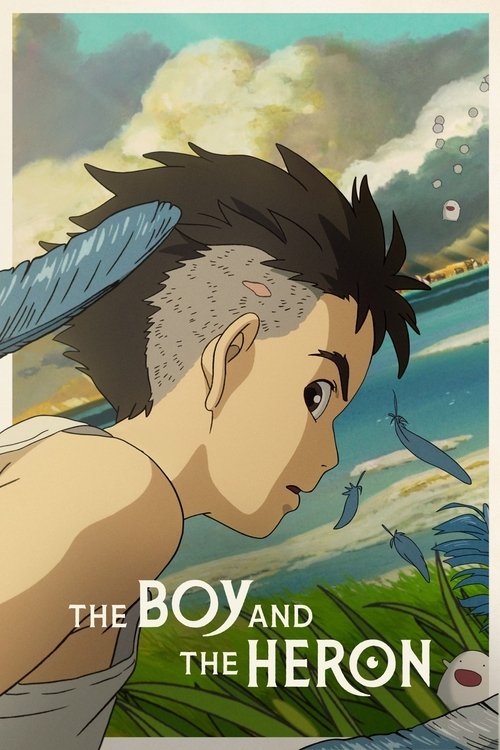
The Boy and the Heron
2023 · Hayao Miyazaki
The Boy and the Heron's no-marketing release and second Oscar fueled the eternal "final film" watch, while his resurfaced "an insult to life itself" AI clip made him the patron saint of anti-AI-art sentiment. Ghibli-style AI image generation controversies keep him at the center of a fight he never asked to join.
When you want a film to chew on for days rather than one that hands you its meaning — a challenging, haunted beauty best met with patience and full attention. Not the Ghibli for a light family night; the one for when you're ready to sit with loss.
What it's about
During the Second World War, a boy named Mahito loses his mother and is moved from Tokyo to a country estate to live with his new stepmother — who looks unsettlingly like the mother he's grieving. A talking gray heron starts needling him with impossible promises, and Mahito follows it into a hidden world of shifting rules, strange creatures, and a reclusive great-uncle who keeps a fragile cosmos in balance. It's Hayao Miyazaki's most personal film, drawn from his own wartime childhood.
The experience
Stranger and more dreamlike than Miyazaki's beloved crowd-pleasers — it moves with dream logic, veering from grief to menace to sudden absurd comedy, and it doesn't explain itself. You come out moved and puzzled in roughly equal measure, and the puzzlement is the point.
The craft
Hand-drawn animation of staggering density — fire, water, wind, and crowds of creatures rendered with a craft almost no studio still attempts — paired with a spare, aching Joe Hisaishi score. The opening sequence alone is among the most visceral things Miyazaki has ever drawn; see it big and loud if you can.
Why it matters
The film Miyazaki made after un-retiring, and it won him a second Academy Award for Best Animated Feature more than twenty years after his first — a late-career summation received worldwide as a master's meditation on grief, creation, and what he leaves behind.
Snapshot
The Boy and the Heron — released in Japan as Kimitachi wa Dō Ikiru ka ("How Do You Live?") — is the twelfth feature by Hayao Miyazaki and the first he directed after publicly retiring in the wake of The Wind Rises (2013). It is a semi-autobiographical wartime fantasy: a grieving boy, Mahito Maki, evacuated from firebombed Tokyo to a country estate, is lured by a talking gray heron into a labyrinthine other-world governed by a reclusive grand-uncle who has spent his life maintaining a fragile cosmos of floating stones. The film reached the widest audience of Miyazaki's late career, winning the Academy Award for Best Animated Feature — his second, more than two decades after Spirited Away — along with a Golden Globe and a BAFTA in the same category. It is at once his most personal and his most cryptic work: a meditation on grief, creation, succession, and the ethics of world-building, wrapped in the densest and least expository narrative he ever released.
Industry & production
The film was produced by Studio Ghibli under longtime producer Toshio Suzuki, with distribution in Japan through Toho. It emerged from an unusually long and unhurried production — widely reported as roughly seven years of predominantly hand-drawn animation, deliberately insulated from commercial schedule pressure. Ghibli's financial cushion in this period is generally attributed to the studio's back catalog and licensing (including its streaming and home-video revenues), which allowed Miyazaki and Suzuki to work without the tight throughput a wholly hand-drawn feature would otherwise demand.
The release strategy became a story in itself. In Japan the film opened on 14 July 2023 with almost no conventional marketing: a single poster image of the heron, no trailers, no clips, and minimal synopsis. Suzuki framed this as a deliberate wager that mystery would draw audiences — a striking inversion of industry norms. Internationally, the film was handled by GKIDS in North America and premiered as the opening film of the Toronto International Film Festival, a first for Miyazaki, before a theatrical release that made it, by reported accounts, the first original anime feature to open at number one at the North American box office. Precise grosses vary by source and I will not fix a figure here, but the consensus is that it performed strongly relative to Ghibli's prior overseas releases.
Technology
The Boy and the Heron is a hand-drawn film in the classical Ghibli tradition: character animation and backgrounds built from drawn cels and painted layouts, with digital compositing, ink-and-paint, and camera work used in service of the drawn image rather than as a substitute for it. Ghibli had experimented earlier with fuller CG (the studio's Earwig and the Witch, 2020, was entirely computer-generated), and the return to hand-drawing here reads as a considered aesthetic choice. The film's technological signature is therefore conservative by design — its ambition lies in the density and fluidity of drawn motion, the number of animators' hours per second of screen time, rather than in any novel pipeline. Where digital tools appear, they support atmosphere: layered composites for fire, water, and the shimmering instability of the other-world. The record does not support claims of any headline technical innovation; the achievement is one of sustained craft at a scale few studios still attempt.
Technique
Cinematography
As an animated film, its "cinematography" is authored entirely through layout, composition, and virtual camera. Miyazaki's visual grammar here is patient and often still, favoring held wide shots of the estate and the sickroom over restless coverage. The early Tokyo firebombing sequence is a notable departure — smeared, distorted figures and warping heat lines that render Mahito's run through the burning city as subjective, almost hallucinatory, distinct from the clean line work elsewhere. In the other-world, compositions grow more vertical and vertiginous, organized around towers, wells, and descents, so that the camera's movement mirrors the narrative's descent into an underworld.
Editing
The film's cutting is unhurried and observational in its opening act, dwelling on domestic textures — arrows, roof tiles, a spread of food, the movements of the old serving women — before the fantasy accelerates. Ghibli's longtime editor Takeshi Seyama is generally credited on the film, continuing a house style in which editing serves rhythm and breath rather than momentum; the pacing has divided viewers precisely because it withholds the propulsive clarity of Miyazaki's more populist adventures.
Mise-en-scène / staging
Staging is where the film is richest. The country estate, with its warren of rooms and its cluster of elderly maids, is rendered with the tactile specificity Ghibli is known for. The other-world is a palimpsest of Miyazaki's recurring spaces — the sea, a walled garden, a tower, the interior of a stone cosmos — populated by the Warawara (soft, rising spirit-forms) and the militaristic, cannibalistic parakeets that are among his strangest inventions. The recurring visual motif of stacked or balanced stones, on which the grand-uncle's world literally rests, organizes the film's climactic staging around an image of precarious equilibrium.
Sound
The sound design leans on naturalistic, foregrounded effects — the beat of wings, fire, water, the wet sounds of the heron's grotesque transformations — set against long passages of near-silence that make Joe Hisaishi's sparse score land more heavily. The gray heron's vocalizations, part bird and part wheedling old man, are a particular achievement of voice-and-sound integration.
Performance
In the Japanese version, newcomer Soma Santoki voices Mahito with a withdrawn, affectless restraint appropriate to a traumatized boy, while Masaki Suda's gray heron supplies the film's comic and sinister register, oscillating between menace and buffoonery. The supporting cast includes Takuya Kimura as the father Shoichi, Yoshino Kimura and Ko Shibasaki, and the singer Aimyon in a key role. The English-language dub assembled a prominent cast — Christian Bale, Robert Pattinson as the Heron, Florence Pugh, Willem Dafoe, and Mark Hamill among them — with Pattinson's grotesque, unrecognizable vocal turn as the Heron singled out in many reviews.
Narrative & dramatic mode
The film's dramatic mode is the initiatory quest-fantasy — a grieving child crosses into a secondary world and must return changed — but Miyazaki tells it in an unusually elliptical, dreamlike register. Motivation is often withheld; images carry meaning the dialogue declines to explain. The structure divides cleanly into a slow, realist first movement (grief, evacuation, the uneasy new household, Mahito's self-inflicted head wound) and a phantasmagoric second movement in the other-world, where the logic is associative rather than causal. This has made the film genuinely divisive: admirers read its opacity as mature, allowing symbol and feeling to operate without the tidy resolutions of his earlier adventures; skeptics find it inchoate. What is not in dispute is that it is Miyazaki's least expository, most interior narrative — closer to Spirited Away's dream-logic than to the clean arcs of Kiki's Delivery Service or Ponyo.
Genre & cycle
It sits within Miyazaki's own cycle of children's fantasy — the coming-of-age portal story shared with Spirited Away and Howl's Moving Castle — while inflecting it with the autobiographical wartime realism of The Wind Rises. Within the broader landscape it belongs to the tradition of the dark, mortality-haunted fairy tale rather than the reassuring family adventure, aligning it with a lineage of literary fantasy in which a bereaved child confronts death directly. As a late work by a founding figure, it also participates in the "artist's testament" mode — the aging creator's reckoning with legacy — which shapes both its subject and its genre position.
Authorship & method
The film is unmistakably auteurist: Miyazaki wrote, directed, and originated it, and it draws openly on his biography. Like Mahito, Miyazaki was a boy during the Second World War; his father was connected to aircraft manufacturing (the family firm, Miyazaki Airplane, made parts for warplanes), a fact that has long informed his ambivalent fascination with flight and machinery. The grand-uncle who has withdrawn to sustain a private, fragile world through balanced stones is widely read as a self-portrait — an artist choosing a successor to inherit and maintain his creation — and the film as a coded statement about Studio Ghibli's continuity after him.
His central collaborators are the constants of his late career. Joe Hisaishi, his composer since Nausicaä of the Valley of the Wind (1984), supplies a restrained, piano-forward score notably sparser than his sweeping earlier work. Toshio Suzuki produced, as he has for decades, and drove the no-marketing release. Takeshi Honda served as supervising animator, a key figure in translating Miyazaki's storyboards into consistent character animation across a vast drawn workload. Editing is attributed to Ghibli veteran Takeshi Seyama. The closing song, "Spinning Globe" (Chikyūgi), was written and performed by the musician Kenshi Yonezu — a deliberate reach toward a younger contemporary audience.
Movement / national cinema
The film is a flagship of Japanese animation and of Studio Ghibli's particular strand within it — the hand-drawn, humanist, nature-attuned feature that Ghibli has defined against the commercial television-anime industry since 1985. Miyazaki's cinema stands somewhat apart even within Japanese animation: rooted in postwar Japanese experience and landscape, yet openly nourished by European illustration, literature, and setting. The Boy and the Heron foregrounds the national dimension more than most of his fantasies, anchoring its dream-world in the concrete history of wartime Japan — evacuation, firebombing, a home-front economy tied to the war machine — so that the film reads as both a universal fable and a specifically Japanese reckoning with that period.
Era / period
It is a product of the 2020s and of the twilight of hand-drawn feature animation as a mainstream form, arriving at a moment when the global industry has largely converted to CG and when the survival of Ghibli's method is itself in question. That context is inseparable from the film's meaning: a hand-drawn film about an aging maker searching for someone to carry his world forward, made as the studio confronts its founder's mortality. In 2023 Ghibli's independence also shifted, with reports that the broadcaster Nippon TV took a controlling stake — a succession question in the boardroom that rhymes with the one on screen.
Themes
Grief and the acceptance of death sit at the film's center: Mahito's journey is a descent into an underworld of the dead and the unborn (the Warawara), and his reconciliation with his mother's loss and his stepmother's place. Interlaced with this is the theme of creation and its burden — the grand-uncle's world of balanced stones is a fragile artifact that demands a keeper, and the film asks whether one should inherit and repair a flawed world or refuse it and build one's own from honest, "unblemished" materials. Mahito's choice to decline the tower, acknowledging the "malice" in himself (the scar he gave himself is a literal mark of it), is the film's ethical climax. Around these run Miyazaki's perennial concerns: the horror and seduction of war and flight, the moral status of the maker, and — signaled by the borrowed title — the direct question posed to the young: how do you live in a broken world.
Reception, canon & influence
Critical reception was broadly strong but more divided than for Miyazaki's most beloved films, with a clear split between those who prized the film's opacity and emotional density and those who found it diffuse. Its awards run, however, was emphatic: the Academy Award, Golden Globe, and BAFTA for Best Animated Feature confirmed its canonical standing and made it, alongside Spirited Away, one of only a handful of hand-drawn and non-English animated features to win the Oscar in that category.
Influences on the film (backward). The most direct is the 1937 novel How Do You Live? by Genzaburō Yoshino, which supplies the Japanese title and appears within the film as a book Mahito's mother left for him, though the film is not an adaptation of it. Miyazaki has also been widely reported to admire John Connolly's novel The Book of Lost Things (2006), whose premise — a boy who loses his mother during the war and passes through a portal into a dark fairy-tale world — closely parallels the film's frame; the connection is frequently cited, and I flag that the record here rests on reportage and resemblance rather than a definitive authorial statement. Beyond these, the film draws on the deep well of European literary fantasy Miyazaki has always favored — Alice's descents, mythic underworlds, Dantean architecture — and, most of all, on his own body of work, which it revisits and interrogates.
Legacy (forward). As a very recent film its downstream influence is still forming, and it would be premature to trace a school from it. Its clearest significance so far is as a capstone that reframes Miyazaki's oeuvre and sharpens the succession question hanging over Studio Ghibli — both artistically, as a template for the "artist's testament" film, and industrially, as a test case for whether patient, hand-drawn feature animation can still command a global mainstream audience. Its commercial performance overseas, and its status as reportedly the first original anime to top the North American box office, will likely be cited in future arguments about the international viability of adult-facing, non-franchise animation. Its deeper legacy — whether it emboldens other filmmakers toward this kind of uncompromising, elliptical fantasy — is a story that has not yet been written.
A Deleuzian reading
A boy picks up a stone at the side of the road and opens his own head with it.
The full Deleuzian reading of The Boy and the Heron →
Reception
Landed in Japan in 2023 as a deliberate mystery and left early audiences half-awed, half-baffled — 'gorgeous but what did I just watch' was the going take. Then it swept the Golden Globe and the Oscar, and the rewatch crowd increasingly reads it as Miyazaki's late-style summation rather than a muddle.
How The Boy and the Heron was received, from release to now →
How to watch The Boy and the Heron: what to notice on a first viewing
- Notice how still the camera holds on the estate's rooms. Miyazaki favors long, held wide shots of the house and sickroom over cutting between angles, letting the space itself accumulate detail. The stillness lets you register the household as a real, tactile place before the fantasy starts to warp it.
- Listen for the silence around Hisaishi's piano cues. The score stays sparse and mostly absent, so each entrance of piano lands against long stretches of near-silence rather than continuous underscoring. Sparse scoring makes emotion arrive as a single struck note instead of a constant emotional cue.
- Watch the line itself distort during the firebombing run. Clean Ghibli contour lines smear and warp with heat during Mahito's run through burning Tokyo, unlike the steady drawing everywhere else in the film. Warping the drawn line, not just the image, makes the fire feel like it is breaking the world's own ground.
- Notice how flat and withdrawn Mahito's voice and face stay. Soma Santoki plays Mahito with affectless restraint; he rarely reacts with visible emotion even as events around him escalate. A boy who cannot act on what he sees is easier to recognize once you notice how little his face does.
- Track every stone the film shows you handling or stacking. Stones recur as objects characters pick up, handle, and set down. A roadside stone Mahito picks up is only the first the film shows. Watching how stones are handled teaches you what the film treats as weight.
The whole guide to watching The Boy and the Heron, with the keys for a rewatch →
Influences: the films it descends from and the films it influenced
- Grave of the Fireflies (1988) — Establishes the hand-drawn rendering of a WWII incendiary raid from a child's subjective vantage — the glowing firebombing and war-orphan frame that Miyazaki's opening hospital-fire sequence directly inherits from his mentor's studio-mate.
- My Neighbor Totoro (1988) — His own template of a child with a hospitalized/absent mother crossing into a hidden spirit-world as a way of metabolizing grief, staged through discovery of a threshold rather than plot.
- Spirited Away (2001) — The same architecture of a bereft child pulled through a portal into a rule-bound labyrinthine otherworld governed by names and tasks — the earlier hand-drawn Oscar winner whose descent structure this film revisits and interrogates.
- Nausicaä of the Valley of the Wind (1984) — Origin of the Hisaishi–Miyazaki scoring partnership, whose sweeping style the Heron score deliberately strips back to sparse, piano-forward restraint.
- La Belle et la Bête (1946) — Codifies the European dark-fairy-tale grammar Miyazaki draws on — enchanted, living architecture and dreamlike portal thresholds crossed as if under a spell.
- Alice in Wonderland (1951) — The down-the-rabbit-hole vertical descent into a nonsense-logic underworld, the animated-portal-fantasy lineage feeding the film's vertical-descent cinematography and Carrollian tumble into the lower world.
- 8½ (1963) — The foundational 'artist's-testament' film — an aging creator's autobiographical fantasy staging his own creative crisis and succession, the self-portrait-as-fable form the grand-uncle's balanced-stones allegory extends.
- Little Amélie or the Character of Rain (2025) — A contemporary counterpart pairing war-aftermath grief with a child's metaphysical passage between worlds in Japan, staged through hand-drawn subjective wonder.
- The Wind Rises (2013) — Directly revisits the same knot of creation, guilt, and mortality in fantastical form, with a maker-figure (the granduncle's tower) mirroring Jiro/Caproni — Miyazaki re-authoring Wind Rises' concerns after his 'farewell.'
- Suzume (2022) — Arriving just after Suzume, it returns to the threshold-into-an-other-world-through-a-ruin and processes wartime/personal loss via folkloric passage — the Ghibli lineage against which Suzume was measured, answering back.
- Wolfwalkers (2020) — The 2020s flag-bearer for hand-drawn feature animation as a deliberate, non-photoreal aesthetic stance — sharing the 'hand-drawn twilight' argument that drawn craft can still command a global audience.
- Mary and the Witch's Flower (2017) — The debut of ex-Ghibli Studio Ponoc, literally enacting the succession question the film allegorizes — former animators attempting to inherit and maintain the master's drawn tradition.
- Your Name (2016) — The Japanese-animation feature that proved adult-facing, non-franchise anime could top the global box office — the commercial viability argument the Heron's overseas success extends and confirms.
- The Tale of the Princess Kaguya (2013) — Ghibli's other late hand-drawn capstone: elliptical, mortality-haunted, and formally uncompromising, testing the same twilight viability of patient drawn craft as an art-film language.
- Pan's Labyrinth (2006) — A wartime child descends into a dark fairy-tale underworld whose cruelty and bargains mirror unbearable real loss — the same portal-fantasy-as-grief structure with a coded adult reading.
- The Red Turtle (2016) — Ghibli-produced, near-wordless mythic fable of life-and-death cycles, extending the studio's push toward hand-drawn animation as adult art cinema rather than family entertainment.
- When Marnie Was There (2014) — The Ghibli film immediately preceding it: a grieving, displaced child meeting a spectral relative across a liminal threshold, working the same grief-and-memory register in hand-drawn form.
- Ponyo (2008) — His own late experiment in fully hand-drawn fluidity and childlike myth-logic, the drawn-water and metamorphosis craft the Heron's grand-uncle's fragile world reprises and darkens.
- The Wild Robot (2024) — Sustains the hand-painted Ghibli surface — grief, motherhood, and a boy crossing into a wild otherworld — that Wild Robot deliberately emulates through CG rather than ink and paint.
- In Waves (2026) — Hand-drawn feature that routes bereavement through associative, dream-logic passages and water imagery, a contemporary case for adult, grief-centered 2D animation reaching mainstream audiences.
- Arco (2025) — A contemporary author-animator's hand-drawn fable of separation, memory and passage between worlds, sharing Arco's tender-wonder register and single-authored vision.
Similar films
- Grave of the Fireflies (1988) — influence & lineage · same viewing thread
- Spirited Away (2001) — influence & lineage · often watched together
- My Neighbor Totoro (1988) — influence & lineage · often watched together
- Ponyo (2008) — influence & lineage · often watched together
- When Marnie Was There (2014) — influence & lineage · often watched together
- The Tale of The Princess Kaguya (2013) — influence & lineage
- Your Name. (2016) — influence & lineage
- Pan's Labyrinth (2006) — influence & lineage · same viewing thread
All the films related to The Boy and the Heron →
Watch it with: curated runs of related films
- Where Children Meet the Dead — Watch these together and Coco's candlelit sweetness darkens by degrees into a run of folk fables where the dead won't stay buried and children bargain with mortality under the shadow of war and fascism.