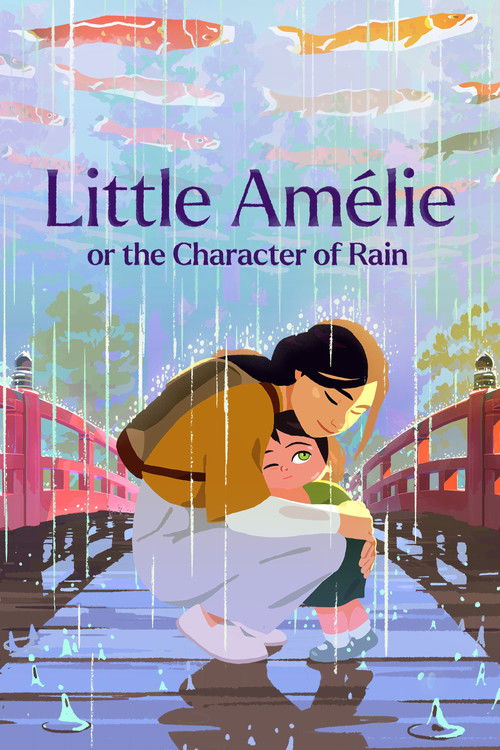
Little Amélie or the Character of Rain
2025 · Maïlys Vallade
For when you want wonder — a soft, luminous film to watch with kids, or alone when you need your sense of the world refreshed. Comfort viewing that still gives adults plenty to feel.
What it's about
A Belgian diplomat's family is living in post-war Japan, and the story unfolds entirely from inside the mind of their toddler daughter Amélie — for whom the world is a peaceful, perplexing mystery until a first taste of chocolate detonates her curiosity. At its center is her deepening bond with the housekeeper Nishio-san, through whom the grown-up world's unspoken griefs slowly come into view.
The experience
Wondrous and gentle, with real emotional depth pooling under the surface — it captures how enormous small things feel when you're new to the world. It leaves you tender-hearted and a little awed.
The craft
Hand-crafted French animation that renders the first years of consciousness from the inside: the world arrives as washes of watercolor and floods of pure sensation, adapted from Amélie Nothomb's supposedly unfilmable autobiographical novel. It's the rare animated film where the visual style is the story.
Why it matters
A showcase for France's artisanal animation tradition, proving that an interior, literary novel about infancy could become vivid cinema.
Amélie Nothomb's autobiographical novel The Character of Rain — narrated by a Belgian toddler who privately believes herself a god — would seem unfilmable, which is precisely what makes this French animated adaptation so quietly astonishing. Maïlys Vallade and Liane-Cho Han, both veterans of France's artisanal animation ecosystem, render the first years of consciousness from the inside: the world arrives as washes of watercolor and floods of sensation, and the discovery of chocolate lands with the force of a religious conversion. Set among a diplomat's family in Japan, the film builds its emotional core around Amélie's bond with the housekeeper Nishio-san, through whom the war's unspoken aftermath — and the gulf between adult grief and a child's wonder — gradually comes into view. Premiered at Cannes and garlanded at Annecy in 2025, it extends the lineage of French animation that trusts children's films to carry real metaphysics, alongside My Life as a Zucchini and The Red Turtle. Its recurring images — rain, ponds, carp, the sheen of water on leaves — tremble with hand-painted delicacy.
Reception
It slipped into Cannes 2025 as a low-key special screening, then quietly became the year's animation sleeper — winning audience awards at Annecy, San Sebastián and Animation Is Film before landing a Golden Globe nomination for Best Animated Feature.
How Little Amélie or the Character of Rain was received, from release to now →
Influences: the films it descends from and the films it influenced
- The Red Turtle (2016) — Establishes the France–Japan artisanal template of dialogue-light storytelling carried by tidal water-imagery, where the sea itself becomes a character rendered in soft painterly washes — the exact register Vallade/Han adopt for the toddler's oceanic self-dissolution.
- Father and Daughter (2000) — Its charcoal-and-watercolor-wash line and use of wind/water as an emotional metronome model the loose, breathing brushstroke that the seed film uses instead of hard cel outlines.
- The Tale of the Princess Kaguya (2013) — Takahata's radical unfinished-sketch aesthetic — visible brush-strokes, bleeding watercolor, blank paper left as space — is the direct technical precedent for hand-painted watercolor animation depicting a child's raw perceptual world.
- Grave of the Fireflies (1988) — Pioneers anchoring war-aftermath grief inside a child's uncomprehending sensory point of view, the affective structure the seed borrows for its post-war diplomatic-Japan setting.
- My Neighbor Totoro (1988) — The template for first-person childhood wonder in a Japanese domestic setting, where scale, light and small sensory events are staged entirely from a small child's eye-level curiosity.
- My Life as a Zucchini (2016) — Named influence — the model for European artisanal (here stop-motion) animation that treats a young child's consciousness of loss with unsentimental, tactile handmade craft rather than gloss.
- Ernest & Celestine (2012) — Its loose ink-and-watercolor illustrative line with soft undrawn backgrounds is the house style of the French artisanal studio tradition (a Vallade credit) that the seed extends into feature painting.
- Persepolis (2007) — Sets the precedent for a first-person autobiographical literary adaptation rendered in stylized 2D, letting an author's memoir voice-over drive childhood-to-consciousness narration.
- Flee (2021) — Carries the artisanal-animated literary memoir forward, proving hand-crafted animation can carry a first-person autobiographical voice through trauma and displacement for adult audiences.
- The Boy and the Heron (2023) — A contemporary counterpart pairing war-aftermath grief with a child's metaphysical passage between worlds in Japan, staged through hand-drawn subjective wonder.
- Song of the Sea (2014) — Shares the watercolor-flat, folklore-tinged palette and a small child's metaphysical relationship to the sea, using water motifs as the visual grammar of memory and grief.
- The Secret of Kells (2009) — Cartoon Saloon's hand-painted, deliberately flat illustrative craft is a parallel European answer to CG animation, prizing painted texture over dimensional realism as the seed does.
- Wolfwalkers (2020) — Extends painterly hand-drawn artisanal animation staged through a child protagonist's shifting perception, where line quality itself encodes emotional state.
- I Lost My Body (2019) — Contemporary French artisanal animation aimed at adult sensibilities, using subjective, sensory-memory sequencing to render interior consciousness — the same non-childish ambition as the seed.
- The Triplets of Belleville (2003) — Exemplifies the French auteur tradition of dialogue-sparse, hand-drawn caricatural animation carrying narrative through image and gesture rather than exposition.
- Only Yesterday (1991) — Structures a film around the fine-grained sensory texture of childhood memory recalled in adulthood, the introspective register the seed's first-person toddler narration inhabits.
Similar films
- My Life as a Zucchini (2016) — influence & lineage · same viewing thread
- Ernest & Celestine (2012) — influence & lineage · same viewing thread
- The Boy and the Heron (2023) — influence & lineage
- My Neighbor Totoro (1988) — influence & lineage
- The Tale of The Princess Kaguya (2013) — influence & lineage
- I Lost My Body (2019) — influence & lineage · same viewing thread
- The Little Prince (2015) — same viewing thread
- Memoir of a Snail (2024) — shared sensibility
All the films related to Little Amélie or the Character of Rain →
Watch it with: curated runs of related films
- Handmade Animation's Dark Wonder — A run of painstakingly handcrafted animation — painted, stop-motion, watercolor — where childhood wonder keeps brushing up against loss and the adult dark.