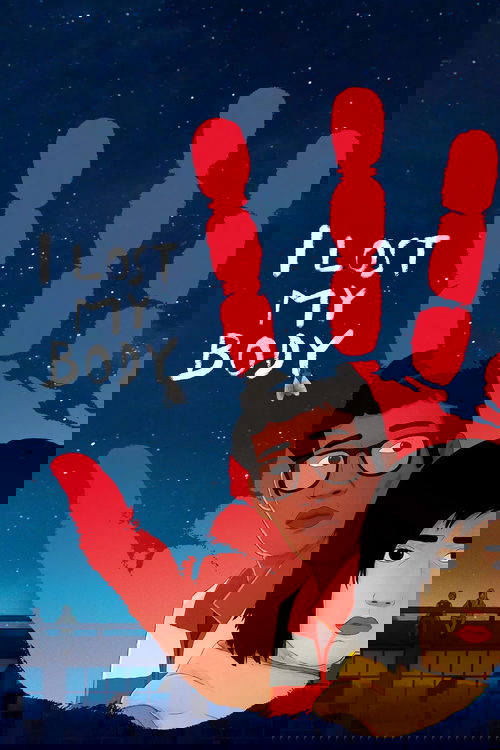
I Lost My Body
2019 · Jérémy Clapin
For when you want something genuinely unlike anything you've seen — a short, haunting evening that trusts you with melancholy. Reach for it when you're ready to feel something odd and true, not when you need comfort.
What it's about
Naoufel is a young Moroccan-born man adrift in Paris, delivering pizzas and nursing a quiet crush on Gabrielle, a librarian he barely knows how to approach. Meanwhile, across the city, a severed hand escapes from a dissection lab and begins crawling home, dodging pigeons, rats, and metro tracks in search of the body it belongs to. The film braids these two strands — a halting courtship and an impossible odyssey — until you understand why they're the same story.
The experience
Strange, tender, and quietly devastating — it moves with a dreamlike hush, punctuated by bursts of genuine peril whenever the hand ventures into the open. You spend the film leaning forward, and it earns the ache it leaves you with.
The craft
Clapin's animation mixes hand-drawn texture with expressive 2D/3D hybrid work, and the hand's journey is staged like a miniature adventure film — Paris at ankle height becomes a wilderness. Dan Levy's pulsing electronic score does enormous emotional lifting; this one rewards headphones or good speakers in a quiet room.
Why it matters
It became a landmark for adult-oriented animation, the first animated feature to win the Grand Prize at Cannes Critics' Week, and took the top prize at Annecy on its way to an Oscar nomination — proof that animation could carry grief and surrealism for grown-ups.
Snapshot
I Lost My Body (J'ai perdu mon corps) is the feature debut of French animator Jérémy Clapin, adapted from Guillaume Laurant's novel Happy Hand. It braids two narrative strands: the tender, halting courtship of Naoufel — a young man of Moroccan origin scraping by in Paris as a pizza delivery boy — and the odyssey of a severed hand that escapes a laboratory and crawls across the city to rejoin the body it was cut from. The film became a landmark in the recent history of adult-oriented animation, taking the Grand Prize at Cannes Critics' Week (the first animated feature to do so), the top Cristal for a feature at the Annecy International Animation Film Festival, and an Academy Award nomination for Best Animated Feature. Its reputation rests on an unusual fusion: a grief-soaked coming-of-age story told with the patience of an art film, and a near-wordless suspense narrative that turns a disembodied hand into a genuine protagonist.
Industry & production
The film was produced principally by Xilam Animation, the Paris-based studio led by Marc du Pontavice better known for commercial television animation (Oggy and the Cockroaches), which here staked a claim on prestige feature production. Development was long and difficult: the project reportedly struggled to find financing for years, an ambitious hand-drawn-inflected adult drama being a hard sell in a marketplace oriented toward family CGI. The screenplay was written by Clapin with Guillaume Laurant, the novelist whose credits as a screenwriter include Amélie and other Jean-Pierre Jeunet films; Laurant adapting his own book gave the project unusual continuity between source and script.
The decisive commercial event was acquisition by Netflix, which took worldwide streaming rights and released the film in late 2019, pairing streaming with a limited theatrical window sufficient to qualify it for awards. This distribution model — a European auteur animation reaching a mass global audience through a streamer rather than the traditional festival-to-arthouse pipeline — is itself part of the film's industrial significance. The precise budget and any box-office figures for the limited theatrical run are not reliably documented in the public record, and I will not invent them; the film's economic story is essentially a streaming-platform one.
Technology
I Lost My Body is a hybrid of two-dimensional and three-dimensional animation rather than a purely hand-drawn or purely CGI work. The hand's crawl through the physical world — gripping, leaping, clinging to trains, fending off rats and pigeons — relies substantially on 3D CGI to render weight, contact, and the tactile physics of a five-fingered creature navigating gutters, rooftops, and the Métro. Character animation and much of the film's texture retain a drawn, 2D sensibility, with the CGI compositing designed to sit within a muted, grainy, illustrative palette rather than announce itself as photorealism. This deliberate blending — using 3D where physical interaction demanded it while preserving a hand-crafted surface — is the film's central technical proposition, executed on a modest budget relative to major studio animation. Beyond that broad account, granular pipeline details (specific software, render approaches) are not something I can specify with confidence, and I won't fabricate them.
Technique
Cinematography
Because this is animation, "cinematography" is a matter of designed staging, virtual camera, and lighting rather than a photographed image, and the film does not foreground a single credited director of photography in the way a live-action production would; I won't attribute a name I can't verify. What is observable is a consistent visual grammar. The hand's storyline is shot low and close, hugging surfaces, so the ordinary city becomes a vast and threatening landscape seen from a few centimeters off the ground — a scale inversion that generates both suspense and pathos. Naoufel's story, by contrast, is framed in melancholic, muted interiors and gray Parisian exteriors. Clapin repeatedly uses point-of-view and near-subjective framing, and the film's memory sequences carry a warmer, more saturated cast associated with childhood in Morocco, so palette itself carries chronology.
Editing
The film's structure is fundamentally an editing achievement: it crosscuts among three temporal registers — the hand's present-tense journey, Naoufel's recent past (his courtship of Gabrielle and apprenticeship to a carpenter), and deeper childhood flashbacks. The cutting withholds the connection between the escaped hand and the young man for much of the running time, letting the audience assemble the relationship gradually, so that the reveal of how the hand was lost lands as both narrative and emotional payoff. Rhythmically, the hand sequences are built for tension and momentum while the Naoufel scenes breathe with the slower tempo of observational drama; the film's craft lies in modulating between these without the parallel structure feeling schematic. I'm not able to confirm the credited editor's name with certainty, so I'll leave that attribution open rather than guess.
Mise-en-scène / staging
The animation stages Paris as a lived-in, unglamorous city of delivery routes, cramped flats, and a carpenter's workshop, grounding the fantastical premise in mundane specificity. Recurring objects do heavy dramatic work: a cassette recorder onto which the child Naoufel captures sounds; a fly; a piano; the tools and wood of the joinery. These motifs recur across timelines, so staging becomes a system of rhymes linking childhood, courtship, and the severed hand's tactile memories.
Sound
Sound is arguably the film's most inventive dimension, precisely because the hand cannot speak. Its passages are carried by foley-like tactility — scraping, gripping, the textures of surfaces — and by the score rather than dialogue. The motif of recorded sound (the child's cassette capturing the world) makes the film partly about listening, and the sound design privileges the sensory and haptic in a way that compensates for the protagonist's silence.
Performance
The vocal performances are restrained and naturalistic, in keeping with the film's dramatic mode. In the original French, Naoufel is voiced by Hakim Faris and Gabrielle by Victoire Du Bois, with Patrick d'Assumçao among the supporting cast; the English-language version recast the roles for Netflix distribution. But the film's most remarkable "performance" is animated, not vocal: the hand is given a legible interiority — curiosity, fear, determination, grief — entirely through movement, timing, and gesture. Sustaining audience empathy for a mute, faceless appendage across a full act of screen time is the film's boldest performance gambit and its clearest success.
Narrative & dramatic mode
The film operates in a realist-melancholic register punctured by a single fantastical conceit. It is not whimsical fantasy in the mainstream-animation sense; the tone is closer to a grief drama or a coming-of-age story, with the fable of the wandering hand functioning as metaphor made literal. The dual structure — one strand suspense/quest, the other intimate romance-and-loss — allows the film to be simultaneously a thriller of small physical stakes and a psychological study of a young man shaped by early trauma. The narrative's central engine is the tension between fate and agency: whether one is condemned to a predetermined path or can, as the film's recurring language suggests, "deviate," break trajectory, and choose differently.
Genre & cycle
I Lost My Body sits within the tradition of adult, auteur-driven animated feature — the lineage that includes films positioning animation as a medium for serious drama rather than children's entertainment. It draws on multiple genre codes at once: fantasy (the animate severed hand), realist drama (Naoufel's immigrant working life and thwarted romance), and quest/survival suspense (the hand's perilous crossing of the city). It belongs to a late-2010s cycle of animation aimed squarely at grown audiences and awards recognition, a cycle in which festival prestige and streaming distribution increasingly replaced the family-multiplex model as the route to visibility.
Authorship & method
The film is decisively a director's work. Clapin came to it from a short-film background — his acclaimed short Skhizein (2008) already displayed his interest in bodies displaced from themselves and in animation as a vehicle for existential unease, a preoccupation that I Lost My Body extends to feature length. His method here is one of controlled hybridity: marrying 2D texture to 3D physicality, and marrying genre suspense to art-cinema patience.
His key collaborators shape that vision. Guillaume Laurant, adapting his own novel Happy Hand and co-writing the screenplay, supplied both the originating conceit and a literary sensibility carried over from his work with Jeunet. The score is by Dan Levy, of the French pop duo The Dø, whose music — blending electronic and orchestral textures — is widely credited as central to the film's emotional and sensory impact, giving voice to the wordless hand and binding the timelines together. On the cinematography and editing credits I'll be candid that I cannot reliably name the individual department heads, and I decline to invent attributions; the authorial signature that the record does firmly support is Clapin's, with Laurant and Levy as the most consequential named collaborators.
Movement / national cinema
The film is a product of contemporary French animation, a national tradition that has cultivated feature animation as an art form — a lineage encompassing figures such as Michel Ocelot, Sylvain Chomet, and Marjane Satrapi and Vincent Paronnaud's Persepolis, and sustained institutionally by the Annecy festival and France's animation funding ecosystem. Within that tradition, I Lost My Body represents the strand most committed to formal experiment and adult subject matter. Its Moroccan-French protagonist and its Parisian working-class milieu also connect it, thematically, to French cinema's ongoing engagement with immigration and displacement, here refracted through animation rather than social realism.
Era / period
Arriving in 2019, the film is emblematic of its moment in two respects. Aesthetically, it reflects a maturing confidence in hybrid 2D/3D pipelines that let a mid-budget European production achieve a distinctive, non-photoreal look. Industrially, it is a signal case of the streaming era reshaping how auteur animation reaches audiences: a festival darling whose global life was underwritten by Netflix. It captures the exact juncture at which the prestige-animation conversation and the streaming-distribution model converged.
Themes
The film's governing theme is destiny versus deviation — the question of whether a life is fixed by its early wounds or can be redirected by will and chance. This is dramatized through the child Naoufel's fascination with becoming an astronaut or a pianist, ambitions overtaken by loss; through the recurring idea of catching a fly (an image of trying to seize the uncatchable, to intervene in fate); and through the literal act of the hand refusing its severed condition and striving back toward wholeness. Memory is a second major theme — the cassette-recorded sounds that preserve the past, the hand as a repository of tactile remembrance. Grief and trauma underlie both strands, as does the body itself: what it means to be whole, to be dismembered, to feel through touch. Love and connection, and the courage required to "deviate" from a determined trajectory in order to reach another person, complete the thematic web. The severed hand is finally legible as a metaphor for a self trying to reintegrate what loss has torn apart.
Reception, canon & influence
Critically, I Lost My Body was received as a revelation and quickly entered the conversation about the finest animated features of its year and of the decade's adult-animation wave. Its festival record is central to its canonization: it won the Grand Prize at Cannes Critics' Week in 2019 — historically the first animated feature to take that award — and swept the top honors at Annecy, winning the Cristal for a feature film along with the Audience Award, a rare double signaling both critical and popular endorsement. It went on to a Best Animated Feature nomination at the Academy Awards, an unusual berth for a hand-crafted European art film in a category dominated by American studio product.
Reading influences backward, the film descends from the tradition of adult European animation and from Clapin's own short-film preoccupations with dislocated bodies; its literary origin in Laurant's Happy Hand ties it to a specifically French sensibility, and its "living severed hand" premise resonates with a long cultural lineage of animate-hand tales without being a direct adaptation of any of them. Looking forward, its legacy is bound up with its distribution model: it helped demonstrate that ambitious, adult, non-franchise animation could find a large audience through streaming and could compete for the industry's top awards. For a generation of animators and producers it became a reference point for the artistic and commercial viability of the personal, hybrid-technique animated feature — evidence that the medium's frontier lies in serious drama as much as in spectacle. Any more specific claims about individual works it directly inspired would be speculative, and I'll leave its forward influence at the level the record supports: a proof-of-concept and a benchmark for prestige animation in the streaming age.
Reception
It premiered as a word-of-mouth sensation — first animated film ever to win the Critics' Week Grand Prize at Cannes in 2019 — then Netflix scooped it up and turned a tiny French indie into a global cult item almost overnight; it's only grown in stature as a high-water mark for grown-up animation.
How I Lost My Body was received, from release to now →
Influences: the films it descends from and the films it influenced
- Skhizein (2008) — Clapin's own short established the signature conceit of a body displaced from itself — a character 91cm out of sync with his own physical location — that the feature scales up into the severed hand crawling back toward its owner.
- The Triplets of Belleville (2003) — Modeled the near-dialogue-free French feature that carries plot and emotion entirely through character-animation pantomime and dense Foley/sound design standing in for speech.
- Amélie (2001) — Shares co-writer Guillaume Laurant, whose method of threading a story through small recurring physical talismans and a destiny-versus-chance armature is carried directly into the hand's flashback objects.
- Persepolis (2007) — Proved the hand-crafted, high-contrast French adult-auteur animated feature could reach an Oscar Best-Animated berth as serious autobiographical drama rather than studio spectacle.
- Fantastic Planet (1973) — Founding text of French art-house animation pitched at adults, using uncanny bodies and existential unease as the medium's subject — the tradition Clapin's tactile dread extends.
- The King and the Mockingbird (1980) — The originating French director-driven animated feature whose patient art-cinema pacing and authored world-building set the auteur template Clapin works within.
- Waltz with Bashir (2008) — Built a fractured non-linear structure that crosscuts memory fragments and withholds the central traumatic reveal until the end, using hybrid animation techniques to render subjective recall — the exact editing logic of the hand's timelines.
- Father and Daughter (2000) — Demonstrated wordless, gesture-only storytelling built on a single recurring motif returning across time, driving emotion through movement and a restrained palette.
- Ernest & Celestine (2012) — French 2D feature holding the hand-drawn line against 3D orthodoxy, part of the wave Ernest helped legitimize commercially.
- The Summit of the Gods (2021) — A French hand-drawn adult feature for grown-up dramatic subject matter distributed via Netflix, extending Clapin's demonstration that serious 2D auteur animation is streaming-viable.
- Robot Dreams (2023) — An entirely wordless European animated feature carrying its whole emotional arc through character gesture and Foley, inheriting the pantomime-and-sound performance mode Clapin gave his voiceless hand.
- Memoir of a Snail (2024) — An adult stop-motion feature built on grief, bodily damage, and recurring object motifs across a fractured life-story timeline, extending the serious-drama-as-animation frontier the film benchmarked.
- In Waves (2026) — French adult 2D-over-3D hybrid organized around associative memory editing, and the Cannes Critics' Week-to-streamer (Netflix) release pipeline In Waves follows almost exactly.
- The Red Turtle (2016) — A feature-length wordless drama where meaning rides entirely on body gesture, ambient Foley, and chromatic minimalism rather than dialogue — the same performance grammar as the hand.
- Flee (2021) — Uses hybrid animation to crosscut layered memory timelines toward a withheld personal reveal, and its triple-Oscar-nominee streaming run extended I Lost My Body's proof that adult animation competes at the top of the awards field.
- Wolfwalkers (2020) — Marries hand-drawn 2D texture to 3D-informed camera and space and rode streaming (Apple) to Annecy and Oscar recognition — the same hybrid-technique, non-franchise prestige model launched near-simultaneously.
- My Life as a Zucchini (2016) — A small-scale European art animation treating childhood grief and loss with unsentimental adult seriousness, part of the same festival-to-streaming prestige wave for non-spectacle animation.
- Marona's Fantastic Tale (2019) — A same-year French-produced adult auteur feature using shifting hand-drawn styles and a non-linear life-in-flashback structure, a direct contemporary in the crosscut-memory adult-animation cohort.
- Little Amélie or the Character of Rain (2025) — Contemporary French artisanal animation aimed at adult sensibilities, using subjective, sensory-memory sequencing to render interior consciousness — the same non-childish ambition as the seed.
- Jim Queen and the Quest for Chloroqueer (2026) — French adult animation feature that literalizes 'the body as destiny' by giving a severed body part its own agency and narrative drive.
- The Little Prince (2015) — French auteur animation distributed via Netflix that crosscuts two temporal/spatial registers into one story, an era-sibling in both streaming pathway and dual-track editing structure.
- Arco (2025) — Part of the French adult-auteur 2D revival, using a cross-time flashback structure and hand-drawn intimacy that parallels Arco's memory-and-preservation editing logic.
Similar films
- My Life as a Zucchini (2016) — influence & lineage · same viewing thread
- Memoir of a Snail (2024) — influence & lineage
- Robot Dreams (2023) — influence & lineage
- Flee (2021) — influence & lineage
- Waltz with Bashir (2008) — influence & lineage
- Little Amélie or the Character of Rain (2025) — same viewing thread
- Loving Vincent (2017) — same viewing thread
- In Waves (2026) — shared sensibility
All the films related to I Lost My Body →
Watch it with: curated runs of related films
- Handmade Animation's Dark Wonder — A run of painstakingly handcrafted animation — painted, stop-motion, watercolor — where childhood wonder keeps brushing up against loss and the adult dark.