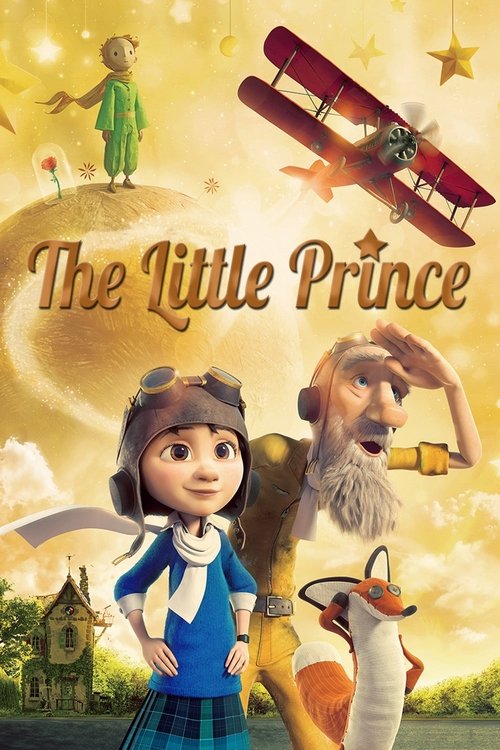
The Little Prince
2015 · Mark Osborne
For a tender family night, or when you need to feel like a kid again — comfort viewing that still leaves grown-ups a little misty. Reach for it when the calendar has been running your life.
What it's about
A little girl's life has been scheduled down to the minute by her anxious single mother — the right school, the right plan, no time wasted — until the eccentric old aviator next door starts slipping her pages of a story about a boy prince he once met in the desert. The film weaves Saint-Exupéry's famous fable into this modern frame, so a tale about a rose, a fox, and tiny planets becomes a lifeline for a child being rushed out of childhood.
The experience
Gentle, wistful, and quietly sad in the way the best family films are, with bursts of real whimsy whenever the fable takes over. It moves at a child's dreamy pace and earns its lump-in-the-throat moments honestly.
Performances
Jeff Bridges gives the Aviator a warm, rumpled, grandfatherly voice that holds the whole film together.
The craft
The film's masterstroke is its two animation styles: the girl's world is rendered in cool, clean CG, while the Little Prince's story unfolds in handmade paper stop-motion that looks like watercolor illustrations come to life. The switch between them is the story's meaning made visible, and the stop-motion passages are gorgeous on a big screen.
Why it matters
One of the most acclaimed screen versions of a book long considered unfilmable, it showed that a beloved literary fable could be adapted by reframing it rather than merely illustrating it.
Snapshot
The Little Prince is a French-produced, English-language animated feature that adapts Antoine de Saint-Exupéry's 1943 novella not by dramatizing it straight, but by wrapping it inside an invented frame story. In the film's present tense, a nameless Little Girl is being drilled through a suffocating "life plan" by her single mother when she befriends an elderly Aviator next door, who parcels out to her — in weathered manuscript pages — the tale of a boy prince he once met in the desert. Director Mark Osborne, whose prior feature was DreamWorks' Kung Fu Panda (2008), builds the film's whole meaning out of a formal split: the contemporary frame is rendered in cool, geometric CG, while the embedded fable is animated in handmade paper stop-motion evoking Saint-Exupéry's watercolors. It premiered out of competition at the 2015 Cannes Film Festival, won the César for Best Animated Film, and became a minor cause célèbre when its planned US theatrical release collapsed and Netflix acquired it. It is the first animated feature adaptation of one of the most translated books in the world, and it is best understood as an essay on how — and whether — the book can be handed from one generation to the next.
Industry & production
The film was a European production assembled principally through French companies — Osborne worked with producers Aton Soumache and Dimitri Rassam, whose On Entertainment / Onyx Films orbit, together with Orange Studio, anchored the financing. This placed The Little Prince within a specific industrial niche: a globally ambitious, English-language animated feature financed largely outside the American studio system, aimed at the international family market while carrying the prestige of a canonical French literary property. It was widely reported at the time to be among the most expensive French-backed animated productions ever mounted, though I won't attach a specific figure to that here, as budget reporting for cross-border animation is notoriously soft.
The production's most consequential industrial episode came after completion. Paramount held US rights and scheduled a wide theatrical release for March 2016, then abruptly pulled the film from the calendar days before it was due to open — an unusual and, for its makers, painful decision that left a finished, festival-decorated film without an American home. Netflix stepped in to acquire US distribution and streamed it in the summer of 2016. That sequence became part of the film's story: a picture explicitly about the tension between industrial "efficiency" and the value of things that resist it was itself yanked by the logic of the release calendar. Elsewhere in the world it had a conventional theatrical life, opening in France and other territories in 2015.
Technology
The defining technological fact of The Little Prince is that it runs two entirely different production pipelines and sets them in dialogue. The frame narrative is computer-generated animation — modeled, rigged, and rendered in the modern feature CG pipeline — while the interpolated fable is genuine physical stop-motion, built from paper, cardstock, wire, and textile. The paper sequences are not a CG imitation of paper; they were handcrafted as tangible puppets and sets and shot frame by frame, so the fibrous edges, creases, and slight imperfections read as real material captured by a camera rather than as a shader effect. The CG frame, by contrast, exploits the medium's capacity for clean geometry, controlled light, and mechanically precise motion.
This is a deliberate technological argument rather than a novelty. Digital tools give the adult world its polished, repeatable, factory-finished surface; the analog, hand-touched process gives the fable its warmth and fragility. The film thus uses the affordances of each technology as characterization — the medium is doing thematic work, aligning the "efficient" modern world with digital reproducibility and the imaginative one with irreproducible handwork.
Technique
Cinematography
Because it is animated, the film's "cinematography" is a matter of virtual and physical camera design, and the two registers are lit and framed to feel like different worlds photographed by different sensibilities. The CG frame favors wide, ordered compositions, planar geometry, and a desaturated, cool palette — grids, right angles, and a city landscaped into identical parcels — with camera moves that are smooth and controlled. The stop-motion fable opens the palette into warm ambers and golds, shallow tactile depth, and a more intimate, storybook framing that keeps the paper puppets close and legible. The transitions between the two — the moment a page comes alive — are among the film's signature images.
Editing
The editing carries the film's central structural burden: it must braid a naturalistic coming-of-age drama with a discontinuous fable delivered in fragments, and make the crosscutting feel motivated rather than mechanical. Sequences typically hand off from the Girl's reading or the Aviator's telling into the paper world and back, with the fable's beats timed to comment on the frame story's emotional turns. The film's third act complicates this further, when the Girl herself enters a stylized version of the story world and the two registers begin to bleed together; the cutting has to manage that convergence without dissolving the distinction the whole film has been built on.
Mise-en-scène / staging
Production and character design draw a hard line between the two worlds. The frame world is staged as a landscape of conformity — uniform houses, scheduled time, muted institutional spaces — against which the Aviator's chaotic, overgrown house and garden read as a pocket of disorder and life. The paper world reproduces the visual grammar of Saint-Exupéry's own illustrations: the small planet, the single rose, the baobabs, the volcanoes, the fox. Staging repeatedly rhymes the two — an object, gesture, or spatial arrangement in the fable answering something in the Girl's real life — so that the mise-en-scène itself argues that the story is a key to her world.
Sound
Sound design reinforces the split, with the modern world's mechanical, clockwork ambience set against the softer, more organic textures of the fable and the desert. The score, discussed below, is central to the sound world, and the film leans on musical cues to mark passage between the two registers and to color the frame story's emotional arc.
Performance
As voice performance, the film is carried by Jeff Bridges as the Aviator and Mackenzie Foy as the Little Girl, whose relationship is the emotional spine; Bridges gives the old man a frayed, affectionate warmth, and Foy modulates from clenched diligence to openness. Rachel McAdams voices the Mother. The fable is populated by a deep supporting cast — including Marion Cotillard as the Rose, James Franco as the Fox, Benicio del Toro as the Snake, and Paul Rudd in the frame-adjacent role of the grown "Mr. Prince," with further turns from performers such as Ricky Gervais, Albert Brooks, Paul Giamatti, and others across the fable's vignettes. The film was also produced in a separate French-language version with a distinct cast, appropriate to its origin.
Narrative & dramatic mode
The film's boldest choice is dramaturgical: it does not simply adapt the novella but frames it. The novella's episodic, aphoristic structure — a series of encounters recounted by a downed aviator — resists conventional feature plotting, so the filmmakers invented an outer story with a clear protagonist, want, and arc: a child taught to be efficient who must learn what the book has to teach. This turns Saint-Exupéry's text into an object within the film — pages, a gift, an inheritance — and makes the drama about reception and transmission rather than about the prince himself.
The mode is thus doubled. The frame is realist, contemporary, character-driven melodrama in the best sense; the fable is lyric, allegorical, and episodic. The controversial extension into a third-act "sequel" — following the Girl as she seeks out what became of the grown prince in a hyper-efficient adult world — is the film's biggest departure from the source and the point critics most often divide over, since it literalizes and plots material the book left as parable. Whatever one makes of it, it is the logical endpoint of the film's decision to dramatize not the story but the act of carrying the story forward.
Genre & cycle
The Little Prince sits at the intersection of family animation, literary adaptation, and auteur-driven "artisanal" animated feature. It belongs to a mid-2010s current in which animation reached self-consciously for handcraft and painterly texture as an alternative to the default gloss of mainstream CG — a milieu that includes the stop-motion of Laika and the international art-house animation feature. Its specific innovation within that cycle is not to choose one mode but to stage the very contrast between industrial CG and handmade stop-motion as the film's subject. As adaptation, it participates in the long tradition of illustrated-classic-to-screen family filmmaking, but distinguishes itself by refusing the straight transcription that the novella's fame might have invited.
Authorship & method
Mark Osborne is the film's clear author, and the project bears the marks of a director thinking about form as argument. Coming from Kung Fu Panda and, earlier, the acclaimed short More, Osborne approached Saint-Exupéry's near-untouchable text by reframing rather than replacing it, and by committing to the technically demanding two-medium structure. The screenplay is credited to Irena Brignull and Bob Persichetti, whose invented frame story is the adaptation's load-bearing idea; Persichetti would go on to co-direct Spider-Man: Into the Spider-Verse (2018), another film built on the expressive collision of animation registers, which makes his presence here retrospectively notable.
The score is by Hans Zimmer with Richard Harvey, and the French singer-songwriter Camille contributed vocal songs, lending the film a distinctly French musical voice that ties it back to its cultural origin; the music is one of the most consistently praised elements. The film was assembled by a large international crew spanning the CG and stop-motion units — the physical fable required a dedicated puppet, set, and stop-motion team distinct from the CG animators — and I'll flag that below-the-line attributions for the two units (individual heads of the stop-motion department, editors, and production designers) are the sort of credit the popular record reports inconsistently, so I won't assign specific names I can't be sure of. The salient authorial fact is the division of labor itself: two crafts, deliberately kept visible.
Movement / national cinema
The film is French cinema in its financing, its cultural ownership of the source, and its Camille-scored musical identity, but it is transnational in language, cast, and address — an artifact of a globalized European animation industry that produces English-first features for the world market while drawing prestige from national literary heritage. Its recognition by the Césars marks it as claimed within French national cinema; its Netflix-mediated US life marks it as a creature of the emerging streaming-distribution order. It does not belong to a single national school so much as to the contemporary condition of European auteur animation reaching for global scale.
Era / period
Made and released in the mid-2010s, the film is legible as a period document in two ways. Thematically, its satire of a scheduled, optimized, productivity-obsessed childhood speaks directly to 2010s anxieties about efficiency culture and over-managed children. Industrially, its distribution saga — a finished theatrical film rerouted to Netflix after a studio abandoned it — captures the exact moment streaming became a viable rescue and rival to theatrical release for mid-budget, non-franchise films. The picture is thus a snapshot of animation caught between the multiplex and the stream.
Themes
At its center is the opposition the synopsis names: a world where "efficiency and work are the only dogmas" versus a way of seeing that values the invisible, the useless, and the loved. The film dramatizes the novella's most quoted idea — that what is essential is invisible to the eye — as a lesson the Girl must recover from an adult world that has trained it out of her. Around this cluster its other themes: the loss and preservation of childhood; the fear of, and reconciliation with, mortality (the Aviator's age, the Snake, the pointed refusal to pretend death away); memory and inheritance, since the film is fundamentally about whether a story — and the values in it — can be passed to the next generation before its keeper is gone. The invented frame makes transmission itself the theme: the book is not just adapted but shown being given away.
Reception, canon & influence
Critically, The Little Prince was warmly received, particularly for the beauty and daring of its paper stop-motion, Osborne's inventive framing device, and the Zimmer/Harvey/Camille score; the most common reservation concerned the invented third act, which some felt over-plotted a book that thrives on suggestion. Its clearest institutional endorsement was the César for Best Animated Film. Its US non-release and subsequent Netflix pickup became a widely discussed footnote about the fate of animated features outside franchise IP, and I'll note honestly that the film's precise commercial performance is not something I'll quantify here.
Its influences run backward to Saint-Exupéry's 1943 text and its indelible watercolors, which the paper sequences consciously reincarnate, and to the broader tradition of handcrafted stop-motion as a marker of authenticity and warmth. Looking forward, its most concrete legacy may be less as a template others copied than as a proof of concept for staging medium-contrast as meaning — an idea that Bob Persichetti, its co-writer, would help carry into the very different but formally kindred Into the Spider-Verse. As the first animated feature to take on this endlessly adapted book, it also set a reference point for how the novella can be honored on screen: not by illustration alone, but by making the reader — the child receiving the story — the true subject of the film.
Reception
A massive hit in France — Cannes premiere, César winner, and for a while the most successful French animated film ever abroad — yet in the US it became famous for the wrong reason: Paramount yanked its theatrical release days before opening and Netflix scooped it up, turning a global blockbuster into an American streaming curio that's since been quietly reclaimed as a hidden gem.
How The Little Prince was received, from release to now →
Influences: the films it descends from and the films it influenced
- The Adventures of Prince Achmed (1926) — Pioneered feature-length flat paper-cutout/silhouette stop-motion, the exact handmade-paper technique the film's inner fable revives to signal the storybook's material origin.
- The Tale of the Princess Kaguya (2013) — Adapts a literary source by animating its original illustrative idiom itself — brush-and-watercolor texture becomes the film's surface, the same 'reincarnate the source art rather than illustrate it' move behind the paper sequences.
- Fantastic Mr. Fox (2009) — Foregrounds deliberately tactile, imperfect puppet stop-motion so that visible handcraft reads as authenticity and warmth against slicker CG — the value system the film's stop-motion unit is built on.
- Coraline (2009) — Runs a hybrid pipeline that fuses stop-motion puppets with CG support and stages a drab-real vs. vivid-other two-world contrast, prefiguring the film's dual-register palette.
- The Princess Bride (1987) — Wraps the tale in a grandparent-reads-to-a-child frame where the listening child, not the story's hero, is the true subject — the load-bearing framing device Brignull and Persichetti invented for the adaptation.
- The Triplets of Belleville (2003) — Models European auteur animation as near-wordless, music-forward storytelling carrying an unmistakably French voice, the tradition the Camille/Zimmer songs place the film within.
- Persepolis (2007) — French adaptation that preserves the source's flat, high-contrast illustrative line rather than rounding it into conventional cartoon volume — fidelity-to-drawn-style as adaptation strategy.
- More (1998) — Osborne's own stop-motion short establishing his handcrafted register and the childhood-wonder-vs-adult-conformity argument the feature restages at length.
- Spider-Man: Into the Spider-Verse (2018) — Co-writer Persichetti carries forward 'medium-contrast as meaning' — colliding distinct animation registers within one film so that the seam between styles itself becomes narrative.
- Kubo and the Two Strings (2016) — Laika hybrid of stop-motion and CG organized around paper/origami as an on-screen craft object, making the handmade medium the story's own subject as the paper unit does here.
- Loving Vincent (2017) — Uses a labor-intensive handmade process (frame-by-frame oil painting) to reincarnate a specific source visual style, the same 'craft as fidelity to the original artwork' logic as the watercolor-derived paper sequences.
- The Red Turtle (2016) — Wordless cross-border European auteur fable (Ghibli/French co-production) that trusts image and gesture over plot — the suggestive, un-over-plotted register critics wished the third act had kept.
- Song of the Sea (2014) — Cartoon Saloon's flat, illustration-honoring hand-drawn line treats folk imagery as design vocabulary, the contemporary European-auteur counterpart to the film's book-faithful surfaces.
- Klaus (2019) — An artisanal-looking, non-franchise animated feature that reached audiences through streaming (Netflix), the same mid-2010s distribution shift that defined the film's US non-release and Netflix pickup.
- My Life as a Zucchini (2016) — Franco-Swiss stop-motion feature using tactile puppets and understated voice performance to handle childhood loss for an art-house audience, sharing the handcrafted-fable-for-grown-and-young register.
- I Lost My Body (2019) — French auteur animation distributed via Netflix that crosscuts two temporal/spatial registers into one story, an era-sibling in both streaming pathway and dual-track editing structure.
Similar films
- My Life as a Zucchini (2016) — influence & lineage · same viewing thread
- Kubo and the Two Strings (2016) — influence & lineage
- Fantastic Mr. Fox (2009) — influence & lineage
- The Tale of The Princess Kaguya (2013) — influence & lineage
- Coraline (2009) — influence & lineage · same viewing thread
- Loving Vincent (2017) — influence & lineage · same viewing thread
- I Lost My Body (2019) — influence & lineage · same viewing thread
- Little Amélie or the Character of Rain (2025) — same viewing thread
All the films related to The Little Prince →
Watch it with: curated runs of related films
- Handmade Animation's Dark Wonder — A run of painstakingly handcrafted animation — painted, stop-motion, watercolor — where childhood wonder keeps brushing up against loss and the adult dark.