My Life as a Zucchini
2016 · Claude Barras
For when you need a good cry that ends in warmth rather than wreckage — short enough for a school night, tender enough to restore your faith in people. Fine for older kids, but it hits adults hardest.
What it's about
After his mother's death, a boy nicknamed Zucchini is taken by a kind police officer to a foster home full of other orphans his age. Among kids who share their catastrophes the matter-of-fact way children actually do, he slowly learns to trust people again — and starts looking for a family of his own.
The experience
Gentle, plainspoken, and devastating in about equal measure — it's only 66 minutes, but it carries more emotional weight than most films twice its length. You'll cry, and it'll be the good kind.
The craft
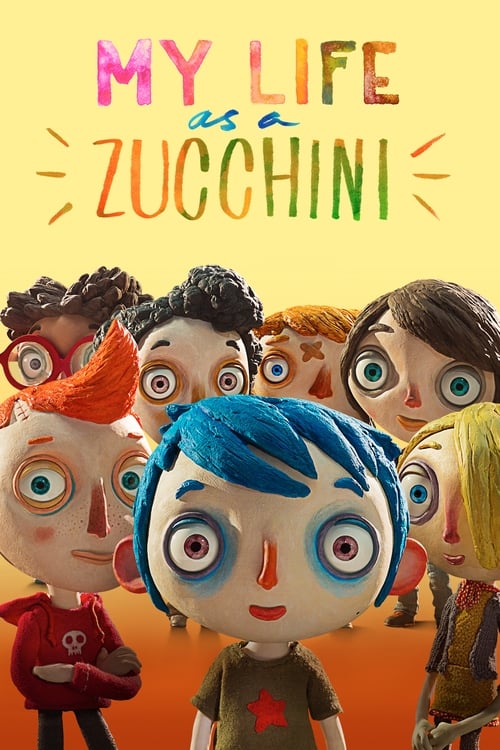
Claude Barras' stop-motion puppets — saucer eyes, blue hair, heads too big for their bodies — look naive on purpose: the childlike surface lets the film speak plainly about abandonment and abuse without ever depicting them. Céline Sciamma's screenplay is a marvel of what's left unsaid, refusing villains and treating tenderness as a form of realism.
Why it matters
An Oscar-nominated proof that handmade animation could tackle the hardest childhood subjects with honesty, it became a modern touchstone for grown-up stop-motion storytelling.
Sixty-six minutes of stop-motion that carries more emotional intelligence than most films twice its length. Claude Barras' puppets are deliberately naive — saucer eyes, blue hair, heads too big for their bodies — and the style turns out to be the point: the childlike surface lets the film speak plainly about abandonment, addiction, and abuse without ever depicting them, everything arriving secondhand in the matter-of-fact way children actually share their catastrophes. The screenplay is by Céline Sciamma, adapting Gilles Paris' novel in the same years she was making her own films about childhood, and her fingerprints are everywhere — in the precision of what's left unsaid, in the refusal of villainy, in the conviction that tenderness is a form of realism. The orphanage here is not a Dickensian trial but a place where damaged kids practice being kind to each other. Premiered in the Directors' Fortnight at Cannes, it earned Switzerland an Academy Award nomination for animated feature. The handmade texture matters: every flicker of those enormous eyes had to be posed by human fingers, and you can feel it.
Reception
No reappraisal needed: it stormed out of Cannes' Directors' Fortnight in 2016, swept Annecy, won two Césars and landed an Oscar nomination — and a decade on it's only consolidated its status as one of the 2010s' most beloved animated sleepers.
How My Life as a Zucchini was received, from release to now →
Influences: the films it descends from and the films it influenced
- The 400 Blows (1959) — The template for a child's-eye view of institutional neglect observed without editorializing, shuttling a boy into juvenile detention and ending on an unresolved image — the same refusal to sentimentalize trauma Zucchini adopts.
- Ponette (1996) — Sustained immersion in a grieving small child's literal logic and point of view, the naive-child performance register that Zucchini's puppets and dialogue deliberately imitate.
- The Kid with a Bike (2011) — An abandoned boy placed in care whose grief is carried by small gestures rather than exposition — the withholding, backstory-starved economy Zucchini's script mirrors.
- Mary and Max (2009) — A feature-length clay-puppet drama that trusts stop-motion to carry adult weight — abandonment, loneliness — with deadpan tenderness instead of gag comedy.
- Fantastic Mr. Fox (2009) — Revived a handmade stop-motion aesthetic that keeps fingerprints, fur-shimmer and visible seams on screen — the anti-slick tactile surface Zucchini's matte puppets share.
- Coraline (2009) — Established the modern articulated-puppet feature pipeline built around a child navigating loss, which Zucchini scales down to deliberately handmade, imperfect intimacy.
- The Triplets of Belleville (2003) — Near-dialogue-free French animation privileging caricatured handmade character design and visual economy over exposition, a precedent for naive puppet design carrying story.
- Petite Maman (2021) — Extends the same pared-down child's-grief storytelling, staking large loss on miniature, near-fairytale simplicity and restraint rather than plot.
- Portrait of a Lady on Fire (2019) — The Sciamma discipline of glances, silence and elision over spoken exposition — the writerly 'emotional economy' first seeded in the Zucchini screenplay.
- Marcel the Shell with Shoes On (2021) — Extends the handmade stop-motion of a small, wide-eyed naive character whose design and quiet loneliness generate tenderness-as-realism rather than spectacle.
- Isle of Dogs (2018) — Carries forward visible-craft stop-motion around a child protagonist and an abandonment theme, foregrounding the deliberately handmade texture Zucchini also prizes.
- Little Amélie or the Character of Rain (2025) — Named influence — the model for European artisanal (here stop-motion) animation that treats a young child's consciousness of loss with unsentimental, tactile handmade craft rather than gloss.
- Tomboy (2011) — Sciamma's own method of a camera pitched at kid-height and dialogue stripped to what children actually say — the 'left unsaid' emotional economy she then wrote into Zucchini.
- Anomalisa (2015) — Adult, dialogue-driven stop-motion that turns the puppet's visible face-seams into expressive vulnerability — the same move to puppetry for interior emotional realism.
- Kubo and the Two Strings (2016) — A same-year stop-motion feature about a bereaved child whose maximalist scale throws Zucchini's deliberately small, quiet, handmade counter-approach into relief.
- Ernest & Célestine (2012) — Franco-Belgian handmade children's feature built on odd-couple orphan tenderness and watercolor-soft, unslick art-house economy — the same European animation ethos as Zucchini.
- Persepolis (2007) — A literary/graphic-novel adaptation using a child's naive-eyed perspective to process trauma in an adult-oriented animated feature — the adaptation model Barras and Sciamma follow.
- Memoir of a Snail (2024) — A stop-motion feature built on childhood grief, orphanhood and institutional loneliness, delivered with tender restraint — the same melancholy-clay register Elliot works, minus the comedy floor.
- The Little Prince (2015) — Franco-Swiss stop-motion feature using tactile puppets and understated voice performance to handle childhood loss for an art-house audience, sharing the handcrafted-fable-for-grown-and-young register.
- I Lost My Body (2019) — A small-scale European art animation treating childhood grief and loss with unsentimental adult seriousness, part of the same festival-to-streaming prestige wave for non-spectacle animation.
Similar films
- Coraline (2009) — influence & lineage · same viewing thread
- Petite Maman (2021) — influence & lineage
- The Kid with a Bike (2011) — influence & lineage
- Kubo and the Two Strings (2016) — influence & lineage
- Anomalisa (2015) — influence & lineage
- Little Amélie or the Character of Rain (2025) — same viewing thread
- The Little Prince (2015) — same viewing thread
- Loving Vincent (2017) — same viewing thread
All the films related to My Life as a Zucchini →
Watch it with: curated runs of related films
- Handmade Animation's Dark Wonder — A run of painstakingly handcrafted animation — painted, stop-motion, watercolor — where childhood wonder keeps brushing up against loss and the adult dark.