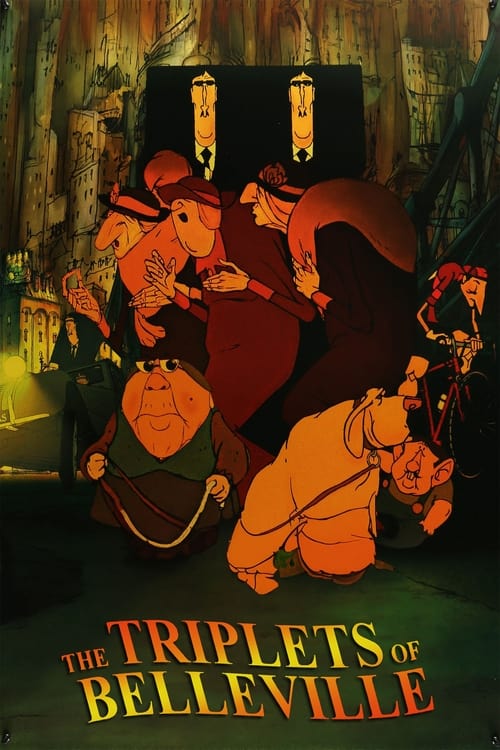
The Triplets of Belleville
2003 · Sylvain Chomet
For when you want something genuinely unlike anything else — a playful, art-forward evening that asks a little patience and pays it back in charm. Great when you're tired of dialogue and want a film that works like music.
What it's about
A stooped, indomitable grandmother raises her orphaned grandson into a Tour de France cyclist — and when faceless mobsters snatch him mid-race and ship him across the ocean to the bloated city of Belleville, she goes after him. Her only allies are Bruno, her fat, train-obsessed dog, and three elderly sisters who were music-hall stars in the 1930s and now live on frog stew. It's a rescue mission told almost entirely without dialogue, through drawing, music, and sound.
The experience
Strange, funny, and oddly tender — you settle into its wordless rhythm and start reading faces, gaits, and squeaks the way you'd normally read lines. It ambles, then swerves into slapstick chase energy, and the grotesque character designs keep tipping between hilarious and unsettling.
The craft
Hand-drawn caricature in the European comics tradition, pushed to gleeful extremes: bodies are geometry, cities are appetites, and every frame is dense with visual jokes. Because there's almost no dialogue, the sound design and the hot-jazz score do the storytelling — this one rewards good speakers as much as a big screen.
Why it matters
It became an international standard-bearer for adult, auteur-driven animation outside the American studio system, earning Oscar nominations and announcing Sylvain Chomet as a singular voice.
Snapshot
The Triplets of Belleville (French: Les Triplettes de Belleville) is a nearly wordless animated feature by the French cartoonist-turned-director Sylvain Chomet, made as a France–Belgium–Canada co-production and released in 2003. Its story is slender by design: Madame Souza raises her orphaned grandson, Champion, into a professional cyclist; when he is abducted mid-race during the Tour de France by faceless mafiosi and shipped across the Atlantic to the bloated metropolis of Belleville, Souza and her overweight, train-haunted dog Bruno pursue him, falling in with three superannuated music-hall singers — the Belleville Triplets, stars of the 1930s jazz age now scraping by on frog stew. What distinguishes the film is not plot but manner: a grotesque, caricatural drawing style descended from European comics; an almost total absence of dialogue; and a jazz- and musique-concrète-inflected score that turns the sisters' kitchen into a percussion orchestra. It earned Academy Award nominations for Best Animated Feature and Best Original Song ("Belleville Rendez-vous") and became one of the most internationally visible non-Disney, non-Pixar animated features of its moment — a standard-bearer for hand-drawn, auteur-driven animation as the industry pivoted to CGI.
Industry & production
The film emerged from the European tradition of patchwork, publicly-supported animation financing rather than a single studio. It was produced by Didier Brunner's Paris-based company Les Armateurs — the same outfit behind Michel Ocelot's Kirikou and the Sorceress — in partnership with Canadian and Belgian entities and with backing typical of the French system (broadcaster co-production via France 3, regional and pan-European animation funds). Production was distributed across studios in France, Belgium and Canada, and Chomet himself relocated to Montreal for part of the work, which helps explain both the Québécois flavor in the music personnel and the film's affectionate-hostile caricature of a North American city. This transnational, subsidy-supported model was the practical alternative to Hollywood scale: it let a first-time feature director retain authorship over a labor-intensive hand-drawn project that no major studio would have greenlit in that form.
The film premiered at the 2003 Cannes Film Festival and was picked up for North American release by Sony Pictures Classics, the arthouse specialty distributor — placement that framed it for critics and audiences as a prestige "world cinema" object rather than a family tentpole. Commercially it performed as a well-received specialty release rather than a blockbuster; I will not cite specific grosses, as reliable figures are easy to misstate, but its cultural footprint plainly exceeded its box office.
Technology
Belleville is a hybrid film made at the hinge point between cel animation and digital production. The bulk of the imagery is traditional two-dimensional character animation, executed through a digital ink-and-paint pipeline rather than physical celluloid. Onto this Chomet's team grafted computer-generated 3D elements for objects whose weight, mechanical motion or repetitive geometry would have been punishing to draw by hand — automobiles, the Tour peloton, bicycles, trains, and above all the transatlantic ocean liner and the churning sea Souza crosses on a pedal-boat. Crucially, the CGI was deliberately de-slicked and re-stylized to sit inside the drawn world: modeled with exaggerated proportions, matte or hand-treated surfaces, and motion tuned to the film's caricatural logic rather than photoreal physics. The result is one of the more successful early integrations of 2D and 3D in feature animation, and a pointed counter-argument, at the height of the post-Toy Story CGI boom, to the assumption that computer imagery had to look like Pixar.
Technique
Cinematography
Lacking a live-action camera, the film's "cinematography" is a matter of pictorial staging and a mobile virtual viewpoint, and Chomet exploits both aggressively. Compositions favor extreme caricatural perspective — deep, distorted space, low angles that make the mafia's black skyscrapers loom, wide vistas of Belleville's harbor crowded with obese pedestrians. The framing is often held long and static, letting gags and behavior play out within the frame in the manner of silent comedy, then punctuated by sweeping moves for the setpieces (the peloton grinding up a mountain, the pedal-boat pursuit across the ocean). Color and light are keyed emotionally rather than naturalistically: warm, faded sepia-browns for the European past and Souza's world; sickly, congested tones for Belleville. Bruno's memory-dreams are rendered in a separate visual register — grainy black-and-white — a deliberate stylistic quotation of early cinema and cartoon.
Editing
The cutting is patient and comic-strip-like, built around sustained observation and payoff rather than rapid coverage — appropriate to a film that thinks in terms of drawn panels and pantomime. Setpieces such as the Tour de France climb and the climactic chase are assembled with more conventional action rhythm, cross-cutting between pursuers and pursued. The film's editing credit is less consistently documented in general reference sources than its direction and music, so I will not attribute it to a specific named editor rather than risk error; what is clear from the finished film is an assembly disciplined around gag architecture and musical time.
Mise-en-scène / staging
This is the film's richest dimension. Every frame is dense with character-drawing and physiognomic invention: Souza with her thick glasses, built-up orthopedic shoe and stumping gait; Champion's grotesquely overdeveloped cyclist's legs atop a bird-thin torso; the mafia henchmen drawn as identical black rectangles, human only from the knees down. Belleville itself is staged as satire — a swollen caricature amalgamating New York, Montreal and the American metropolis, its Statue-of-Liberty analog gone corpulent, its citizens uniformly enormous. Props do narrative and comic labor: the tricycle-icecream-cart, the vacuum cleaner, the refrigerator shelf and newspaper the Triplets repurpose as instruments. The staging descends visibly from the European bande dessinée and from the observational physical comedy of Jacques Tati, whose crowded, behavior-driven long shots Chomet openly admired.
Sound
Sound is arguably the film's true dialogue. With spoken language reduced to almost nothing — a few television announcers, muttered mafia lines — the soundtrack carries meaning through effects, music and Foley: Bruno's rhythmic barking at the passing train, the metronomic whir of bicycle wheels, the slap of the ocean. The centerpiece is the Triplets' performance sequence, a set of musique concrète made from household objects (newspaper as percussion, vacuum cleaner and refrigerator shelf as instruments, bicycle spokes plucked), fused with scat singing — a witty literalization of the idea that these women are their music even in poverty.
Performance
"Performance" here is animation and voice-in-the-margins. The acting is pantomimic, in the lineage of silent film — expression carried by posture, gait, weight and gesture rather than speech. Souza's stoic determination, Bruno's anxious appetite, and the Triplets' brisk unsentimental competence are all built from movement. Vocal work is minimal and largely non-verbal (grunts, song, scat), which keeps the film legible across languages and foregrounds Benoît Charest's music and the sung refrain as the emotional voice of the picture.
Narrative & dramatic mode
The dramatic mode is silent-comedy fable crossed with picaresque quest. Chomet strips narrative to a chase-and-rescue spine and lets tone, gag and character behavior do the work — a structure closer to Chaplin or Tati than to dialogue-driven screenwriting. Causality is often absurdist and dreamlike (the mafia's stationary-bicycle gambling racket; the pedal-boat ocean crossing), yet the emotional throughline — grandmother's devotion, the loyalty of the dog, the solidarity of forgotten old women — is sincere and unironic. The film trusts the audience to read pantomime and image, an unusually demanding choice for a feature and a deliberate rebuke to the exposition-heavy norms of mainstream animation.
Genre & cycle
Nominally "animation / comedy / drama / adventure," the film sits at the intersection of several traditions: European auteur animation, silent physical comedy, and satire of American excess. It belongs to an early-2000s cycle in which non-American, hand-drawn features (alongside the work of Studio Ghibli, Michel Ocelot, and later Chomet's own The Illusionist) asserted animation as a medium for adult, art-cinema sensibilities rather than a children's genre. It also participates in a long line of caricatural anti-modern satire, using the cartoon's license for exaggeration to lampoon obesity, spectacle, and mechanized consumer culture.
Authorship & method
Belleville is a strongly authored film. Sylvain Chomet — a French comics artist who came to animation via the acclaimed, Oscar-nominated short The Old Lady and the Pigeons (1997) — is its writer, director and controlling design sensibility; the feature reads as an expansion of that short's caricatural universe and its taste for grotesque old women and physical comedy. His method fuses the draftsmanship of the graphic novel with the comic timing of silent cinema.
His decisive collaborator is composer Benoît Charest, the Québécois jazz guitarist whose gypsy-jazz- and Django-Reinhardt-inflected score — anchored by the recurring song "Belleville Rendez-vous" — is inseparable from the film's identity and earned its own Oscar nomination; Charest subsequently toured the material with a live ensemble. On the visual-authorship side, character design and art direction were central to the film's look and were driven by Chomet's own drawing, supported by a European art department; because individual department credits (art director, editor, director of photography) are inconsistently reported across reference sources, I will not pin specific names to those roles where I cannot verify them, rather than manufacture attributions. What is certain is that the screenplay was Chomet's own and that authorship is unusually concentrated for an animated feature.
Movement / national cinema
The film is a flagship of contemporary French animation and of the broader European auteur-animation revival, produced within France's distinctive ecosystem of broadcaster co-production and public animation funding, and shaped by the bande dessinée as a national visual language. Its Belgian and Canadian partners reflect the pan-Francophone, co-production character of that ecosystem. Aesthetically it is anti-Hollywood by disposition — its very subject is a satire of the American metropolis — positioning it within a European tradition that treats animation as fine art and social commentary.
Era / period
Made and released in 2003, the film is a product of the early-2000s transition in animation: the moment when computer animation, following Pixar's ascendancy, was rapidly displacing hand-drawn features at the major American studios. Belleville's hybrid technique and its unabashed commitment to 2D read, in that context, as both nostalgic and combative — a defense of the drawn line. Its diegetic period, by contrast, is layered: the opening pastiche resurrects the 1930s jazz age (with caricatures evoking Josephine Baker, Fred Astaire and Django Reinhardt), while the main action unfolds in a timeless-modern present, so that the film is in part about the distance between a lost European past and a coarsened contemporary spectacle culture.
Themes
Several themes interlock. Devotion and loyalty — grandmother, grandson and dog — supply the emotional core against a heartless world. The endurance of the old and overlooked: the Triplets and Souza are elderly women dismissed by modernity who prove resourceful and heroic, a pointed reversal of animation's usual youth. Satire of American / consumer excess: Belleville's obesity, gambling and gigantism caricature globalized consumer culture and spectacle. Obsession and mechanization: cycling as both discipline and dehumanizing machine, literalized in the mafia's stationary-bike betting racket where athletes become interchangeable engines. And a running meditation on music and memory as what survives — the Triplets' improvised music, and Bruno's black-and-white train-dreams, are the film's ways of holding the past.
Reception, canon & influence
Critically, The Triplets of Belleville was widely and warmly received as a singular, sophisticated work — praised for its visual invention, its audacity in dispensing with dialogue, and its music — and its twin Oscar nominations (Best Animated Feature and Best Original Song) confirmed its arrival on the international stage, even though it did not win. It has since become a touchstone in discussions of adult and auteur animation and a staple reference for the argument that hand-drawn feature animation retained artistic vitality against the CGI tide.
Its backward influences are legible and largely acknowledged: the physical, near-silent comedy and crowded observational staging of Jacques Tati (a debt Chomet would make explicit by later directing The Illusionist, 2010, from an unproduced Tati script); the European comics/bande dessinée tradition of grotesque caricature; the elastic surrealism and black-and-white idiom of early sound-era cartooning (the Fleischer-flavored opening); and the jazz culture of interwar Paris, invoked through Django Reinhardt-style guitar and the caricatured 1930s stage stars.
Its forward legacy lies less in imitation of its exact style than in what it demonstrated: that a wordless, caricatural, auteur-driven animated feature could travel internationally, win critical prestige and Academy recognition, and stand shoulder to shoulder with the American mainstream. In doing so it helped keep space open — alongside Studio Ghibli and figures like Michel Ocelot — for the wave of festival-oriented, artistically distinctive 2D features that followed later in the decade and beyond. Chomet himself became a recognized auteur on the strength of it, and the film remains a frequently cited model for how music, silence and drawing can carry a feature where dialogue conventionally would.
A Deleuzian reading
Champion's legs get into the frame before the rest of him does.
The full Deleuzian reading of The Triplets of Belleville →
Reception
An arthouse sensation from its Cannes 2003 debut, it became the rare foreign hand-drawn oddity to crash the Oscars with two nominations — and it's only grown in stature since, now routinely cited as proof that animation was never just for kids.
How The Triplets of Belleville was received, from release to now →
How to watch The Triplets of Belleville: what to notice on a first viewing
- Notice how each character's body looks purpose-built for one thing. Champion's cyclist legs, Souza's built-up shoe, the mafia's identical black rectangles: nobody explains a background, the drawing tells you everything about how each person lives. The film uses caricature to show what each character's life has done to their body.
- Listen for how little spoken dialogue the film actually uses. Barking, bicycle wheels, and household objects carry most of the storytelling, with only a few muttered lines of speech across the whole runtime. Sound and gesture do the work that dialogue usually does in almost every other film.
- Notice the color change between the countryside and Belleville. Warm, faded sepia-browns mark Souza's European past, while sickly, congested tones take over once the story moves to the swollen American city. The color itself carries the film's mood rather than just describing where you are.
- Notice how enormous and uniform Belleville's citizens all look. Chomet draws the harbor crowd as identically obese figures, a satirical exaggeration of consumer excess that turns a whole population into a single caricatured mass. The city reads as one bloated organism rather than a collection of individuals.
- Watch Bruno the dog react to the passing train. The anxious, overweight dog barks rhythmically at the train every time it passes, a piece of behavior built entirely from movement and timing rather than words. His habit tells you who he is more clearly than any line of dialogue could.
The whole guide to watching The Triplets of Belleville, with the keys for a rewatch →
Influences: the films it descends from and the films it influenced
- Playtime (1967) — Dialogue is reduced to ambient babble while comedy is staged in deep-focus wide shots where the eye must hunt gags across a crowded frame — the exact crowd choreography and sound-gag construction Belleville inherits (a debt Chomet later made explicit in The Illusionist).
- Mon Oncle (1958) — Satirizes modern consumer excess by colliding a shambling human body against over-designed gadgetry, the design-as-satire method Belleville turns on its bloated American cityscape.
- City Lights (1931) — Carries an entire narrative and its pathos through pantomime with no spoken dialogue — the silent-comedy performance grammar Belleville revives for Madame Souza and Champion.
- Bimbo's Initiation (1931) — Supplies the rubber-hose elasticity, inky monochrome grotesques and looping surreal menace that Belleville quotes almost literally in its opening 1930s music-hall cartoon.
- The Old Lady and the Pigeons (1997) — Chomet's own Oscar-nominated short first develops the grotesque caricatured old woman, wordless black comedy and physical-gag timing that Belleville expands to feature scale.
- Fantastic Planet (1973) — Establishes the European adult auteur animated feature through cut-out figures and distorted, alien perspective — the arthouse-animation prestige lineage Belleville extends.
- Allegro non troppo (1976) — Builds wordless animated set-pieces whose rhythm and structure are dictated entirely by the musical score, plus a European caricatural-satire register Belleville shares.
- Yellow Submarine (1968) — A flat graphic-design caricature feature whose identity is carried by its songs rather than dialogue, proving music can anchor a hand-drawn feature the way Belleville Rendez-vous anchors Belleville.
- The King and the Mockingbird (1980) — Chomet inherits Grimault's line of French caricatural graphic design and near-wordless, architecturally exaggerated cityscapes as expressive character in their own right.
- Kirikou and the Sorceress (1998) — Part of the French hand-drawn renaissance Kirikou catalyzed, extending caricatural flat design and near-wordless vocal-directness as a deliberate rejection of Hollywood polish.
- The Illusionist (2010) — Chomet's direct follow-up, drawn from an unproduced Tati screenplay, reproduces the near-wordless melancholy pantomime and elongated caricature of Belleville almost as a companion piece.
- Persepolis (2007) — A French hand-drawn auteur feature translating bande dessinée's flat monochrome caricature into cinema, riding the international-prestige door Belleville had just pushed open for adult 2D.
- The Secret of Kells (2009) — A festival-circuit 2D auteur feature built on flattened, decorative graphic-design compositions, thriving in the space Belleville helped hold open for hand-drawn features against the CGI tide.
- April and the Extraordinary World (2015) — Built directly from Tardi's bande dessinée line and a soot-stained retro-Paris caricature, it is a near-literal heir to Belleville's comics-derived character design and grimy period palette.
- Ernest & Celestine (2012) — A French hand-drawn feature using loose watercolour line and physical comedy over dialogue, continuing the French 2D-auteur wave that Belleville's success helped legitimize.
- I Lost My Body (2019) — A French adult auteur animation that sustains long near-wordless passages on movement and sound design alone, carrying forward Belleville's proof that dialogue is optional in a feature.
- My Life as a Zucchini (2016) — Near-dialogue-free French animation privileging caricatured handmade character design and visual economy over exposition, a precedent for naive puppet design carrying story.
- Robot Dreams (2023) — Near-dialogue-free European 2D animation that caricatures a real city and lets music carry the through-line, showing hand-drawn animation can sustain feature-length wordless comedy for adults.
- The Mitchells vs. the Machines (2021) — Proved caricatured, illustrative character design over realist proportion could carry a feature, licensing Mitchells' proudly non-photoreal figure drawing.
- The Summit of the Gods (2021) — Landmark of French adult 2D that proved a near-wordless, graphically economical hand-drawn feature could hold grown audiences — the movement Summit extends into non-comic realism.
- The Little Prince (2015) — Models European auteur animation as near-wordless, music-forward storytelling carrying an unmistakably French voice, the tradition the Camille/Zimmer songs place the film within.
- Marona's Fantastic Tale (2020) — Character-as-function caricature — bodies distorted into single legible shapes that encode role before dialogue does — plus a near-wordless feature carried by a dog's perceptual world, with Bruno's sound-triggered dream sequences prefiguring Marona's non-human perception mix.
- Chico & Rita (2010) — An adult 2D feature whose caricatured, illustrator-driven figures are inseparable from a live jazz score — the same music-drives-the-film integration Charest achieves with his gypsy-jazz cues.
- Sita Sings the Blues (2008) — Structures its narrative around recurring musical numbers and flat graphic caricature, using song rather than dialogue to carry emotion much as Belleville does.
- The Tale of the Princess Kaguya (2013) — Pushes deliberately unfinished, expressive sketch-line and negative space as an emotional device — a parallel insistence that visible hand-drawing conveys feeling CGI cannot, the very argument Belleville embodied.
- Delicatessen (1991) — French bande-dessinée caricature translated into motion — exaggerated grotesque physiognomy and near-wordless rhythmic visual gag-telling from the same graphic lineage.
- Interstella 5555: The 5tory of the 5ecret 5tar 5ystem (2003) — A contemporaneous animated feature that carries its entire story through pantomime, music and sound design with essentially no dialogue, proving the wordless music-led feature as a mode.
- Little Amélie or the Character of Rain (2025) — Exemplifies the French auteur tradition of dialogue-sparse, hand-drawn caricatural animation carrying narrative through image and gesture rather than exposition.
- The French Dispatch of the Liberty, Kansas Evening Sun (2021) — Near-wordless hand-drawn animation whose caricatural ligne-claire motion is the same tradition Anderson's Dispatch car-chase cartoon interlude draws on.
- Ruben Brandt, Collector (2018) — Caricatured, grotesquely elongated bodies and a near-wordless, deadpan European animation carried by a jazzy score parallel the film's performance and sound design.
- Boy & the World (2014) — A feature that runs on caricatured silhouette design, grunt-and-gesture performance and a found-object percussion score instead of dialogue — the nearest contemporary demonstration that wordless character animation can hold ninety minutes of a general audience.
Similar films
- Mon Oncle (1958) — influence & lineage
- I Lost My Body (2019) — influence & lineage
- Persepolis (2007) — influence & lineage
- Fantastic Planet (1973) — influence & lineage
- Robot Dreams (2023) — shared sensibility
- Marona's Fantastic Tale (2020) — shared sensibility
- Three Colors: Blue (1993) — shared sensibility
- Three Colors: Red (1994) — shared sensibility