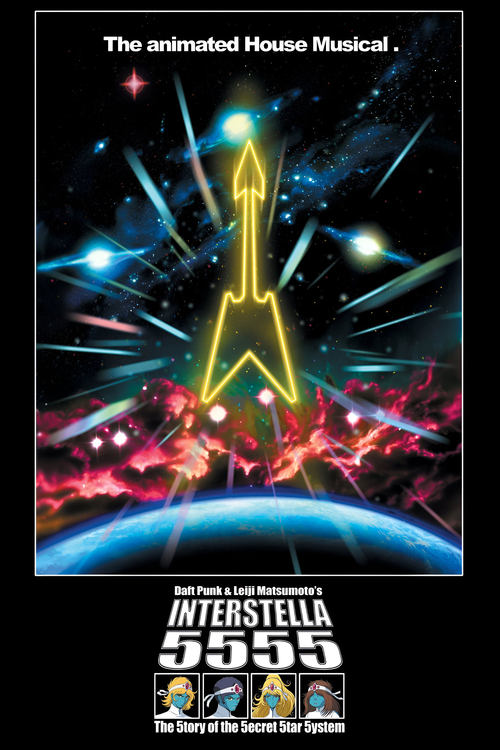
Interstella 5555: The 5tory of the 5ecret 5tar 5ystem
2003 · Kazuhisa Takenouchi
For when you want to put on great headphones, turn the lights down, and let something wash over you — a late-night vibe watch that doubles as listening to a classic album front to back.
What it's about
Four blue-skinned alien musicians are kidnapped by a sinister record producer, wiped of their memories, disguised as humans, and marketed on Earth as a chart-topping pop band called The Crescendolls. A lovestruck space pilot chases them across the galaxy to get them back. The whole story is told without a single line of dialogue — Daft Punk's album Discovery is the entire soundtrack and script.
The experience
Pure flow — it plays like one continuous dream, the music carrying you from candy-colored space opera to a slyly bitter satire of the pop machinery. It's hypnotic rather than gripping, the kind of film you sink into with the volume up.
The craft
Daft Punk went straight to the source of their childhood obsessions: anime legend Leiji Matsumoto supervised the designs and Toei Animation produced, giving the film the exact retro-cosmic glow of 1970s Japanese science fiction. With no dialogue and long stretches without sound effects, the album does all the storytelling — this is a film that genuinely demands good speakers.
Why it matters
It turned a run of music videos — including the beloved 'One More Time' sequence — into a cult feature, and stands as one of the great album-length visual works, a bridge between French house music and classic anime.
Daft Punk's Discovery, visualized end to end: a feature-length animated space opera with no dialogue, no sound effects for long stretches, just the album carrying four blue-skinned alien musicians through abduction, amnesia, and manufactured pop stardom on Earth. The French duo, raised on the anime that aired on their childhood television, went straight to the source — Leiji Matsumoto, the legendary creator of Galaxy Express 999 and Space Pirate Captain Harlock, supervised the designs, and Toei Animation produced, giving the film the exact retro-cosmic glow of 1970s Japanese science fiction. What begins as a string of music videos (several aired separately, including the beloved 'One More Time' sequence) accumulates into a surprisingly pointed fable about the music industry's talent-harvesting machinery — sly self-commentary from a band that famously hid its own faces. The film stands at a genuine cultural crossroads: French house music, Japanese animation history, and the MTV era's dying art of the long-form video. Matsumoto's signature imagery — slender heroines, star-oceans, ships sailing the void — was never put to stranger or funkier use.
Reception
In 2003 it landed as a curio — a dialogue-free 'anime music video' for Daft Punk's Discovery that went mostly straight to DVD after a Cannes screening. Since the duo's 2021 split it's been fully canonized, with a remastered 2024 theatrical re-release playing to packed, openly emotional crowds.
How Interstella 5555: The 5tory of the 5ecret 5tar 5ystem was received, from release to now →
Influences: the films it descends from and the films it influenced
- Fantasia (1940) — Established the wordless feature built as a suite of animated set-pieces cut to a fixed, pre-existing musical program — the exact 'album-as-score, no dialogue' architecture Interstella inherits.
- Yellow Submarine (1968) — The pop band rendered as animated protagonists whose own record supplies the score and episodic structure, pioneering the album-driven animated musical Interstella builds on Discovery.
- Fantastic Planet (1973) — Its cool, storybook European sci-fi surrealism and unhurried tableau staging feed the retro-planetary design language behind Interstella's alien concert worlds.
- Phantom of the Paradise (1974) — A song-driven narrative where a masked artist's identity is stolen and repackaged by a predatory producer — the manufactured-stardom / hidden-identity music-industry plot Interstella animates almost beat-for-beat.
- Tommy (1975) — A rock opera that tells its whole story through the sequenced tracks of a single album with virtually no spoken dialogue, and whose 'pinball messiah' is a critique of fabricated celebrity.
- Allegro non Troppo (1976) — Anthology of animation choreographed shot-for-beat to recorded music, refining the discipline of letting a pre-cut soundtrack, not dialogue, drive the edit.
- Galaxy Express 999 (1979) — Matsumoto's signature grammar — willowy tall figures, star-flung train/ship voyages, melancholy cosmic vistas — is the direct visual DNA Matsumoto reuses in Interstella's designs.
- Heavy Metal (1981) — An animated feature engineered chiefly as a delivery vehicle for a rock soundtrack album, treating the record as the film's spine.
- Arcadia of My Youth (1982) — Matsumoto/Toei space-opera iconography — Harlock's silhouettes, ornate star-cruisers, 1970s Japanese sci-fi romanticism — supplies the staging vocabulary of Interstella's alien band.
- Pink Floyd — The Wall (1982) — A near-dialogue-free album-as-narrative film whose animated interludes dramatize the machinery of fame and dehumanized stardom that Interstella turns into its whole plot.
- D.A.F.T.: A Story About Dogs (1999) — Daft Punk's own Homework video collection established their method of outsourcing an album's imagery to auteur visualists while staying masked — the production model Interstella scales to feature length.
- Daft Punk's Electroma (2006) — Daft Punk extend Interstella's wordless, band-authored visual-album approach into live action, again telling a robot-identity fable with zero dialogue driven purely by music and image.
- Sita Sings the Blues (2008) — A feature that narrates its story by animating to a fixed suite of pre-recorded songs, extending Interstella's model of letting an existing album, not scripted speech, structure the film.
- KPop Demon Hunters (2025) — The purest model of music-driven cutting: a dialogue-free feature whose entire edit is timed to a pop album (Daft Punk's Discovery), treating songs as the narrative spine exactly as KDH structures scenes around its tracks.
- Metropolis (2001) — Contemporary anime feature marrying retro-futurist Tezuka/Matsumoto-era design to a lush pop-orchestral score, sharing Interstella's fusion of nostalgic 2D craft and manufactured-idol anxieties.
- Gorillaz — 'Clint Eastwood' (2001) — A 'virtual band' whose members exist only as animated avatars, dramatizing hidden identity and industry artifice through music video — the same manufactured-stardom conceit told in the same animated-idol form.
- The Triplets of Belleville (2003) — A contemporaneous animated feature that carries its entire story through pantomime, music and sound design with essentially no dialogue, proving the wordless music-led feature as a mode.
Similar films
- Fantastic Planet (1973) — influence & lineage
- Macross: Do You Remember Love? (1984) — shared sensibility
- Lost in Starlight (2025) — shared sensibility
- Cowboy Bebop: The Movie (2001) — shared sensibility
- Blue Giant (2023) — shared sensibility
- Moonage Daydream (2022) — shared sensibility
- Cosmic Princess Kaguya! (2026) — shared sensibility
- Mars Express (2023) — shared sensibility
All the films related to Interstella 5555: The 5tory of the 5ecret 5tar 5ystem →