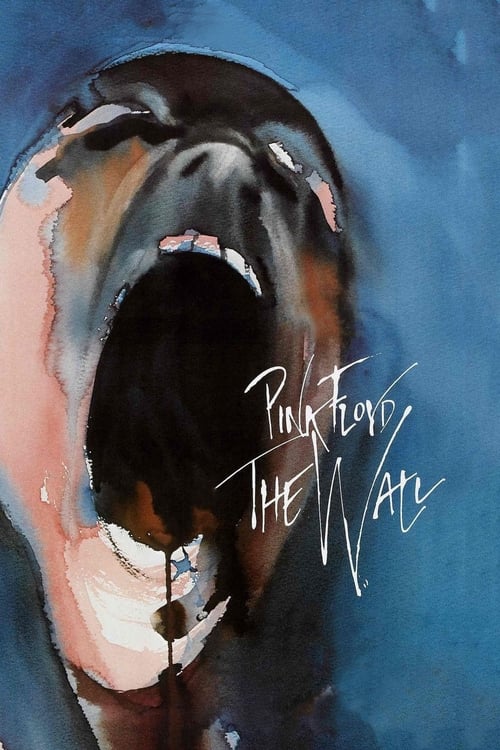
Pink Floyd: The Wall
1982 · Alan Parker
For when you want to turn the lights off, turn the volume up, and be pulled under by something dark and operatic — absolutely not a comfort watch, and best met head-on in one sitting.
What it's about
Pink is a rock star alone in a Los Angeles hotel room, and the film is the inside of his head: a childhood father lost to the Second World War, a smothering mother, sadistic schoolmasters, a marriage gone cold, and the grinding machinery of fame — each trauma another brick in the wall he's built between himself and the world. Told almost entirely without dialogue, it carries the story through Pink Floyd's music, staged imagery, and eruptions of savage animation, as Pink's retreat curdles into something darker.
The experience
An assault, in the best and worst senses — pounding, hallucinatory, and genuinely disturbing, with moments of aching sadness in between. It's less watched than endured, and it means to leave you rattled.
Performances
Bob Geldof, in his first acting role, plays Pink with a raw, hollowed-out physicality — since he barely speaks, everything lives in his blank stare and sudden violence, and it works.
The craft
Alan Parker fuses live action with Gerald Scarfe's ferocious animation — marching hammers, devouring flowers, faceless children on a conveyor belt — into some of the most iconic imagery ever put to rock music. The album is the script, so the sound design and songs carry the entire narrative; it demands good speakers played loud. Whole sequences function as self-contained nightmares.
Why it matters
It became the defining rock-album film and a midnight-movie perennial, its imagery — the hammers, the wall, the faceless schoolchildren — passing into pop culture and shaping decades of music video.
Snapshot
Pink Floyd — The Wall is a feature-length adaptation of Pink Floyd's 1979 concept double album, itself largely the creation of bassist and lyricist Roger Waters. It belongs to a rare category: a narrative film that dispenses almost entirely with spoken dialogue, carrying its story instead through song, staged image, and animation. The film follows Pink (Bob Geldof), a burned-out rock star who, isolated in a Los Angeles hotel room, mentally reconstructs the accumulated traumas — a father killed in the Second World War, a smothering mother, brutal schooling, a failed marriage, the numbing machinery of stardom — that he imagines as bricks in a psychic wall sealing him off from the world. The retreat curdles into a fascist fantasy before a hallucinatory "trial" tears the wall down. Directed by Alan Parker, with roughly fifteen minutes of animation by the political cartoonist Gerald Scarfe, it stands as one of the most ambitious attempts to translate an album into cinema, and as a landmark of the moment when rock, animation, and film-image fused at the dawn of the music-video era.
Industry & production
The film emerged from a project Roger Waters had nursed since the album's supporting tour, when Pink Floyd staged The Wall as an elaborate theatrical spectacle featuring a literal wall built across the stage and Scarfe's projected animations. An early plan envisioned a concert film blending live footage with dramatized and animated material, with Waters himself possibly playing Pink. That approach was abandoned in favor of a fully dramatized feature. Produced by Alan Marshall — Parker's long-standing producing partner — and Waters, with Pink Floyd's manager Steve O'Rourke involved, the film was distributed by MGM and premiered at the Cannes Film Festival in 1982.
The production is notorious for creative conflict. Waters, Parker, and Scarfe each held a strong and not always compatible vision, and Parker later described the experience in unusually bleak terms as among the most difficult of his career. Screen tests with Waters in the lead were shot but the role went instead to Bob Geldof, then the frontman of the Boomtown Rats, who had not previously acted in a feature. The music was substantially the existing album, produced by Bob Ezrin, though the film reworked and re-recorded portions and added the song "When the Tigers Broke Free," which addresses the wartime death of Waters's father. Precise budget and box-office figures I won't assert, as I can't verify them from memory with confidence; the film is generally described as a modest commercial performer that became a durable catalog and repertory title.
Technology
The Wall sits at a specific technological hinge. It was made just as MTV launched (1981) and the promotional music video was becoming an industrial form; the film's dense, montage-driven marriage of pre-recorded music to image both drew on and fed that emerging grammar. Technically its most distinctive feature is the integration of hand-drawn cel animation with live-action photography — a labor-intensive process overseen by Scarfe and his animation team, cut against Parker's photographed material so that the two registers comment on and dissolve into each other. The album's status as an early, meticulously produced studio artifact also shaped the film's sound design, which exploited multi-channel theatrical playback to give the music enveloping, near-physical presence in the cinema — a selling point in an era when a rock film's audio fidelity was itself an attraction.
Technique
Cinematography
Peter Biziou photographed the film, and his work is central to its power. The palette moves between the drained, blue-gray desolation of Pink's hotel entombment, the sepia-tinged memory of wartime and childhood, and the harsh red-and-black graphics of the fascist rally. Biziou favors strong, near-graphic compositions that hold their own against Scarfe's animation, and the film repeatedly uses scale and emptiness — a lone figure in a vast room, an anonymous crowd — to visualize isolation. Biziou would go on to win an Academy Award for Mississippi Burning (1988), also directed by Parker, and later shot The Truman Show; the controlled, expressive image-making that defines his career is already fully present here.
Editing
Gerry Hambling, Parker's regular editor across most of his filmography, cut the picture, and editing is arguably the film's true engine. With little dialogue to structure scenes, the film is organized as an associative montage in which musical rhythm, rather than causal plot, dictates cutting. Match cuts and graphic rhymes carry the viewer between time frames — present breakdown, childhood, the war — and between live action and animation, so that a wound, a wall, a marching mass, or a flower can migrate across registers. The result is closer to sustained музыкальный montage than conventional continuity, and it is Hambling's cutting that makes the associative logic legible.
Mise-en-scène / staging
Parker stages the film as a series of tableaux keyed to individual songs. The most famous set pieces are essentially production numbers: the regimented schoolroom of "Another Brick in the Wall, Part 2," in which faceless children move as automatons toward a meat grinder; the wrecked hotel suite; the blackshirt rally with Pink as a demagogue. Recurring motifs — walls, marching, the meat-grinder as metaphor for institutional processing — are staged with a poster-like directness that borrows from Scarfe's graphic sensibility. The design leans consistently toward the emblematic over the naturalistic; even the "real" scenes are heightened toward nightmare.
Sound
Sound is the film's organizing principle. The soundtrack is effectively the album, re-recorded and re-sequenced, with James Guthrie among those responsible for the audio and Michael Kamen contributing orchestral arrangement and conducting. Diegetic sound and dialogue are minimal and often submerged; where they appear — a television murmuring, a phone operator, snatches of speech — they are woven into the musical texture rather than set against it. This near-total subordination of the image track to a pre-existing musical score is the film's defining formal gambit and the source of both its hypnotic force and its critics' complaints of monotony.
Performance
Bob Geldof gives a largely wordless, physically committed performance as Pink, conveying catatonia, rage, and collapse through posture and face rather than speech; the most cited moment is Pink's methodical shaving of his eyebrows and body hair, a self-mutilation played with unsettling calm. Because the film withholds conventional dialogue scenes, the supporting players — including the figures of the mother and the wife — function more as archetypes glimpsed in memory than as fully drawn characters. The performance mode is expressionist and gestural throughout, subordinated to image and song.
Narrative & dramatic mode
The film's dramatic mode is subjective and anti-linear. There is a nominal present tense — Pink immobile in his hotel room as concert promoters try to rouse him — but the substance of the film is interior: a fragmented, involuntary recollection triggered by breakdown. Events do not unfold so much as recur and intensify, circling the founding wounds of paternal loss and maternal suffocation. The "wall" is at once metaphor, stage device, and organizing conceit, and the film trusts the viewer to assemble meaning from juxtaposition rather than exposition. Its closest structural kin is the song cycle and the fever dream; conventional plot mechanics are deliberately withheld.
Genre & cycle
The Wall belongs to the rock opera / rock film cycle that ran from the late 1960s through the early 1980s — a lineage including Tommy (Ken Russell, 1975, likewise adapted from a concept album), Quadrophenia, Yellow Submarine in its animated dimension, and the broader tradition of the concept-album-as-film. It also intersects the "musical" only obliquely: songs advance the interior action, but no one bursts into diegetic performance in the classic sense. Set against the promo-video boom of the early MTV years, the film can be read as feature-length art film and as an unusually sustained, unusually bleak music video — a hybrid that helped define, and was defined by, that cultural moment.
Authorship & method
Authorship here is genuinely divided, which is part of the film's interest and its friction. Roger Waters is the originating author: he wrote the album and the screenplay and drew the material from his own life — the death of his father Eric Fletcher Waters in the Second World War, an overprotective upbringing, disillusionment with fame — as well as from the disintegration of former bandmate Syd Barrett. Alan Parker, a director who came up through British advertising and whose eclectic filmography spans Bugsy Malone, Midnight Express, Fame, Mississippi Burning, and Evita, brought the visceral, image-first craft and the industrial discipline to realize it. Gerald Scarfe, the caustic British political cartoonist, supplied an animated language — the marching hammers, the copulating-then-devouring flowers, the goose-stepping regalia — so distinctive it has become inseparable from the album's identity. Peter Biziou (cinematography), Gerry Hambling (editing), Michael Kamen (orchestration), and producer Alan Marshall round out the principal collaborators. The finished film is the product of three strong, competing authorial temperaments held in uneasy balance, and the tension is legible on screen.
Movement / national cinema
The film is a product of British cinema of the early 1980s, and specifically of the cohort of directors — Parker, Ridley Scott, Adrian Lyne, Hugh Hudson — who migrated from British advertising into features and carried a polished, high-impact visual style with them. It also draws on a deeper British graphic-satirical tradition through Scarfe, whose caricature idiom links back to a long national lineage of political cartooning. Its animation and expressionist staging show clear debts to continental European visual traditions, but its institutional home and sensibility are firmly British.
Era / period
The Wall is saturated with two time frames. Its story reaches back to the Second World War and the austere, disciplinarian Britain of the postwar years — the schooling, the loss, the repression that Waters treats as formative national experience. Its production, meanwhile, is stamped by the late-1970s and early-1980s moment: post-punk disillusion, the arena-rock excess the album critiques, and anxieties about resurgent authoritarianism that the fascist-rally sequences make explicit. The film thus reads simultaneously as a memoir of wartime and postwar Britain and as a document of the cultural mood at the turn of the 1980s.
Themes
The film's governing themes are isolation and the walling-off of the self as defense against pain. Radiating from that center are the trauma of the absent father and the wound of war; the smothering, infantilizing mother; the deadening cruelty of institutional education and its manufacture of conformity ("we don't need no education"); the emptiness and dehumanization of rock stardom; and the seductive slide from private grief into authoritarian fantasy, in which the wounded individual reinvents himself as a fascist strongman leading an obedient crowd. Drugs, sexual dysfunction, self-harm, and mental collapse recur as symptoms. The closing "trial" and the wall's demolition gesture toward the ambiguous possibility of tearing down one's defenses — at unknown cost.
Reception, canon & influence
Critically, The Wall was divisive on release and has remained so. Admirers praised its audacity, the ferocity of Scarfe's animation, and Biziou's imagery; detractors found it relentless, humorless, and emotionally airless — a punishing two hours of unbroken bleakness with a passive protagonist and no dialogue to modulate the assault. That split has proved durable, and the film is now discussed as much for its cult standing and its formal daring as for any consensus on its success.
Backward, its influences are legible: the rock-opera film precedent of Ken Russell's Tommy; the graphic violence and dystopian menace associated with Kubrick's A Clockwork Orange; the iconography of totalitarian spectacle, echoing the mass-rally imagery of 1930s propaganda cinema, repurposed as critique; German Expressionism's legacy of externalized psychological states; and the deep well of British political caricature that Scarfe embodies.
Forward, its legacy is substantial and specific. As one of the most sustained fusions of album, animation, and film-image at the exact moment music video became a dominant form, it helped model an image-vocabulary — associative montage cut to pre-recorded music, animation as emotional shorthand, the surreal literalized — that music video and later narrative-less music films absorbed. Scarfe's hammers, flowers, and marching masses passed into the permanent visual identity of Pink Floyd and, through countless reproductions, into wider pop-cultural iconography. The film endures as a fixture of midnight and repertory programming and as a reference point for any subsequent attempt to make a feature that thinks in song rather than dialogue. Its standing is less that of a settled classic than of an influential, singular experiment whose ambition and excess are, finally, inseparable.
A Deleuzian reading
A man sits in a hotel room in Los Angeles with the curtains drawn, watching an old war picture on television.
The full Deleuzian reading of Pink Floyd: The Wall →
Reception
Booed-adjacent bafflement at Cannes '82 and mixed reviews at release — but home video and late-night screenings turned it into the definitive dorm-room/midnight album-film, now treated as a landmark of the form.
How Pink Floyd: The Wall was received, from release to now →
How to watch Pink Floyd: The Wall: what to notice on a first viewing
- Watch the palette shift between blue-gray, sepia, and red. Biziou moves the image between the drained blue-gray of Pink's hotel room, sepia-toned childhood and wartime memory, and the harsh red-and-black of the rally footage. Each register tells you which layer of Pink's mind you are inside before a word explains it.
- Notice how small a single figure looks in each room. Parker and Biziou keep placing one person inside a vast, mostly empty frame, whether a hotel suite or a rally ground, and let the space itself carry the isolation. The emptiness around him does the work dialogue would normally do.
- Listen for how rarely anyone actually speaks. The soundtrack is essentially the Floyd album re-recorded, and the little dialogue that exists is submerged into the music rather than set against it. Song, not conversation, is what carries the story here.
- Track how a wound, a wall, or a flower recurs. Hambling cuts on shape rather than chronology, so an image from childhood, the war, and tonight's breakdown can migrate across the same edit. The film links its scenes by resemblance, not by what happened before what.
- Watch the schoolroom sequence move the children like machines. Faceless students march in unison toward a meat grinder, staged with poster-flat directness that borrows Scarfe's graphic style. A crowd moving as one body is the image the film returns to for control.
The whole guide to watching Pink Floyd: The Wall, with the keys for a rewatch →
Influences: the films it descends from and the films it influenced
- Tommy (1975) — Established the feature-length, sung-through rock opera in which the band's concept album IS the screenplay — no spoken dialogue, only staged song-set-pieces — the exact structural template Waters and Parker adopt.
- A Clockwork Orange (1971) — Model for the film's dystopian menace and its aestheticized, ironically-scored violence, plus the trapped-inside-one-damaged-mind subjectivity that Pink's hotel-room breakdown directly echoes.
- Yellow Submarine (1968) — Pioneered pop-song-driven feature animation where graphic caricature and surreal metamorphosis carry the narrative in place of dialogue — the same animation-as-emotional-shorthand strategy Scarfe extends.
- Fantasia (1940) — Original proof that a dialogue-free feature can be built entirely as image cut to pre-recorded music, letting animation literalize the score rather than illustrate a plot.
- Triumph of the Will (1935) — Source of the mass-rally totalitarian iconography — serried ranks, crossed-hammers banners, worshipful low angles — that Scarfe and Parker reproduce and invert as anti-fascist critique in the 'In the Flesh' sequence.
- The Cabinet of Dr. Caligari (1920) — Bequeathed the Expressionist principle of externalizing a disturbed psyche through distorted, stylized mise-en-scène — Pink's interior collapse rendered as warped world rather than explained in words.
- Performance (1970) — Fragmented, associative match-cut editing fusing a rock star's identity crisis with hallucinatory imagery, prefiguring The Wall's anti-linear, subjective assembly of memory and breakdown.
- A Hard Day's Night (1964) — Codified the proto-music-video grammar — image cut to the beat of a pre-existing track as self-contained set-piece — that The Wall industrializes at feature length.
- Midnight Express (1978) — Parker, with editor Gerry Hambling, escalates the subjective-deterioration and intercut-fantasy techniques of Midnight Express into a near-wordless visualization of psychic confinement.
- Moulin Rouge! (2001) — Extends the admen-directors technique of hyper-kinetic associative montage cut to pop songs, using the jukebox track as the scene's structural spine exactly as Parker does.
- Requiem for a Dream (2000) — Inherits the rhythmic, music-locked associative montage and the relentless-unbroken-bleakness assault on a passive protagonist descending into breakdown.
- Interstella 5555 (2003) — The purest heir: a dialogue-free feature that animates an entire album end-to-end, letting the record be the soundtrack and the images do all narrative work — The Wall's model taken to its limit.
- Waltz with Bashir (2008) — Uses expressionist animation as emotional shorthand for war trauma and repressed memory, the Scarfe strategy of drawing what live action cannot show applied to a father's-war reckoning.
- Across the Universe (2007) — Builds its narrative entirely from a single act's song catalog, punctuated by surreal animated/puppet tableaux, reprising The Wall's song-tableau staging and album-as-story method.
- Anima (2019) — A wordless, album-length film of choreographed expressionist tableaux set to Thom Yorke's record — the dialogue-free 'feature that thinks in song rather than dialogue' lineage carried into the streaming era.
- Rocketman (2019) — Parker's technique of using animation and live-action dissociation to externalize a rock musician's mental breakdown — with diegetic/non-diegetic slippage as the perceptual signal marking transitions between reality and psychic interior — provides a British rock-psychodrama formal model for Rocketman's fantasy interpolations.
- Richard III (1995) — Shot by Peter Biziou with the same glossy menace, and a key source of fascist-rally crowd iconography that the cinematographer carries into Richard III.
- Interstella 5555: The 5tory of the 5ecret 5tar 5ystem (2003) — A near-dialogue-free album-as-narrative film whose animated interludes dramatize the machinery of fame and dehumanized stardom that Interstella turns into its whole plot.
- Hedwig and the Angry Inch (2001) — Gerald Scarfe's hand-drawn animated interludes externalizing a rocker's psychic wounds are the direct formal precedent for Emily Hubley's animation in 'The Origin of Love.'
- Hercules (1997) — Gerald Scarfe's animated caricature language — elongated blade-sharp silhouettes, grotesque metamorphosis, acidic satirical line — is imported almost wholesale as Hercules's production-design signature.
- Quadrophenia (1979) — Contemporary British attempt to translate a Who concept album into narrative cinema, sharing the album-as-blueprint method and the same postwar-Britain generational-alienation material.
- Heavy Metal (1981) — Same-moment fusion of hard-rock soundtrack with adult, grotesque animation as a feature's primary language, riding the same early-'80s convergence of album and animated image.
- The Snowman (1982) — Released the same year as a wordless, music-carried animated narrative — proof of a shared British animation instinct to tell an entire story through image and score with zero dialogue.
- Angel Heart (1987) — Parker, cinematographer Michael Seresin, and Hambling perfect the nightmare-logic insert and metaphor-dense surreal montage — the advertising-honed maximalist image-stream carried directly into Angel Heart's smoke-and-haze visuals.
- Mississippi Burning (1988) — Biziou's first major Parker collaboration, developing the bleached, oppressive image-forward palette and montage intensity the cinematographer wins his Oscar refining here.
Similar films
- Yellow Submarine (1968) — influence & lineage
- A Clockwork Orange (1971) — influence & lineage
- Performance (1970) — influence & lineage
- Quadrophenia (1979) — influence & lineage
- Moonage Daydream (2022) — shared sensibility
- Alice (1988) — shared sensibility
- The Doors (1991) — shared sensibility
- Elvis (2022) — shared sensibility