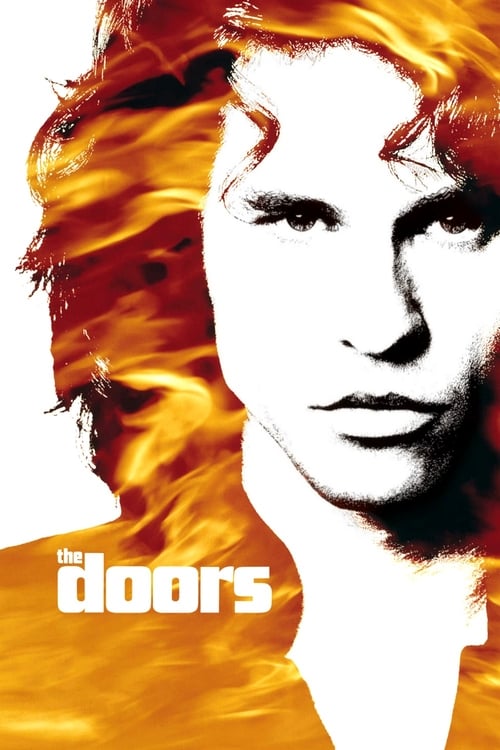
The Doors
1991 · Oliver Stone
For when you want to be swallowed by a rock-and-roll spectacle — volume up, lights off, no moderation. This is a wild ride, not a comfort watch; reach for it when excess sounds like a feature.
What it's about
Jim Morrison drifts out of Venice Beach as a poetry-obsessed film student and, within a few years, is fronting one of the biggest rock bands in America. The film tracks the Doors from their Sunset Strip beginnings through stardom, acid trips, riotous concerts, and Morrison's deepening spiral into alcohol and self-destruction, ending in Paris in 1971. It's less a straight biography than a fever dream about the sixties burning through its own icons.
The experience
Loud, druggy, and deliberately too much — the concerts roar, the hallucinations bleed into reality, and the film barrels forward with almost no pause for breath. It's intoxicating for a while, then exhausting in a way that feels intentional, like the comedown is part of the show.
Performances
Val Kilmer's Jim Morrison is the whole show: he gets the voice, the stage moves, the swagger, and the glassy-eyed drift so completely that the line between actor and subject basically disappears. It remains one of the great acts of total physical impersonation in any music film.
The craft
Oliver Stone directs like he's mixing an album at maximum gain — swirling cameras, hallucinatory desert visions, and concert scenes staged with real menace and heat. The sound design and wall-to-wall Doors music make this one to play loud on good speakers; it's built as a sensory assault, not a history lesson.
Why it matters
It set the template — and the argument — for the modern rock biopic: myth over facts, sensation over chronology, and it anchored Stone's early-nineties run of big, combustible American epics. People still fight about whether it's a portrait or a tall tale, which is part of its staying power.
Snapshot
Oliver Stone's operatic portrait of Jim Morrison and the Doors treats its subject not as a conventional rock biography but as myth—a Dionysian fable about the American counterculture devouring its own gods. Running nearly two and a half hours, the film follows Morrison from his Venice Beach bohemian origins through the band's explosive Sunset Strip ascent, their combustible late-1960s peak, and Morrison's accelerating self-destruction before his death in Paris in 1971. Val Kilmer's physically and vocally total inhabitation of Morrison anchors a production that consistently subordinates linear narrative to sensory overload, using cinema itself as a hallucinatory instrument. The film sits at the center of Stone's early-1990s run of maximalist American historical spectacles and remains the defining artifact—contested, excessive, impossible to dismiss—of the rock-musician biopic as a genre form.
Industry & production
The Doors arrived at the peak of Stone's commercial and critical authority. Following Platoon (1986), Wall Street (1987), and Born on the Fourth of July (1989), Stone had become Hollywood's most prominent director of politically and culturally charged material, a filmmaker trusted with large budgets and given unusual final-cut latitude. Produced through Imagine Entertainment in association with Carolco, with Bill Graham—the legendary rock promoter—serving as a producer, the film carried unusual credibility from within the music industry. Graham's involvement helped secure cooperation with surviving band members and access to original Doors recordings, though the film's creative treatment of Morrison's life ultimately produced friction with Ray Manzarek and John Densmore, who expressed reservations about Stone's mythologizing angle and his choices about what to include or exclude. Robby Krieger was more circumspect. Pamela Courson, Morrison's companion, had died in 1974, and the film's portrayal of her (played by Meg Ryan) as a sometimes passive, sometimes complicit figure in Morrison's destruction was contested by those who knew her.
Stone has spoken at length about his personal connection to Morrison and the Doors, describing them as a formative soundtrack of his Vietnam years. This autobiographical investment shaped the film's passionate excess but also its blind spots. The screenplay, credited to J. Randal Johnson and Stone, went through extensive development as Stone sought to balance mythic elevation with at least the appearance of biographical accountability. The production recreated the Sunset Strip of the late 1960s on location in Los Angeles, and Stone and his team assembled an extraordinary cast of lookalikes whose resemblance to their historical counterparts—Kyle MacLachlan as Manzarek, Kevin Dillon as Densmore, Frank Whaley as Krieger—reinforced the film's insistence that it was reconstructing a real world even as it openly distorted it.
Technology
Robert Richardson shot the film on a combination of 35mm and 16mm stocks, deliberately mixing gauges, frame rates, and exposure levels to produce an image that fluctuates between slick studio clarity and grainy, blown-out documentary instability. This mixed-stock strategy had precedents in the New Hollywood era but Richardson and Stone pushed it further: certain sequences shift mid-scene, using stock change as a psychological index rather than a simple period indicator. Anamorphic widescreen compositions alternate with squarer Academy ratios in flashback and vision sequences. Optical printing produced many of the film's psychedelic inserts—desert hallucinations, Native American shaman imagery—using in-camera and post-production superimpositions at a time when digital compositing was not yet the industry standard. The result is a film that feels simultaneously period-authentic and deliberately, derangingly unreal. The Dolby surround sound mix was engineered to replicate the visceral impact of live Doors concerts, with bass frequencies and dynamic range pushed hard.
Technique
Cinematography
Richardson's visual strategy throughout is one of controlled destabilization. His lighting schemes shift between the warm, saturated amber of 1960s nostalgia and the cold, blue-gray of clinical observation—the same scene sometimes moving through both registers within a single take. He favors extreme close-ups of Morrison's face during performance, colliding with wide-angle long shots of concert crowds and desert landscapes that dwarf the human figure. The handheld camera orbits Kilmer in concert sequences with an urgency that quotes documentary rock films, particularly D.A. Pennebaker's work, while the tripod-locked wide shots during the band's recording sessions introduce a formal stillness against which the chaos reads more violently. Richardson's use of natural and practical light in the Venice Beach and Laurel Canyon scenes gives these sequences a documentary texture that makes the hallucination inserts all the more disconcerting.
Editing
David Brenner and Joe Hutshing cut the film with a rhythm calibrated less to conventional dramatic pacing than to musical time. Sequences breathe and contract according to the internal dynamics of Doors songs rather than the arc of scenes, a structural decision that makes the film feel more like an extended album-side than a three-act narrative. The editing is densest during concert and performance sequences, where Brenner and Hutshing intercept concert footage with vision and memory in rapid montage, and deliberately slack in the Paris sequences, where long takes signal Morrison's exhausted withdrawal from the velocity of his own mythology. Stone and his editors had established this impressionistic approach in Born on the Fourth of July; The Doors extends it further toward abstraction.
Mise-en-scène / staging
Stone stages the film as a series of set-pieces—each concert, each confrontation, each drug sequence—rather than as continuous dramatic flow. The concert reconstructions at the Fillmore West and other venues are the film's largest and most technically demanding: extras costumed and movement-directed to replicate the specific physicality of late-1960s rock crowds. Morrison's shamanic stage persona—crouching, convulsing, turning away from the audience—is choreographed with care and then photographed as if spontaneous. The desert sequences in the American Southwest, which function as an origin myth (Morrison encounters a dying Navajo shaman as a child) and recur as hallucinatory reprises throughout the film, are staged in wide, burning-light landscapes where the mise-en-scène approaches the painterly. Stone's use of real Los Angeles locations—Laurel Canyon, the Whisky a Go Go, the Venice Canals—grounds the mythologizing in physical geography.
Sound
The film's sound design is inseparable from its identity. The Doors' original recordings are used throughout, supplemented by Kilmer's own vocal performances, which according to accounts from the production were so close to Morrison's timbre and phrasing that the surviving band members and original engineers had difficulty distinguishing them on playback in certain registers. Whether every Kilmer vocal moment in the film is fully his own or blended with original Morrison recordings has never been definitively cataloged publicly. The sound editors layer concert audio with crowd noise, feedback, and environmental effects to create a sonic immersion strategy that anticipates what would become standard in music biopics of the following decade. Woven through the film is also the ambient sound of the desert and the Pacific—wind, surf—which Stone and Richardson use as counterpoint to the electric roar of performance.
Performance
Val Kilmer's performance is the film's defining fact. He spent months studying Morrison's movement vocabulary, vocal style, and stage physicality before production, and the result—whatever one concludes about the screenplay's interpretation—is a piece of sustained physical and vocal mimicry that crosses into something less identifiable than impersonation. Kilmer does not simply reproduce Morrison; he inhabits the myth of Morrison with such total conviction that the film's more hagiographic tendencies seem to emerge partly from the performance itself, from the gravity field the characterization generates around it. Meg Ryan's casting against type as Pamela Courson—she was known primarily for comedic and romantic roles—was a deliberate provocation that the performance partially vindicates and partially exposes. Kyle MacLachlan's Manzarek is the film's skeptical intelligence, a foil whose analytical remove from Morrison's chaos the screenplay uses to externalize what Stone won't quite let Morrison articulate directly.
Narrative & dramatic mode
The Doors uses a loose mythographic structure rather than a classical biographical arc. Events are organized associatively—by theme and emotional register as much as by chronology—and the film is frank about subordinating factual accountability to its mythological project. Stone positions Morrison as a Dionysian figure: the god of intoxication, transgression, and the dissolution of boundaries who must die to complete his mythic function. This is not covert; the film quotes Nietzsche and uses Morrison's own poetry and stated aesthetic theories as both dialogue and voice-over. The narrative frame periodically dissolves into hallucinatory sequences whose relationship to Morrison's interior consciousness is deliberately ambiguous—are we in his vision, in the film's symbolic register, or in an undifferentiated space between them? This mode distances The Doors from the conventional cradle-to-grave biopic and aligns it with the European art film's interest in figure-as-idea.
Genre & cycle
The Doors belongs to the American rock biopic, a genre that had produced La Bamba (1987) and Great Balls of Fire (1989) in the years immediately preceding it and would generate What's Love Got to Do with It (1993) and others in its wake. Stone's film is notable for its rejection of the genre's typical didactic framing—the overcoming of obstacles, the redemption narrative, the public legacy as validation—in favor of a tragic structure with no compensatory lessons. In this it anticipates the "anti-hagiographic" tendency in music biopics that would eventually produce films like Control (2007) and Love & Mercy (2014). Within Stone's own body of work, The Doors is part of an informal trilogy with Platoon and Born on the Fourth of July—films about American men destroyed or transformed by the forces their culture simultaneously worships and deploys.
Authorship & method
Stone functions as the film's dominant author in the auteurist sense: the screenplay's interpretive framework, the visual strategy, the structural decisions are all consistent with his approach across the early-1990s films. Richardson's cinematography is an essential creative contribution rather than a technical service—his prior collaborations with Stone on Platoon, Salvador, and Born on the Fourth of July had developed a shared visual language that Richardson extends here toward greater abstraction. Hutshing's editorial sensibility, also developed across multiple Stone collaborations, shapes the film's rhythm at the deepest level. Stone's method during this period was research-intensive but ultimately author-driven: extensive interviews, archival immersion, and technical consultation provided material that Stone then radically reshaped in accordance with his thematic priorities. On The Doors, this method produced a film that the surviving band members recognized in parts and contested in others—a characteristic outcome of the Stone approach.
Movement / national cinema
The film is firmly American but registers the influence of the British and European rock film. Performance (Roeg and Cammell, 1970)—which uses a rock musician's identity dissolution as its central subject—is a visible antecedent in its treatment of celebrity as ontological threat. The French New Wave's interest in improvisation and documentary texture inflects Richardson's mixed-stock approach. Stone's own experience of early-1970s European art cinema, absorbed during and after his Vietnam service, enters the film in its comfort with structural looseness and symbolic excess. The Doors can also be situated within a specifically American mythographic tradition—the Western, the gangster film—that recasts its subject as a doomed folk hero.
Era / period
The film is a product of the early 1990s' retrospective fascination with the 1960s, arriving at a moment when the cultural meaning of that decade was actively contested between nostalgia, critique, and commercial recuperation. Stone's treatment sides firmly with romantic mythologizing, a choice that put it at odds with the revisionist historical impulse also present in early-1990s American culture. Its visual excess and maximalist formal ambition also locate it precisely in the late-classical Hollywood moment before digital production transformed the look of mainstream American cinema.
Themes
The Doors is organized around several interlocking preoccupations: the Romantic myth of the artist as sacrificial figure whose destruction is inseparable from his genius; the specific pathology of American male charisma, which the film represents as both irresistible and catastrophic; the 1960s counterculture as simultaneously liberation and trap; the relationship between intoxication and vision, between the dissolution of the self and the expansion of consciousness that Morrison pursued as both aesthetic program and self-destructive compulsion. Native American shamanism functions in the film as a spiritual horizon against which Morrison's appetites are measured and found both authentic and inadequate—a framing Stone takes seriously in ways that have generated legitimate scholarly discomfort about its romanticization of Indigenous spiritual practice as a white bohemian resource. Mortality runs through the film not as threat but as destination.
Reception, canon & influence
Critical reception on release was sharply divided. Admirers praised Kilmer's performance and Richardson's cinematography as achievements of the first order; detractors found the film hagiographic to the point of dishonesty, accusing Stone of reproducing Morrison's self-mythologization rather than interrogating it. The film's length—140 minutes—and its refusal of narrative efficiency frustrated reviewers expecting biographical clarity. Stone's visible personal investment read to some critics as undisciplined excess and to others as the source of the film's peculiar energy. Box-office performance was respectable but not exceptional for a film of its budget and profile; specific figures are not reliably documented in sources available for attribution here.
In the decades since, The Doors has moved from controversy to cult status. Kilmer's performance is now routinely cited as among the more remarkable instances of physical transformation and musical embodiment in American film acting, a benchmark against which later musical biopics—Walk the Line (2005), with Joaquin Phoenix's preparation for Johnny Cash, being the most frequently cited comparison—are measured. The film's influence on the visual and structural conventions of the music biopic is substantial: its willingness to prioritize myth over chronology, its use of performance sequence as formal climax, and its integration of the subject's actual recordings into the film's fabric all became genre conventions. Films like Control, Love & Mercy, and Bohemian Rhapsody (2018) operate in a generic space that The Doors helped define even when they react against its excesses. The film consolidated and amplified Morrison's posthumous myth in ways that continue to shape how The Doors are received by successive audiences encountering the band for the first time through the film rather than the records.
A Deleuzian reading
A boy in the back seat of a car, somewhere in the burning New Mexico light, watches a Navajo shaman die by the roadside.
The full Deleuzian reading of The Doors →
Reception
Divisive in 1991 — critics praised Val Kilmer's uncanny Jim Morrison while knocking Stone's mythologizing excess, and the surviving Doors (especially Ray Manzarek) loudly disowned it. Today it's remembered less as a biopic than as a legendary performance trapped inside a fever dream, with Kilmer's 2025 death prompting a fresh wave of appreciation.
How The Doors was received, from release to now →
Influences: the films it descends from and the films it influenced
- Don't Look Back (1967) — Pennebaker's backstage handheld intimacy — available-light close-ups of the rock star's face in private moments, the camera as uninvited witness — established the documentary visual vocabulary Richardson quotes directly in The Doors' Venice Beach and Laurel Canyon sequences, treating Morrison's offstage self with the same verité proximity Pennebaker applied to Dylan.
- Gimme Shelter (1970) — The Maysles' orbiting handheld camera grammar in the Altamont concert footage — the lens circling the performer as the event escalates toward violence and chaos — is the direct formal model for Richardson's concert cinematography throughout The Doors, establishing the rock concert as a site of uncontrollable Dionysian energy captured in unstable handheld movement.
- Performance (1970) — Roeg and Cammell's treatment of the rock star's performance space as a zone where identity dissolves and psychedelia erupts through optical superimposition and layered in-camera effects directly established the visual grammar Stone and Richardson use for Morrison's onstage hallucinations, including the conceit that performance itself is an altered state rather than mere entertainment.
- Tommy (1975) — Russell's use of psychedelic optical inserts as direct externalizations of the rock visionary's inner state — the hallucinatory psychic landscape made literal on screen through superimposition and distortion — established the visual strategy Stone and Richardson adopt for Morrison's desert shaman sequences and concert visions, treating the rock musician's interiority as available for expressionist rendering.
- The Last Waltz (1978) — Scorsese's methodology of treating the rock concert as a controlled multi-camera cinematic spectacle — choreographed stage lighting, planned camera positions, the performance space redesigned for film — established the template for staged concert reconstruction that Stone's team followed, moving the rock biopic away from documentary capture toward theatrical set-piece construction.
- Apocalypse Now (1979) — Coppola's mythographic structure — the American protagonist consumed by the mythology he embodies, Vietnam as Dionysian descent, American hubris rendered as Greek tragedy — established the narrative grammar Stone applies to Morrison, and Coppola's deployment of 'The End' over the film's napalm opening crystallized the identification between Morrison's music and the Vietnam War mythos that Stone would make architecturally central.
- The Rose (1979) — Rydell's requirement that Bette Midler perform all vocal tracks herself — treating physical and vocal total inhabitation as the central performance demand of the rock biopic — established the precedent Stone applied in requiring Kilmer to sing every Morrison vocal line, making performer-vocal-mimicry the genre's defining act of embodiment rather than a technical convenience.
- Sid and Nancy (1986) — Cox's refusal to glamorize the rock couple's mutual self-destruction — maintaining an anti-hagiographic stance through unglamorous 16mm texture, squalid locations, and withholding catharsis even in tragedy — established the generic template The Doors adapts for Morrison and Pamela Courson, where the camera observes destruction without editorializing rescue.
- Born on the Fourth of July (1989) — Stone and Richardson developed their mixed-stock cinematography — 35mm and 16mm intercut as a psychological index rather than a period marker — and their impressionistic music-driven editing grammar on this collaboration; The Doors is the direct technical continuation and intensification of Richardson's lighting-scheme oscillation between warm nostalgia-amber and clinical blue-gray within single scenes.
- Natural Born Killers (1994) — Stone and Richardson extend The Doors' mixed-stock strategy to its formal extreme, layering 35mm, 16mm, Super-8, video, animation, and rear-projection within single sequences, inheriting and radicalizing the grammar The Doors established — the optical printing psychedelic insert becomes the entire film's default mode rather than a reserved device.
- Nixon (1995) — Stone applies the mythographic structure developed in The Doors — the American leader consumed by the mythology he embodies, rendered through mixed film stocks and impressionistic editing that functions as psychological index rather than conventional biopic chronology — to Nixon, treating the presidency as another Dionysian descent narrative.
- Velvet Goldmine (1998) — Haynes directly responds to The Doors' mythographic biopic form by constructing a glam-rock subject through unreliable fragmented testimony and Citizen Kane investigative structure, extending Stone's anti-hagiographic insight that mythic rock figures exceed unified biographical representation and must be approached through the distortions of myth itself.
- Almost Famous (2000) — Crowe inherits The Doors' concert-reconstruction methodology — the staged recreation of specific historical performances as dramatic set-pieces, the rock concert as ritualized communal spectacle — while tempering Stone's expressionist excess with period realism; the film's treatment of the 1970s rock circuit as lost mythology is indebted to Stone's mythographic framing.
- Control (2007) — Corbijn makes total physical inhabitation — Sam Riley performing Ian Curtis's epileptic seizure-dance onstage with full physical commitment across every concert scene — the central performance demand of the film, in direct lineage from the precedent The Doors set when Kilmer's embodiment of Morrison's every movement and vocal inflection became the genre's defining measure of actor devotion.
- I'm Not There (2007) — Haynes radicalizes The Doors' implicit argument — that mythic rock subjects resist conventional biographical representation — by fragmenting Dylan across six actors embodying separate mythic personae, following Stone's structural insight that the rock figure-as-myth demands anti-biographical form and extending it to its logical fragmentation.
- Rocketman (2019) — Fletcher adopts Stone's formal strategy of using the subject's own music as hallucinatory dramatic material — songs erupting into fantasy sequences that externalize emotional interiority as spectacle — and his convention of the performer embodying musical performance rather than lip-syncing, both devices developed in The Doors and here applied to Elton John with comparable operatic excess.
- Bohemian Rhapsody (2018) — Kinetic concert editing — rapid intercutting between performance and crowd, handheld intrusion into staged spectacle — combined with anamorphic widescreen for rock-spectacle sequences; Stone's rock-star-as-doomed-outsider biographical arc is the template McCarten domesticates.
- JFK (1991) — Shot by Richardson in overlapping production with The Doors, JFK shares the identical formal grammar: mixed-film-stock paranoid documentary texture, rapid archival-footage montage intercut with reconstruction, and optical printing technology to layer testimonial fragments — both films developing Stone and Richardson's maximalist historical-spectacle method simultaneously and cross-pollinating technique.
Similar films
- Nixon (1995) — influence & lineage
- Natural Born Killers (1994) — influence & lineage
- JFK (1991) — influence & lineage
- Born on the Fourth of July (1989) — influence & lineage
- Gimme Shelter (1970) — influence & lineage
- Performance (1970) — influence & lineage
- The Last Waltz (1978) — influence & lineage
- Apocalypse Now (1979) — influence & lineage
All the films related to The Doors →
Watch it with: curated runs of related films
- The Making of a Legend — A run of biopics that watch private people get forged into public icons — the ambition, the pressure, and the loneliness of becoming somebody the world can't stop looking at.