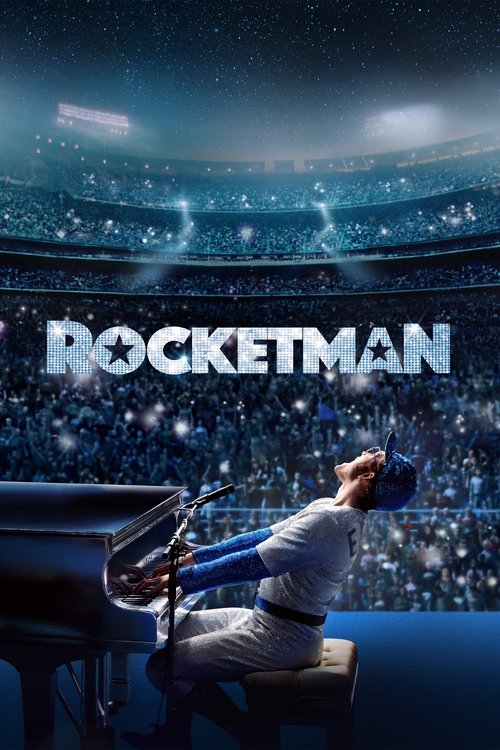
Rocketman
2019 · Dexter Fletcher
For when you want to sing along and feel something — a big, glittery night in that sneaks up on you with real tenderness. Comfort viewing with an ache in it.
What it's about
Elton John's life told the way he might remember it in a fever dream — from piano prodigy at the Royal Academy of Music to global superstar, with his songwriting partnership with Bernie Taupin as the love story at its center. Framed as a confession delivered mid-crisis, it follows the boy from the suburbs who invented a persona big enough to hide in, then watched fame, addiction and loneliness close over him.
The experience
Exuberant and heartbroken at once — full-throttle musical numbers that lift off from reality, then quiet scenes that land like a bruise. It's flashy, funny, and more emotionally raw than you expect from a jukebox premise.
Performances
Taron Egerton does his own singing and plays Elton as a wound wrapped in sequins — needy, ferocious, and completely committed rather than doing an impression.
The craft
Dexter Fletcher stages the songs as fantasy set pieces that erupt out of feelings instead of concerts, so the film moves like actual musical theater rather than a greatest-hits reel. The costumes and production numbers are maximalist spectacle; it rewards a big screen and speakers that can handle a stadium chorus.
Why it matters
It broke the mold of the reverent rock biopic by admitting its own artifice, and proved a musician's life story could be staged as full-blown fantasy musical rather than dutiful reconstruction.
Snapshot
Rocketman is a fantasy musical biography of Elton John, covering his formation at the Royal Academy of Music through his explosive global stardom and into the substance-abuse crisis that eventually drove him into rehabilitation. What distinguishes it from the wave of prestige biopics surrounding it is its declared unreality: rather than simulate the past, it stages it as musical theater, with the songs erupting out of emotional states rather than being performed for diegetic audiences. Taron Egerton plays John, singing every number himself, and the film moves freely between memory, fantasy, and group-therapy confession. The result is less a documentary reconstruction than an emotional autobiography — closer in spirit to Bob Fosse's All That Jazz (1979) than to the conventional cradle-to-microphone rock biopic. Released by Paramount Pictures in May 2019, Rocketman won the Academy Award for Best Original Song for "(I'm Gonna) Love Me Again," a new composition by Elton John and Bernie Taupin written specifically for the film.
Industry & production
The project had a protracted gestation. Elton John had been attached to a biopic at various studios for years before the Marv Films production, shepherded by producer Matthew Vaughn, found its home at Paramount. The involvement of John himself as producer proved decisive in shaping the film's tone: he reportedly insisted on preserving the R-rating content — explicit sequences depicting drug use, sexual intimacy, and emotional dysfunction — against pressure to soften the film for wider certification. This was a conspicuous choice at a moment when Bohemian Rhapsody (2018), a film Dexter Fletcher had himself finished after Bryan Singer's removal, had drawn sustained criticism for eliding Freddie Mercury's sexuality and the chronology of his HIV diagnosis. Rocketman's relative frankness about John's homosexuality, his relationship with manager John Reid, and the texture of his addictions was read, correctly, as a corrective statement about what the genre owed its subjects.
Dexter Fletcher was brought aboard early in the development. Lee Hall, whose theater work — particularly Billy Elliot the Musical — demonstrated fluency in working-class British stories shaped by music and performance, wrote the screenplay. The decision to cast Taron Egerton, who had appeared in Vaughn's Kingsman films, brought a young star without rock-biopic baggage; crucially, Egerton could and did sing his own performances, a point the production emphasized to distinguish it from the lip-sync controversies attendant on other entries in the genre. Jamie Bell was cast as Bernie Taupin, Richard Madden as John Reid, and Bryce Dallas Howard as Sheila, John's emotionally withholding mother.
Technology
Rocketman is not an effects-heavy film by contemporary blockbuster standards, but its fantasy sequences required significant visual effects work to blend physical production with digital extension. The recurring device of characters levitating — most strikingly, a young Reggie Dwight rising with his mother at a kitchen table — was achieved through a mixture of wirework, practical staging, and post-production compositing. The film was shot on large-format digital capture, enabling the rich, saturated color palette that underpins its visual identity.
The costume design, by Julian Day (who had also handled Bohemian Rhapsody), was technically and historically demanding. Elton John's stage wardrobe from the early 1970s through the Las Vegas years is among the most elaborate in popular music history, and Day worked closely with the John archive to produce either precise replicas or stylized interpretations for the film's fantasy logic.
Technique
Cinematography
George Richmond, whose previous collaboration with Vaughn on the Kingsman series had developed a language of heightened, kinetically composed widescreen imagery, shot Rocketman. Richmond's approach is not naturalist: the film's palette leans toward deep, slightly hallucinatory saturation, and the lighting design shifts registers fluidly between the warm amber of domestic 1960s Pinner, the cold institutional white of rehab, and the blown-out spectacle of stadium concerts. The camera is mobile but not aggressively so; the fantasy sequences use wider angles and more exaggerated perspectives than the realistic passages, allowing the film's visual grammar itself to signal transitions between memory and imagination. The opening shot — Elton in full Pinball Wizard costume walking through the corridors of a rehabilitation center — establishes the film's core visual tension between theatrical excess and institutional austerity.
Editing
The editing by Chris Dickens — an Oscar-winner for Slumdog Millionaire — manages Rocketman's most structurally challenging passages: the sequences in which diegetic time dissolves into musical number and back. Dickens's cuts within the musical sequences tend to hold imagery slightly longer than classical continuity editing would dictate, allowing Egerton's performance and the song arrangement to carry the rhythm. The film's non-linear architecture, anchored to the rehabilitation group-therapy framing, requires the editing to move comfortably between three temporal registers — the present of the therapy sessions, the memory narrative, and the fantasy extrapolations from that narrative — without losing the audience's orientation.
Mise-en-scène / staging
Fletcher's staging reflects theatrical rather than purely cinematic logic. The number "Crocodile Rock," set at the Troubadour in Los Angeles, expands spatially into an impossible space, the crowd rising into the air, the venue becoming grander and more abstract as the song progresses. This is a conscious rejection of the filmed-concert aesthetic: the mise-en-scène makes the exhilaration of the moment its subject, rather than documenting the event. The rehabilitation-room sequences are staged in deliberate contrast — confined, symmetric, static — and function as the film's reality principle. Lee Hall's script deploys this staging philosophy as dramaturgy: the degree of spatial impossibility in a given sequence corresponds roughly to the degree of emotional pressure Elton is under, with the most fantastical imagery clustering around the lowest points of his adult life.
Sound
The sound design and mix make careful use of the gap between diegetic and non-diegetic registers. Songs begin in one mode and migrate to the other — a piano chord played by Reggie Dwight in his grandmother's sitting room becomes, in a cut, the opening of a fully orchestrated arrangement. This sleight of hand is handled cleanly enough that audiences acclimated to it quickly. The songs themselves use new recordings by Egerton rather than either the John originals or live performance recordings, and the arrangements, produced for the film, are close to the canonical versions without being identical, giving the music a slightly theatrical shimmer. The production's investment in keeping Egerton's actual voice in the foreground was sound-strategically significant: his voice, lower and rougher than John's, creates a productive distinction between the film-Elton and the historical one, marking this as interpretation rather than imitation.
Performance
Taron Egerton's performance is the film's central instrument. He carries the physical comedy of John's stage persona — the goggle-glasses, the duck-walk, the deliberate camp — without reducing it to caricature, and his work in the quieter scenes, particularly those depicting John's emotional isolation within success, is correspondingly inward. Egerton's singing, while stylistically distinct from John's, is musically convincing and emotionally calibrated to the dramatic moment rather than to faithfulness of reproduction. Jamie Bell's Taupin is rendered with considerable subtlety as the film's moral compass and emotional constant: a figure of steady affection where almost everyone else in John's life is defined by appetite or withdrawal. Richard Madden's Reid is allowed to be more schematic — the charming exploiter — though the film is careful to give him a plausible early tenderness before the relationship calcifies into manipulation. Bryce Dallas Howard's Sheila is the more psychologically complex portrait, a woman whose love for her son is genuine and whose incapacity to express it is the wound the film circles back to repeatedly.
Narrative & dramatic mode
Rocketman adopts a confessional frame: Elton John, mid-crisis, walks into group therapy in full stage costume and tells his story. The therapy setting literalises the retrospective mode that most biopics use invisibly; here the recollection is an act of public self-examination, and the group — fellow addicts in tracksuits — function as a de-idealising audience, present and sometimes skeptical. This device borrows from both theatrical tradition (the solo confessional, the addressed audience) and from the psychoanalytic biography — the story is understood to be Elton's account of himself, partial and emotionally shaped.
The fantasy mode reinforces this: because the film announces its subjectivity from the outset, it earns the right to dramatize emotional truth rather than factual surface. Songs don't appear when John performed them historically but when what they express is most pressingly relevant to the narrative moment. "Tiny Dancer" appears as an anthem of longing for connection during a period of isolation; "Crocodile Rock" indexes the euphoria of American breakthrough; "Rocket Man" is used, with particular elegance, as a vehicle for depicting not performance but the existential estrangement of fame.
Genre & cycle
Rocketman enters a specific and glutted genre cycle. The late 2010s saw a resurgence of the prestige musical biopic following the commercial success of Bohemian Rhapsody and, slightly earlier, Straight Outta Compton (2015). The cycle itself can be traced back further — Walk the Line (2005), Ray (2004), La Bamba (1987) — but the immediate context was a moment of industry enthusiasm for IP-adjacent biographical properties whose music rights could be secured through subject cooperation. Rocketman is distinguished from most of this cycle by its explicit rejection of realism as a governing mode: it positions itself alongside Moulin Rouge! (2001) and, in a different register, Ken Russell's Tommy (1975) and Lisztomania (1975) as films that treat music biography as occasion for spectacular, formally self-aware musical theater. The term "fantasy musical" was used in the marketing materials, an unusual piece of generic candor for a mainstream release.
Authorship & method
Dexter Fletcher had worked as a child and young actor — he was among the most recognizable young faces of British television in the late 1980s — before moving to direction with low-budget features and eventually the sports biopic Eddie the Eagle (2015). His completion of Bohemian Rhapsody (uncredited) gave him both practical experience in the genre and a clear object lesson in the consequences of subject-approved timidity. His directorial approach on Rocketman is best characterized as one of organized theatrical excess: he brings energy and formal willingness to the musical sequences while maintaining emotional legibility in the dramatic passages.
Lee Hall, the screenwriter, brings to the project the same understanding of performance and working-class formation that distinguished Billy Elliot. His screenplay for Rocketman is most assured in its depiction of the Pinner childhood — the combination of musical gift and domestic emotional insufficiency — and in the relationship between Elton and Taupin, which it treats with genuine tenderness.
George Richmond (cinematographer) and Julian Day (costume design) provide the visual surfaces through which the film's affective claims are made legible: Richmond's color and optics, Day's extraordinary wardrobe archaeology.
Movement / national cinema
Rocketman is a British film in a fairly straightforward national-industrial sense: UK production, Lottery funding, a British subject, British creative leads. It sits within a tradition of British music biopics and music-adjacent dramas that extends from the Swinging London films of the 1960s through to This Is England (2006) and beyond. The film's treatment of class — Reggie Dwight's Pinner origins, the trajectory from suburban respectability to aristocratic excess, the emotional cost of self-invention — is distinctly British in its preoccupations, and the contrast between American reception (the Troubadour triumph) and the English domestic environment is handled with a sharply observed sense of cultural geography.
Era / period
The film covers roughly 1950 to 1990, with the rehabilitation scenes set in an implied contemporary of production. The period design ranges from 1960s suburban Middlesex through the glam-rock early 1970s to the designer-excess 1980s. Fletcher and his design team avoid period pedantry in favour of emotional stylization: the 1970s sequences exaggerate the decade's color and costume rather than neutrally documenting them.
Themes
The film's organizing theme is the cost of self-invention. Reginald Dwight becomes Elton John by an act of sustained will and creative transformation, and the film is interested in both what that transformation makes possible and what it forecloses. The emotional argument is that the persona was constructed to fill a space left by parental inadequacy — Sheila's emotional withholding, Stanley's cold disapproval — and that it eventually overwhelmed the person inside it. Addiction in Rocketman is not treated as a character flaw but as a structural consequence of this dynamic: the chemical highs as substitute for the love he wasn't given.
Alongside this, the film treats homosexuality not as scandal to be managed but as constituent of identity. Elton's relationships with men — Reid, in particular — are presented with the same dramatic weight as his creative and professional relationships, and the film is explicit that his inability to build a stable intimate life is continuous with, not separate from, his broader emotional formation.
The friendship with Taupin functions as the film's utopian counterpoint: an uncomplicated love, expressed through collaborative art, that survives everything. It is the one relationship in the film not structured by appetite or insufficiency, and the screenplay leans heavily on it as the axis of emotional recovery.
Reception, canon & influence
Influences on the film (backward): The fantasy biopic mode connects Rocketman most directly to Bob Fosse's All That Jazz (1979), which similarly uses the retrospective confession of a showman's self-destruction as the frame for spectacular musical numbers that comment on the narrative rather than illustrate it. Baz Luhrmann's Moulin Rouge! (2001) is the obvious recent antecedent for the jukebox musical approach in which songs are displaced from their original contexts and reassigned to new emotional situations. Ken Russell's rock-opera films — Tommy, Lisztomania — established the British tradition of treating popular music biography as pretext for formally unruly cinema. More distantly, the film draws on the MGM musical tradition, specifically those films (An American in Paris, Singin' in the Rain) in which fantasy sequences erupt from realistic frames.
Critical reception: Rocketman received substantially positive reviews. Critics broadly praised Egerton's performance and the film's formal ambition, and the contrast with Bohemian Rhapsody — released the previous year and widely criticized for its biographical evasions — operated as an implicit frame that worked in Rocketman's favour. Some reservations were expressed about the screenplay's tendency toward schematism in its secondary characters and its reliance on biopic convention even within its ostensibly anti-conventional frame.
Legacy and forward influence: It is too early to fully assess Rocketman's canonical position, though it clearly contributed to a revaluation of what the musical biopic might permit itself. Its insistence on the R-rating and on depicting John's sexuality without euphemism did influence subsequent conversations about subject-cooperation biopics and their tendencies toward self-serving mythologization. The film's formal approach — fantasy interpolations within biographical narrative — has been cited in discussions of subsequent music biography projects as a model for how the genre might free itself from its own conventions. The Oscar for "(I'm Gonna) Love Me Again" recognized an unusual achievement: a new song, written by the film's subject, that functioned both as dramatic resolution and as genuine addition to a canonical body of work.
A Deleuzian reading
He comes down the corridor in horns.
The full Deleuzian reading of Rocketman →
Reception
Premiered at Cannes 2019 to a warm standing ovation and solid reviews, but lived its whole first year in the shadow of Bohemian Rhapsody's box office; since then it's steadily become the film cinephiles point to as the one that did the music biopic right.
How Rocketman was received, from release to now →
Influences: the films it descends from and the films it influenced
- All That Jazz (1979) — Fosse's device of the showman-protagonist narrating his own dissolution to a spectral interlocutor while musical fantasy sequences erupt around him establishes the confessional-therapy-frame and diegetic/non-diegetic slippage that Rocketman's rehabilitation-group structure directly inherits.
- 8½ (1963) — Fellini's technique of fragmenting a showman's biography across memory, fantasy, and wish-fulfillment — with a retrospective confession in which the protagonist restages his own life for an imagined audience — is the formal grandfather of the All That Jazz mode Rocketman inherits two generations on.
- Moulin Rouge! (2001) — Luhrmann's technique of stripping songs from their original recordings and reassigning them to new emotional contexts — anachronistic jukebox sequencing — is the direct formal model for Rocketman's treatment of the Elton John catalog as emotional raw material rather than chronological record.
- Tommy (1975) — Russell's strategy of treating rock performance as hallucinatory spectacle — abandoning narrative continuity in favour of sensory assault and theatrical spatial impossibility — establishes the British formal precedent for Rocketman's levitation sequences and stage-to-biographical-reality dissolves.
- Lisztomania (1975) — Russell's anachronistic casting of Liszt as a modern rock celebrity, using surreal set design and theatrical excess to conflate nineteenth-century concert hysteria with 1970s stadium spectacle, models the device of reading a historical musician's biography through the grammar of contemporary performance grammar that Rocketman applies to Elton John.
- An American in Paris (1951) — Minnelli's seventeen-minute closing ballet sequence — a sustained fantasy interpolation rupturing the film's realist register to externalize the protagonist's psychology through choreographic spectacle — establishes the formal principle that Rocketman extends across its entire biographical structure.
- Singin' in the Rain (1952) — The embedded 'Broadway Melody' fantasy sequence — a self-contained eruption that comments on the protagonist's psychology rather than advancing the plot within an otherwise realistic backstage narrative — models the device Rocketman extends into its whole formal logic, including the Crocodile Rock schoolyard sequence.
- Pink Floyd – The Wall (1982) — Parker's technique of using animation and live-action dissociation to externalize a rock musician's mental breakdown — with diegetic/non-diegetic slippage as the perceptual signal marking transitions between reality and psychic interior — provides a British rock-psychodrama formal model for Rocketman's fantasy interpolations.
- Hedwig and the Angry Inch (2001) — Mitchell's migration of theatrical musical staging to film form — retaining proscenium-awareness, direct address, and theatrical-spatial-impossibility while using cinematic close-up to intensify rather than naturalize performance — provides a key formal model for Rocketman's refusal to disguise its theatrical origins in its musical sequences.
- I'm Not There (2007) — Haynes's fragmentation of Dylan's biography across six actors of different genders and races prioritizes emotional-truth-over-factual-surface through formal means — different film stocks, genres, and fictional personas per biographical facet — anticipating Rocketman's strategy of treating biographical fantasy as a more truthful register than documentary reconstruction.
- Walk the Line (2005) — Mangold's requirement that Joaquin Phoenix and Reese Witherspoon perform their own vocals rather than lip-sync to Cash and Carter's recordings established the actor-sung-vocals principle as an authenticity marker in the prestige musical biopic cycle that Rocketman continues and radicalizes.
- The Doors (1991) — Fletcher adopts Stone's formal strategy of using the subject's own music as hallucinatory dramatic material — songs erupting into fantasy sequences that externalize emotional interiority as spectacle — and his convention of the performer embodying musical performance rather than lip-syncing, both devices developed in The Doors and here applied to Elton John with comparable operatic excess.
- Elvis (2022) — Luhrmann extends Rocketman's saturated-hallucinatory-palette and theatrical-spatial-impossibility while incorporating its formal permission for depicting a star's exploitation and sexual persona without euphemism; Austin Butler's performance of Elvis's early vocal identity in select sequences directly follows Egerton's precedent for actor-sung embodiment over lip-sync in the fantasy biopic.
- Maestro (2023) — Cooper extends Rocketman's model of the actor-as-biographical-vessel — performing the subject's vocal and physical mannerisms as embodied research rather than impression — while expanding the multi-temporal biographical structure across a marriage-length span, using large-format cinematography with deliberate aspect-ratio and palette shifts to mark temporal registers in place of Rocketman's fantasy interpolations.
- Better Man (2024) — Model for the non-realist, first-person-confessional music biopic that stages a star's psychology through fantastical musical numbers rather than realist chronology—Better Man's structural template minus the ape.
- Bohemian Rhapsody (2018) — Fletcher's uncredited completion of this film gave him the practical template he would formally invert on Rocketman: where Bohemian Rhapsody suppresses sexuality and mythologizes without interrogation, Rocketman deploys fantasy interpolation and the R-rating to restore psychological complexity to the identical prestige-biopic-cycle genre structure.
- Nowhere Boy (2009) — Taylor-Johnson's British biopic of the young Lennon — depicting the emergence of performance identity from domestic emotional insufficiency, in a register close to Lee Hall's Pinner chapters in Rocketman — uses interiority-externalised-through-music as its structural device, sharing both the national production context and the working-class-formation-as-artistic-origin craft logic.
- Judy (2019) — Goold's film, released in the same prestige cycle, reinforces and is reinforced by Rocketman's insistence on actor-sung-vocals as an authenticity criterion — Renée Zellweger performing Garland's material live on set — while using physical-persona-embodiment as both dramatic strategy and awards argument in identical genre terms.
- Michael (2026) — Extends the catalog biopic by staging songs as diegetic fantasy production numbers rather than straight concert recreations, pushing the form toward musical.
- Latin Blood – The Ballad of Ney Matogrosso (2025) — Deploys songs as non-diegetic fantasy numbers that dramatize interior states and drive the emotional arc rather than mark real gigs — the same song-as-structure principle organizing Filho's edit.
- Kneecap (2024) — A music biopic that abandons literal realism for heightened, subjective fantasy staging of the artist's mythology — the same license Kneecap takes to fictionalize and exaggerate its subjects' real lives.
Similar films
- All That Jazz (1979) — influence & lineage · same viewing thread
- Bohemian Rhapsody (2018) — influence & lineage
- Elvis (2022) — influence & lineage
- Moulin Rouge! (2001) — influence & lineage
- Pink Floyd: The Wall (1982) — influence & lineage
- tick, tick... BOOM! (2021) — same viewing thread
- La La Land (2016) — same viewing thread
- Babylon (2022) — same viewing thread
All the films related to Rocketman →
Watch it with: curated runs of related films
- Burning to Be the Best — Watch these together for the shared fever of ambition — musicians, dancers and one table-tennis obsessive driving themselves past exhaustion toward a greatness that keeps costing more.