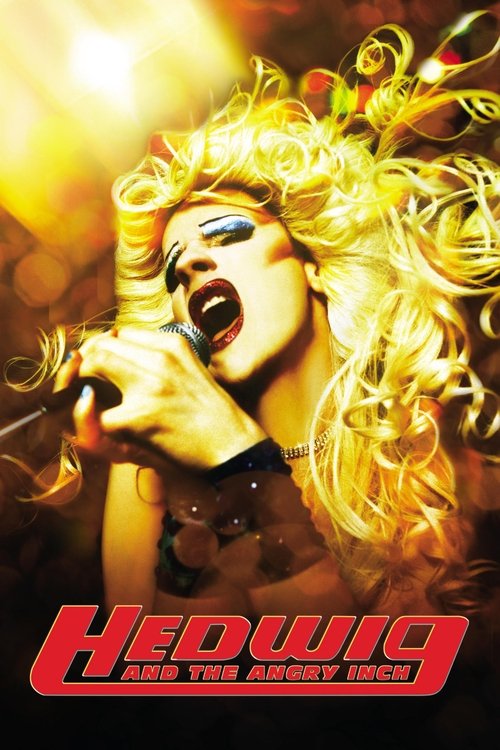
Hedwig and the Angry Inch
2001 · John Cameron Mitchell
For when you want to sing along and cry a little — big wigs, big feelings, and an anthem for anyone who's ever felt split in two. Comfort viewing for the gloriously unconventional.
What it's about
Raised a boy in East Berlin, Hedwig escapes to America at the cost of a botched surgery — the 'angry inch' of the title — and reinvents herself as an 'internationally ignored' rock diva touring dive restaurants with her band. Between blistering numbers, she tells the story of how she got here: the wall, the loves, the betrayals, and the search for her other half.
The experience
A glam-rock concert film with a broken heart — riotously funny and bitchy one minute, achingly sad the next. The songs carry you; the yearning underneath them sneaks up and floors you.
Performances
John Cameron Mitchell, who co-created the stage show, directs and stars — a ferocious, fully-lived performance that swings from stand-up venom to raw vulnerability without ever dropping the beat.
The craft
Stephen Trask's punk-cabaret songs are shot like a real concert film, and the centerpiece number 'The Origin of Love' retells Plato's myth of split beings in Emily Hubley's hand-drawn animation — one of the loveliest sequences in the American musical. Turn it up.
Why it matters
The glam apotheosis of the New Queer Cinema, it won Mitchell the directing prize at Sundance and has only grown as a cult and stage phenomenon since.
John Cameron Mitchell directs and stars in the film of the off-Broadway rock musical he built with composer Stephen Trask — the story of an East German singer whose escape to the West costs her, in a botched surgery, the 'angry inch' of the title, and who claws her way back through dive-tour America armed with eyeliner and a killer band. It arrived in 2001 as the New Queer Cinema's glam apotheosis: punk-cabaret numbers shot like concert film, bitterness and yearning braided into every lyric. The centerpiece, 'The Origin of Love,' retells Plato's myth of split beings in Emily Hubley's hand-drawn animation — one of the loveliest sequences in the American musical, period. Mitchell won the directing prize at Sundance and went on to a singular career of communal, sexually frank filmmaking, but nothing has matched Hedwig's fusion of camp armor and open wound. The wigs alone — teased into cartoon halos — are a thesis: self-invention as survival, performed nightly, whether anyone shows up or not.
A Deleuzian reading
The wig goes on first.
The full Deleuzian reading of Hedwig and the Angry Inch →
Reception
A Sundance 2001 darling — it won both the Audience Award and Best Director — that promptly bombed at the box office, then did the full Rocky Horror arc: midnight sing-alongs, devoted 'Hed-heads', and finally a Criterion release in 2019 sealing its status as a queer-cinema classic.
How Hedwig and the Angry Inch was received, from release to now →
Influences: the films it descends from and the films it influenced
- The Rocky Horror Picture Show (1975) — The founding template Hedwig extends: a queer glam-rock stage musical transposed to film with its gender-transgressive lead and camp theatricality preserved rather than naturalized into realist cinema.
- Cabaret (1972) — Fosse's diegetic model — every song staged as a literal cabaret act that ironically counterpoints the offstage story — is exactly Hedwig's number-as-gig structuring device.
- Pink Floyd – The Wall (1982) — Gerald Scarfe's hand-drawn animated interludes externalizing a rocker's psychic wounds are the direct formal precedent for Emily Hubley's animation in 'The Origin of Love.'
- Ziggy Stardust and the Spiders from Mars (1973) — Bowie's androgynous glam persona and Pennebaker's handheld concert-film grammar for capturing it feed both Hedwig's look and its concert-style shooting of the numbers.
- Female Trouble (1974) — Divine's 'crime is beauty' camp-as-armor performance and trash-glamour aesthetic are the model for Hedwig's weaponized, wounded glamour.
- Tommy (1975) — The sung-through rock-opera-to-film in which narrative advances through numbers rather than dialogue, an inheritance Hedwig carries into its confessional set.
- Purple Rain (1984) — The semi-autobiographical musician-plays-himself vehicle built with live-club performances as its narrative spine, the same actor-musician braid Hedwig uses.
- Stop Making Sense (1984) — Concert-film craft that builds rising emotional architecture out of the stage act itself — the escalating-gig logic Hedwig's tour framing borrows.
- Velvet Goldmine (1998) — The immediate New Queer Cinema glam-rock companion, reconstructing '70s glam androgyny as a lens on queer self-invention within the same movement and moment.
- The Adventures of Priscilla, Queen of the Desert (1994) — Drag-as-survival lip-sync numbers strung along a touring-across-country structure that mirrors Hedwig's gig-by-gig road-tour spine.
- Muriel's Wedding (1994) — Treats a pop songbook as emotional scripture and splits diegetic performance from interior fantasy, the found-object-second-score device Muriel builds around ABBA.
- Shortbus (2006) — Mitchell's own follow-through: an ensemble of non-actors and performers, sexual frankness, and music as communal catharsis extending his actor-director workshop method.
- Repo! The Genetic Opera (2008) — A goth rock-opera cult film built, like Hedwig, from a stage show that keeps its overtly theatrical and comic-panel/animated devices intact on screen.
- Were the World Mine (2008) — An indie queer musical that literalizes a myth (A Midsummer Night's Dream) into song, echoing Hedwig's turning of Plato's 'Origin of Love' into an animated number.
- Rocketman (2019) — The queer jukebox biopic staging a musician's memory as fantasy production numbers, taking Hedwig's confessional-concert-as-therapy shape into the mainstream.
- Tick, Tick... Boom! (2021) — A stage-to-screen rock musical that intercuts a live-performance frame with dramatized flashback — Hedwig's exact backstage/concert braid — to structure the film.
- Party Monster (2003) — Club-kid camp and self-mythologizing performance-of-identity in the same early-2000s queer-indie register, treating fabricated persona as autobiography.
Similar films
- Velvet Goldmine (1998) — influence & lineage
- The Adventures of Priscilla, Queen of the Desert (1994) — influence & lineage
- tick, tick... BOOM! (2021) — influence & lineage
- Lady Bird (2017) — shared sensibility
- Barbie (2023) — shared sensibility
- Dinner in America (2020) — shared sensibility
- Almost Famous (2000) — shared sensibility
- Frances Ha (2013) — shared sensibility