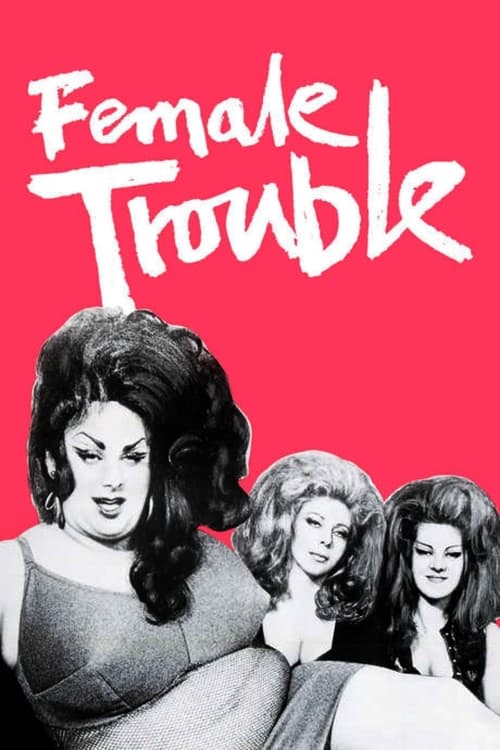
Female Trouble
1976 · John Waters
For a rowdy night when you want transgressive, quotable trash with friends — the opposite of a polite watch, and gloriously so. Strictly for viewers who want their comedy confrontational.
What it's about
Dawn Davenport's life goes off the rails on Christmas morning when her parents fail to deliver the cha-cha heels she demanded, and she storms out of the house into a career of delinquency. Single motherhood, a disastrous marriage into a hair salon family, and a pair of demented beauticians who preach that crime is beauty all propel her toward the fame she's always felt entitled to — told as a mock star-is-born biography of a magnificent monster.
The experience
Loud, filthy, and riotously funny — a film that commits so totally to bad taste it comes out the other side as a kind of grand opera. Every scene tries to top the last, and the shock and the laughter arrive together.
Performances
Divine is monumental as Dawn, playing her from teen brat to full-blown diva with total ferocity — and takes a second role besides — while Edith Massey's turn as the smitten Aunt Ida is one of cult cinema's most beloved grotesques.
The craft
Waters takes the shape of the Hollywood rise-and-fall biography and the classic women's picture and stuffs it with mayhem: garish homemade costumes, outrageous set pieces, and dialogue built to be shouted back at the screen. The craft is in the structure — real dramatic architecture underneath the filth.
Why it matters
Made on the heels of Waters' midnight-movie breakthrough, it became a cornerstone of trash cinema and drag culture, cementing Divine as an icon whose influence runs through decades of queer performance.
Snapshot
Female Trouble is John Waters' mock-biography of a monster he clearly adores: Dawn Davenport, high-school delinquent turned unwed mother turned thief, model, murderer and finally condemned prisoner, played across two decades of screen time by Divine. It is the film Waters made immediately after Pink Flamingos (1972) broke out on the midnight circuit, and it uses that windfall not to clean up but to build out — more sets, more costume changes, a longer arc, a real dramatic architecture underneath the filth. Where Pink Flamingos was a contest ("the filthiest people alive"), Female Trouble is a career, and the career is the joke: Waters takes the shape of the Hollywood star biography and the woman's-picture rise-and-fall and fills it with a heroine whose talent is crime and whose fans are her executioners.
A dating note, since catalog records disagree and this file's header carries 1976: the film was made and premiered in Baltimore in 1974, and circulated through the mid-seventies on the midnight and repertory circuit, which is why databases variously list 1974, 1975 and 1976. Production belongs to 1974.
Industry & production
Female Trouble was produced by Dreamland Productions, Waters' own banner and effectively the name for a Baltimore repertory company of friends — Divine, David Lochary, Mink Stole, Mary Vivian Pearce, Edith Massey, Cookie Mueller, Susan Lowe — who had been making films together since the late sixties for sums that would not cover a studio catering bill. The budget is commonly reported at roughly $25,000; that figure traces to Waters' own accounts, principally his memoir Shock Value (1981), and there is no audited production record behind it. It is worth saying plainly that the documentary base for these films is thin: no completion bonds, no trade-press production charts, no reliable grosses. Midnight-movie revenue in the seventies was collected theater by theater over years of runs and was never systematically reported, so any box-office number attached to Female Trouble should be treated with suspicion.
The industrial fact that matters is distribution. Waters' early features were handled by New Line Cinema, then a small New York outfit run by Robert Shaye whose business was campus bookings and repertory dates. Pink Flamingos was one of the titles that made New Line viable; Female Trouble followed into the same circuit. This is the seventies alternative-distribution machine working exactly as designed — a film with no rating, no stars in any conventional sense, and no possibility of a mainstream release finding a national audience through midnight slots, college film societies and word of mouth. Waters was not an outsider to the industry so much as a fluent operator of a parallel one.
Everything was shot in and around Baltimore, in apartments, borrowed storefronts and locations secured by nerve. The company doubled as crew. That economy is not incidental to the film's texture; it is the film's texture.
Technology
The film was shot on 16mm, Waters' format since Mondo Trasho, with theatrical prints blown up for wider bookings — a workflow that accounts for the grain, the thickened contrast and the slightly smeared color that read now as the seventies underground's signature. Lighting was minimal and often practical or single-source, and interiors show the characteristic 16mm falloff into muddy corners.
Sound was recorded separately and synced, and the results are uneven: dialogue sits close and dry in some scenes, boomy and distant in others, with occasional drift. Waters had been improving his sound capability across each film, and Female Trouble is markedly more intelligible and more sustained in dialogue than Multiple Maniacs or Pink Flamingos — long scenes are carried on talk rather than on stunts. The precise equipment record for Dreamland productions is not well documented outside Waters' own recollections, and I won't invent specifics.
The relevant technological postscript is restoration. The film circulated for decades in battered prints and poor video transfers that, for many viewers, were the aesthetic. A digital restoration supervised by Waters, released by the Criterion Collection in 2018, resolved the image far past anything the midnight audience saw — an act of canonization that also, unavoidably, changes the object.
Technique
Cinematography
Waters shot the film himself, as he had his previous features; the transition to a professional cinematographer would not come until Polyester (1981). The camera is frontal, waist-to-head, planted. Compositions are centered and symmetrical, with performers arranged facing the lens as though on a proscenium, and the camera moves mainly to reframe rather than to reveal. Zooms do work that dollies would do in a funded film. Where the style becomes genuinely expressive is in the tabloid and fashion material: the Dashers' photographic sessions let Waters shoot Divine the way a magazine would, in flat glamour lighting and posed attitudes, so that the film's own image-making becomes visibly complicit with the characters' project of turning crime into beauty.
The color scheme is not naturalistic — Van Smith's costume and makeup palette and Vincent Peranio's sets are chosen to fight each other, and 16mm's saturation pushes them further.
Editing
Charles Roggero is the credited editor, joining a production that had previously been cut largely by Waters himself, and the difference is legible: Female Trouble runs as a sustained narrative rather than a string of set pieces. The cutting is functional, unhurried, and deliberately unpolished — shots are held past the point of comfort so that performances can curdle, and jokes are allowed to sit rather than being clipped for rhythm. The film's most sophisticated editorial gesture is structural: elliptical jumps of years between episodes, each one presenting Dawn already transformed, which lets the biography move at the clip of a wire-service summary of a criminal's life.
Mise-en-scène / staging
This is where the film's real craft sits. Peranio's sets — the Davenport family living room at Christmas, the Lipstick Beauty Salon, the trailer, the nightclub, the courtroom — are built from a precise reading of lower-middle-class American décor, then pushed one degree into hallucination. Van Smith's work on Divine is the era's most consequential act of screen design: the shaved-back hairline that turns the forehead into a canvas, the drawn brows, the sprayed and architectural hair. Dawn's late-film look — scarred face, teased vertical crest, hardware — arrives roughly two years before punk's visual vocabulary consolidated in London, and the resemblance is not coincidence so much as parallel discovery from shared sources.
Staging is theatrical in the literal sense: entrances, declamation, tableaux. Characters announce their positions rather than reveal them.
Sound
There is no score in the conventional sense. The film runs on source records and on a title song performed by Divine over the credits — the star singing her own myth, which is the whole film in thirty bars. Waters' habitual use of obscure pop and rockabilly sides as needle drops continues here; complete and reliable source-music credits for the early Dreamland films are not well documented, and I won't guess at them. The dominant sonic texture is voice: Divine's, Edith Massey's, Mink Stole's, each pitched at a volume no realist film would tolerate, recorded close and left unsweetened.
Performance
Divine gives a genuine performance, not a stunt, and the film's stature rests on it. Dawn at sixteen is played with a schoolgirl's petulance that Divine does not condescend to; Dawn at forty is grandiose, self-pitying and finally deluded in a way that earns something close to pathos in the electric-chair finale. The doubling — Divine also plays Earl Peterson, the man who impregnates Dawn, so that the star has sex with himself in a junkyard — is a conceptual gag that also literalizes the film's argument that Dawn is entirely self-generated.
Around Divine, the company plays in incompatible registers by design. Edith Massey's Aunt Ida is barely acting in any trained sense and is unforgettable for it. Mink Stole's Taffy is a sustained scream of adolescent grievance. David Lochary and Mary Vivian Pearce play the Dashers in a brittle high-society parody that supplies the film's only characters with a theory.
Narrative & dramatic mode
The structure is the showbiz biography — humble origins, discovery, patron, rise, hubris, fall, execution — laid over the criminal-career film. Dawn runs away from home on Christmas morning after her parents fail to produce the cha-cha heels she demanded; is impregnated by a stranger; raises a daughter, Taffy, whom she despises; marries the hairdresser Gater; is taken up by the salon's owners, Donald and Donna Dasher, who hold that crime and beauty are the same act; is disfigured with acid by Gater's Aunt Ida; is celebrated for the disfigurement; murders her daughter; performs a nightclub act that climaxes with her firing into the audience; and is tried, convicted and electrocuted, delivering an awards-show acceptance speech from the chair.
The dramatic mode is melodrama played at full sincerity by performers whose sincerity the film simultaneously frames as absurd. Nothing is ironized within scenes — Dawn means it, Ida means it, Taffy means it — and the comedy comes entirely from the gap between the characters' conviction and the film's arrangement of them. That is a harder register to sustain than parody, and it is why the film survives repeat viewing.
Genre & cycle
Female Trouble belongs to the midnight movie as a distribution category more than to any single genre, but it draws on several with precision: the juvenile-delinquency picture of the fifties, the women-in-prison film, the maternal melodrama, the fallen-woman narrative, and the Hollywood star-tragedy. Its immediate cycle is American underground exploitation as it stood in the early seventies — the Warhol–Morrissey features, the work of Russ Meyer and Herschell Gordon Lewis, Kenneth Anger's ritual pop-iconography — and its immediate peers on the midnight circuit were El Topo, The Rocky Horror Picture Show, Eraserhead and Waters' own Pink Flamingos.
Authorship & method
Waters wrote, directed and photographed the film, and cast it from a company he had been writing for since the sixties — the method is closer to a theater troupe's than a film production's. Parts were written for specific bodies and specific voices, which is why the dialogue is unplayable by anyone else.
The key collaborators are stable across his filmography and are properly co-authors of the style: Vincent Peranio (production design), Van Smith (costume and makeup, and the architect of Divine's face), Charles Roggero (editing), and Divine as the persona around which the writing is built. There is no composer in the traditional sense.
One authorial fact should be stated rather than skated past: the film carries a dedication to Charles "Tex" Watson, of the Manson family, with whom Waters corresponded. Waters' fascination with the Manson case is documented at length in Shock Value, and he has in later decades revisited that fascination critically, becoming a public advocate for Leslie Van Houten's parole. The dedication is not a throwaway; the film's entire thesis about crime, celebrity and the audience's appetite for both comes out of the same preoccupation.
Movement / national cinema
The film sits at the intersection of the American underground (Warhol's Factory, Jack Smith, Anger) and regional independent exploitation. What distinguishes Waters from the New York underground is Baltimore — a specific, unglamorous American city rendered with an anthropologist's accuracy underneath the grotesquerie. The Dreamlanders are not bohemians playing at trash; the film's sense of hairspray, formica, sectarian family cruelty and beauty-parlor hierarchy is observed. It is also, unmistakably, a work of pre-Stonewall-inflected, post-Stonewall-era queer cinema: drag as ontology rather than impersonation, and Aunt Ida's campaign to make her nephew gay — her line that the heterosexual world is a sick and boring life — inverting the conversion narrative decades before that inversion became a common joke.
Era / period
Made in 1974, the film reads the American seventies with unusual accuracy: the exhaustion of the counterculture, the tabloidization of the Manson and Patty Hearst era, the arrival of the criminal-as-celebrity, and the fashion industry's absorption of transgression as style. Dawn's ascent through the Dashers' patronage is a compressed satire of exactly the mechanism by which the avant-garde was being converted into product during the decade. The film's period settings — a fifties Christmas, a sixties go-go bar, a seventies gallery-salon — also make it a rapid survey of postwar American aspiration.
Themes
Crime as art, and art as a marketing category. Celebrity as the terminal form of delinquency: Dawn wants to be looked at, and the film follows that want through mutilation to execution without ever suggesting she should have wanted otherwise. Motherhood as a war of attrition — the Dawn/Taffy relationship is the film's cruelest and most sustained joke, and its most recognizable. Beauty as violence, literalized in the acid attack that makes Dawn a star. And, running under all of it, the complicity of the spectator: Dawn's nightclub act ends with her shooting at the audience, and her last words are addressed, gratefully, to us.
Reception, canon & influence
Contemporary mainstream critical coverage was sparse and largely hostile where it existed; Waters in 1974 was a scandal, not a subject, and the film's reputation was built on the midnight circuit rather than in the review pages. Its critical rehabilitation came gradually — through Waters' own crossover with Hairspray (1988), through the retrospective canonization of the midnight-movie phenomenon, and decisively through the Criterion Collection's 2018 restoration and release, which placed Female Trouble in the art-house canon it had spent forty years mocking. Waters himself has frequently named it his favorite among his own films.
Backward, its influences are legible and were freely acknowledged by Waters: the Warhol–Morrissey features and their superstars; Kenneth Anger's pop-occult iconography; Russ Meyer's and Herschell Gordon Lewis's exploitation grammar; William Castle's showmanship (which Waters would take up literally with Polyester's Odorama); the woman's picture and its excesses; the fifties delinquency film; and tabloid true-crime, especially the Manson trial coverage.
Forward, its reach is disproportionate to its budget. Divine's persona — engineered here at full strength — became a template for drag as confrontational performance rather than illusion, a lineage that runs through club culture, Divine's own Hi-NRG recording career, and into the mainstreamed drag of the present; Waters' periodic appearances in that world have been explicit about the debt. Divine's look is also the acknowledged model for Ursula in Disney's The Little Mermaid (1989), a genuinely strange piece of transmission. The film's punk-adjacent visual language anticipated and then fed the punk and post-punk image economy. And its central move — the deadpan aestheticization of the American grotesque, played straight by actors who mean it — became foundational for New Queer Cinema and for a broad strain of American independent film that includes Gregg Araki, Bruce LaBruce and Harmony Korine.
The company itself did not last. David Lochary died in 1977, Edith Massey in 1984, Divine in 1988, Cookie Mueller in 1989. Female Trouble is, among other things, the fullest record of what that group could do together at its peak.
A Deleuzian reading
A girl asks for cha-cha heels for Christmas.
The full Deleuzian reading of Female Trouble →
Reception
Dismissed as gross-out midnight-movie trash on release (Variety famously trashed it), it's now widely argued to be John Waters' actual masterpiece — a status made official when the Criterion Collection inducted it in 2018.
How Female Trouble was received, from release to now →
How to watch Female Trouble: what to notice on a first viewing
- Watch how flatly and directly the camera faces each performer. Waters shoots frontal, waist to head, centered and symmetrical, as if every actor were standing on a small stage built just for the lens. The plainness of the camera makes every outrageous thing in front of it look presented, not caught.
- Notice Divine's shaved-back hairline and sprayed, architectural hair. Van Smith turns the forehead into a canvas and builds the hair like a piece of set design, changing Dawn's look across the film's decades. The makeup itself tells the story of who Dawn is becoming, scene by scene.
- Notice how ordinary and lower-middle-class each set actually is. Peranio builds the Davenport living room and the beauty salon from a precise reading of everyday décor, then pushes it one degree into hallucination. You could price the furniture in these rooms, and something is still deeply off about all of them.
- Listen for source records instead of any traditional film score. The film runs entirely on needle drops and a title song performed by Divine, with voices recorded close and pitched louder than any realist film would allow. The star sings her own myth before the story even starts, which is the whole film in thirty seconds.
- Watch Divine play a teenager's petulance with complete sincerity. Nothing in the performance winks at the audience, and that unbroken sincerity is what lets the comedy come from the arrangement of the scene instead of a joke. The film never lets Dawn know she's funny, and that's exactly why she is.
The whole guide to watching Female Trouble, with the keys for a rewatch →
Influences: the films it descends from and the films it influenced
- Flaming Creatures (1963) — Smith's method of shooting a costumed non-professional troupe on scavenged, overexposed 16mm in flat frontal setups — where makeup, wigs and drapery substitute entirely for production design — is the 'moldy glamour' technique Van Smith and Vincent Peranio systematize around Divine.
- Scorpio Rising (1963) — Anger's replacement of a composed score with wall-to-wall pop 45s used as ironic commentary track, cut against fetish-object insert close-ups, is the exact source-music strategy of a film that has no composer and opens on Divine singing its own title song.
- Trash (1970) — Morrissey's planted camera, scene-length takes and zoom-in-place in lieu of a dolly, with drag and superstar performers playing amplified versions of themselves, is the shooting economy Waters adopts wholesale — but applies to a fully scripted screenplay rather than improvisation.
- Faster, Pussycat! Kill! Kill! (1965) — Meyer's delinquent-woman grammar — declamatory hard-boiled dialogue delivered at maximum volume by monumentalized female leads, framed from low angles that make them architectural — is the register Divine's Dawn Davenport is written in.
- Blood Feast (1963) — Lewis's regional non-union exploitation economics: atrocity staged frontally in a static wide so the effect reads as tableau rather than shock cut, with amateur line readings left unsmoothed in the edit — Waters keeps both the flat staging and the unpolished takes.
- What Ever Happened to Baby Jane? (1962) — Aldrich's grotesque-makeup star vehicle — caked white pancake, drawn-on features and penciled brows photographed in deliberately unflattering close-up on a fallen showbiz figure — is the design premise Van Smith pushes to its terminal point in Dawn's post-acid face.
- Mildred Pierce (1945) — The woman's-picture rise-and-ruin skeleton advanced by hard year-jump ellipses, with glamour key lighting reserved for the sacrificing mother while the daughter methodically destroys her — Waters lifts the structure and the lighting scheme and plays them straight.
- The Violent Years (1956) — The fifties girl-gang delinquency picture's rigid moral machinery — bad girl, crime spree, courtroom, execution — plus Ed Wood's unspeakable over-written dialogue, which Waters borrows as both plot architecture and comic performance register.
- Pink Flamingos (1972) — The immediate prototype: Dreamland as a written-for company, Waters operating his own 16mm camera, Divine as the persona the script is built around — Female Trouble reworks it with a three-act showbiz-biography arc and Van Smith's upgraded glamour lighting.
- Beyond the Valley of the Dolls (1970) — Pushes BVD's morality-melodrama-parody to its logical end — a crime-spree narrator framing that culminates in a literal electric-chair grand-guignol climax played as triumphant spectacle.
- Desperate Living (1977) — Peranio's Mortville — an entire town built from scratch and shot head-on — extends the proscenium-tableau set logic of Dawn's living room into a fully artificial world, with the same company and the same criminal-heroine arc minus Divine.
- The Little Mermaid (1989) — Ursula's character design — the jowly face with black-and-white greasepaint blocking, the shaved-and-redrawn arched brow, the shoulder-forward silhouette — was modeled by the animators on Van Smith's Divine makeup as fixed in this film.
- The Living End (1992) — Araki shoots, writes and cuts his own micro-budget features with performers deliberately pitched in incompatible registers against needle-drop soundtracks, treating atrocity as deadpan — New Queer Cinema inheriting Waters' one-man production economy intact.
- Hustler White (1996) — LaBruce casts non-professionals and porn performers essentially as themselves and stages them in composed frontal tableaux with held, unpolished takes — the Dreamland troupe method transposed to nineties queercore.
- Gummo (1997) — Korine's planted camera photographs real non-actors in their own faces and rooms with fashion-grade lighting, structured as elliptical vignettes rather than plot — the abject shot as glamour subject, which is Female Trouble's central formal move.
- Hedwig and the Angry Inch (2001) — Divine's 'crime is beauty' camp-as-armor performance and trash-glamour aesthetic are the model for Hedwig's weaponized, wounded glamour.
- But I'm a Cheerleader (2000) — Divine's grotesque-glamorous performance style and Waters' treatment of gender as costume seeds Babbit's central conceit that heterosexuality is a learnable, performable set of props.
- Hairspray (1988) — Establishes the Divine dual-role gag Hairspray reuses wholesale — Divine plays both Dawn Davenport and her male rapist Earl Peterson, exactly as she later plays both Edna Turnblad and station owner Arvin Hodgepile, with Van Smith's makeup engineering the split.
- The Rocky Horror Picture Show (1975) — Proscenium staging and direct-to-camera numbers designed for the midnight circuit's participatory exhibition model, with Frank-N-Furter's drag built as confrontation rather than illusion — the Divine template, working the same theaters in the same years.
- Forbidden Zone (1980) — Hand-painted flat sets shot frontally as proscenium tableaux, with a cabaret troupe (the Mystic Knights) doubling roles under heavy graphic makeup — Peranio-and-Van-Smith construction logic arrived at independently on the other coast.
- Eating Raoul (1982) — Bartel stages serial murder in flat, frontally-lit, sitcom-composed setups and has his leads play petit-bourgeois killers with total sincerity — the deadpan aestheticization of American grotesque that Waters codified, minus the shock imagery.
- Liquid Sky (1982) — Anne Carlisle plays both Margaret and Jimmy in the same frames — dual-role doubling as the film's central performance device — while fashion-editorial key light and post-punk makeup design carry the production value that the budget can't.
Similar films
- Pink Flamingos (1972) — influence & lineage · same viewing thread
- Desperate Living (1977) — influence & lineage · same viewing thread
- Gummo (1997) — influence & lineage
- What Ever Happened to Baby Jane? (1962) — influence & lineage
- The Rocky Horror Picture Show (1975) — influence & lineage · same viewing thread
- Castration Movie Anthology i. Traps (2024) — same viewing thread
- Hairspray (1988) — shared sensibility
- Daisies (1966) — shared sensibility
All the films related to Female Trouble →
Watch it with: curated runs of related films
- The Grotesque Sublime — Watch these when you want cinema that pushes the body to hallucinatory, grotesque extremes — each a lurid transformation, half ecstasy and half horror, that dares you to keep looking.