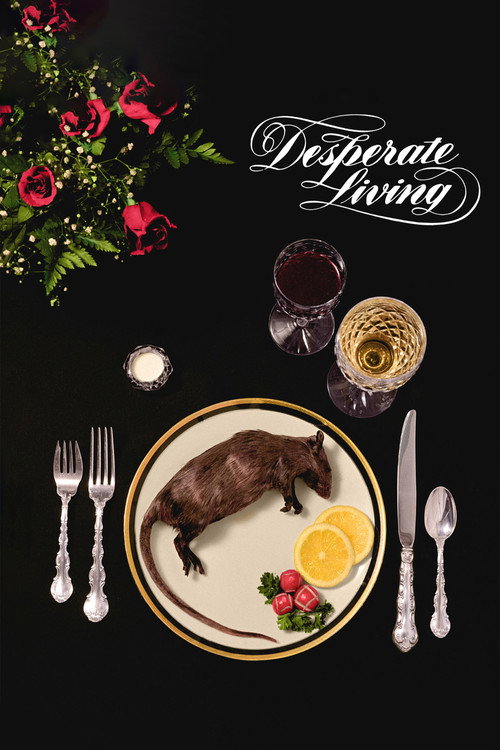
Desperate Living
1977 · John Waters
For a late night when you want to be scandalized — trash cinema as a dare, best with friends who won't flinch. This is challenge viewing, not comfort viewing; approach only if 'in bad taste' sounds like a recommendation.
What it's about
A hysterical suburban matron murders her husband and goes on the run with her hulking maid, landing in Mortville — a garbage-built shantytown for criminals ruled by the vain, sadistic Queen Carlotta. What follows is a filthy fairy tale of exiles, outlaws, and lovers plotting revolt against a tyrant. John Waters called it a 'monstrous fairy tale,' and that's exactly the register: castle, queen, peasants, all coated in grime.
The experience
Loud, gross, gleefully offensive, and weirdly principled underneath — it plays like a storybook read by someone determined to appall you, and it keeps topping itself. You'll laugh, wince, and occasionally do both in the same breath.
Performances
Mink Stole runs at a full scream from the first scene as the unraveling Peggy Gravel, and Edith Massey's cackling Queen Carlotta is one of the great outsider-cinema villains — untrained, unforgettable, impossible to fake.
The craft
Made without Divine for once, the film spreads its energy across Waters' Dreamland ensemble and its greatest asset: the Mortville set itself, a real shantytown of scavenged junk that gives the fairy-tale premise a genuinely handmade, fetid physicality. The cheapness is the aesthetic — every frame looks like it smells.
Why it matters
The last of Waters' truly underground Baltimore provocations before Polyester nudged him toward respectability, it became a midnight-movie fixture and a touchstone of queer outlaw cinema.
Snapshot
Desperate Living is John Waters' fourth feature and, by his own framing, a "monstrous fairy tale" — a lurid, scatological revenge fable staged in Mortville, a shantytown penal colony populated entirely by criminals and ruled by the grotesque tyrant Queen Carlotta. It occupies a pivotal seam in Waters' career: the last of his truly underground Baltimore provocations before the comparative respectability of Polyester (1981), and the one major Dreamland production of the era conceived without Divine, who was committed to a stage engagement during shooting. In Divine's absence the film redistributes its energies across an ensemble — Mink Stole's hysteric matron Peggy Gravel, Jean Hill's colossal maid Grizelda, Susan Lowe's butch outlaw Mole McHenry, Liz Renay's faded beauty Muffy St. Jacques, and Edith Massey's cackling Carlotta — producing Waters' most ideologically pointed film, an explicitly queer, class-conscious cartoon of insurrection. It is transgressive comedy pushed to the border of horror, and it remains a touchstone of American underground and midnight cinema.
Industry & production
Desperate Living was produced through Waters' informal Dreamland collective in and around Baltimore, the same regional, self-financed, semi-amateur apparatus that had generated Multiple Maniacs (1970), Pink Flamingos (1972), and Female Trouble (1974). This was filmmaking outside the studio system in the most literal sense: a repertory company of friends and local eccentrics, favors and small sums, shot on location in Maryland with sets — most famously the sprawling refuse-built town of Mortville — constructed by hand from scavenged materials. The film was distributed by New Line Cinema, then a young company that had built much of its early identity on Waters' work, particularly the runaway midnight success of Pink Flamingos. That relationship gave Desperate Living an established pipeline into the midnight-movie and repertory circuit that sustained transgressive cinema in the 1970s.
Precise production figures for the film are not reliably documented in the public record, and Waters' own retellings tend toward anecdote rather than accountancy; I will not invent a budget or box-office number. What is clear is that the film operated at the modest, hand-to-mouth scale characteristic of Waters' pre-Polyester period, and that it received an X rating in the United States, a designation that both signaled and constrained its distribution to adult, midnight, and art-house venues rather than mainstream theaters. The single most consequential production circumstance was Divine's unavailability: the star around whom Waters' previous features had been built was performing on stage, and Desperate Living was written and cast accordingly, making it the great exception in the Divine-centered filmography.
Technology
The film was shot on 16mm — the format that defined Waters' early work and, more broadly, the American underground of the period, prized for its cheapness, portability, and tolerance for improvised, non-professional conditions. It was made in the analog, photochemical era: direct-recorded and post-dubbed sound, physical splice editing, and optical rather than electronic effects. No technological novelty is at stake here; if anything, Desperate Living is notable for what it refuses. Where Waters would soon experiment with gimmickry in Polyester — the scratch-and-sniff "Odorama" card — Desperate Living is technologically plain, its aesthetic deriving from the grain, flatness, and unglamorous exposure of low-budget 16mm rather than from any innovation in the apparatus. That plainness is itself expressive: the coarse image reads as documentary truth applied to manifestly fake material.
Technique
Cinematography
The photography is functional, frontal, and unfussy — a deliberate flatness that lets the outrageous production and performance carry the frame. Waters had operated the camera himself on his earliest films; by Desperate Living the cinematography was handled by a credited director of photography (the record commonly attributes the photography to Thomas Loizeaux), reflecting a modest professionalization of the Dreamland method even as the aesthetic stayed defiantly rough. The camera favors medium and full shots that keep the grotesque tableaux of Mortville legible, with the harsh, even lighting of low-budget 16mm exposing every seam of costume and set. This is anti-glamour as a governing principle: the compositions present their freaks and squalor without the softening of mood lighting or expressive angles, so that the fairy-tale content is delivered in the visual register of a home movie or a crime-scene photograph.
Editing
Editing on the film is credited to Charles Roggero, an editor associated with Waters' work in this transitional phase (he would also cut Polyester). The cutting serves narrative clarity and comic timing rather than rhythm-for-its-own-sake: it lets performances play out, holds on the film's escalating gross-out setpieces long enough to register their full effrontery, and moves the fable briskly through its episodic structure. Waters' comedy depends on the audience being given time to absorb each transgression, and the editing accommodates that — punchlines of image and dialogue are allowed to land rather than being clipped.
Mise-en-scène / staging
Mise-en-scène is where Desperate Living is richest and most distinctive. Mortville is one of the great low-budget production designs of the American underground: a fetid, junk-built shantytown, its architecture assembled from garbage, its citizenry costumed in a maximalist parade of the tawdry and the deranged. Waters stages the film as a debased storybook — a fairy tale rendered in filth — and the design commits totally to that conceit, from Queen Carlotta's absurd regalia to Mole McHenry's leather butch iconography. The staging is theatrical and frontal, closer to a lewd pageant than to naturalist blocking, which suits the material's cartoon logic. Every surface is dressed toward excess and decay; the visual world is legibly artificial, and that artifice is the point.
Sound
The soundtrack bears the marks of its budget: post-synchronized dialogue and a rough, unpolished audio surface that contributes to the film's raw texture. Music functions largely as source and coloring rather than as an integrated score, and the public record on a credited composer for the film is thin — I will not fabricate an attribution. The most important sonic element is language itself. Waters writes dialogue as a form of assault, and the performers deliver it in a heightened, declamatory mode; the sound design foregrounds this torrent of profane, epigrammatic speech, which does much of the work that music or effects might carry in a conventional film.
Performance
Performance is the film's engine, and it operates in a register of committed, camp overstatement that Waters had cultivated across the Dreamland pictures. Mink Stole, promoted here to a lead in Divine's absence, plays Peggy Gravel as a spectacle of bourgeois hysteria — shrieking, phobic, homicidally fragile — and her pitch of anti-naturalism sets the film's tone. Jean Hill's Grizelda is a force of sheer physical presence; Susan Lowe grounds Mole McHenry with a genuine, near-earnest conviction that anchors the film's queer heart; Liz Renay brings a real-life notoriety (as a figure with underworld and burlesque associations) to Muffy; and Edith Massey, as Queen Carlotta, delivers the untrained, gleeful strangeness that made her a Dreamland icon. The ensemble's amateur-adjacent theatricality is not a limitation to be excused but the aesthetic itself: a style of performance that treats sincerity and outrage as the same gesture.
Narrative & dramatic mode
The film's dramatic mode is fable — explicitly so. Waters frames the story as a warped fairy tale, complete with a wicked queen, an oppressed populace, princesses, and a revolution, and then floods that structure with murder, disease, mutilation, and every available bodily transgression. The narrative is episodic and picaresque: Peggy Gravel and Grizelda flee into Mortville after a killing, become enmeshed in the town's tyranny and its underground of lesbian outlaws, and the plot builds toward collective uprising against Carlotta. The mode is satirical and allegorical rather than realist — characters are types and grotesques, events escalate by the logic of the cartoon and the tall tale, and the emotional pitch stays at hysteria throughout. Crucially, Waters gives this fable a political shape: it is a revenge-and-revolution story in which the oppressed rise against a monstrous ruler, and it closes on an image of insurgent triumph rather than the pure nihilism of Pink Flamingos.
Genre & cycle
Desperate Living sits at the intersection of several genres and cycles. It belongs, first, to Waters' own cycle of Dreamland transgression comedies — the run from Multiple Maniacs through Female Trouble — and functions as that cycle's most overtly political and, in some respects, its coda. It participates in the broader American underground and "trash" tradition, and in the midnight-movie phenomenon that gave films like Pink Flamingos, El Topo, and The Rocky Horror Picture Show their audiences. Generically it braids black comedy and crime with the grotesque and the horrific: its late passages, with plague and mutilation and cannibalistic revolt, tip the comedy into something adjacent to horror. And it is, importantly, a landmark of queer and specifically lesbian-centered exploitation, foregrounding butch and femme outlaw figures at a moment when such representation was virtually absent from commercial cinema.
Authorship & method
Desperate Living is unmistakably a John Waters film: written and directed by Waters, it bears his signature fusion of bad taste as aesthetic program, camp sensibility, love of the criminal and the abject, and delight in profane, quotable dialogue. His method was that of the Dreamland auteur-impresario — building each film around a stable repertory company and a regional, DIY production model, writing roles for specific non-professional performers, and mining Baltimore's marginal spaces for locations and personnel. The film is also a document of key collaborations. Among the cast, Edith Massey and Mink Stole and Susan Lowe were long-standing members of the troupe; on the technical side, editor Charles Roggero and the credited cinematographer (commonly given as Thomas Loizeaux) represent the modest professionalization of Waters' team in this period. The signal authorial fact of Desperate Living, though, is Waters' response to a constraint: deprived of his central star, he decentered his authorship onto an ensemble and, in doing so, produced his most explicitly ideological work. On the question of a credited composer the documentary record is genuinely sparse, and I decline to attribute one.
Movement / national cinema
The film belongs to the American cinematic underground — the post-1960s current of independent, transgressive, often regional filmmaking that ran parallel to and against Hollywood, and that found its exhibition life on the midnight and repertory circuit. Waters is frequently placed in the lineage of camp and "trash" aesthetics running back through Andy Warhol's Factory films, the physique-and-shock traditions, and the queer underground of figures like Kenneth Anger, even as his sensibility is entirely his own. Geographically, the movement here is intensely local: Waters is the great cinematic chronicler of a particular Baltimore of the marginal and the déclassé, and Desperate Living, however fantastical its Mortville setting, is a Maryland film through and through, made by and for a specific regional counterculture before its national afterlife on the midnight circuit.
Era / period
Made and released in 1977, Desperate Living is a product of the late-1970s tail of the midnight-movie boom, a moment when transgressive underground work could still find a sustainable, if narrow, theatrical audience. It arrives after the cultural high-water mark of Pink Flamingos had made Waters a countercultural name, and just before the industry and Waters both shifted: the coming decade would push midnight cinema toward home video and would carry Waters himself toward the relative accessibility of Polyester and, later, the mainstream crossover of Hairspray (1988). The film thus captures a threshold — the last full expression of Waters' underground period, made in the closing window when that period's economic and exhibition conditions still held.
Themes
The film's dominant theme is revolution against tyranny, staged as class and gender war. Mortville is a kingdom of the criminalized poor ruled by a capricious despot, and the narrative drives toward the overthrow — and literal consumption — of the oppressor, an ending that reads as gleeful proletarian and queer insurrection. Bound up with this is a sustained engagement with queerness and the body: the film centers lesbian outlaws, treats butch and femme identity with a mixture of camp and conviction, and stages the body as a site of horror, transformation, and revolt (Mole McHenry's regret over surgical transformation is one of its most discussed and provocatively ambivalent threads). Bourgeois hysteria and respectability are savaged through Peggy Gravel, whose phobic gentility is the film's satirical target from the first scene. Running beneath all of it is Waters' abiding fascination with filth, disease, and the abject as instruments of both comedy and social critique — waste and contamination made into the medium of a political fairy tale.
Reception, canon & influence
On release, Desperate Living met the divided response typical of Waters' underground films: embraced by devotees of transgressive and midnight cinema and by an emerging queer counter-public, and dismissed or refused outright by mainstream critics for whom its X-rated excess placed it beyond the pale. Because much of its early reception played out in the ephemeral world of midnight screenings and fan culture rather than in the paper of record, the contemporaneous critical archive is comparatively thin, and I will not manufacture reviews or receipts that the record does not securely support. Over time, however, the film's standing has risen as Waters' whole body of work has been reassessed — its eventual availability through the Criterion Collection is emblematic of that canonization of the once-disreputable.
Looking backward, the film draws on the camp and underground traditions that shaped all of Waters' work — the Warhol/Factory lineage, the queer underground, exploitation and "trash" cinema, and the storybook forms it desecrates. Looking forward, its influence runs strongest as part of Waters' collective legacy: he is a foundational figure for later transgressive, camp, and queer filmmakers, and for the whole cultural project of reclaiming "bad taste" as a serious aesthetic and political stance. Within that legacy Desperate Living holds a specific and honored place as the most politically explicit and the most emphatically queer of his early films — the one that imagines not just transgression but revolt, and lets its outcasts win.
A Deleuzian reading
Edith Massey sits on a throne in a town made of garbage, wearing something that is trying very hard to be regalia, and cackles.
The full Deleuzian reading of Desperate Living →
Reception
Dismissed on release as too ugly and too grim even by some Waters diehards — the one without Divine — it's since been reclaimed, especially by queer audiences, as maybe his most radical film: a filthy lesbian punk fairy tale that was ahead of everyone.
How Desperate Living was received, from release to now →
How to watch Desperate Living: what to notice on a first viewing
- Notice the lighting stay flat and harsh in every scene. Waters lights Mortville and its citizens with the same even, unflattering 16mm light throughout, exposing every seam of costume and set instead of hiding them. The flat light treats the grotesque like ordinary documentary fact, never dressing it up.
- Watch characters pose frontally like a staged pageant. Waters keeps arranging his cast frontally and theatrically, closer to a lewd stage show aimed right at you than to naturalistic blocking between people. The staging keeps announcing that you are the target of the joke, not a bystander to it.
- Notice how much of Mortville is built from garbage. The shantytown's houses, thrones, and costumes are visibly assembled from junk and scavenged material, never disguised as anything sturdier than what it actually is. The world looks exactly as cheap and improvised as the people who were forced to build it.
- Watch Peggy Gravel react without ever seeming to decide anything. Mink Stole plays her shrieking, phobic, and homicidal, pitched well past ordinary acting, so every outburst reads as reflex rather than a choice she is weighing. She plays a class of person converted into a set of tics, not a woman making decisions.
The whole guide to watching Desperate Living, with the keys for a rewatch →
Influences: the films it descends from and the films it influenced
- Multiple Maniacs (1970) — Establishes the post-synchronized 16mm sound and single-take theatrical-frontal blocking Desperate Living reuses — dialogue recorded wild and re-laid over static long takes.
- Pink Flamingos (1972) — Codifies the Dreamland 'contest of filth' structure and the anti-glamour flat 16mm lighting that renders the grotesque as deadpan document, the exact technique applied to Mortville.
- Female Trouble (1974) — Shares the repertory-company casting written for specific non-professionals (Divine, Mink Stole, Edith Massey) and the camp-overstatement register pitched deliberately past naturalism.
- The Chelsea Girls (1966) — Model for building a film from a stable of non-professional 'superstars' performing amplified versions of themselves before a static frontal camera — the Factory method Waters imports.
- Trash (1970) — Morrissey's deadpan framing of abject bodies in a drug-outcast milieu supplies the anti-glamour flatness and the repertory-of-the-marginal casting logic.
- Flaming Creatures (1963) — Source of the junk-built glitter-and-rags production design and the queer camp tableau — the underground aesthetic of 'trash as glamour' Waters inherits.
- Scorpio Rising (1963) — The Anger half of Waters' cited Warhol–Anger lineage: queer subcultural iconography staged as transgressive ritual through pop-camp appropriation.
- Blood Feast (1963) — Template of regional, self-distributed exploitation shot with flat frontal lighting and amateur performers — the DIY commercial model Waters adapts to midnight cinema.
- Freaks (1932) — Precedent for casting real marginalized bodies as a community of outcasts who turn on their oppressors — the ensemble-revolt structure Desperate Living politicizes.
- The Wizard of Oz (1939) — The storybook fable whose enchanted-kingdom quest structure Desperate Living desecrates — Mortville as a grotesque anti-Oz with wicked queen and picaresque journey.
- Polyester (1981) — Extends the Dreamland repertory method toward professionalization while retaining the camp-overstatement performance and post-synced comic timing worked out here.
- Pepi, Luci, Bom (1980) — Transposes the DIY non-professional camp-underground model to Madrid's Movida with the same anti-glamour flatness and episodic transgression-comedy structure.
- The Toxic Avenger (1984) — Carries the regional DIY trash-exploitation production and the abject-hero-revolts-against-the-town narrative forward into 1980s midnight cinema.
- Poison (1991) — New Queer Cinema's formalization of Waters' bad-taste transgression into the Genet register — queer abjection and revolt rendered as deliberate aesthetic program.
- The Living End (1992) — Extends the queer-outlaw revolt and picaresque-episodic outcast structure with the same shoestring, anti-glamour DIY production values.
- Gummo (1997) — Pushes the junk-built regional production design, non-professional local casting, and anti-glamour flatness to an extreme as portraiture of the grotesque margin.
- Hustler White (1996) — Queercore's DIY, non-professional, sexually transgressive underground filmmaking directly extends Waters' bad-taste-as-program method and repertory casting.
Similar films
- Pink Flamingos (1972) — influence & lineage · same viewing thread
- Gummo (1997) — influence & lineage
- Female Trouble (1976) — same viewing thread
- Castration Movie Anthology i. Traps (2024) — same viewing thread
- Cecil B. Demented (2000) — shared sensibility
- Dogville (2003) — shared sensibility
- Only Lovers Left Alive (2013) — shared sensibility
- House of 1000 Corpses (2003) — shared sensibility
All the films related to Desperate Living →
Watch it with: curated runs of related films
- The Grotesque Sublime — Watch these when you want cinema that pushes the body to hallucinatory, grotesque extremes — each a lurid transformation, half ecstasy and half horror, that dares you to keep looking.