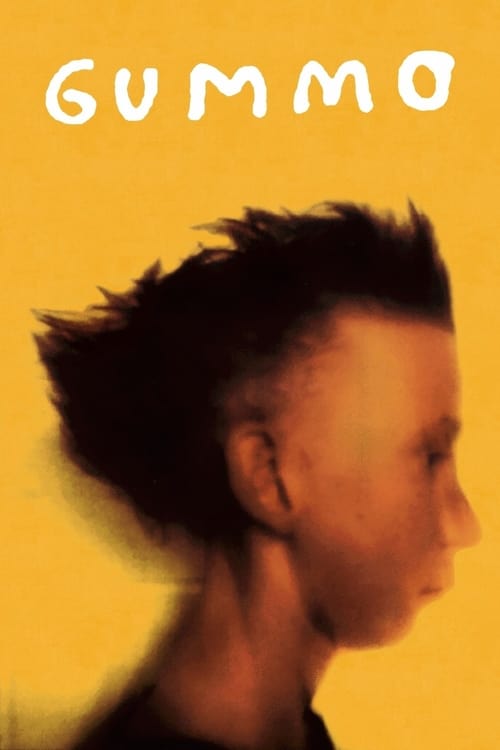
Gummo
1997 · Harmony Korine
For when you want cinema at its most confrontational — something to argue about, not relax into. Absolutely not a casual watch; reach for it when you're ready to be provoked and can't predict whether you'll be disgusted or moved.
What it's about
In Xenia, Ohio — a town flattened by a tornado in the 1970s and never really put back together — two teenage boys drift through the wreckage, killing cats for pocket money and huffing glue, while a boy in pink bunny ears haunts the overpasses. There's no plot, just a place and the people stranded in it: sisters, hustlers, back-porch philosophers, all filmed like found artifacts.
The experience
Disorienting, abrasive, and stranger than you're braced for — moments of genuine ugliness sit right next to passages of unexpected tenderness and weird beauty. It works less like a story than a fever you drift through, and it does not care whether you're comfortable.
The craft
Harmony Korine builds the film from deliberately degraded textures — video, film, snapshots — cut together with a scrapbook logic that makes poverty look both raw and hallucinatory. It's a debut that invents its own grammar, mixing staged scenes with moments that feel stolen from real life.
Why it matters
One of the defining provocations of '90s American independent film, it split critics violently and became a touchstone for filmmakers drawn to non-actors, broken forms, and the American margins.
Snapshot
Gummo is the directorial debut of Harmony Korine, made when he was barely into his twenties and already notorious as the screenwriter of Larry Clark's Kids (1995). It is less a story than a fixed gaze: a drift through Xenia, Ohio — a town the film tells us was flattened by a tornado in the 1970s and never quite reassembled — assembled from fragments of degraded image and incident. Two boys, Solomon and Tummler, kill cats to sell to a local supplier of meat; a boy in pink bunny ears wanders overpasses and drainage ditches; sisters tape their nipples to make them grow; a chair gets wrestled, bacon gets taped to a bathroom wall, and a man pimps out his sister with Down syndrome. There is no plot to spoil because there is no plot to deliver. The film is built as a deliberate provocation and a deliberate elegy at once — an attempt to make a movie that behaves like a shoebox of found snapshots, home videos, and overheard confessions rather than a narrative machine. On release it split audiences and critics with unusual violence: dismissed by some as exploitation and child-staring nihilism, embraced by others (Werner Herzog among the most famous) as a genuinely new image-grammar. Its reputation has only grown, and it now functions as a foundational text for a whole strain of American art-cinema interested in poverty, the grotesque, and the texture of the discarded.
Industry & production
Gummo emerged directly from the commercial and cultural energy of Kids. Korine's screenplay for Clark's film had made him, briefly, the most talked-about young writer in American independent film, and that visibility gave him the leverage to direct. The picture was produced by Cary Woods — who had also been behind Kids — together with Scott Macaulay and Robin O'Hara's Forensic Films, and it was released by Fine Line Features, the specialty arm associated with New Line. This placed Gummo squarely inside the late-1990s American indie ecosystem: a studio-adjacent specialty division willing to underwrite a difficult, low-budget, festival-oriented art film in hopes of prestige and a cult afterlife rather than mass returns.
The shoot relocated its fictional Xenia: although the town and its 1974 tornado are real (Xenia was devastated in the 1974 Super Outbreak), the film was largely photographed around Nashville, Tennessee, using real houses, real neighborhoods, and a mix of nonprofessional local performers and a small number of trained actors. Korine's casting method — recruiting striking faces and bodies off the street and around the production, then building scenes around them — is central to the film's industrial identity: it is a movie that spent its modest resources on texture and presence rather than coverage and stars. Precise budget and box-office figures are not something I can responsibly cite here; what is clear from the record is that this was a small picture by design, made to travel the festival circuit (Telluride, Venice, Toronto in the 1997 season) rather than to open wide.
Technology
The most consequential technological choice in Gummo is its refusal of a single capture format. The film braids 35mm, 16mm, Super 8, consumer video, and still photography (including Polaroid-style snapshots) into one continuous fabric. This was a pointed decision in 1997, a moment when the cheapness and ugliness of camcorder video was beginning to be treated by adventurous filmmakers as an aesthetic resource rather than a defect — the same cultural current that would soon feed Dogme 95 and the desktop-video boom of the early 2000s. Korine, working with cinematographer Jean-Yves Escoffier, treats each format as a different emotional register: glossy film stock for certain staged tableaux, raw video for the confessional and the casual, degraded small-gauge film and snapshots for memory and dread. The result anticipates, by a few years, the normalization of mixed and "low" formats in art cinema, and it reframes the home-video look as the native language of a forgotten American interior rather than as amateurism.
Technique
Cinematography
The presence of Jean-Yves Escoffier is one of Gummo's great paradoxes and one of the keys to why it transcends shock. Escoffier was a major European cinematographer, celebrated for his work with Leos Carax (Mauvais Sang, Les Amants du Pont-Neuf) — a master of saturated, romantic, near-operatic light. Bringing that eye to derelict Midwestern interiors and rain-soaked overpasses produces an unstable beauty: squalor lit with genuine tenderness and chromatic richness. The famous image of the bunny-eared boy on a freeway overpass in the rain, or Solomon eating spaghetti in a filthy bathtub while his mother washes his hair, are composed and lit with a painterly seriousness that complicates any simple reading of the material as freak-show. The handheld, restless, often grainy camera coexists with these held, lyrical compositions, and the tension between Escoffier's lyricism and Korine's abjection is precisely the film's signature.
Editing
Cut by Christopher Tellefsen, the film's editing is its most radical formal gesture. Gummo is structured by association and rhyme rather than cause and effect. Scenes do not build; they accumulate, interrupt, and recur. Snapshots and video interludes are spliced into staged sequences with no narrative justification, so that the film reads as a collage or a scrapbook — closer to the logic of a photo album or a mixtape than to conventional continuity. This montage strategy is the engine of the film's meaning: by refusing to subordinate moments to a storyline, Tellefsen and Korine insist that each fragment is equally weighted, equally a piece of evidence about a place and its people.
Mise-en-scène / staging
The staging mixes documentary appropriation with theatrical artifice in a way that keeps the viewer uncertain about what is "real." Real houses, real clutter, and real bodies are arranged into tableaux — the boys atop a sagging couch, the taped-up bathroom, the kitchen confessionals — that are clearly composed and yet feel stumbled-upon. Korine's interest in the grotesque is genuinely sculptural here, indebted to the gallery world (his ties to contemporary art, and the influence of artists like Mike Kelley and the snapshot tradition of Diane Arbus and Nan Goldin, are visible in the framing of the human figure). The mise-en-scène treats decay — peeling walls, hoarded objects, junked yards — as set design with moral weight.
Sound
The soundtrack is one of the most aggressive and influential elements of the film. Korine scores the picture with extreme metal — black metal, death metal, and doom (artists associated with that underground, such as Burzum, Bathory, and Sleep, recur in accounts of the film) — juxtaposed against tender pop standards and a stream of overlapping voices, found dialogue, and Korine's own opening narration. The collision of sub-cultural noise and sentimental song mirrors the visual collision of squalor and beauty. Diegetic sound is frequently raw and ugly; the metal cues are deployed almost ironically, as both threat and lament. The aural strategy — treating curated extreme music as a structuring authorial voice — would prove broadly influential on later independent filmmakers.
Performance
Performance in Gummo sits on the seam between acting and being. Jacob Reynolds (Solomon) and Nick Sutton (Tummler) deliver flat, affectless presence rather than conventional characterization; Sutton in particular was reportedly discovered by Korine on a television talk show about teenage drug use, and the film trades on that authenticity. Around them, Korine places both nonprofessionals and seasoned performers. Chloë Sevigny — already Korine's collaborator and partner, and credited with contributing to the film's wardrobe — brings a fragile naturalism as one of the peroxide-blonde sisters. Most poignantly, the film resurrects Linda Manz, the unforgettable child-narrator of Terrence Malick's Days of Heaven (1978) and the lead of Out of the Blue (1980), casting her as Solomon's mother in what amounts to a knowing piece of cinephile casting: a face of American 1970s cinema returned to a film about American ruin. The performances are not "good" by classical standards and are not meant to be; their power is documentary and physiognomic.
Narrative & dramatic mode
Gummo is essentially plotless, and this is its dramatic thesis rather than a failure of craft. It operates in an episodic, anti-dramatic mode: a series of vignettes held together by place, mood, and recurring figures rather than by goal-driven characters. There is no protagonist's arc, no rising action, no resolution. The dramatic interest lies in juxtaposition and tone — the way a moment of unexpected sweetness (a boy and his mother, a tap dance, a love song) is set against cruelty or boredom. The film borrows the grammar of documentary (direct-address confessions, found footage, ambient observation) and grafts it onto staged fiction, producing a hybrid that critics have variously called a tone poem, a collage film, and an anti-narrative. The closest structural analogs are not feature screenplays but photo essays and ethnographic scrapbooks.
Genre & cycle
Nominally tagged as drama and comedy, Gummo resists genre as thoroughly as it resists plot. It belongs most clearly to a loose cycle of 1990s American transgressive realism — films and works preoccupied with marginal youth, poverty, and the body, of which Kids is the obvious sibling and precursor. It can also be placed within the long tradition of the cinema of the grotesque and the carnivalesque, and within a documentary-fiction hybrid lineage. To the extent that it has comedy, it is a deadpan, uneasy comedy of the absurd; to the extent that it is drama, it is the drama of atmosphere. It is most accurately understood as art cinema operating in the idiom of the home movie.
Authorship & method
Gummo is the foundational statement of Harmony Korine's authorship, and nearly all of his later concerns are present in embryo: the dignity and strangeness of the overlooked, the collage method, the embrace of "bad" images, the fascination with American vernacular subcultures. Korine's stated working method — scripts that read more like assemblages of fragments and images than conventional screenplays, casting based on faces and real lives, and a willingness to let scenes be discovered on set — defines the film. His key collaborators each amplify a different axis of the project: Escoffier's cinematography supplies the redemptive beauty that keeps the film from collapsing into mere abjection; Tellefsen's editing supplies the associative architecture; the curated extreme-music soundtrack supplies the authorial voice; and the casting of Linda Manz and Chloë Sevigny binds the film to both cinema history and Korine's own circle. The line from Gummo runs straight to his subsequent features — julien donkey-boy (1999), made under the Dogme 95 banner, and later Trash Humpers (2009) and Spring Breakers (2012) — which extend its formal experiments.
Movement / national cinema
The film is a product of American independent cinema's most fertile and contentious late-1990s moment, but its sensibility is conspicuously transnational. Korine has repeatedly aligned himself with European masters — Werner Herzog, Rainer Werner Fassbinder, Jean-Luc Godard — and with the British social-realist provocateur Alan Clarke, and the hiring of a French art-cinema cinematographer underlines that orientation. Gummo sits at the intersection of the American indie scene's appetite for shock and authenticity and a European art-film tradition of formal radicalism. Its near-contemporaneity with Dogme 95 is notable: Korine would formally join that movement with his next film, and Gummo already shares Dogme's hostility to gloss and its embrace of available means.
Era / period
Made in 1997, Gummo is a deeply end-of-century American document. It captures a Rust Belt and rural interior left behind by the decade's prosperity — a landscape of vacant houses, drug use, and improvised economies — and it does so just as cheap video was about to democratize image-making. Its disaster premise, the tornado that "never let the town recover," reads as a metaphor for a broader American condition of arrested aftermath. The film belongs to the moment when American independent cinema, flush with the success of the early-decade indie boom, was testing how far audiences and distributors would follow genuine formal and moral difficulty.
Themes
The film's governing theme is survival amid ruin: the persistence of play, tenderness, and desire in a landscape of decay. It is preoccupied with the body — its growth, its damage, its commodification (cats sold for meat, a sister sold for sex, nipples taped to grow) — and with childhood and adolescence as states of both innocence and brutality. Boredom is treated as an existential condition. Running beneath everything is a meditation on what gets discarded — places, people, animals, images — and an insistence on looking at the discarded with attention rather than turning away. The recurring motif of the tornado frames the whole as a study of life after catastrophe, of communities and individuals improvising meaning in the wreckage. The film's refusal to moralize is itself a theme: it presents cruelty and grace without ranking them.
Reception, canon & influence
On release, Gummo was among the most polarizing American films of its year. A significant strand of mainstream criticism reacted with revulsion — Janet Maslin's review in The New York Times was notoriously hostile, and the film was widely accused of exploiting its nonprofessional subjects and trafficking in shock. Against this, a vocal body of defenders treated it as a breakthrough; Werner Herzog's admiration, frequently expressed and centered on the image of bacon taped to a grimy bathroom wall as evidence of genuine cinematic poetry, became part of the film's mythology and lent it serious auteurist credibility. (Precise festival prizes and award outcomes I won't assert here, as the public record on them is not something I can confirm with confidence.)
The film's influences run backward to a clear lineage: cinéma vérité and direct cinema; the social realism of Alan Clarke; the humane grotesquerie of Herzog and Fassbinder; the American snapshot and documentary-photography traditions of Diane Arbus, Nan Goldin, and Larry Clark; and the gallery sensibility of contemporary art. Its forward legacy has proven substantial and durable. Gummo became a touchstone for a generation of filmmakers and image-makers interested in poverty, abjection, and the texture of "low" media — its DNA is visible in later American independent cinema's appetite for grit and formal hybridity, in fashion photography and music video, and in the wider rehabilitation of degraded video as an art material. Within Korine's own career it is the origin point of a coherent and influential body of work. More than a quarter-century on, the film has migrated from succès de scandale to recognized cult landmark: a movie still capable of repelling viewers, and still cited as one of the boldest formal experiments to come out of 1990s American film.
A Deleuzian reading
A boy in pink rabbit ears stands on a freeway overpass in the rain.
The full Deleuzian reading of Gummo →
Reception
Savaged on release in 1997 — Janet Maslin of the New York Times called it "the worst film of the year" — while Werner Herzog and Gus Van Sant loudly defended it; three decades on it's a cult landmark whose champions vastly outnumber its detractors.
How Gummo was received, from release to now →
Influences: the films it descends from and the films it influenced
- Killer of Sheep (1977) — Establishes the plotless associative-vignette structure that finds lyrical beauty in an impoverished neighborhood, observing squalor as poetry rather than driving it through narrative — the formal template Gummo inherits.
- Kids (1995) — Korine's own debut screenplay; Clark's documentary-photographer eye and casting of real street youth fed directly into Gummo's snapshot realism and nonprofessional-casting method.
- Stroszek (1977) — Herzog's casting of genuine outsiders and ecstatic-grotesque vision of marginal Americana — and his public championing of the bacon-on-the-wall image — confirm the humane-grotesquerie debt.
- Scum (1979) — Clarke's unsentimental social realism and flat observational staging of brutalized working-class lives, a cited model for Gummo's documentary-tableaux approach to abjection.
- Days of Heaven (1978) — Korine cast its child narrator Linda Manz (cinephile casting) and echoes its drifting first-person voiceover laid over hardscrabble lives as a lyrical counterweight to poverty.
- Mauvais Sang (1986) — Shares cinematographer Jean-Yves Escoffier, whose saturated, painterly handling of degraded urban space — honed with Carax — supplies the redemptive beauty Escoffier brings to Gummo.
- Pixote (1981) — Nonprofessional street children performing near-documentary abjection in a fiction-documentary hybrid about survival amid ruin, prefiguring Gummo's casting and tonal register.
- Titicut Follies (1967) — Direct-cinema tableaux of institutional grotesquerie — the unblinking vérité observation of the abject that Gummo restages as fiction.
- Eraserhead (1977) — Monochrome industrial grotesque with immersive sound-as-dread, a model for mining horror and strange beauty from decayed domestic interiors.
- Even Dwarfs Started Small (1971) — Korine applies Even Dwarfs' entropy-accumulation structure — destruction replacing drama, anti-climax replacing resolution — to American social grotesque, with non-professional performers in marginal space refusing the film's own capacity to distinguish critique from spectacle, the same ethical indeterminacy Herzog refused to resolve.
- Drugstore Cowboy (1989) — Fractured naturalism of a damaged American subculture governed by private superstition-as-logic and ritual, extending Van Sant's interest in self-destructive outsiders observed without a moral frame.
- Stranger Than Paradise (1983) — Blackout-vignette anti-narrative of marginal Americana, abandoning continuity coverage for discrete tableaux of dead-end lives.
- julien donkey-boy (1999) — Directly extends Gummo's fragment-assemblage collage method and nonprofessional casting, now formalized under the Dogme 95 vow of chastity.
- Trash Humpers (2009) — Pushes Gummo's camcorder-video aesthetic to its limit, presenting the whole feature as a degraded found VHS artifact of abjection.
- George Washington (2000) — Lyrical, near-plotless poverty among nonprofessional rust-belt kids — Gummo's poetic-squalor cinematography and associative drift without the shock.
- American Honey (2016) — Casts real road kids as nonprofessionals and uses a curated soundtrack as authorial voice to lyricize poor-America squalor, a direct extension of Gummo's method.
- The Florida Project (2017) — Nonprofessional casting and saturated, candy-colored cinematography mining beauty from an impoverished vernacular landscape — Gummo's lyrical-squalor inheritance.
- Beasts of the Southern Wild (2012) — Handheld lyrical-poverty tableaux performed by a nonprofessional cast, dramatizing survival amid ruin in Gummo's documentary-fiction hybrid mode.
- Heaven Knows What (2014) — Street-cast nonprofessionals in near-documentary urban abjection scored with an abrasive curated soundtrack used as authorship, extending Gummo's sound and casting strategies.
- Napoleon Dynamite (2004) — Regional small-town Americana observed as a string of plotless vignettes among marginal eccentrics, anti-narrative and fascinated by the overlooked — the documentary-of-place impulse.
- Rap World (2024) — Pioneers degraded consumer-video texture and non-actor ensembles to portray aimless exurban American male adolescence — the visual and casting grammar Rap World inherits.
- mid90s (2018) — Establishes the episodic-vignette architecture Hill borrows — plot dissolved into loosely-strung observed fragments of marginal youth, carried by non-actors rather than dramatic causality.
- Elephant (2003) — Plotless observational drift through American adolescence sharing Gummo's debt to Alan Clarke's long-take social-realist staging.
- Ratcatcher (1999) — Korine's elliptical, non-narrative accumulation of fragments around impoverished children in a damaged American town — non-professional performances, ambient documentary texture, refusal of moral closure — develops an anti-dramatic logic of accumulation without climax structurally parallel to Ratcatcher's.
- Buffalo '66 (1998) — Parallel 1990s pursuit of handmade, bleached working-class Americana through abrasive anti-naturalism and collage-like tonal hybridity.
- Jesus' Son (2000) — Contemporary episodic mosaic of American degradation assembled from associative tableaux with no through-line, sharing the trust in tone over story.
- L.I.E. (2001) — Fragmentary, naturalistically-lit portrait of suburban/exurban decay and feral adolescence, sharing L.I.E.'s commitment to environment-as-character and unsentimental neglect.
- Nowhere (1997) — Contemporaneous plotless ensemble drift through an apocalyptic teen wasteland, sharing the fragmented antinarrative and dead-affect grotesquerie.
- Dinner in America (2020) — The transgressive-abjection strain of American-margins cinema — a refusal of good taste as governing value, staging squalor and provocation without apology, the same appetite Rehmeier redirects toward romance.
Similar films
- Julien Donkey-Boy (1999) — influence & lineage
- Kids (1995) — influence & lineage
- Elephant (2003) — influence & lineage
- Happiness (1998) — shared sensibility
- Gozu (2003) — shared sensibility
- When Evil Lurks (2023) — shared sensibility
- Bowling for Columbine (2002) — shared sensibility
- House (1977) — shared sensibility
All the films related to Gummo →